
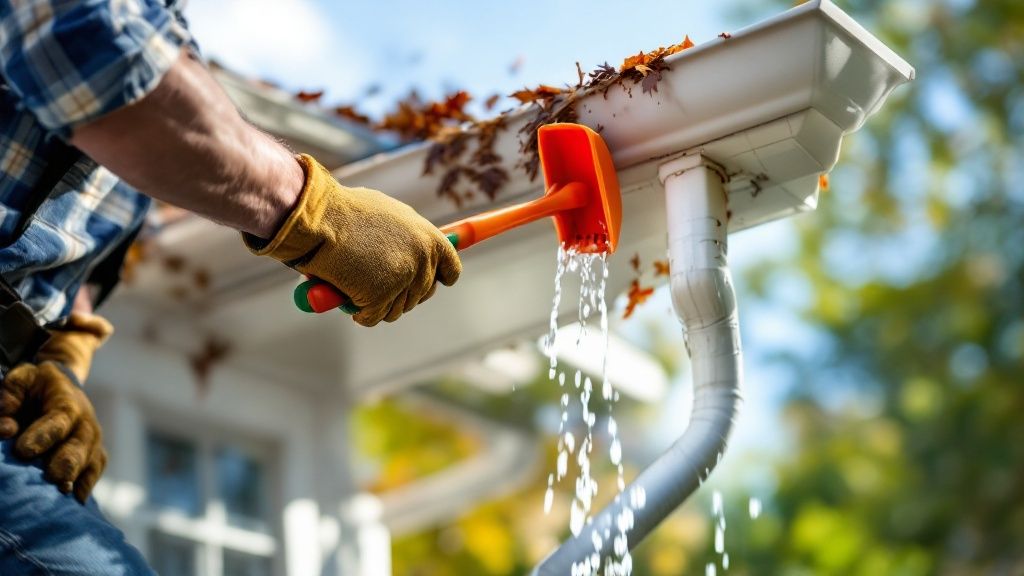
Knowing how to clean your gutters and downspouts is about a lot more than just getting rid of a few handfuls of leaves. It’s a core part of protecting your entire home from the kind of water damage that can lead to massive headaches and even bigger repair bills.
The basic idea is simple enough: scoop out the big stuff by hand, give the gutters a good flush with a hose, and then make sure the downspouts are clear of any blockages. It's this simple routine that prevents a whole host of problems down the line.
Why Gutter Cleaning is a Non-Negotiable Homeowner Task

Let's be honest, nobody loves cleaning gutters. It's often seen as just another tedious chore on a long to-do list. But putting it off is one of the worst mistakes a homeowner can make for the long-term health of their property.
When gutters and downspouts get choked with leaves, pine needles, and other gunk, they can't do their one job: directing rainwater safely away from your house. Instead, that water has to go somewhere, and it usually ends up causing a lot of trouble.
The most immediate problem is water pouring over the sides and soaking the ground right next to your foundation. This might not seem like a big deal at first, but over time, that constant saturation can lead to cracks, basement flooding, and serious structural damage.
To give you a clearer picture, here's a quick rundown of the whole process from start to finish.
Quick Overview of the Gutter Cleaning Process
| Stage | Key Action | Primary Goal |
|---|---|---|
| Preparation | Gather tools and set up your ladder safely. | Ensure you can work efficiently and without risk of injury. |
| Debris Removal | Scoop out leaves, twigs, and sludge from gutters. | Clear the main channel so water can begin to flow again. |
| Flushing | Use a hose to rinse the gutters thoroughly. | Remove fine sediment and check for hidden clogs. |
| Downspout Check | Force water down the spout to ensure it's clear. | Confirm the entire system is free-flowing from roof to ground. |
| Final Inspection | Look for leaks, sagging, or damage to the system. | Identify any repairs needed to keep the system working properly. |
This table shows the core steps, but the consequences of skipping them are what really matter.
The Domino Effect of Clogged Gutters
What starts as a simple clog can quickly cascade into a whole series of issues. The sheer weight of waterlogged debris can strain your gutters, causing them to pull away from the fascia boards and damage your roofline and siding. All that trapped moisture also creates the perfect breeding ground for mold, wood rot, and pests like mosquitoes and rodents.
And the problems don't stop there. Overflowing water can also lead to:
- Roof Damage: When water has nowhere to go, it can pool and seep under your shingles, rotting the underlying roof decking. This kind of persistent dampness is a frequent culprit, which is why finding a roof leak early is so important for any proactive homeowner.
- Landscape Erosion: That uncontrolled waterfall coming off your roof can easily wash away expensive topsoil, mulch, and flowers, wrecking your garden beds.
- Winter Ice Dams: In colder climates, clogged gutters are notorious for causing ice dams. These ridges of ice can force melting snow back under the shingles, leading to significant water damage inside your home.
The bottom line is that gutter maintenance isn't just about keeping up appearances. It's a fundamental part of home preservation that protects your biggest investment from easily preventable, and often expensive, water damage.
The financial impact is clear, too. The professional gutter and drain cleaning industry has grown into a massive market, reaching about $3.1 billion in revenue by 2024. That number alone shows just how seriously property owners are finally taking this essential task.
Gathering the Right Tools for the Job

Before you even think about climbing up to clean your gutters, you need to gear up. Showing up unprepared doesn't just make the job a slog; it can be downright dangerous. You don't need a truck full of expensive equipment, but you absolutely need the right tools for your specific home.
Your ladder is, without a doubt, the most important piece of gear you'll use. It has to be tall enough for you to work comfortably without stretching or leaning precariously. Always make sure it's on solid, level ground. For most two-story homes, an extension ladder is the way to go, but you might get by with a heavy-duty stepladder if you have a single-story ranch.
Beyond that, a few simple items will make the job go a whole lot smoother. A bucket with a sturdy handle that can hang from your ladder is a game-changer for collecting all that gunk. And please, don't forget a pair of thick, waterproof gloves—you never know what sharp surprises are hiding in that leafy muck.
Your Core Gutter Cleaning Kit
Having everything you need within arm's reach means fewer trips up and down the ladder. That's not just efficient, it's a huge safety win.
- A sturdy ladder: Double-check that it's the right height for the job and completely stable before you take that first step.
- Thick gloves: These are your first line of defense against bacteria, sharp twigs, and the rough metal edges of the gutters themselves.
- Gutter scoop or trowel: You can buy a specialized scoop that fits the channel perfectly, but honestly, a small garden trowel does the trick just as well.
- A bucket: This keeps all the scooped-out debris contained instead of making a second mess for you to clean up on the ground.
- Garden hose with a spray nozzle: This is non-negotiable for flushing out the last bits of dirt and, more importantly, testing that your downspouts are clear.
For the vast majority of homes, this simple kit is all you'll ever need. It's no surprise that the professional gutter services market was valued at around USD 0.17 billion in 2024; people recognize the value of proper maintenance. You can find more details about this growing market on Business Research Insights.
If you're looking for a more high-tech solution, there are options like pressure washer attachments and even gutter-cleaning robots. While they can be effective, they also come with a much higher price tag. For a standard twice-a-year cleaning, sticking with the basics is almost always the most practical and budget-friendly approach.
Clearing Debris from Your Gutters
Alright, your ladder is secure and you’ve got your tools. Time to tackle the muck. The key to doing this right—and safely—is to work in small, manageable sections. This is the best way to avoid overreaching, which is how most ladder accidents happen.
Set up your ladder so you can comfortably reach about an arm's length to your left and right without leaning. Once you’re set, you can start scooping out the gunk. Don't just start digging in anywhere; a little strategy makes a huge difference here.
Here’s a pro tip I learned years ago: always start scooping near a downspout. If you start at the other end, you risk pushing a whole section's worth of leaves and sludge right into the opening, creating a nasty clog you'll have to deal with later. Instead, clear the area around the downspout first, then work your way away from it.
What to Expect Inside Your Gutters
You'll find all sorts of interesting things up there. Heavy, wet leaves often turn into a thick, paste-like sludge that’s best handled with a gutter scoop or a small garden trowel. On the other hand, you might find dry pine needles, twigs, and shingle grit, which can form a surprisingly solid dam that stops water in its tracks.
As you clear out each section, drop the debris into your bucket. It’s tempting to just fling it onto the lawn, but trust me, you'll just be making a second mess to clean up later. When you've cleared everything within a safe reach, climb down carefully and move the ladder to the next spot.
Don't just clean—inspect. While you're up there, take a moment to look around. Are there any parts of the gutter sagging? Do you see any loose brackets or even small cracks? Finding these little problems now can save you from a major headache and a much bigger repair bill down the line.
The whole process really boils down to a few core actions.
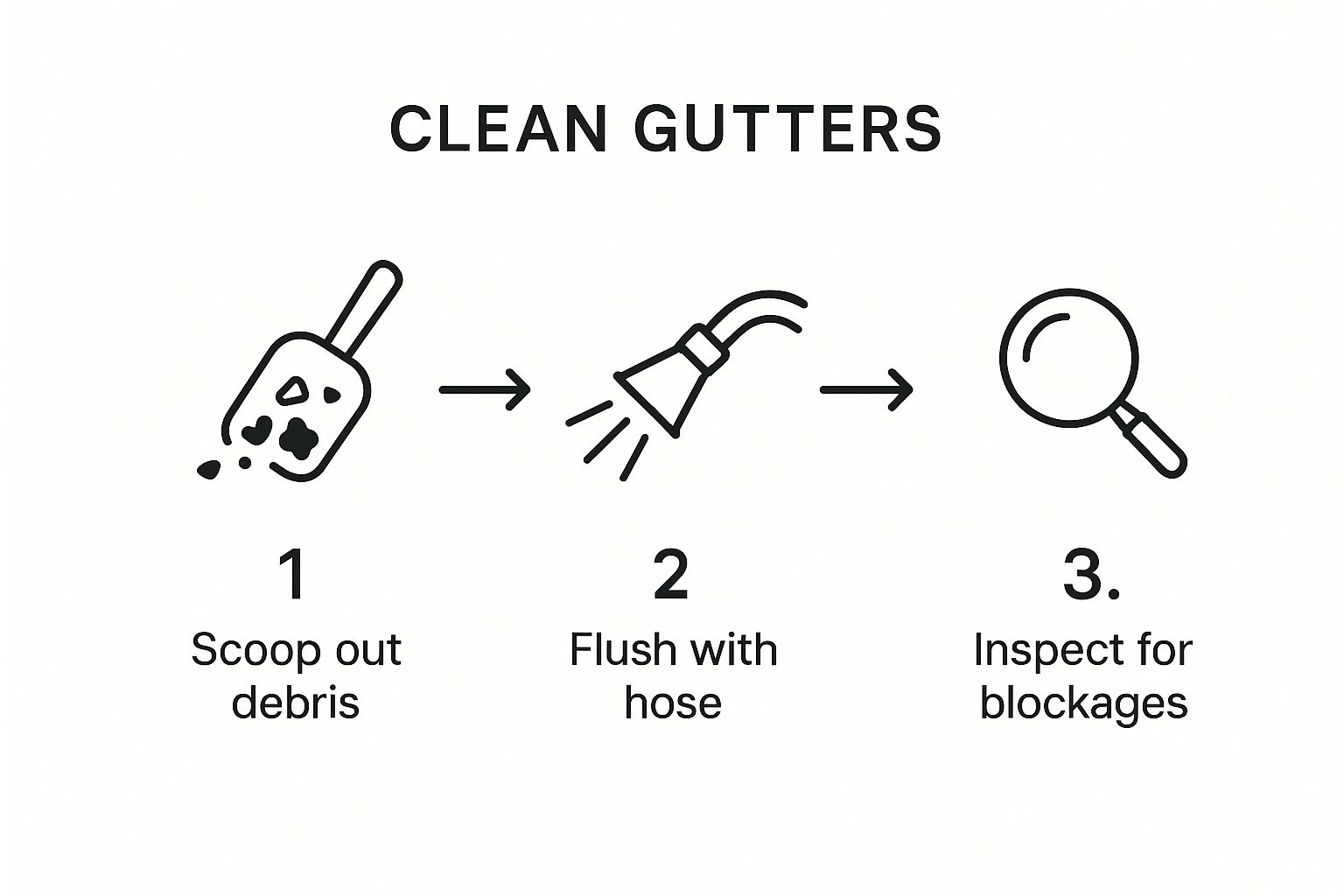
This simple flow—scoop, flush, and inspect—is your recipe for making sure the job is done right.
Smart Scooping Techniques
The actual scooping part is pretty simple, but a few tricks make it go faster. Get your scoop under the main layer of debris and lift it out in chunks. For that last layer of fine silt and grit that always sticks to the bottom, a stiff brush works wonders to sweep it into a pile for easy removal.
Keep these pointers in mind as you work:
- Move the ladder often. Don’t get lazy and try to stretch. Reposition your ladder every 4-5 feet. This ensures you’re always stable and working directly in front of your body.
- Protect your plants. If you have flower beds or nice landscaping below, lay a tarp down first. It’s a small step that makes cleanup a breeze and saves your garden from a coating of gutter sludge.
- Never lean on the gutter. Gutters aren't built to hold your weight. Always keep three points of contact on the ladder (two feet and one hand, or two hands and one foot) and resist the urge to lean against the gutter itself.
Tackling the job with this focused, section-by-section approach is not only more effective, but it’s also much, much safer. Once all the solid debris is out of the channels, you're ready to move on to the final, crucial step: flushing the entire system.
Flushing Downspouts and Busting Clogs
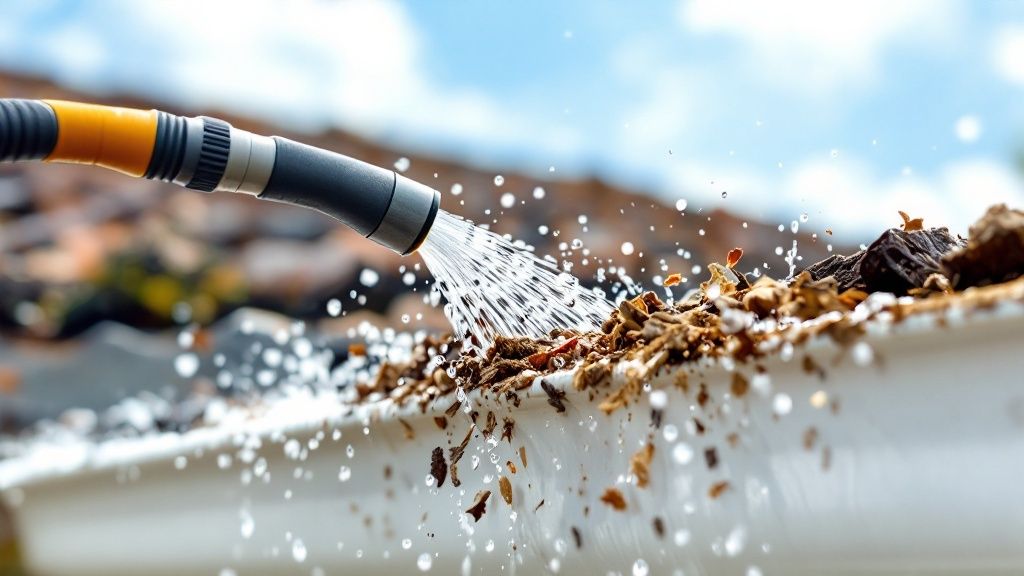
You've scooped all the gunk out of the horizontal runs, and things are looking good. But don't pack up your ladder just yet. The most critical step is making sure your downspouts are actually clear. A clogged downspout turns your entire gutter system into a useless trough, guaranteeing water will spill over and cause problems for your home's foundation and siding.
The easiest way to test the flow is with a garden hose. Grab one with a high-pressure spray nozzle, stick it in the gutter at the end farthest from the downspout, and let it rip. What you're hoping to see is a strong, confident stream pouring out of the bottom.
If the water starts pooling in the gutter or you only get a sad little trickle at the exit, you've got a clog on your hands.
Identifying a Stubborn Clog
A good blast from the hose will often push out minor blockages, but some clogs are just plain stubborn. You have to know what to look—and listen—for.
- Listen for the gurgle. You'll often hear the sound of the water change from a clean rush to a muffled gurgle. That's the sound of it hitting a wall of debris.
- Watch for overflow. This one's hard to miss. If water is spilling over the top of the downspout, the blockage is severe.
- Spot the leaks. Pressure from a clog can force water out of the seams. Drips from the elbows or straight sections are a dead giveaway that something is blocking the pipe.
A slow drain is a problem waiting to happen. Even if a little water is making it through, a partial clog will become a total one in the next big storm. Fix it now while you've got everything out.
Methods for Dislodging Tough Blockages
When the hose just isn't cutting it, you need to step up your game. A surprisingly effective first move is to tap firmly on the side of the downspout with a screwdriver handle. The vibrations can be just enough to break up compacted leaves and twigs.
No luck? Time for a plumber's snake. Feed the snake into the downspout from the top, cranking the handle as you go. When you feel it hit the blockage, keep pushing and twisting to chew through the clog.
For the absolute worst clogs, you might need to perform a little surgery and take the downspout apart. The culprit is almost always in one of the S-shaped elbows. Luckily, they're usually just held on with a few screws. You can take them off, clear them out by hand, and reattach them pretty easily. For truly impossible blockages, professional services use some impressive techniques; it's worth understanding how hydro jetting works to see what's possible.
More and more homeowners are realizing how critical this task is. In fact, the global market for gutter cleaning services was valued at around USD 98 million in 2023 and is projected to hit nearly USD 167 million by 2032. It's a clear sign that people are catching on to how a little maintenance can prevent a lot of expensive water damage.
Keeping Your Gutters Clear for the Long Haul
Alright, you’ve put in the work and your gutters are flowing like new. The last thing you want is to be back up on that ladder in a month. So, how do you keep them that way? It's all about shifting from a big clean-out job to simple, ongoing maintenance.
The best defense is a good offense. Look at what’s falling into your gutters in the first place. If you have trees with branches hanging over your roof, you're just inviting clogs. A little strategic pruning can make a world of difference. For a deep dive, this expert homeowner guide to tree trimming is a great resource for tackling that project safely.
What About Gutter Guards?
You’ve probably seen ads for gutter guards, and they can be a fantastic investment—for the right house. They really shine when you're dealing with big leaves from trees like maples and oaks.
But they’re not a perfect, set-it-and-forget-it solution. Fine debris like pine needles, seeds, and shingle grit can still work its way through the mesh. Over time, this can create a dense layer of sludge under the guard, which is a real pain to clean out.
So, before you shell out the cash, think about your specific yard.
- Big leaves? Guards might be a game-changer.
- Pine trees? You might find that a quick manual cleaning twice a year is actually easier and more effective.
The secret to long-term success isn't just one thing. It's a combination of smart habits: trimming back those branches, doing a quick visual check from the ground after a big storm, and maybe investing in guards if they make sense for your home. This approach will save you a ton of time and effort down the road.
Ultimately, keeping your gutters clear is about protecting your entire roofing system. When everything works together, you protect your home from water damage. You can learn more about how all the pieces fit together and what pros look for when servicing gutters, soffits, and fascia.
Your Top Gutter Cleaning Questions, Answered
Over the years, I've heard just about every question there is when it comes to gutters. Let's clear up a few of the most common ones that homeowners ask.
How Often Should I Really Clean My Gutters?
The standard advice you'll hear is twice a year—once after the spring pollen and seed drop, and again after the leaves fall in autumn. Honestly, that’s just a starting point.
The real answer depends entirely on your property. If you've got a yard full of tall oak or pine trees, you might need to get up there every few months. On the other hand, if your house is out in the open with no overhanging branches, you can probably get away with just one solid cleaning a year.
Is It a Good Idea to Use a Leaf Blower?
This is a tempting shortcut, I get it. A leaf blower can work, but only under perfect conditions—when the debris is completely dry and fluffy.
The moment you're dealing with damp leaves, pine needles, and that heavy, mucky sludge, a leaf blower just makes a colossal mess. It will spray that grime all over your siding, windows, and anything else below. If you decide to try it, make sure you're wearing solid eye protection and are extremely stable on your ladder.
Your home’s specific location and the types of surrounding trees are the biggest clues for your cleaning schedule. It’s better to observe your own gutters than to follow a generic rule.
Sometimes, constantly overflowing gutters point to a bigger issue than just clogs. If the gutters themselves are pulling away from the house, the problem might be with the structure they're attached to. Understanding how to repair roof eaves can help you spot these related problems before they cause serious damage.
If you're dealing with stubborn gutter problems, or if you simply don't feel safe tackling this job yourself, it's always best to call in the professionals. The team at Penn Ohio Roofing & Siding Group has the experience to make sure your entire system is working perfectly. Reach out today for a free estimate at https://pennohiorc.com.