
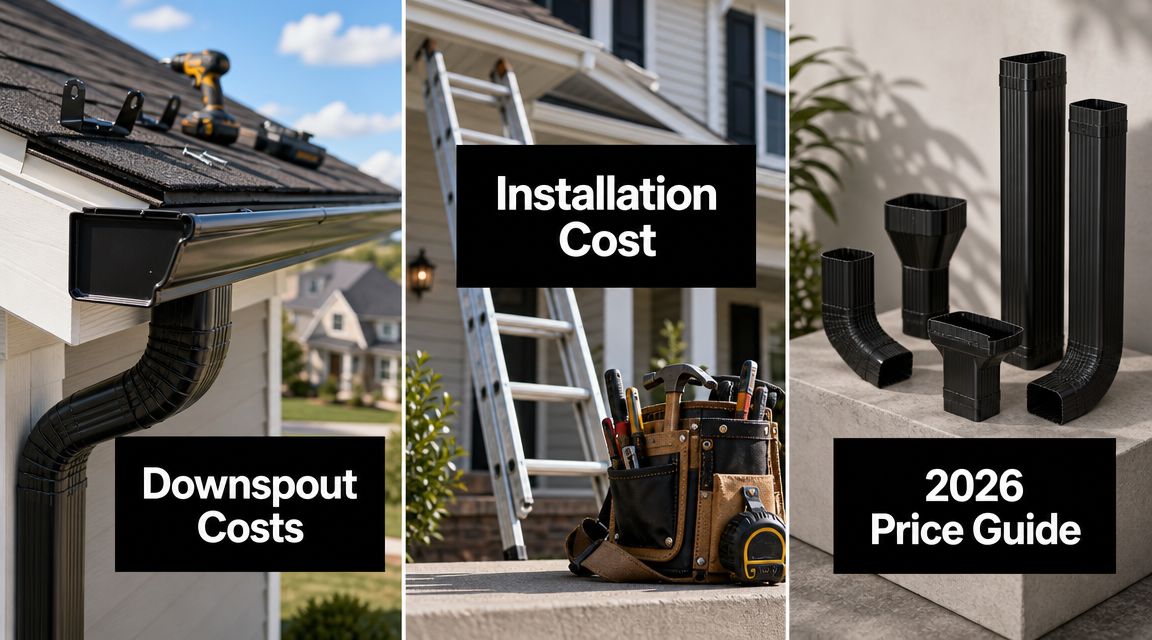
Most homeowners can expect a typical downspout installation cost to range from about $200 to over $800, while a full system replacement can run from a few hundred dollars to over $3,000 depending on materials, home size, and installation complexity. National pricing shows why that range is so wide: some homeowners pay about $30 to $75 per downspout, some projects average $670, and broader full-project estimates can range from $100 to $3,265 depending on labor, access, and drainage add-ons.
If you're reading this after spotting water pooling near the foundation, a bent downspout after a storm, or overflow pouring off the gutter corner, you're asking the right question at the right time. Downspouts don't get much attention until they fail, but when they do, the problem usually shows up where you don't want it: basement walls, mulch beds, fascia trim, and the soil right against the house.
In Mercer, Beaver, and Lawrence counties, the cost isn't just the metal or vinyl tube on the wall. It's whether the system is sized right, whether the crew can work safely on your roofline, whether the discharge point moves water away from the house, and whether hidden gutter or fascia issues get caught before they turn into rot. That's what separates a cheap repair from a smart drainage fix.
Table of Contents
- Is a Faulty Downspout Putting Your Home at Risk
- Understanding Your Downspout Installation Quote
- Key Factors That Influence Your Final Downspout Cost
- Downspout Material Showdown Aluminum vs Steel vs Copper
- DIY vs Hiring Penn Ohio A Cost and Risk Analysis
- Sample Downspout Costs in Mercer Beaver and Lawrence Counties
- Smart Savings and Protecting Your Investment
- Get a Clear Accurate Downspout Quote for Your Home
Is a Faulty Downspout Putting Your Home at Risk
You hear it during a hard rain first. Water is slapping the flower bed, one corner of the gutter is overflowing, and the downspout is dumping everything right beside the house instead of carrying it away. In Mercer, Beaver, and Lawrence counties, that is often how a small drainage problem starts turning into foundation staining, washed-out mulch, and saturated soil along the basement wall.
A faulty downspout usually causes trouble slowly, then all at once. The ground at the base stays wet. Siding gets splashed with dirt. Freeze-thaw weather opens up joints, loosens straps, and makes minor separation worse over one or two seasons. By the time many homeowners call us, the issue is no longer just the pipe on the wall. The gutter outlet may be strained, the fasteners may be pulling loose, and the wood behind the system may already be taking on water. If the attachment area looks soft or weathered, it helps to understand how fascia boards support the roof edge and gutter line.
The cost question usually comes up right away. Homeowners want to know if they are looking at a basic fix or a bigger project. In the Penn Ohio service area, a simple downspout replacement on an accessible one-story section often stays in the low hundreds. A multi-downspout job on a taller home, or a project that also needs new elbows, straps, outlet work, or drainage extensions, can climb well beyond that.
That local difference matters.
National averages can help with general expectations, but they do not reflect every house in western Pennsylvania and nearby Ohio. Older homes in New Castle, Beaver Falls, Sharon, and surrounding communities often have rooflines, siding conditions, and foundation drainage patterns that add labor even when the material itself is straightforward. A quote that looks high on paper may include work that prevents a much more expensive water problem later.
A bad downspout rarely stays a downspout-only problem. Water keeps working on the next weak spot until someone redirects it correctly.
Seasonal upkeep also plays a bigger role here than many homeowners expect. Leaves, ice, and heavy spring rain put more stress on joints and lower elbows than you see in milder areas. For a broader upkeep checklist that fits well with gutter and roof care, this Flagstaff seasonal home maintenance guide is a practical reference.
Understanding Your Downspout Installation Quote
A good quote answers the question behind the price. What is being replaced, how far the water will be carried, what access problems the crew has to work around, and what is excluded.
In Mercer, Beaver, and Lawrence counties, I see homeowners get tripped up when two quotes look close on the total but cover different work. One may include removal, new straps, new elbows, and a discharge extension. The other may cover only the vertical downspout run and leave the rest as extras. That is how a "cheaper" bid turns into a higher final invoice.
Your quote should spell out the parts, the labor, and the discharge plan in plain language. At a minimum, that usually means downspout sections, elbows, brackets or straps, fasteners, removal of damaged pieces, installation of the new run, and cleanup. If the upper outlet at the gutter needs adjustment, or the lower section needs an extension to move water away from the foundation, that should be written into the scope.
The connection to the full roof edge system matters too. If the gutter is loose, the fascia is soft, or the outlet is pulling away, replacing only the downspout may not solve the drainage problem. This overview of gutters, soffits, and fascia working together helps explain why some quotes include related repairs.
Labor often changes the number more than homeowners expect. A straight swap on a one-story wall is one type of job. A second-story corner over a porch roof, shrub bed, deck, or narrow walkway takes more setup time and more care. On older homes around New Castle, Ellwood City, Sharon, and Beaver Falls, crews also run into uneven siding, outdated fastening points, and outlet connections that need adjustment before the new downspout can be secured properly.
A quote worth trusting usually makes these items easy to spot:
- Removal and disposal: Old downspouts, straps, and bent elbows should be listed if they are coming off.
- Material identified clearly: The estimate should say aluminum, steel, copper, or vinyl, not just "metal."
- Accessories called out: Extensions, splash blocks, leaf strainers, diverters, and extra elbows should not be buried in the total.
- Discharge method explained: Water can exit onto a splash block, through an above-ground extension, or into a buried drain line. Those are different scopes with different costs.
- Access conditions noted: Story height, porch roofs, landscaping, and tight side yards all affect labor time.
One missing line item can change the whole comparison.
If you are reviewing bids, ask one simple question before you sign anything: where does the water end up after it leaves the downspout? If the estimate does not answer that clearly, it is incomplete.
Key Factors That Influence Your Final Downspout Cost
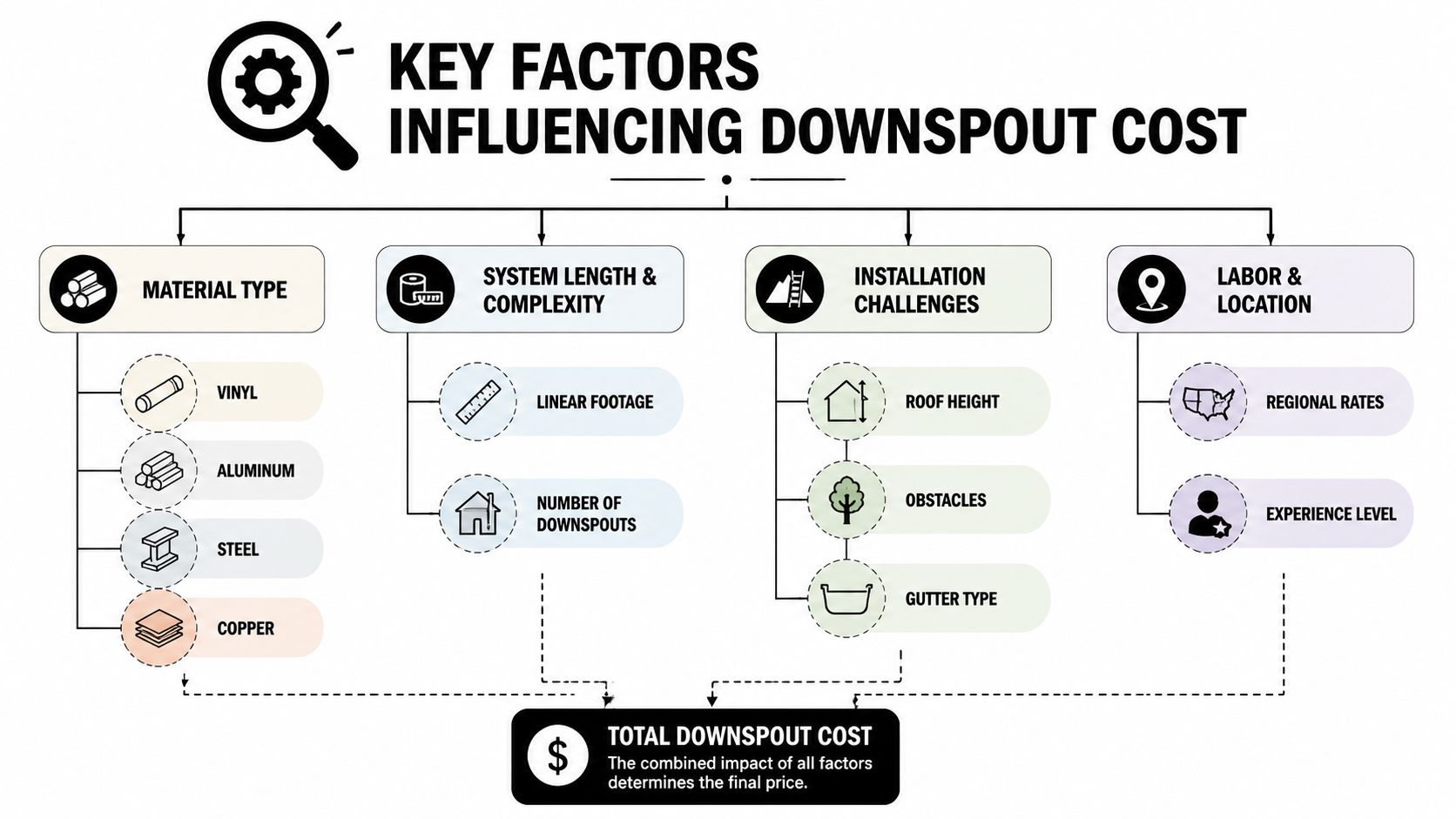
A homeowner in Mercer County might need a basic replacement on a one-story ranch. A homeowner in Beaver or Lawrence County might need longer drops, extra offsets, or a better discharge route because the grade pitches back toward the house. Both jobs sound similar on the phone. They do not price the same in the field.
The final cost usually comes down to six things: material, height, size, routing, attachment condition, and where the water goes after it leaves the downspout. If you are pricing the whole roof edge at once, this guide to gutters, soffits, and fascia systems helps explain how those parts affect one another.
Material type
Material sets the budget range quickly.
Vinyl and basic aluminum usually keep the price lower. Heavier aluminum, galvanized steel, and copper raise both material cost and labor expectations. Copper especially changes the job from a functional replacement to a finish-sensitive installation, which matters on older homes in places like Sharon, Beaver Falls, and New Castle where appearance is part of the decision.
Homeowners often ask whether upgrading material is worth it. My answer depends on the house. On a standard suburban replacement, aluminum is usually the practical choice. On a historic or high-visibility elevation, paying more for a stronger or better-looking material can make sense.
Home height and roof access
Height affects labor fast. A clean one-story wall with open ground below it is efficient. A second-story corner above a porch roof, AC unit, retaining wall, or dense landscaping takes longer and requires more setup.
That is why two homes with the same number of downspouts can still get very different quotes in the Penn Ohio area. Access drives labor hours, and labor is often the part homeowners underestimate.
Size and drainage capacity
Proper sizing is a cost decision, not just a technical one.
If a downspout is too small for the roof area feeding it, water overshoots gutters, strains elbows, and washes out the soil near the foundation. Fixing that later usually costs more than sizing it correctly during installation. On larger roof sections, the answer may be a wider downspout, an extra drop, or both.
This shows up often on additions and garage tie-ins. The original drainage layout may have been adequate before the roofline changed. After the change, the old downspout count no longer matches the runoff.
Length, elbows, and routing
A straight drop is the least expensive layout. Costs rise when the crew has to route around windows, hose bibs, electric meters, bump-outs, masonry ledges, or deck framing.
Every offset adds parts and labor. It also creates more points that can loosen over time if the wall surface is uneven. On brick and older siding, getting a clean attachment sometimes takes more care than the downspout itself.
Gutter condition and wall attachment points
A new downspout only works as well as the outlet and structure supporting it. If the gutter outlet is stretched, the fascia is soft, or old strap locations no longer hold, the installer has to correct that first.
This is common on older homes in Mercer, Beaver, and Lawrence counties. We see plenty of jobs where the downspout is not the underlying problem. Instead, the issue is a failing outlet, loose fascia, or movement in the wall surface that keeps pulling fasteners loose. If a quote ignores those conditions, expect a change order or a disappointing result.
Discharge method and drainage add-ons
The scope of work most significantly impacts budget variations. A downspout that drops onto a splash block is one scope. A downspout tied into an extension, pop-up emitter, or buried drain line is a larger drainage job.
Homeowners usually spend more here for a good reason. If water is pooling near the foundation, staining concrete, or running back across a walkway, replacing the vertical pipe does not solve much. Carrying water farther away costs more up front, but it often prevents the bigger expense.
Local labor and scheduling
Local conditions matter. Homes across Hermitage, Beaver, Ellwood City, and the surrounding townships are not built to one standard footprint. Older homes often have tighter side yards, mixed siding materials, and uneven surfaces that slow installation. Steep driveways and limited rear-yard access can slow it down too.
Season affects pricing as well. If you wait until after a heavy rain exposes a drainage problem, you are scheduling in the same window as everyone else. Planning the work before peak demand usually gives you more flexibility and a clearer scope.
Downspout Material Showdown Aluminum vs Steel vs Copper
A homeowner in Mercer County may get two very different quotes for the same downspout count, and material is often the reason. Four new aluminum downspouts on a standard home can stay in a practical budget range. The same layout in copper can change the job from routine exterior work into a finish detail with a much higher price tag.
Material affects more than the invoice. It changes how the downspout handles dents, how it looks against the siding, how much upkeep it needs, and whether the replacement matches the age and style of the house.
Downspout Material Comparison
| Material | Average Cost (Installed per foot) | Lifespan | Pros | Cons |
|---|---|---|---|---|
| Vinyl | Low end | Varies by sun exposure and weather | Lower purchase cost, light, simple for basic runs | Cracks more easily, looks less substantial, not a good fit for many higher-value homes |
| Aluminum | Mid-range | Good service life in normal residential use | Common, light, easier to color-match, usually the best value for the money | Dents more easily than steel, thinner products can feel flimsy |
| Galvanized steel | Mid- to upper-mid range | Good if coating stays intact | Stronger feel, solid appearance, works well on traditional exteriors | Heavier, can rust over time if finish fails or cut edges are exposed |
| Copper | Premium | Long service life | Distinct look, ages well visually, fits historic and custom homes | High material cost, higher labor cost, replacement parts and repairs cost more too |
What works for most homes in Penn Ohio
In Mercer, Beaver, and Lawrence counties, aluminum is the material we recommend most often. It fits the budget of a typical replacement project, works well with standard gutter systems, and comes in enough color options to avoid an obvious mismatch on the front of the house.
That does not mean all aluminum is equal.
A thinner, builder-grade product can keep the quote down, but it dents faster and may oil-can or look wavy on a long visible run. A heavier-gauge aluminum downspout costs more upfront and usually looks better after a few winters, especially on homes exposed to ladder traffic, snow slide-off, or busy walkways.
Where steel makes sense
Steel is a reasonable choice for homeowners who want a firmer, heavier feel. On older homes in Beaver and Lawrence counties, it can look more appropriate than a light aluminum profile, especially if the exterior already has a more traditional appearance.
The trade-off is maintenance. Once the protective finish gets scratched or the coating starts to wear at fastener points and cut ends, rust becomes part of the conversation. Steel can last well, but it is less forgiving if neglected.
When copper earns its price
Copper belongs on a specific kind of project. Historic homes, high-end custom exteriors, and houses where the owner wants the drainage system to be part of the finished look are the usual candidates.
It is rarely the right answer for a simple budget-driven replacement.
Copper also affects labor. Installers need to handle it more carefully, details matter more, and tying new copper into lower-grade existing components usually looks patched together. If the gutters, elbows, straps, and outlets are not being treated as one coordinated system, the premium often goes to waste.
Choose material based on the house, the exposure, and how long you plan to stay there. The cheapest option can be fine on a rear elevation. On a front corner that takes runoff, foot traffic, and full view from the street, spending more for the right material often pays off.
DIY vs Hiring Penn Ohio A Cost and Risk Analysis
A lot of homeowners in Mercer, Beaver, and Lawrence counties call after trying to fix a downspout themselves on a Saturday. By Monday, the pipe is back on the wall, but the underlying problem is still there. Water is still dumping near the foundation, the straps are loose in old wood, or the outlet above was never lined up correctly.
DIY can be a reasonable choice on the right job. It usually works best when the repair is limited to a short lower section on a one-story area with clear ladder access and no drainage design issues to solve.
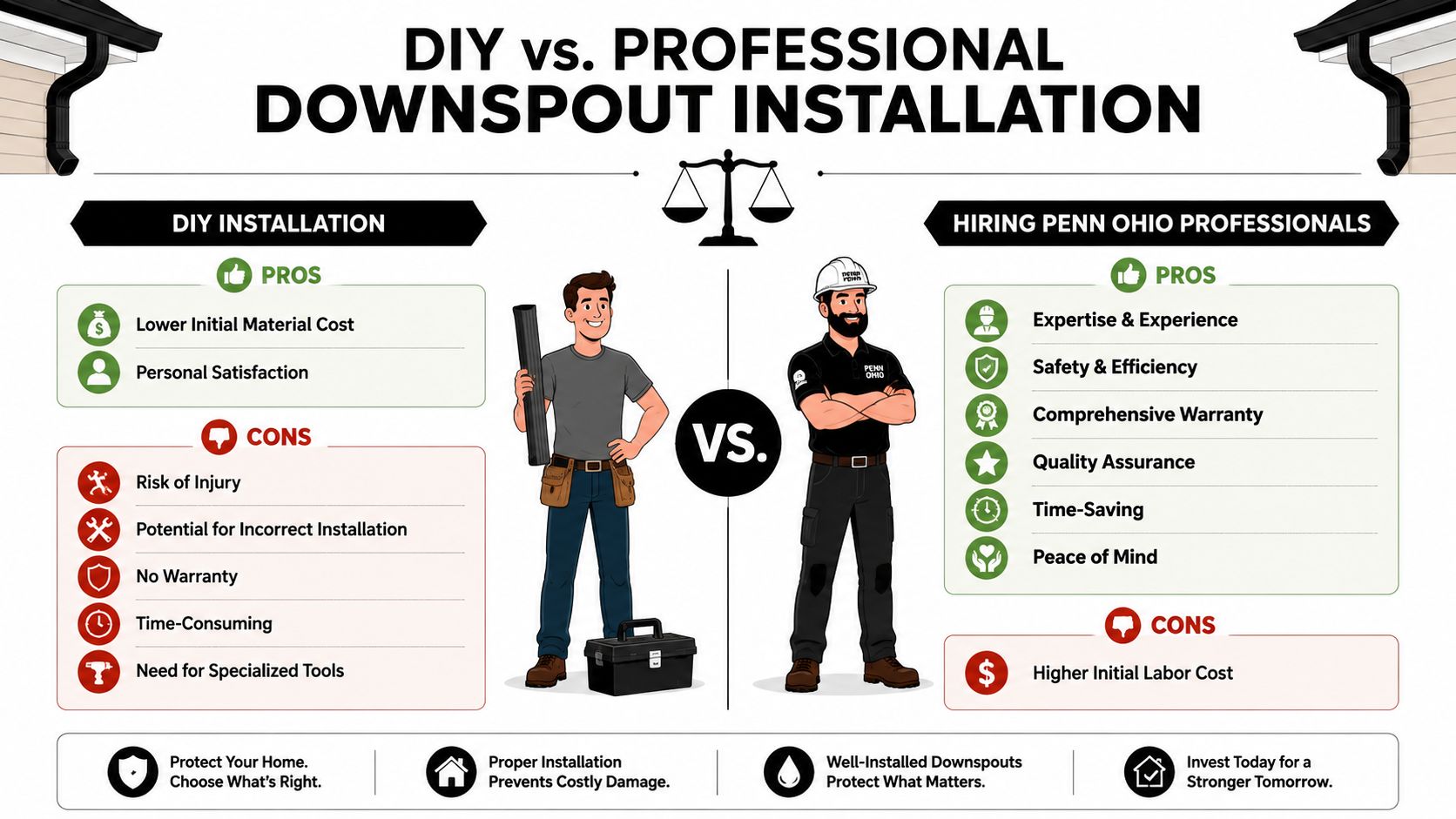
That is a narrow slice of the work we see.
Once the job involves a second story, a steep grade, older fascia, custom bends around trim, or a discharge point that needs to be moved farther from the house, the risk changes. At that point, the question is not just whether you can attach a new piece of pipe. The question is whether the finished system will control water the way it should during a hard Penn Ohio rain.
Where DIY can save money
Homeowners can save money if all of these are true:
- The replacement is on a first-story wall
- The existing outlet and downspout path are already correct
- The wall surface and fastening points are still solid
- The new section matches the existing size and material
- Water already discharges far enough away from the foundation
In that situation, DIY may trim out the labor portion of a small repair. For a simple ranch house in Beaver County or a basic one-story section on a Mercer County home, that can be a fair trade if the homeowner already owns the tools and is comfortable on a ladder.
Where DIY usually gets more expensive
The hidden cost is rework.
I see the same problems over and over. Screws get driven into weak trim instead of solid backing. Elbows are forced into place and leak at the joints. The lower extension ends too close to the house because the original splash pattern was never checked. On older homes in Lawrence County, I also see rotten fascia or loose gutter outlets that a DIY repair does not address, so the new downspout is tied to failing material.
That kind of shortcut often turns a small project into a larger one.
Common trouble spots include:
- Poor outlet alignment: Water misses the throat of the downspout or overshoots the connection in heavy flow
- Weak fastening: The downspout pulls loose in wind, snow, or ice
- Bad discharge planning: Water keeps pooling at the foundation, walkway, or basement wall
- Missed surrounding repairs: Damaged fascia, trim, or gutter sections stay in place and keep causing leaks
- Repeat labor: The homeowner buys parts, spends the time, then still pays for professional correction
When hiring a pro makes better financial sense
Professional installation usually makes more sense on taller homes, complex rooflines, or any project where runoff needs to be corrected instead of a straightforward reattachment. That includes a lot of houses in this service area. Two-story colonials in Mercer County, hillside properties in Beaver County, and older homes with layered repairs in Lawrence County all tend to have details that affect labor and long-term performance.
The value is not just labor. It is proper sizing, secure fastening, clean routing, matching materials, and a drainage plan that gets water away from the structure.
Penn Ohio Roofing & Siding Group offers free estimates and checks the surrounding roof edge, gutter outlet, and fascia condition at the same time. That matters because a downspout problem is often tied to something above it. If the outlet is loose or the wood behind the straps is failing, replacing the pipe alone does not solve much.
For a small, low-risk repair, DIY can be fine. For anything involving height, drainage correction, or signs of hidden damage, hiring a crew is usually the cheaper decision once you factor in safety, repeat work, and the cost of getting water management wrong.
Sample Downspout Costs in Mercer Beaver and Lawrence Counties
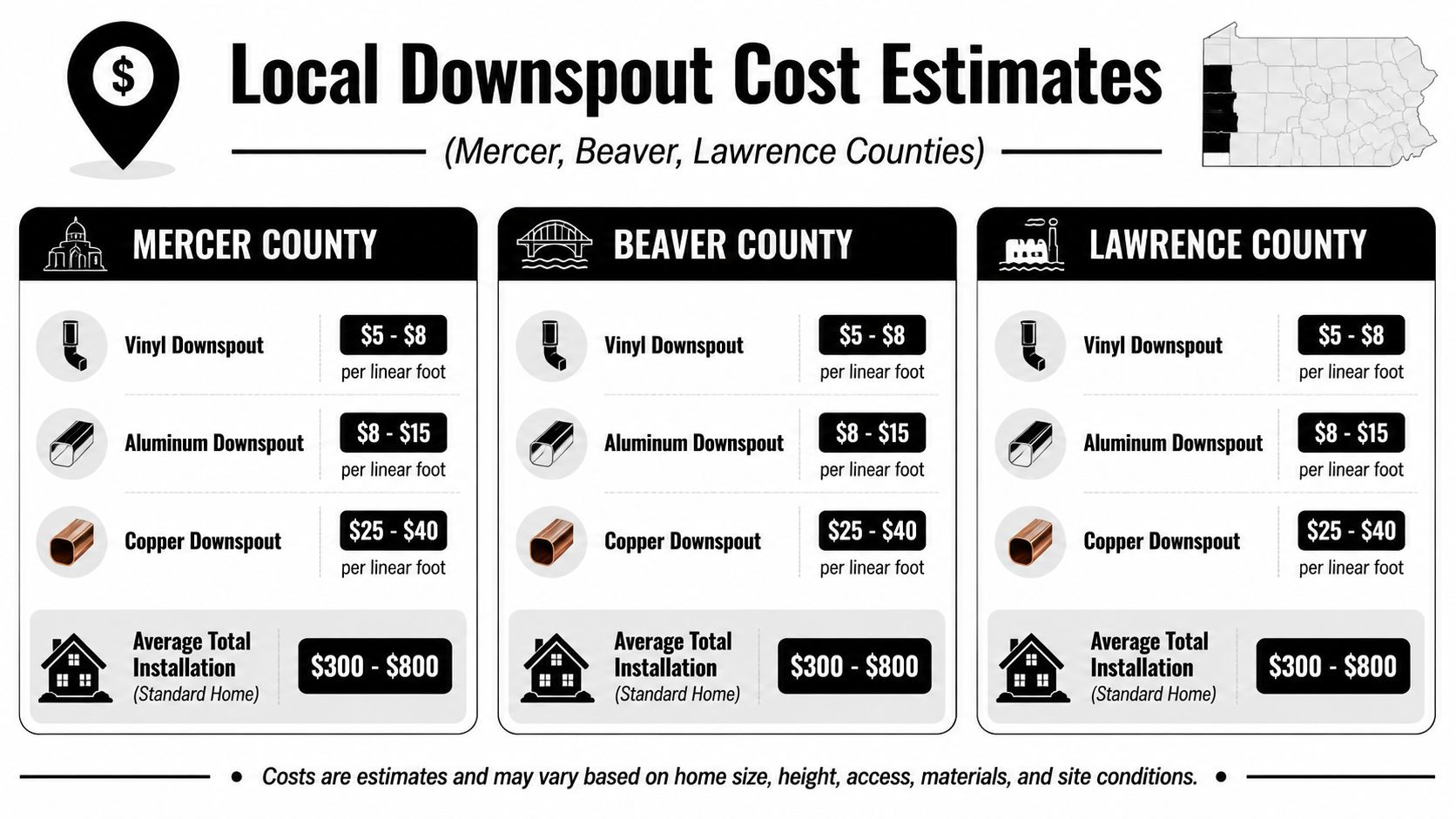
A homeowner in Beaver, Mercer, or Lawrence County usually is not asking for a national average. They want to know what this job is likely to cost on a ranch in Chippewa, a two-story in Hermitage, or an older farmhouse outside New Castle. That is the right way to price downspout work, because height, access, siding condition, and where the water needs to discharge all affect the quote.
These examples are budgeting ranges, not fixed prices. They reflect the kinds of homes we see across the Penn Ohio service area and the cost patterns already discussed earlier in this guide.
Beaver County ranch with a simple aluminum replacement
A one-story ranch with open access and a straight drop is usually the most affordable setup. If the gutter outlet is sound, the fascia is holding well, and the crew is replacing one or two standard aluminum downspouts without rerouting anything, the job often stays in the low hundreds.
That price can climb if the bottom discharge needs to be extended farther from the foundation or if the old straps pulled loose and damaged the trim behind them. On a lot of Beaver County ranch homes, the downspout itself is not the expensive part. The added time comes from correcting the reason it failed.
Mercer County two-story colonial with full replacement
A two-story colonial changes the labor side of the job fast. Ladder setup takes longer, fastening has to be more precise, and full replacement usually means checking every outlet and run instead of swapping one damaged piece.
For many Mercer County homes, a full set of standard downspouts lands in the mid-hundreds and can move into the low thousands if several sides of the house need work. Corners, long wall runs, and buried drain tie-ins add cost. So does any repair at the gutter connection point.
Lawrence County farmhouse with a copper upgrade
Older homes in Lawrence County often bring a different decision. The homeowner is not always looking for the cheapest replacement. They may want copper because it fits the look of the house better, or because they are already upgrading gutters and trim on a visible front elevation.
That pushes the budget up quickly. Copper costs more, takes more care to install cleanly, and usually makes the most sense when appearance matters and the surrounding exterior is in shape to match it. On a farmhouse or historic-style home, the quote can move well past a basic aluminum replacement, especially if custom offsets or longer runs are involved.
One local factor homeowners sometimes miss is maintenance access. A downspout that clogs every fall because of nearby trees may need a different discharge setup or easier cleanout access. If that is a concern, it helps to review how to clean downspouts and gutters properly before deciding whether a basic replacement is enough.
A practical budgeting guide for this area
For quick planning, this is a reasonable starting point:
- One or two basic replacements on an accessible one-story home: usually low hundreds
- Multiple downspouts on a standard two-story home: usually mid-hundreds to low thousands
- Copper, custom routing, or older-home detail work: often above a standard replacement budget
The cleanest way to budget is to match the estimate to the house, not to a national average. In Mercer, Beaver, and Lawrence counties, two homes with the same number of downspouts can still price very differently once height, drainage path, and surrounding repairs are part of the job.
Smart Savings and Protecting Your Investment
The cheapest quote isn't always the lowest cost over time. A downspout that empties in the wrong place, pulls loose after one season, or gets installed into weak trim can create bigger repair bills around the foundation and roof edge.
Homeowners usually save the most when they cut the right things, not when they cut everything.
Where you can save without creating problems
A few practical moves can keep a project under control:
- Bundle related work: If the gutter needs adjustment or cleaning at the same time, handling it together can reduce repeat setup and service visits.
- Keep the route simple when it works: Reusing an effective discharge path is usually less expensive than redesigning the whole run.
- Choose a practical material: Aluminum often lands in the sweet spot for cost and appearance on standard homes.
- Address the problem early: Replacing a loose or damaged section now is usually simpler than waiting until overflow damages nearby trim or landscaping.
Where cutting corners backfires
Some savings aren't savings at all. Skipping brackets, ignoring a damaged outlet, or leaving water to discharge near the foundation usually means the house still has the same drainage problem after the work is done.
Good value also includes maintenance. Leaves, shingle grit, and seasonal debris can overwhelm even a properly installed system if nobody keeps it clear. If you want a homeowner-level walkthrough for ongoing upkeep, this guide on how to clean downspouts and gutters is a useful starting point.
A downspout earns its keep after the installer leaves. If it can't control water during the next hard rain, the invoice wasn't the real cost.
Think in terms of protection, not just purchase
The best installations protect more than the gutter system. They protect the fascia, siding, basement edge, landscaping, and the grade around the house.
That means a smart investment usually includes three things:
| Priority | Why it matters |
|---|---|
| Correct sizing | The system has to carry the roof runoff it receives |
| Solid attachment | Loose sections fail early and often pull on surrounding trim |
| Planned discharge | Water must end up away from the house, not simply at ground level |
If a contractor offers workmanship protection or a written scope, that's valuable because it sets expectations before the work begins. Clear scope and clear maintenance usually matter more than chasing the lowest line item.
Get a Clear Accurate Downspout Quote for Your Home
Downspout installation cost varies because houses vary. Material, height, access, discharge method, and the condition of the surrounding gutter system all shape the final number. That's why one home may need a straightforward low-hundreds repair while another needs a broader drainage project that pushes into the thousands.
What matters most is getting the right fix for the water problem you're seeing. If water is pooling by the foundation, washing out beds, staining siding, or overflowing at the corners, the question isn't just "what does a downspout cost?" It's "what will it take to move water away from this house correctly?"
For homeowners in Mercer, Beaver, and Lawrence counties, the best quote is one that explains the material, labor, routing, accessories, and any related roof-edge issues in plain language. It should show whether you're replacing a damaged section, upgrading an undersized system, or solving a drainage layout problem that has been there for years.
If the issue is urgent after a storm, don't wait for visible interior damage. A fast assessment can determine whether the problem is limited to the downspout or tied to gutters, fascia, or roofline drainage. That matters even more on older homes and multi-story properties, where access and hidden deterioration can change the scope quickly.
If you need a clear, no-pressure assessment, contact Penn Ohio Roofing & Siding Group for a free, no-obligation quote on downspout and roof-edge drainage work in Hermitage, Mercer County, Beaver County, and Lawrence County. The team is also available 24/7 for emergency service when storm damage or sudden drainage failure can't wait.