
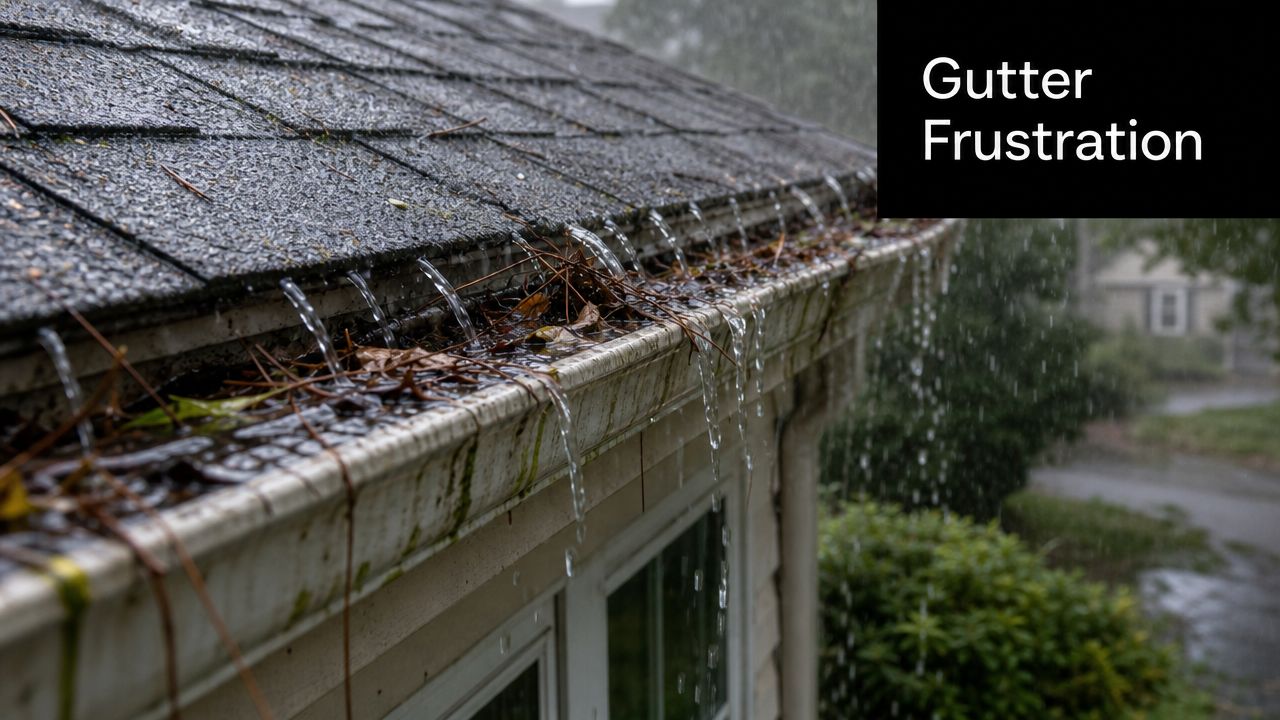
A lot of homeowners in Hermitage don't start thinking about gutters until they see water spilling over the edge in a hard rain, dripping behind the gutter, or freezing into ugly ridges along the roofline in winter. By that point, the issue usually isn't just the gutter. It's the siding below it, the fascia behind it, the mulch beds under it, and sometimes the foundation next to it.
That's why continuous gutter installation matters so much in Western Pennsylvania. In places like Hermitage, Sharon, Pittsburgh, and Erie, gutters have to deal with steady rain, wet leaves, snowmelt, and freeze-thaw swings that expose every weak joint and every bad slope. A system that works fine in mild weather can fail fast here if it's undersized, poorly pitched, or attached to damaged wood.
Table of Contents
- Why Seamless Gutters Are the Standard for PA Homes
- Seamless vs Sectional Gutters What's the Difference
- Choosing Your Gutter Materials and Sizes
- The Professional Installation Process Explained
- Understanding Seamless Gutter Installation Costs in the Hermitage Area
- Lifespan Maintenance and When to Replace Your Gutters
- Hiring a Qualified Local Gutter Contractor
Why Seamless Gutters Are the Standard for PA Homes
After a long winter in Western PA, sectional gutters often tell on themselves. The seams open up. The spikes loosen. Water runs over the front in one spot and behind the gutter in another. Homeowners in Hermitage and Sharon usually notice it first near an entry door, over a porch, or where mulch keeps washing out.
That's why continuous gutters have become the standard choice for homes across this part of Pennsylvania. They're formed on site to fit the house, which cuts down on connection points and gives the installer tighter control over fit, pitch, and drainage. In a climate like Erie or Pittsburgh, where runoff loads can change quickly during storms and snowmelt, that custom fit matters.
What Western PA weather exposes
The local problem isn't just rain. It's rain followed by debris, then snow, then ice, then thaw. Each cycle stresses the gutter system a little more. If one section is slightly off, water sits. If water sits, it freezes. If it freezes, the system gets heavier and weaker.
A strong gutter system helps with more than moving water off the roof edge. It plays a direct role in protecting house wall integrity by keeping runoff from repeatedly soaking siding, trim, and the areas around windows and foundations.
In Western Pennsylvania, gutters aren't trim. They're part of the drainage system that protects the whole exterior.
Why homeowners upgrade instead of patching
Repairs make sense when a gutter has a small isolated issue. They don't make sense when the whole setup is aging, poorly pitched, or separating at multiple joints. That's when a one-piece gutter system installation usually becomes the smarter move.
Many homeowners dealing with winter roof-edge problems also end up learning how gutters and ice conditions work together. If that's part of what you're seeing, this guide on preventing ice dams in winter is worth reading before you make replacement decisions.
Seamless vs Sectional Gutters What's the Difference
A lot of Western PA homeowners reach this comparison after the same pattern. Water starts dripping from a joint over the porch, a repair lasts through one season, then another connection opens up after snow and ice work on the system all winter.
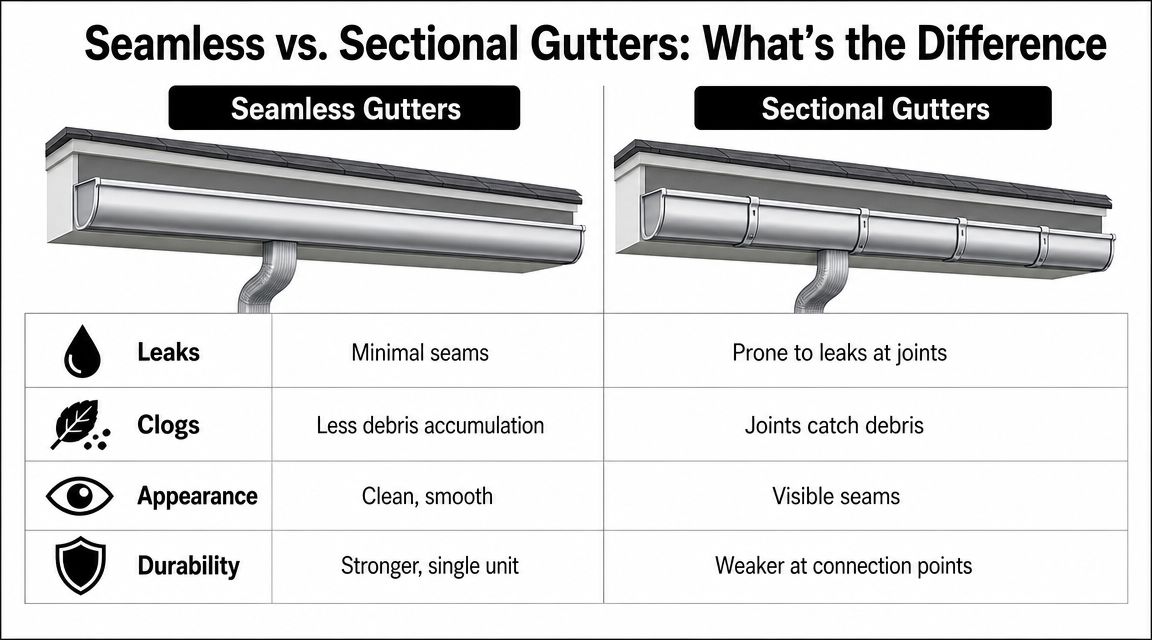
A sectional gutter is built from shorter pieces fastened together. A continuous gutter is formed in long runs to fit each roof edge, with joints usually kept to corners and downspout connections.
Where continuous systems pull ahead
The practical difference is simple. More joints usually mean more opportunities for leaks, debris buildup, and separation over time. In Hermitage, Erie, and Pittsburgh, freeze-thaw cycles put extra stress on every connection, so joint count matters more here than it might in a milder climate.
According to gutter lifespan statistics from New England Gutter, one-piece aluminum systems typically last longer than vinyl sectional setups and usually cost more up front. That matches what installers see in the field. Continuous runs ask for a higher initial investment, but they often cut down on recurring joint repairs and nuisance leaks.
Seamless vs sectional gutters at a glance
| Feature | Continuous Gutters | Sectional Gutters |
|---|---|---|
| Construction | Custom-formed on site in longer continuous runs | Built from shorter pieces joined together |
| Leak risk | Fewer joints means fewer common failure points | More joints mean more places to leak |
| Appearance | Cleaner lines along the fascia | Visible seams break up the roof edge |
| Maintenance | Usually less trouble at joints | Joints often catch debris and need more attention |
| Repair style | Individual damage may require section replacement or custom work | Small sections can be swapped out more easily |
| Best fit | Homeowners focused on durability and long-term performance | Budget-driven installs or temporary replacements |
Trade-offs that matter
Continuous gutters are not automatically better just because they are made in longer runs. Poor pitch, weak fasteners, undersized downspouts, and sloppy outlet placement will still cause overflow and drainage problems.
Sectional systems do have one real advantage. They are easier to buy off the shelf and patch in short segments. If a branch crushes one area, that repair can be more straightforward.
For many homes in the Hermitage area, though, the long-term weak spot is the same one homeowners keep repairing. It is the joint. If the current system is leaking at connections, separating at end caps, or catching debris where pieces meet, replacing it with another joint-heavy setup often leads back to the same service calls.
Practical rule: If the trouble keeps starting at joints and end caps, choose a system with fewer of them.
Choosing Your Gutter Materials and Sizes
Material and size decisions affect how the system performs every time it rains or thaws. A good installer shouldn't just ask what color you want. They should ask about roof area, roof pitch, tree coverage, drainage paths, and whether the current setup has a history of overflow.
Material choices for Western PA homes
Aluminum is the common standard for continuous gutter installation. It's practical, widely available, and a strong fit for most homes in Hermitage, Sharon, and nearby communities. It also works well for on-site fabrication.
Steel can make sense where durability is a bigger concern, especially on homes that see tougher exposure or where owners want a heavier-feeling system. The trade-off is weight and the need for careful installation at the fascia.
Copper is usually chosen for appearance, long service life, and high-end projects. It costs more, but it can be the right fit for historic homes or homeowners who want a distinctive exterior finish that ages naturally.
The right answer depends on the house. A basic ranch in Sharon and a steep-roofed older home in Pittsburgh won't always need the same setup.
Why size matters more than many homeowners think
Capacity changes fast when you move up in size. Fine Homebuilding and manufacturer-backed specifications note that 5-inch gutters hold about 1 1/4 gallons per foot, while 6-inch gutters hold about 2 gallons per foot, and runs of 20 feet or more are commonly better served with two downspouts to reduce overflow risk (gutter capacity and downspout sizing guidance).
That's a meaningful jump in carrying capacity. On larger roofs, steep roofs, or rooflines that dump water into concentrated areas, a 6-inch system can be the difference between controlled drainage and water running over the front edge.
A practical way to choose
Use this checklist when you talk with an installer:
- Roof size and pitch: Bigger or steeper roofs send water faster. Those homes often need more capacity.
- Long straight runs: If one gutter run is lengthy, ask whether a second downspout would improve drainage and give you backup if one outlet clogs.
- Tree coverage: Homes under maples, oaks, or pines often benefit from designs that are easier to clean and less prone to debris hangups.
- Exterior goals: If curb appeal matters as much as function, material and profile choices deserve more attention.
If a contractor gives you a one-size-fits-all recommendation without looking at runoff patterns, that's a red flag. Good gutter design is simple, but it isn't generic.
The Professional Installation Process Explained
A proper continuous gutter installation starts before any metal goes on the machine. The work begins with inspection, measurements, and drainage planning. If those first steps are rushed, the finished system may look fine from the driveway and still perform poorly in the first serious storm.
Step one starts at the fascia
One of the most overlooked parts of the job is the wood behind the gutter. Installation guidance stresses that the fascia board needs to be inspected for damage or rot before fastening new gutters, because the system is only as stable as the structure supporting it. The same guidance notes that proper pitch is critical, with about 1/4 inch per 10 feet toward the downspout used as a standard benchmark for drainage (fascia inspection and slope guidance).
If the fascia is soft, split, or deteriorated, hanging new gutters on it is asking for trouble. The hardware may hold for a while, but the system can start pulling loose under water load, snow load, or ice.
What a solid install usually includes
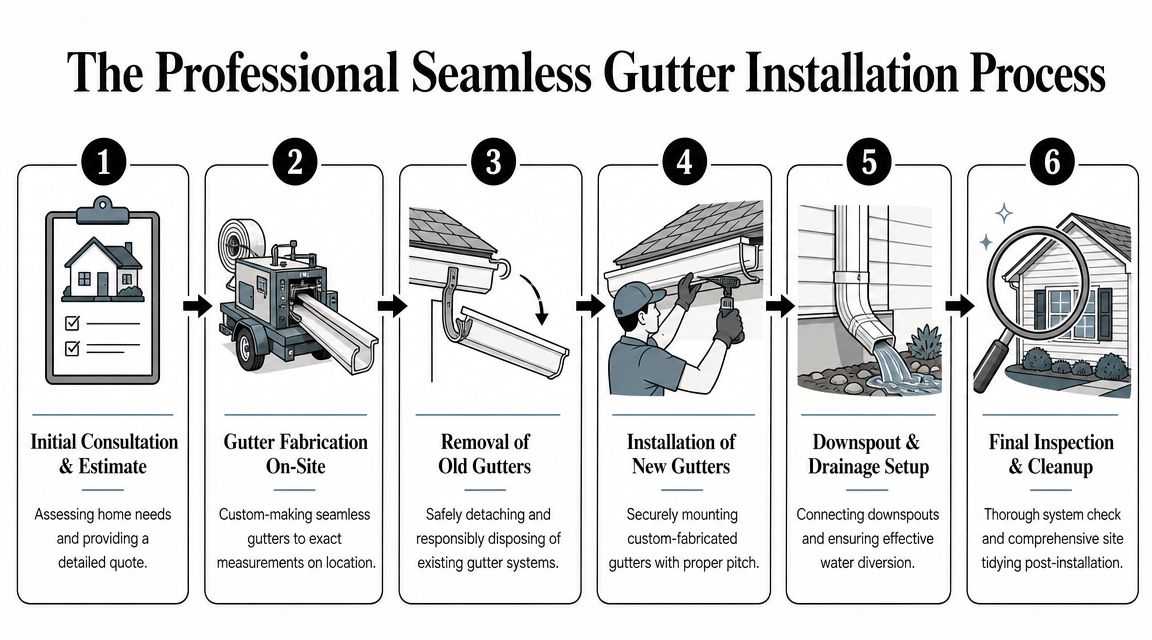
A professional crew typically works through the job in a clear sequence:
Measure the roofline carefully
Every run, corner, outlet, and drop location gets mapped so the new gutter can be formed to fit the house instead of forcing the house to fit stock pieces.Check drainage paths
Water has to leave the roof edge and end up away from the foundation. That means looking at downspout placement, splash areas, walkways, landscaping, and grade.Remove failing components
Old gutters, loose spikes, and damaged brackets come off cleanly so the new system starts on a sound base.Form the gutter on site
This is what sets these gutters apart. The machine produces custom runs to the required length right there at the property.
The details that separate good work from sloppy work
After fabrication, installers set the line, establish pitch, and secure the gutter with hidden hangers. Hidden hangers matter because they provide a cleaner appearance and more consistent support than older spike-and-ferrule setups.
Then the crew cuts outlets, attaches downspouts, and checks water movement. On a quality job, the installer doesn't just step back and admire the straight line. They make sure water travels where it should.
Most gutter problems I see after a replacement aren't caused by the metal itself. They come from bad layout, bad pitch, or fastening into wood that should have been repaired first.
What homeowners should watch for on install day
A good installation should leave you with more than new gutters. It should leave you with confidence that the system was planned correctly.
Look for these signs:
- Clear communication: The crew explains where downspouts are going and why.
- Visible pitch control: They're using lines and layout methods, not eyeballing the run.
- Clean fastening: Hangers are spaced consistently and attached to solid backing.
- Thoughtful cleanup: Old metal, screws, sealant debris, and cutoffs are removed from the property.
A gutter system can look straight and still be wrong. The best installers pay attention to what you can't see from the ground.
Understanding Seamless Gutter Installation Costs in the Hermitage Area
A Hermitage homeowner usually calls about price after the first hard overflow. Water is washing over the front edge, mulch is moving, and now the question is simple. What will it cost to fix this the right way?
For a one-piece gutter system, the honest answer is that price depends on the house in front of you. A straight ranch with easy access is one kind of job. A two-story home with several rooflines, worn fascia, and tricky downspout routing is another. In Western Pennsylvania, snow load, heavy spring rain, and leaf buildup also affect what the installer needs to size and support correctly.
What changes the price on a real house
A quote usually moves based on five practical factors.
- Material choice: Aluminum is common because it balances cost, corrosion resistance, and appearance. Steel costs more but handles abuse well. Copper is in a different price category altogether.
- Total roof edge: More linear footage means more formed gutter, more hangers, more outlets, and more labor.
- House height and access: A low roof over open ground is faster to work on than a steep rear elevation over landscaping, decks, or tight side yards.
- Condition of the wood behind the gutter: If fascia or sub-fascia is soft, the crew may need repairs before new hangers can hold properly.
- Drainage layout: Downspouts, extensions, splash blocks, and discharge location all affect performance and labor. If you want a closer look at that part of the bid, this guide to downspout installation cost factors gives useful context.
In this area, local weather matters more than many national guides admit. Erie and Pittsburgh see plenty of rain, but Hermitage homes also deal with freeze-thaw cycles, wet leaves, and winter ice that punish weak fastening and undersized drainage. That is one reason two homes with similar square footage can receive very different proposals.
How to read an estimate without guessing
A solid estimate should spell out what is included, what is excluded, and where a hidden problem could change the number. Homeowners get into trouble when they compare only the bottom-line total.
Here is what I tell people to check first:
| Cost Item | Why It Matters |
|---|---|
| Material type | Changes price, appearance, and resistance to rust or denting |
| Gutter size | Capacity should match roof area and local rainfall conditions |
| Downspout count and placement | Too few downspouts can cause overflow even on a new system |
| Removal and disposal | Leaving tear-off out of the bid can make one quote look cheaper than it is |
| Fascia or trim repairs | Rotten wood changes the scope and should be addressed before installation |
| Leaf protection options | Guards add cost and are not the right fit for every roof and tree mix |
One more point matters here. Maintenance planning affects long-term cost, even if it is not part of the install line items. Homes under heavy tree cover may spend more over time on cleanings or guard systems, so it helps to understand proper home gutter care before you choose upgrades.
If a quote looks much lower than the others, ask why. Sometimes the contractor is using lighter material, fewer downspouts, wider hanger spacing, or leaving out wood repairs and disposal. A fair estimate is specific. That usually tells you more than a cheap number.
Lifespan Maintenance and When to Replace Your Gutters
Once gutters are installed correctly, the goal is simple. Keep water moving and catch problems before they affect the trim, siding, or foundation. Most gutter failures don't start with dramatic collapse. They start with small signs that get ignored for too long.
What maintenance actually matters
Routine care isn't complicated, but it does need to happen. Leaves, seed pods, shingle grit, and roof-edge debris all interfere with flow. Homeowners who want a practical seasonal checklist can use resources on proper home gutter care to stay ahead of clogs and overflow.
A good maintenance habit usually includes:
- Clearing debris in heavy leaf seasons: Fall is the obvious one, but spring cleanout matters too.
- Checking downspout flow: If water backs up at the top, the system can't do its job.
- Watching the fascia line: Staining, peeling paint, or dark moisture marks can signal trouble.
- Looking at discharge areas: If water is pooling near the house, the issue may be at the bottom, not the top.
A gutter can be intact and still fail if the downspout is blocked or the outlet is undersized for the runoff it receives.
When maintenance is no longer enough
There's a point where cleaning and minor repairs stop making financial sense. If the system is repeatedly separating, leaking at multiple spots, or pulling away from the house, replacement is usually the smarter route.
Watch for these signs:
- Visible cracks or corrosion: Small damage spreads once water keeps finding the same weak area.
- Sagging or separation: Gutters that pull away from the fascia often indicate fastening or substrate problems.
- Water staining on siding: That usually means water isn't staying in the system.
- Pooling at the foundation: If runoff isn't being moved away, the whole drainage plan needs review.
Material affects long-term expectations
As covered earlier, material choice changes lifespan. Aluminum continuous systems are a common long-term solution. Copper can stay in service much longer with proper care. Lower-cost materials may make sense in some situations, but they often change the maintenance and replacement timeline.
What matters most is catching failure early. Replacing gutters before they damage fascia, soffit, and foundation areas is usually much cheaper than waiting for visible structural problems.
Hiring a Qualified Local Gutter Contractor
A gutter system can look fine on day one and still cause problems through the first Western PA winter if the installer misreads the roof, undersizes the downspouts, or fastens into weak fascia. In Hermitage, Erie, and Pittsburgh, heavy rain, wet leaves, and freeze-thaw cycles expose bad workmanship fast.
That is why the contractor matters as much as the material.
What to verify before you sign
A good estimate should show more than a price. It should tell you how the contractor plans to handle runoff on your specific house.
Before you agree to the job, check for a few basics:
- Insurance and licensing: Confirm they are properly covered and allowed to work in your area.
- Local project history: Reviews from homeowners in Hermitage, Sharon, Erie, or Pittsburgh say more than broad marketing claims.
- Clear scope: The estimate should spell out material, gutter size, downspout count, removal of old sections, and disposal.
- Fascia and soffit inspection: Ask what happens if they find rot, soft wood, or fastening problems during installation.
- Cleanup standards: A professional crew should leave the property free of scrap, screws, and sealant waste.
Ask to see how they arrive at the layout. On many Western Pennsylvania homes, the difference between a good install and a callback comes down to pitch, outlet placement, and whether the crew accounts for valleys that dump a lot of water into one run.
Questions worth asking on the first call
The first phone call usually tells you a lot. Ask how they decide between 5-inch and 6-inch gutters, how they place downspouts on long runs, and whether they inspect the fascia before quoting the work.
Listen for direct answers. A contractor who understands drainage should be able to explain why one-piece gutters make sense for your roofline, where overflow risk is highest, and what conditions could change the price after inspection.
Homeowners also benefit from reviewing broader Expert gutter maintenance tips because a contractor who speaks clearly about maintenance usually has a better grasp of installation quality and long-term performance.

Why local experience matters in Western PA
Western PA homes deal with conditions that many national guides barely mention. Snow load, ice at the eaves, maple and oak debris, and older rooflines with awkward drainage patterns all change how a gutter system should be sized and installed.
That local experience also matters when you compare bids. A low number can leave out downspout extensions, fascia repairs, oversized gutters where they are needed, or removal of existing materials. When comparing roofing companies serving Hermitage and nearby communities, use the list as a starting point, then judge each contractor by inspection quality, estimate detail, and how well they explain runoff control around your foundation.
Penn Ohio Roofing & Siding Group is one local option that offers gutter-related exterior work alongside roofing, soffit, and fascia services. The company is family-owned, serves Hermitage and surrounding counties, has more than two decades of experience, and notes recognition including the GAF Triple Excellence Award in its company background.
A reputable installer does not rush you. They inspect the house carefully, explain what they found, and give you enough detail to choose the right continuous gutter system for your budget and your home.
If you're dealing with leaking joints, overflow, sagging gutters, or drainage issues around your home in Hermitage, Sharon, Pittsburgh, or Erie, Penn Ohio Roofing & Siding Group offers free, no-obligation estimates. A clear inspection and a detailed quote can tell you whether repair is enough or whether a full one-piece gutter installation makes more sense for your home.