
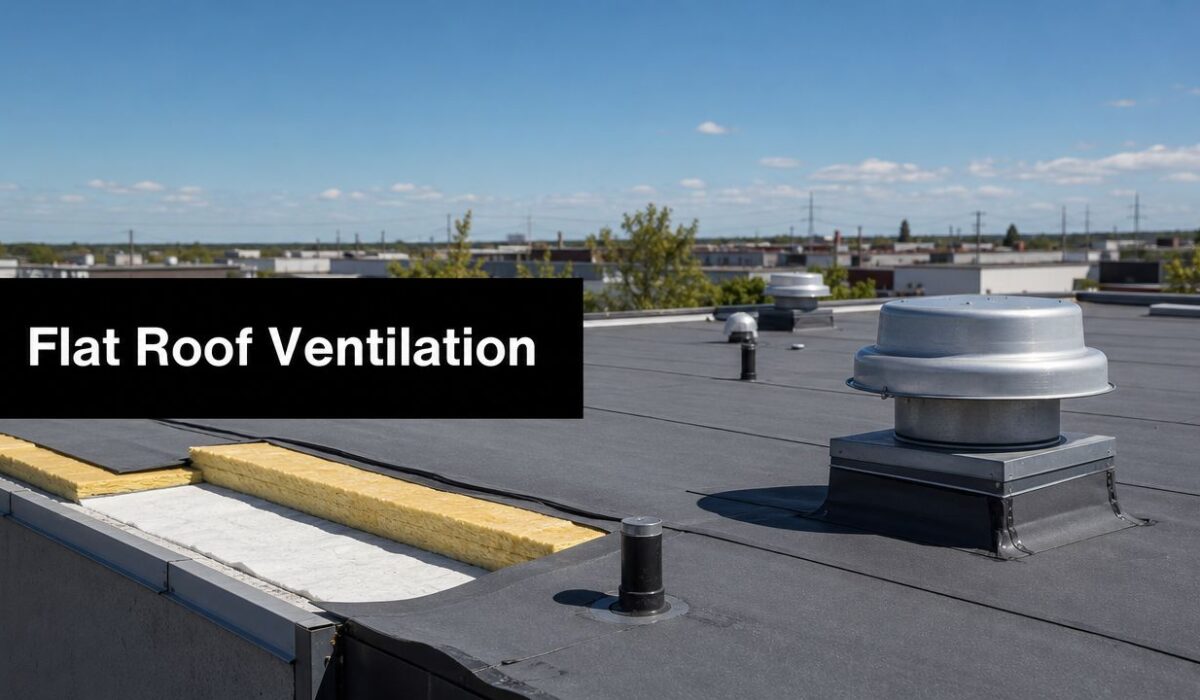
If you own a building in Pittsburgh, Sharon, or Erie, you may already be seeing the symptoms. A ceiling stain that keeps coming back. Utility bills that feel off for the season. A flat roof that was “repaired” more than once, yet still seems to hold moisture, trap heat, or create winter problems after every freeze and thaw.
In Western Pennsylvania and Eastern Ohio, flat roof ventilation isn't a side issue. It's one of the details that decides whether a roof system stays stable or starts breaking down from the inside. Snow sits longer here. Ice lingers around edges, drains, and shaded sections. Warm indoor air rises, hits colder surfaces, and turns into hidden moisture where owners can't see it until the damage shows up indoors. That's why ventilation has to be treated as part of the roofing system, not an afterthought.
Table of Contents
- The Unseen Threat to Your Flat Roof
- What Flat Roof Ventilation Actually Does
- Vented vs Unvented Roofs The Two Core Strategies
- Common Flat Roof Ventilation Types and Systems
- Warning Signs of Poor Ventilation and How to Inspect It
- Design Codes and When to Call a Professional
The Unseen Threat to Your Flat Roof
A property owner in Sharon usually doesn't call about “ventilation.” They call about stains, odors, damp insulation, recurring leaks, or a roof that never seems to dry out. The complaint sounds simple. The cause often isn't.
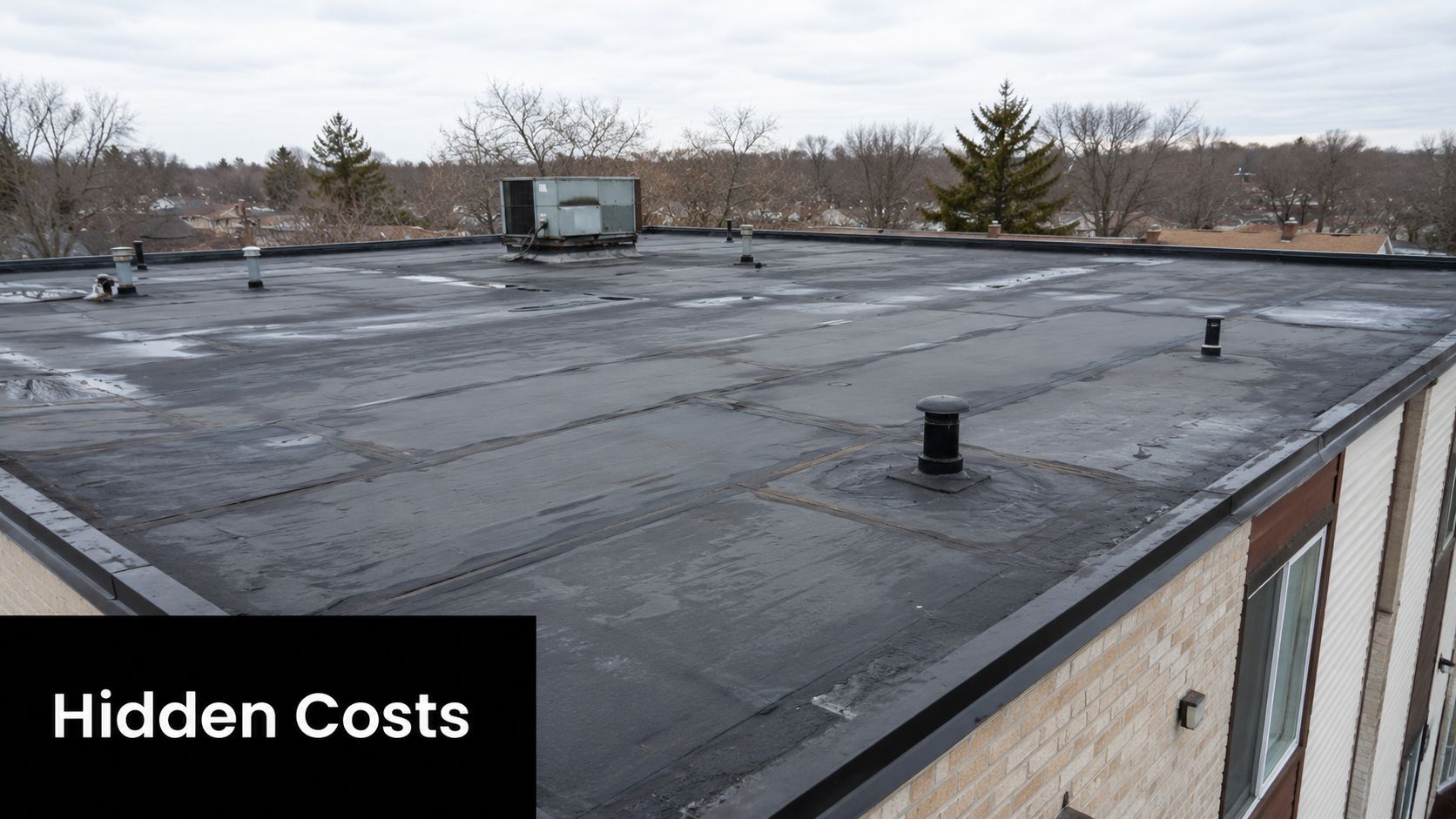
A flat roof can look fine from the parking lot and still be holding wet air inside the assembly. That trapped moisture moves slowly. It darkens decking, weakens insulation, stresses seams, and shows up indoors only after the roof has been under strain for a while. In this region, that process speeds up during winter because the roof deck can stay cold while interior air stays warm.
Why owners miss it
Most owners focus on the membrane. That makes sense. The membrane is what you see, patch, coat, and inspect after storms. But poor flat roof ventilation creates problems underneath the visible surface.
Common first clues include:
- Ceiling discoloration: Staining doesn't always mean an active hole in the membrane. Moisture can condense inside the assembly and migrate.
- Musty indoor air: If upper floors smell damp, roof ventilation may be part of the building-wide moisture problem. Indoor conditions and home air quality are often connected more than owners realize.
- Winter edge issues: Snow melts unevenly, then refreezes at colder edges and trouble spots.
- Repeat repairs in the same area: If the symptom keeps returning, the assembly may be managing moisture poorly.
Poor ventilation doesn't always announce itself with a dramatic leak. Often it shows up as a pattern. Stains, odors, and repeat service calls in the same zones.
Why Western Pennsylvania roofs take a harder hit
Flat and low-slope roofs in Pittsburgh, Erie, and nearby communities deal with long cold stretches, wet weather, and frequent temperature swings around freezing. That matters because moisture doesn't need a major opening to become destructive. It only needs a cold surface and trapped air.
On a badly vented roof, humid air can linger in dead zones. Then the freeze-thaw cycle does the rest. Materials expand, contract, stay damp too long, and age faster than they should. Owners often think they have a drainage problem only. Sometimes they do. Sometimes they also have a ventilation problem that keeps the roof from stabilizing between weather events.
What this means for your budget
The expensive mistake is waiting until the damage is obvious. By then, you may be paying for interior repairs, insulation replacement, membrane work, and repeated diagnostics. Ventilation problems rarely stay isolated to one component. They affect the roof deck, the insulation, the interior environment, and the service life of the whole assembly.
What Flat Roof Ventilation Actually Does
Flat roof ventilation gives trapped heat and moisture a controlled path out of the roof assembly. The simplest way to think about it is this. The building needs a way to release damp, warm air before that air reaches a cold surface and turns into water.
That's the core job. Everything else flows from it.
It controls moisture before moisture controls the roof
Moisture is the main reason ventilation matters. Warm indoor air rises, and on a cold day it moves toward the roof. If that air reaches a cold underside of the deck and has nowhere to go, condensation can form inside the assembly.
That creates a chain of problems:
- Air carries moisture upward.
- Moisture hits a colder surface.
- Water forms inside the roof system.
- Insulation loses effectiveness.
- Wood, fasteners, and adjacent materials stay damp longer than they should.
On a flat roof, that hidden wetness can sit for a long time. Owners may only notice a soft spot, a stain, or a recurring odor months later.
It protects the roof structure
A roof doesn't fail only from above. It can also deteriorate from below when trapped moisture keeps materials from drying out. Ventilation helps preserve the condition of the deck and the surrounding components by reducing the amount of damp air that lingers in enclosed spaces.
That matters in our climate because snow cover and cold exterior temperatures can keep roof surfaces colder for longer stretches. If the assembly can't release moisture, the materials stay under stress.
Practical rule: A flat roof assembly has to manage water in all forms. Rain from above, vapor from below, and condensation inside the system.
It helps the building perform more consistently
Ventilation also supports energy performance, though owners often feel that effect before they understand the cause. Wet insulation doesn't perform the way dry insulation should. Trapped heat in warmer months can also push indoor systems harder than necessary.
In winter, ventilation works alongside insulation and air sealing to reduce the uneven roof temperatures that contribute to ice-related issues. If you're dealing with recurring winter edge buildup, this guide on how to prevent ice dams gives useful context on the broader roof behavior involved.
What ventilation does not do
Ventilation isn't a cure-all. It won't fix bad drainage, failed flashing, open seams, or a roof that was assembled incorrectly. It also won't compensate for poor vapor control. A good roof system treats airflow, insulation, drainage, and moisture management as connected parts.
Here's where owners get into trouble:
- Adding a vent without a plan: One new vent in the wrong spot can do very little.
- Assuming all moisture is a leak: Condensation and air movement can mimic leak symptoms.
- Treating every flat roof the same: Residential additions, retail buildings, and warehouses don't all behave alike.
A well-designed ventilation strategy is there to keep the roof assembly dry enough, stable enough, and balanced enough to last. That's why it's not optional on the right type of system.
Vented vs Unvented Roofs The Two Core Strategies
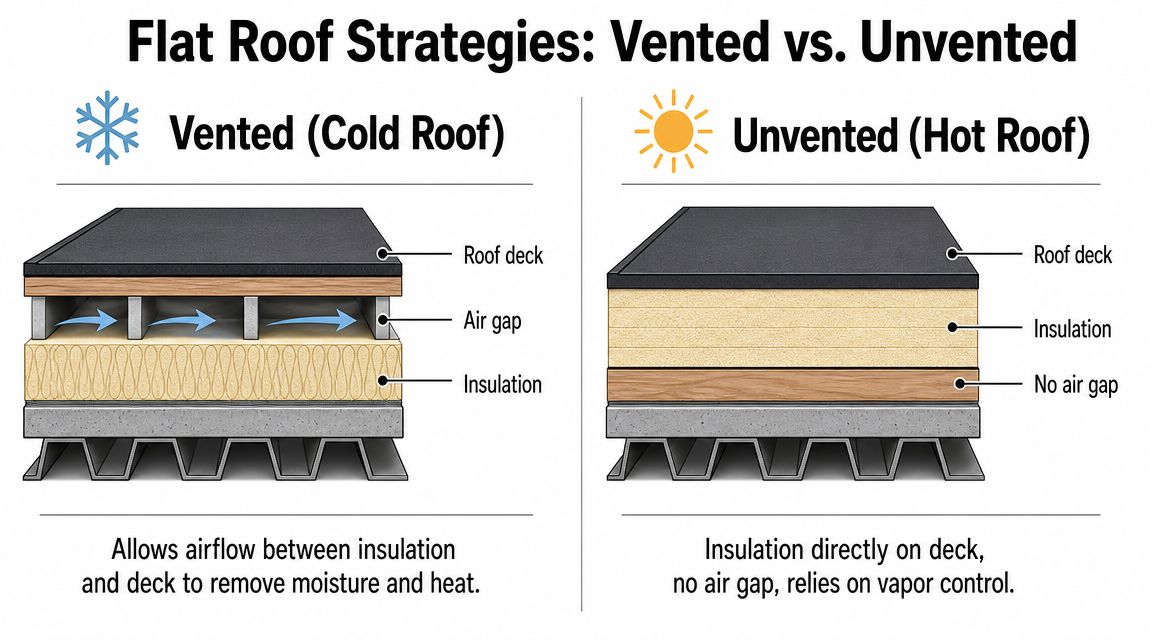
There are two basic ways to approach a flat or low-slope roof assembly. You either build it as a vented roof that moves air through a cavity, or you build it as an unvented roof that controls moisture with insulation placement and vapor management instead of airflow through that cavity.
Both can work. Both can fail if they're detailed poorly.
How a vented cold roof works
A vented flat roof, often called a cold roof, includes an air space that allows moisture and heat to move out of the cavity. The assembly relies on airflow across that void rather than trapping everything inside.
Commercial guidance citing the International Residential Code uses a minimum of 1 square foot of net free ventilation area per 150 square feet of roof cavity, with intake and exhaust balanced. For a 2,000 square foot roof, that works out to about 13 to 14 square feet of net free vent area total, as explained in this overview of flat roof ventilation benchmarks.
That benchmark matters for one reason. Balance. Too little ventilation traps moisture. Too much, or the wrong placement, can short-circuit airflow so one area moves air while another stays stale.
Where vented systems make sense
A vented assembly can be a practical fit when the roof design allows a clean, continuous path for intake and exhaust. It can also help on buildings where interior moisture load and winter condensation risk are persistent concerns.
In Western Pennsylvania and Eastern Ohio, these roofs need careful layout because snow, ice, and long cold periods can expose weak points fast.
Best use cases often include:
- Simple roof geometry: Straightforward layouts are easier to ventilate evenly.
- Accessible edge conditions: Intake and exhaust have to work as a system.
- Assemblies with a true cavity: Without usable air space, the idea falls apart.
Where vented systems struggle
A vented flat roof can disappoint when the cavity is interrupted by framing, ducts, rooftop equipment, or inconsistent detailing. It also struggles when someone assumes “some venting” is enough.
If air can't move from one side of the roof assembly to the other, you don't have ventilation. You have openings.
How an unvented hot roof works
An unvented roof, often called a hot roof, doesn't depend on airflow through a cavity. Instead, it keeps the deck and assembly warm enough, and controlled enough, that condensation is less likely to occur inside the roof system.
This approach often fits modern low-slope construction, especially when the design uses continuous insulation above the deck and when the roof shape or penetrations make true cavity ventilation difficult. It can be a smart answer on buildings with complicated rooftop layouts or on retrofits where a vent path can't be created cleanly.
A side-by-side view for local conditions
| Roof strategy | Main strength | Main risk | Typical local challenge |
|---|---|---|---|
| Vented cold roof | Removes moisture through airflow | Dead zones if airflow path is broken | Snow and cold can expose weak vent layout |
| Unvented hot roof | Avoids reliance on cavity airflow | Moisture problems if vapor control is wrong | Freeze-thaw stress punishes bad detailing |
For properties in Pittsburgh, Sharon, and Erie, the right choice comes down to assembly design, interior moisture conditions, roof geometry, and how well the details can be built in the field. The wrong move is copying a strategy from another building without checking whether your roof can support it.
Common Flat Roof Ventilation Types and Systems
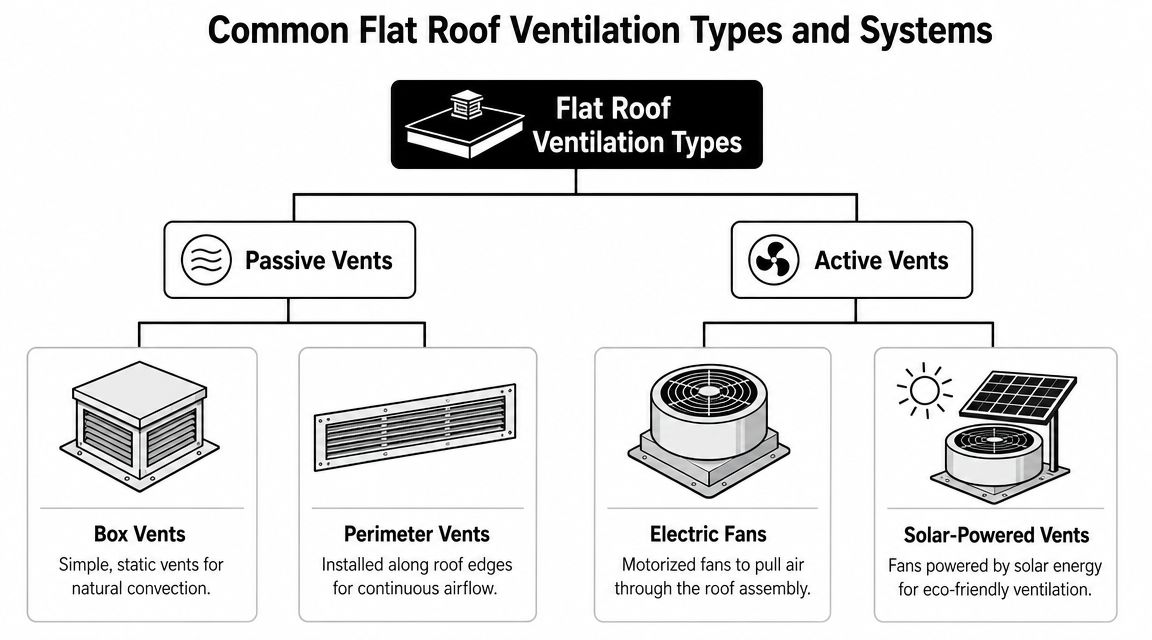
Once the overall strategy is chosen, the next question is hardware and layout. Flat roof ventilation then shifts from theoretical concepts to practical field decisions. The vent type has to match the assembly, the building shape, and the local weather it will face.
Passive systems that rely on natural airflow
Passive ventilation uses pressure differences and natural air movement rather than a powered fan. On many flat and low-slope roofs, this is the first place to look because fewer moving parts usually means fewer service issues.
For a cold flat roof, Glidevale Protect states that ventilation should provide the equivalent of 25,000 mm²/m on two opposing sides of the roof to meet British Standards. The key point is continuous cross-ventilation through the joist void, not a single vent opening. Their explanation of cold flat roof cross-ventilation is useful because it highlights what often goes wrong. One-sided venting leaves stagnant zones.
Common passive components include:
- Perimeter vents: These work along roof edges and can support continuous airflow when the assembly allows it.
- Parapet and edge intake details: These matter on buildings where the roof edge design controls whether air can even enter the cavity.
- Breather vents: These are often used to help release trapped moisture or pressure within certain roof systems, but they are not a substitute for a complete vented design.
- Air channels formed within the assembly: Framing details can either help air move or block it entirely.
Active systems for problem conditions
Powered ventilation has a place, but it's often misunderstood. Fans can assist airflow in specific situations, especially when passive movement is weak or the building has unusual interior moisture loads. Still, they don't erase design flaws.
A fan won't fix:
- Blocked airflow paths
- Poor vapor control
- Wet insulation already trapped in place
- Dead-end cavities
That's why active systems have to be matched carefully to the roof assembly. Otherwise, owners end up paying for equipment that masks symptoms without correcting the cause.
Assembly details matter as much as the vent itself
The roof may include vents, but the assembly still has to allow air to travel. In older low-slope guidance, even simple framing choices were used to promote cross-ventilation. On actual projects, that same principle still applies. If framing, curbs, or insulation interrupt the pathway, the vent openings won't do much.
A practical setup often includes:
- A clear intake path.
- A continuous air route through the cavity.
- A reliable exhaust point.
- Moisture control at the ceiling or deck level.
- Drainage that works independently of the ventilation plan.
Penn Ohio Roofing & Siding Group handles flat roofing work in this region, and on local buildings the deciding factor is often not the vent product itself. It's whether the roof was designed so all these parts work together in a real Western Pennsylvania winter, not just on paper.
Warning Signs of Poor Ventilation and How to Inspect It
Most ventilation failures leave clues before they turn into major repairs. The problem is that owners often read those clues as isolated issues. A blister in the membrane gets treated as a membrane issue. Mold near the ceiling gets treated as an indoor issue. Ice at the edge gets treated as a gutter issue.
Sometimes those are separate problems. Often they're connected.

Red flags worth taking seriously
If you own a flat-roofed building in Pittsburgh, Sharon, or Erie, watch for patterns like these:
- Recurring ceiling stains: Especially when they appear after cold weather shifts, not only after heavy rain.
- Blistering or bubbling membrane areas: These can signal trapped moisture or vapor pressure within the system.
- Persistent musty smell on upper floors: Damp roof assemblies often affect indoor air before visible damage spreads.
- Uneven snow melt: Warm spots and cold spots can reveal heat loss and poor roof balance.
- Ice buildup at edges or drainage points: That can point to temperature imbalance and moisture behavior inside the assembly.
- Insulation that feels damp during repair work: Once insulation is wet, roof performance changes quickly.
A roof with repeat symptoms usually has a system problem, not a one-time defect.
A safe inspection you can do yourself
Property owners can do a useful first check without walking the roof. Start inside. Look at ceiling lines, top-floor corners, and mechanical-room ceilings for staining, peeling paint, odor, or mold spotting.
Then inspect from the ground or from a safe vantage point:
- Check roof edges: Look for signs of blocked vents, heavy staining, or ice concentration.
- Look at rooftop penetrations with binoculars if needed: Pipes, curbs, and vent locations often reveal where moisture patterns are developing.
- Notice seasonal behavior: If the same part of the roof always melts first or holds snow longest, there's a reason.
For commercial owners, this commercial roof inspection checklist can help organize what to document before you bring in a contractor.
When a professional needs to step in
Call for a professional inspection when you see repeat moisture symptoms, active blistering, unexplained interior staining, sagging, or chronic winter edge ice. At that point, the question isn't just where water is showing up. The question is how the entire roof assembly is handling air, vapor, insulation, and drainage.
A professional should inspect when:
- The problem keeps returning after repairs
- The roof has multiple penetrations or rooftop units
- You suspect wet insulation
- The building has winter condensation issues
- You're planning a retrofit or replacement
Walking a flat roof without training can also create damage. Owners crack aging surfaces, disturb seams, or miss subtle warning signs because they're focused only on obvious leak points.
Design Codes and When to Call a Professional
Ventilation decisions belong in the design phase, not at the end of a leak call. Once a flat roof starts showing moisture-related symptoms, a proper fix usually involves more than adding a vent or patching a seam. You need to know how the roof was assembled, how it handles vapor, and whether it can effectively move air the way people assume it does.
Code benchmarks are there for a reason
Flat and low-slope roofs have long been treated cautiously in building standards because condensation risk is higher when assemblies trap moisture. A long-standing benchmark is the 1:150 rule. The National Building Code of Canada 2020 requires that where the roof slope is less than 1 in 6, the unobstructed vent area must be at least 1/150 of the insulated ceiling area, and the same IIBEC review notes this ratio was already introduced in the NBCC 1977. That review also notes code encouragement for 2 by 2 in. purlins to promote cross-ventilation and dissipation of humid air, as outlined in IIBEC's discussion of low-slope roof ventilation guidance.
Those numbers matter because they reflect a basic truth. Low-slope roof assemblies don't forgive moisture mistakes very easily.
Why this isn't a simple DIY correction
Owners sometimes assume a ventilation problem can be solved by cutting in a few openings. That approach can backfire. If intake and exhaust aren't balanced, if the cavity isn't continuous, or if the roof is really better suited to an unvented assembly, random changes can make performance worse.
A proper evaluation should answer questions like these:
- What type of assembly is already in place
- Whether the insulation location supports venting or prevents it
- How interior humidity is affecting the roof
- Whether rooftop equipment interrupts airflow
- If the observed damage is from leaks, condensation, or both
Why local experience matters
Roofs in Erie, Pittsburgh, and nearby Ohio communities deal with freeze-thaw stress, snow retention, and long wet periods. A design that looks acceptable in a milder climate may not hold up the same way here. Local experience helps because the contractor has seen how assemblies behave after repeated winters, not just right after installation.
Before hiring anyone to redesign or repair a low-slope assembly, it's worth reviewing these questions to ask roofers before you hire in 2025. Ventilation design is one of those areas where weak answers usually mean weak results.
Good flat roof ventilation is never just about adding openings. It's about choosing an assembly that can survive your building use, your weather, and your roof layout.
The cost question owners really need to ask
The right question isn't “What does a vent cost?” The right question is “What does it cost to let hidden moisture stay in the roof?” Once insulation gets wet and the deck starts cycling through damp and dry conditions, repair costs can spread fast into interior finishes, HVAC strain, and shortened roof life.
If your flat roof has recurring moisture signs, winter edge issues, or repeated repairs in the same areas, it's time for a full assessment. That's especially true for buildings in Sharon, Pittsburgh, and Erie where weather pressure on the roof system is constant.
If you want a clear answer on whether your flat roof needs ventilation changes, a redesign, or a different assembly strategy altogether, contact Penn Ohio Roofing & Siding Group. A professional roof assessment can identify whether you're dealing with trapped moisture, failed detailing, poor airflow, or a combination of all three before the damage gets more expensive.