When you’re standing at a crossroads in your roofing project, the choice often comes down to architectural shingles versus traditional 3-tab shingles. At its heart, this is a decision between investing in modern, high-performance materials or sticking with a time-tested, budget-friendly option. Architectural shingles are a premium, multi-layered product, built for serious durability and a striking, dimensional look. On the other hand, 3-tab shingles are a basic, single-layer option that gets the job done with a classic, flat appearance and a lower price tag.
Shingle Showdown: A Quick Comparison
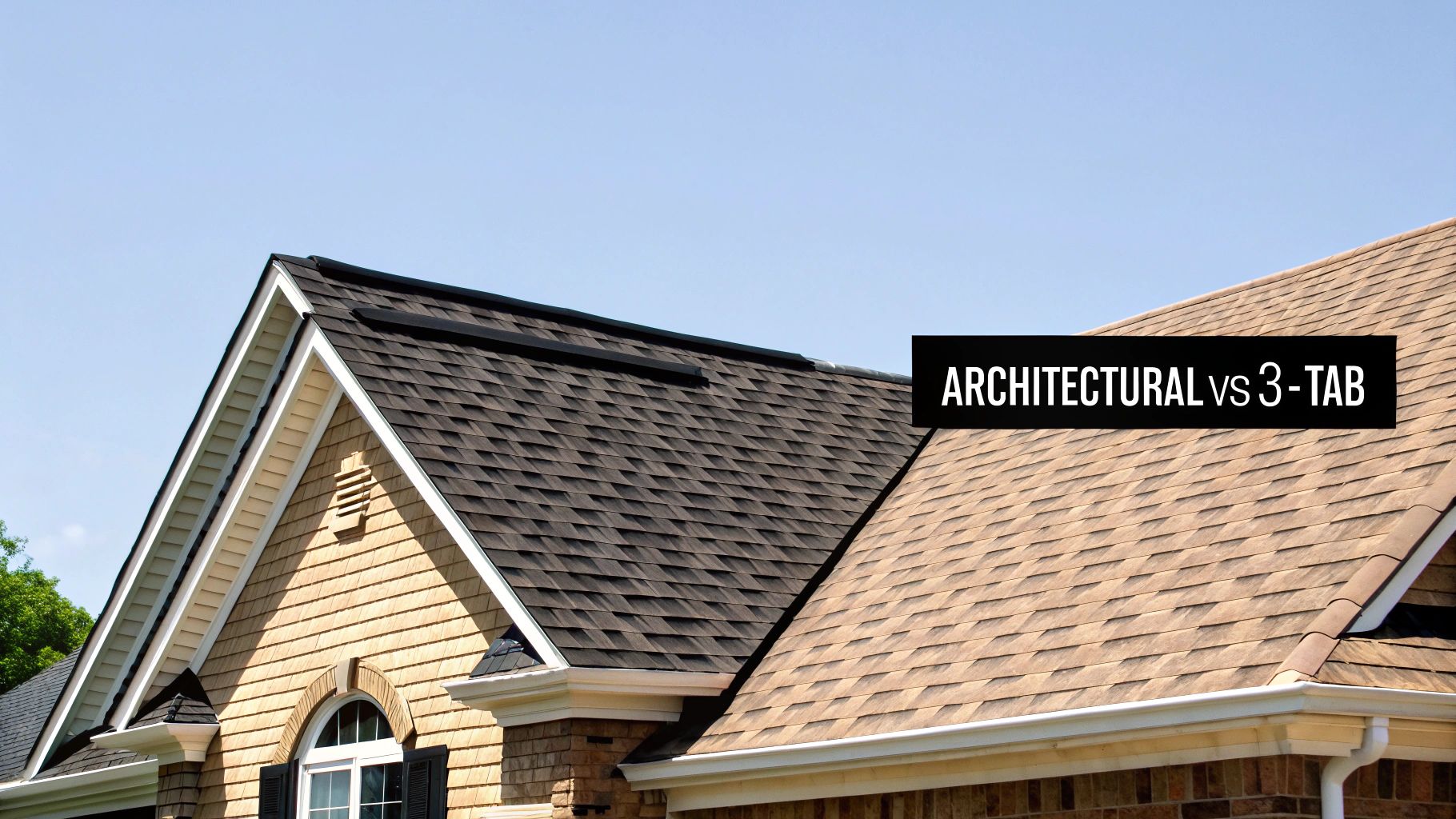
The shingles you put on your roof are more than just a finishing touch—they're your home's first line of defense. This choice directly impacts curb appeal, how well your home stands up to a storm, and what your maintenance budget looks like for years to come. While both architectural and 3-tab shingles are asphalt-based, that's where the similarities end. Their construction, performance, and overall value couldn't be more different.
Before we get into the nitty-gritty details, let's start with a high-level overview. This table cuts right to the chase, comparing the key factors that set these two roofing materials apart.
Architectural vs 3 Tab Shingles Key Differences
Here's a side-by-side comparison of the most important features to consider when choosing between architectural and 3-tab shingles for your home.
| Feature | 3-Tab Shingles | Architectural Shingles |
|---|---|---|
| Construction | Single, flat layer of asphalt | Multiple layers laminated together |
| Appearance | Flat, uniform, repetitive pattern | Dimensional, textured, varied look |
| Average Lifespan | 15-20 years | 30-50 years |
| Wind Resistance | Typically rated for up to 60 mph | Rated for 110-130 mph |
| Weight | Lighter, easier to install | Heavier, more durable |
| Upfront Cost | Lower | Higher (often 20-40% more) |
| Warranty | Shorter term (e.g., 20-year) | Longer term (e.g., Limited Lifetime) |
| Best For | Budget projects, rental properties | Homeowners seeking long-term value |
This table gives you the specs, but the real story is in what those numbers mean for your home. The thicker, laminated build of an architectural shingle is precisely why it can last twice as long and withstand much higher winds than a single-layer 3-tab. It’s a completely different class of material.
The biggest takeaway here is that architectural shingles aren't just a cosmetic choice. Their multi-layer design creates a fundamentally stronger, more resilient barrier against the elements. That structural integrity is the real reason they come with much longer lifespans and better warranties.
Getting a handle on these core differences is the first step. The right choice really hinges on your priorities—are you focused on the lowest initial cost, or are you playing the long game with a better investment for your home? Now, let's dig deeper into what makes each shingle tick.
Understanding 3-Tab Shingles: The Traditional Choice
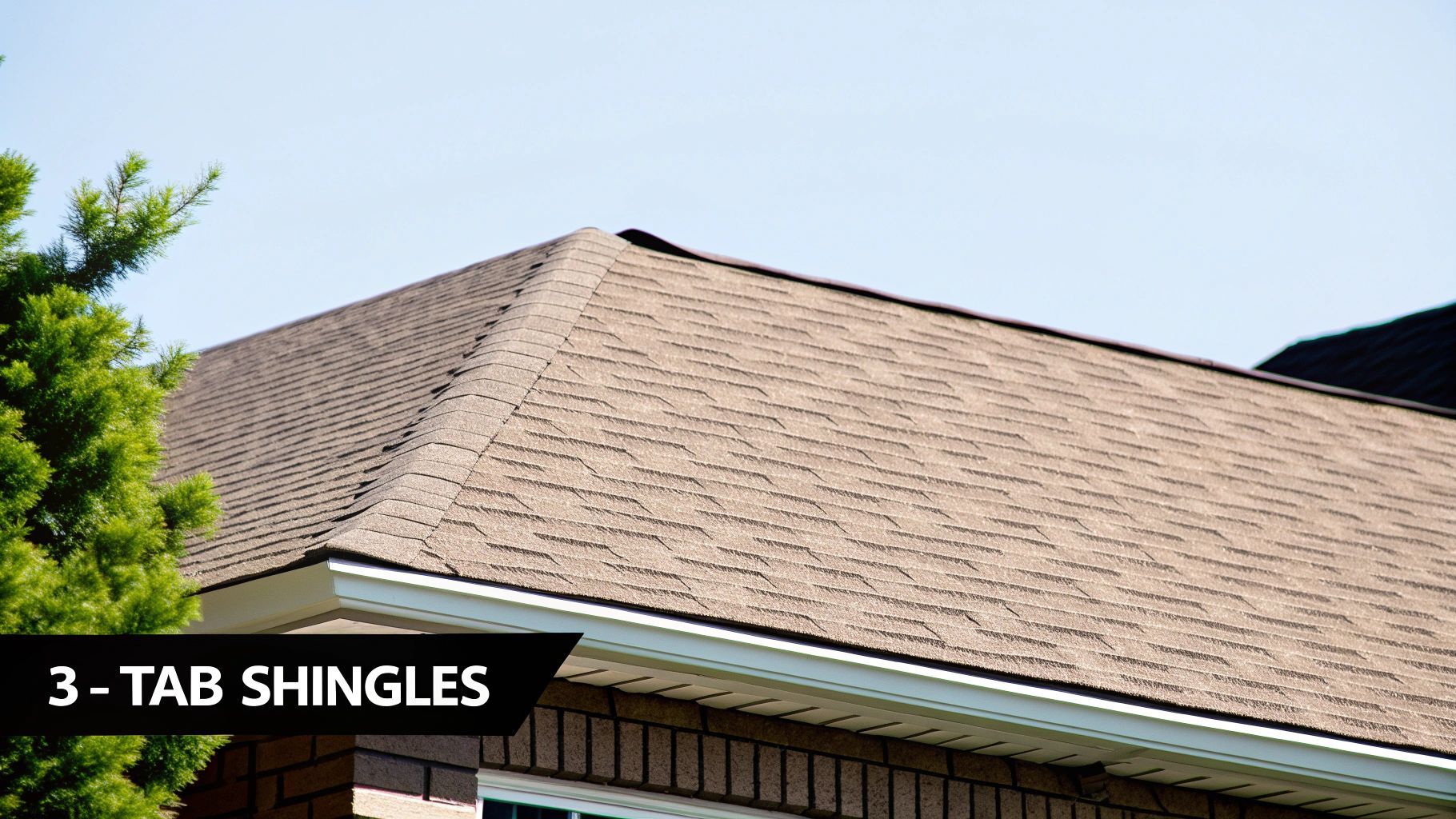
For decades, the 3-tab shingle was the undisputed champion of residential roofing, and for good reason. It’s the classic, no-frills option that has reliably covered countless homes across the country. Its straightforward design is the key to its long-standing popularity.
A 3-tab shingle is exactly what it sounds like: a single-layer shingle cut to look like three separate pieces, or "tabs." This simple construction—a fiberglass mat coated in asphalt—creates a flat, uniform pattern on the roof. It's a clean, repetitive look that many people still associate with a traditional home.
Why It Became the Go-To Option
The main reason 3-tab shingles became so common comes down to one thing: affordability. As the most budget-friendly asphalt shingle on the market, it put a new roof within financial reach for a massive number of homeowners. The lower price tag is a direct result of using less material and having a simpler manufacturing process.
On top of the material savings, its lightweight design makes for a quicker, easier installation. That often translates to lower labor costs, adding to its appeal for builders and homeowners trying to keep project budgets in check. This one-two punch of low material and labor costs is what cemented its place as the industry standard for so long. To see how things have evolved, you can explore the different types of asphalt shingle roofs we install today.
While modern materials now offer far greater performance, the 3-tab shingle’s legacy is built on providing a functional, cost-effective roofing solution. It successfully balanced basic protection with mass-market affordability for generations.
Practical Applications Today
Even with more advanced options available, 3-tab shingles still have a place. Their economic advantage makes them a logical choice for buildings where top-tier aesthetics and long-term durability aren't the primary concerns.
Here are a few common situations where 3-tab shingles still make sense:
- Rental Properties: For an investment property, minimizing capital expenses is often the name of the game. A 3-tab roof is a cost-effective way to get a new, functional roof on a rental without over-investing.
- Outbuildings: Structures like detached garages, sheds, or workshops don't need the same level of protection as your house, making 3-tab shingles a perfect, budget-friendly fit.
- Matching Existing Roofs: If you're building an addition or just need to repair one section of an older roof, you might need to use 3-tab shingles to maintain a consistent look with the rest of the home.
- Strict Budget Constraints: When a roof replacement is an unexpected emergency and the budget is extremely tight, 3-tab shingles can provide a necessary solution to protect your home without breaking the bank.
Ultimately, choosing 3-tab shingles means balancing immediate cost savings against your long-term goals. They may not have the staying power of their architectural counterparts, but they absolutely still serve an important purpose.
Architectural Shingles: The Modern Standard in Roofing
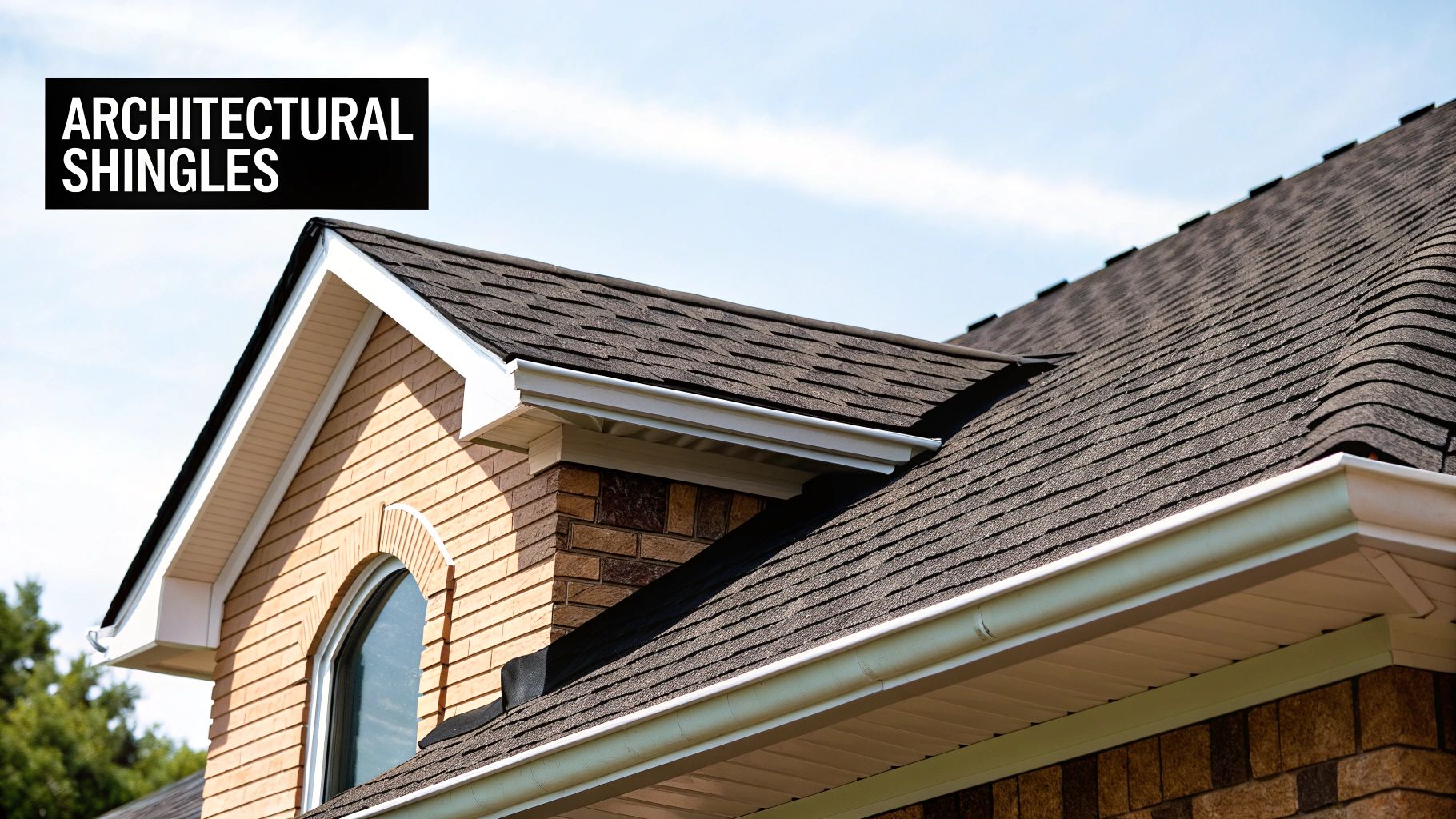
As roofing technology has evolved over the years, a new industry benchmark has taken hold, pushing the old 3-tab shingle to the side. Architectural shingles, also called dimensional or laminated shingles, are the high-performance successor and have become the modern standard for a reason. They deliver a powerful combination of strength, longevity, and visual appeal that older designs just can't match.
The real difference between an architectural shingle and a 3-tab comes down to how they're built. Instead of a single flat layer, an architectural shingle is made by laminating multiple layers of asphalt and fiberglass matting together. This layered fusion creates a product that's substantially thicker, heavier, and far more resilient.
That robust construction translates directly into better performance on your roof. Architectural shingles are often up to 50% heavier than their 3-tab counterparts, which helps them stay put in high winds and better resist impacts from hail and falling debris.
The Power of a Dimensional Design
One of the most noticeable benefits of architectural shingles is their striking visual depth. The manufacturing process layers tabs of different shapes and sizes, which breaks up the flat, uniform pattern you see on older 3-tab roofs. This creates a textured, dimensional look with rich shadow lines that adds real character and boosts curb appeal.
This varied appearance can convincingly mimic the look of more expensive roofing materials. You can get the high-end aesthetic of natural slate or classic wood shake without the huge price tag and demanding maintenance those materials require.
The "dimensional" look isn't just for show. The varied thickness and overlapping layers contribute directly to the shingle's durability, creating a stronger, more weather-resistant surface that stands up better to the elements.
Modern technology has been a huge factor in their rise to the top. Manufacturers now use incredibly strong adhesives to fuse the layers, making sure they stay bonded through hot summers and freezing winters. On top of that, the fiberglass mat at the core is often tougher, providing a stronger foundation for the asphalt.
Setting a New Industry Standard
With their superior design and higher-quality materials, architectural shingles are now the preferred choice for most homeowners. Their longer lifespan, enhanced weather resistance, and stronger warranty coverage provide a level of security and long-term value that 3-tab shingles have a hard time competing with. It’s an investment in your home’s protection and beauty.
Key advantages that really set the modern standard include:
- Advanced Laminated Construction: Fusing multiple layers creates a shingle that is thicker and much more durable.
- Superior Weather Resistance: The extra weight and strength provide higher wind ratings, often up to 110-130 mph.
- Enhanced Curb Appeal: A textured, dimensional look elevates a home's entire exterior aesthetic.
- Long-Term Value: A longer lifespan and fewer repair needs mean a lower total cost of ownership over the life of the roof.
Ultimately, architectural shingles became the go-to option not just because they look better, but because they perform better. Their design effectively solves the shortcomings of older single-layer shingles, offering homeowners a reliable and attractive roofing solution that's built to last.
A Closer Look at Durability, Lifespan, and Weather Resistance
When you’re choosing a new roof, you’re not just picking a color. You're making a long-term investment in your home's first line of defense against the weather. The real test for any shingle is how it holds up over the years, and this is where the gap between architectural and 3-tab shingles becomes impossible to ignore.
The reason for the performance difference is baked right into their construction. A 3-tab shingle is essentially one flat, single layer of asphalt on a fiberglass mat. It’s a simple design. Architectural shingles, on the other hand, are laminated, meaning multiple layers are fused together to create a thicker, heavier, and far more robust product.
This difference in build quality has a huge impact on how long your roof will last. Architectural shingles are engineered to be significantly more durable, often lasting nearly twice as long as their 3-tab counterparts. You can generally expect 15 to 20 years out of a 3-tab roof, maybe 25 if the conditions are perfect. In contrast, a well-installed architectural shingle roof can last 30 to 50 years.
This impressive longevity comes down to their multi-layered design, which provides superior strength and weather resistance. It’s also why they have much higher wind ratings—often up to 110 mph or even 120 mph. A standard 3-tab shingle just can't compete, usually topping out at a wind rating of around 60 mph. These insights on shingle durability offer more detail on why this matters.
Head-to-Head on Weather Resistance
In Hermitage and the surrounding counties, we see it all: heavy snow and ice in the winter, and severe summer thunderstorms that bring high winds and hail. This is where the heavier, layered design of an architectural shingle really proves its worth.
- Wind Resistance: This is probably the most critical difference. A 3-tab shingle’s 60 mph wind rating can easily be surpassed by a strong summer storm. Once the wind gets under those flat shingles, they can lift and tear away, leaving your home exposed.
- Architectural Shingle Strength: With wind ratings that start at 110 mph and go up to 130 mph for premium options, architectural shingles are built to stay put. Their weight and bonded layers mean you have far greater peace of mind when the weather turns nasty.
The powerful adhesives used to laminate architectural shingles also help prevent them from separating during the freeze-thaw cycles we see every winter—a common problem that can weaken 3-tab shingles over time.
When it comes down to it, an architectural shingle is engineered to protect your home during severe weather. A 3-tab shingle is simply more vulnerable to the kind of damage that leads to expensive, unexpected repairs.
Impact Resistance and Granule Loss
Durability isn't just about wind. It’s also about how a shingle handles physical impacts, whether from a hailstorm or a falling tree limb. The extra thickness of an architectural shingle gives it a much better cushion, making it less likely to crack or puncture.
This thickness also helps with granule adhesion. Those tiny, ceramic-coated granules on the surface are what protect the asphalt from damaging UV rays. Because 3-tab shingles are thinner, they tend to shed these protective granules more quickly, especially after a storm, which speeds up the aging process.
Of course, great shingles need to be installed correctly to perform their best. A quality underlayment is crucial for maximizing durability. If you're curious, you can learn more about what roof underlayment is and the vital role it plays in your roof's overall health.
From every angle—lifespan, wind resistance, and impact durability—the architectural shingle is the clear winner. It was designed to overcome the inherent weaknesses of the older 3-tab style, offering homeowners a much more reliable and long-lasting shield for their most important asset.
Comparing Costs and Calculating Long-Term Value
Let’s talk numbers. When you're looking at a new roof, it’s easy to get sticker shock and fixate on the initial price tag. But the real story isn't just about the upfront cost—it's about the total investment over the life of your roof. This is where the choice between architectural and 3-tab shingles gets interesting.
There's no getting around it: architectural shingles cost more out of the gate. That higher price isn't arbitrary, though. It reflects a completely different level of manufacturing. They’re built with more material, feature thicker base mats, and use powerful adhesives to bond the layers. You're paying for a tougher, more substantial product from the very beginning.
Breaking Down the Upfront Investment
The initial quote for your roof comes down to two big things: the shingles themselves and the labor to install them. While labor costs are often similar, the material cost is where you'll see the main difference.
On average, you can expect architectural shingles to cost somewhere between 20% and 40% more than their 3-tab counterparts. To put that in perspective, installed 3-tab shingles usually fall in the $2.50 to $3.50 per square foot range. Architectural shingles, on the other hand, typically run from $3.50 to $5.50 per square foot.
For homeowners on a really tight budget or landlords managing rental properties, that lower initial cost for 3-tab can be tempting. But it's critical to see that number for what it is: just the beginning of the story. Dig a little deeper into how shingle costs reflect performance, and you’ll see why that premium often makes sense.
That initial savings with 3-tab shingles often gets eaten up over time by more frequent repairs and a much shorter replacement schedule.
Calculating the Total Cost of Ownership
To really grasp the value, you have to think long-term. This is where architectural shingles pull away and show their true financial strength.
Let's play it out over 30 years:
- Scenario A (3-Tab Shingles): You go with a 3-tab roof, which might last 20 years if you're lucky. Around that 20-year mark, you’re not just repairing it—you’re paying for a full tear-off and replacement. That means buying new materials and paying for labor all over again. You're also far more likely to be shelling out for repairs after big wind or hail storms along the way.
- Scenario B (Architectural Shingles): You invest in an architectural roof, which is rated for 30 to 50 years. After 30 years, that roof is still doing its job, likely needing nothing more than routine check-ups. You've completely avoided the massive expense of a second roof replacement.
The long-term math is simple: paying for one high-quality roof is almost always cheaper than paying for two lower-quality roofs. That higher initial investment in architectural shingles effectively buys you an extra 10 to 30 years of protection and peace of mind.
The Impact on Your Home's Resale Value
Think about the first thing you see when you pull up to a house. The roof plays a massive role in curb appeal—it can make up as much as 40% of your home’s exterior. That first impression matters, especially to potential buyers.
- Architectural Shingles: Their dimensional, textured look immediately signals quality. A buyer sees a sturdy, modern architectural roof and thinks, "Great, that's one huge expense I won't have to worry about." It becomes a major selling point.
- 3-Tab Shingles: A flat, dated 3-tab roof can be a red flag. To a buyer, it can suggest that the previous owner cut corners, and it immediately puts a future roof replacement on their to-do list—and their budget.
Investing in an architectural roof isn't just about protection; it's about preserving and increasing your home's value. It makes your home stand out in a good way, which often leads to a better return when it's time to sell. For most homeowners, it’s simply the smarter financial move from every angle.
Making the Right Choice for Your Home
When you're standing at a crossroads between architectural and 3-tab shingles, the decision really boils down to one simple question: Are you solving for the lowest upfront cost, or are you investing in long-term value? We've looked at how they're made, how they hold up, and what they cost over their lifetime. A pretty clear picture starts to form.
It's all about balancing your immediate budget against what your roof will need to handle down the road. One option is a quick, affordable patch. The other is a fortress that delivers decades of protection and boosts your home's value. Getting this right means you'll be happy with your roof for years to come.
This decision tree can help you visualize the choice, depending on what matters most to you right now.
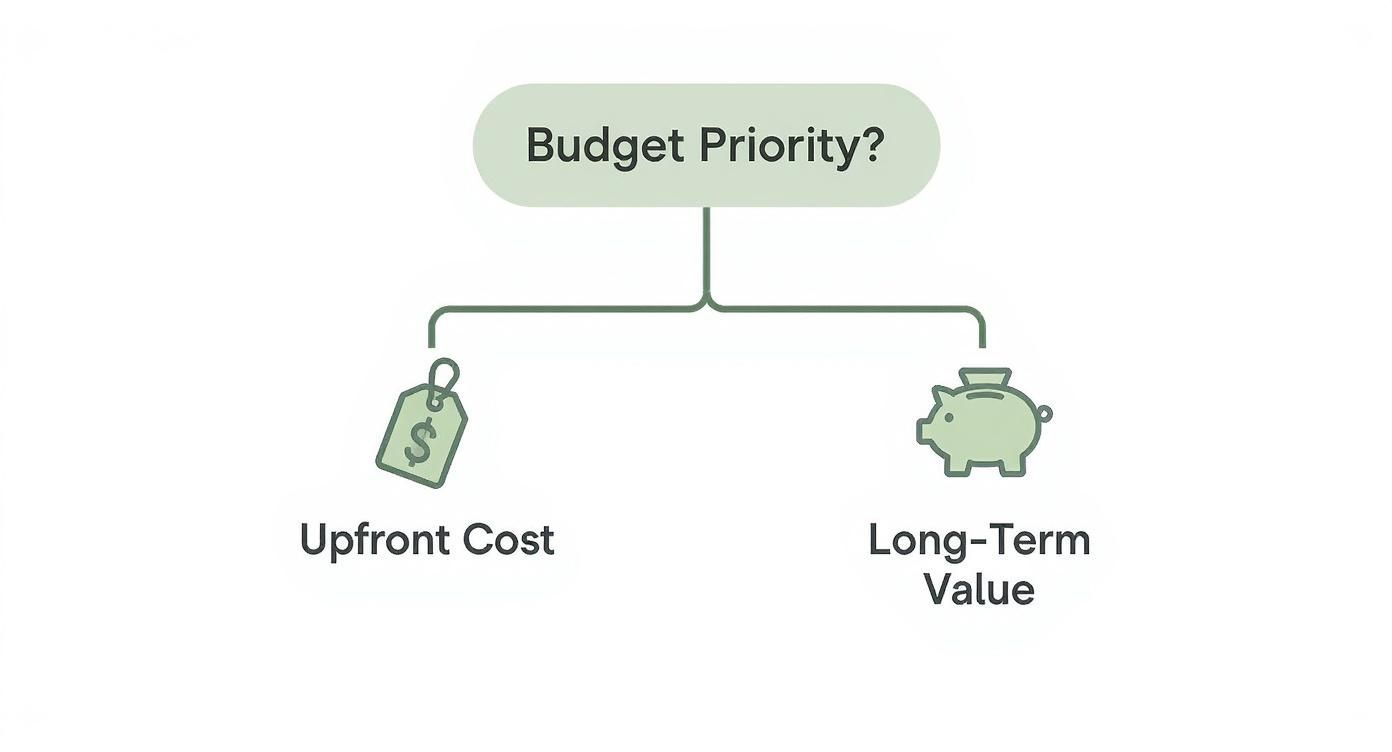
As you can see, the path forward really depends on whether the immediate price tag or the lifetime return on your investment is driving the project.
When 3-Tab Shingles Make Sense
Let's be clear: architectural shingles outperform 3-tab shingles on nearly every level. But that doesn't mean 3-tabs don't have their place. There are a few practical scenarios where their budget-friendly nature is exactly what's needed, especially when longevity isn't the top priority.
You might want to consider 3-tab shingles if:
- You're on a very tight, short-term budget. If a storm forces an unexpected roof replacement, 3-tabs get the job done safely and affordably.
- The property is a rental or you're planning to sell soon. For investment properties where minimizing upfront capital is key, 3-tabs are a sensible business decision.
- You're roofing a detached garage, a shed, or another outbuilding. These structures simply don't need the same high-performance protection as your house, making 3-tabs a smart, cost-effective choice.
Our Recommendation: The Superior Long-Term Investment
For the vast majority of homeowners we work with, we strongly recommend architectural shingles. Think of the higher initial cost not as an expense, but as a strategic investment that pays dividends over time. Their incredible durability, 30 to 50 year lifespan, and serious weather resistance give you a peace of mind that's priceless.
Investing in architectural shingles isn't just about getting a better product; it's about securing a lower total cost of ownership. You avoid the headache and expense of a premature reroof, deal with fewer repair calls, and add real curb appeal that can increase your home's resale value.
This choice is an upgrade to your home's resilience, especially against the kind of weather we get here in the region.
Of course, picking the right material is only half the battle. The quality of the installation is what unlocks the true performance and lifespan of any shingle. Knowing how to choose a roofing contractor is just as important as picking the right product. To make sure the job is done right from the start, many homeowners find it beneficial to work with a reliable general contractor who can oversee the project.
A Few Common Questions We Get About Shingles
Even with all the specs laid out, most homeowners have a few lingering practical questions. It's completely normal. Here are some of the most common things we're asked about choosing between architectural and 3-tab shingles, with straight answers to help clear things up.
Can I Just Put Architectural Shingles Over My Old 3-Tab Shingles?
While you technically can, it's a really bad idea. We almost never recommend a "roof-over." Putting heavy, dimensional architectural shingles on top of a flat, worn-out 3-tab layer creates an uneven surface that looks bumpy and, more importantly, can completely void your new shingle warranty.
The only right way to do it is with a complete tear-off. This lets us get down to the roof deck and inspect it for any rot or damage. You can't build a strong new roof on a weak foundation, and a tear-off ensures we're starting with a clean, solid slate.
A roof-over might save a little money upfront, but it's a huge gamble. You're just covering up potential problems that will cost you far more down the road. The only way to get the full performance and warranty you're paying for is to install your new shingles on a properly prepared roof deck.
Which Shingle Really Gives Me More Color and Style Choices?
Hands down, architectural shingles win this one. While both types have basic color options, architectural shingles are in a different league when it comes to style and rich color blends. Their multi-layer construction allows manufacturers to create incredible depth with shadow lines and sophisticated color gradients.
Think of it this way: 3-tab shingles are designed to be a functional, uniform covering. Architectural shingles are designed to mimic the look of premium materials like natural slate or cedar shakes, so the color and texture options are far more dynamic and interesting.
Will Architectural Shingles Actually Help My Home's Resale Value?
Absolutely, and it's a big factor for many people. Your roof is one of the first things a potential buyer sees, and it makes a huge statement about the home's condition. An architectural roof looks modern, durable, and well-maintained—a clear signal that the new owner won't be facing a major replacement expense.
On the flip side, a 3-tab roof can sometimes be seen as a sign of cutting corners or an upcoming project for the buyer. Investing in an architectural roof can bring a return of 60-70% at resale, but the immediate impact on curb appeal and buyer confidence is priceless.
Is There Any Special Maintenance for Architectural Shingles?
Nope. Architectural shingles don't need any special or tricky upkeep. The same basic roof maintenance that keeps any roof healthy applies here:
- Look it over: Give it a quick check from the ground after a big storm.
- Clean your gutters: This is crucial. Clogged gutters cause water to back up under the shingles.
- Clear off debris: Don't let leaves and branches sit and rot on your roof.
In fact, because architectural shingles are tougher and resist wind and granule loss so much better, you'll probably find they need fewer repairs over their lifetime. That durability and lower maintenance burden is a huge part of their overall value.
Choosing the right shingle is a critical decision for your home's protection and value. The experts at Penn Ohio Roofing & Siding Group are here to help you navigate the options and provide a flawless installation. For a free, no-obligation estimate, visit us at https://pennohiorc.com.