
The average cost of new siding in 2026 typically ranges from $8,000 to $30,000, and for a 2,000-square-foot home the average vinyl siding replacement cost is about $12,252. If you're standing in your driveway looking at faded panels, loose corners, or storm-worn walls, that range is the honest starting point, not the final answer.
Most homeowners start with one question. What will this cost me? In Mercer, Beaver, and Lawrence counties, that answer depends on more than the siding style you like. The final number changes with labor, tear-off, wall condition, insulation choices, and how your house is built. A simple ranch and a two-story colonial don't price out the same way, even if they use the same product.
National averages help set expectations, but they miss the local realities that matter in Penn Ohio. Our winters are harder on exteriors, and our pricing can move differently than what you'll see in broad online calculators. A useful quote has to account for the house in front of you, not a generic house somewhere else.
Table of Contents
- Your Siding Project What Will It Really Cost
- Siding Material Costs Vinyl vs Fiber Cement and More
- Beyond the Panels Factors That Influence Total Siding Cost
- Calculating Your Siding Cost Two Home Examples
- Siding ROI and Enhancing Your Home's Resale Value
- How to Get an Accurate Siding Quote in Penn Ohio
Your Siding Project What Will It Really Cost
A Mercer or Beaver County homeowner usually calls after the warning signs stop looking minor. One wall is faded harder than the rest. A few panels flap on windy days. Trim joints around the windows keep opening back up after another Penn Ohio winter. At that point, the question is not whether the house needs attention. The question is how wide the price range really is for this house.
For most full replacement jobs in our area, homeowners are usually looking at a five-figure project. The actual contract price can swing quite a bit based on what is already on the house, how much wall area is exposed, and what shows up once the old siding comes off. National averages can help set expectations, but they miss local labor rates, disposal costs, weather delays, and the extra prep older homes in Lawrence County often need.
A simple ranch with clean wall lines and no hidden moisture damage lands in a very different place than a two-story home with gables, layered trim, and brittle old sheathing. I tell homeowners to start with a range, then narrow it after someone measures the exterior and checks the problem areas up close.
Three cost drivers usually move the number the most:
- Material choice: Standard vinyl is usually the lower-cost path. Fiber cement, engineered wood, metal, and premium profiles raise both material and labor cost. If you're comparing styles beyond basic lap siding, cedar shake siding installation options can change the look of the home, but they also change the budget.
- Labor and access: One-story homes with open access are faster to side. Two-story elevations, steep grades, porches, bump-outs, and detailed trim all add labor hours.
- Tear-off and repair work: Removal, dumpster fees, housewrap, flashing updates, and any rotten wood behind the siding can add a meaningful amount before the new panels are fully installed.
That last item is where quotes can get misleading.
A low price sometimes covers the visible siding and little else. A solid quote breaks out removal, trim, moisture protection, and repair allowances so you can see what you are paying for. Good siding work is the full wall system, not just the finished surface you see from the street.
Siding Material Costs Vinyl vs Fiber Cement and More
On the same street in Mercer or Beaver County, two houses can price very differently just from the siding choice. One homeowner goes with a standard vinyl profile and keeps the project in a manageable range. Another chooses fiber cement or real wood and adds a heavier product, slower install pace, and more trim detail. That difference shows up fast in Penn Ohio, where winter scheduling, crew time, and material handling all affect the final number.
What the installed price really means
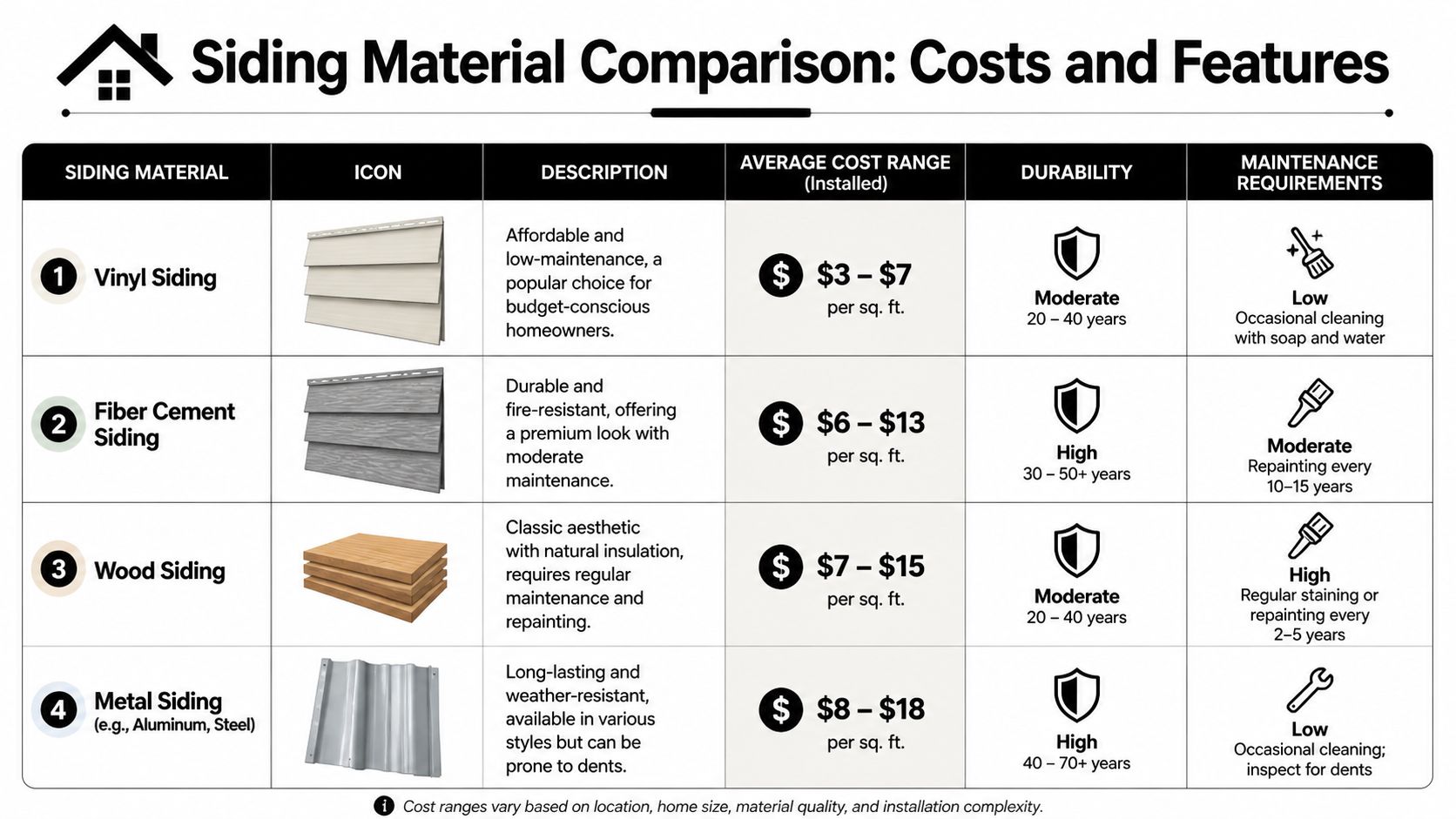
Installed price is the number that matters because it includes both product and labor. Homeowners sometimes compare panel prices alone, but that does not reflect what the signed contract will look like.
As noted earlier in the article, vinyl usually sits at the lower end of the installed cost range, while fiber cement, wood, and steel often come in higher. In the Penn Ohio area, that spread can widen when crews are working around cold-weather delays, tall wall sections, or detailed trim packages on older homes.
Material weight matters more than people think. Vinyl is lighter, faster to carry, and faster to hang. Fiber cement is heavier, cuts slower, and usually needs more labor to install cleanly. Wood brings its own labor and upkeep demands, especially on homes that already have moisture-prone walls or lots of shaded exposure.
How the main siding options compare
| Material | Avg. Cost/Sq. Ft. (Installed) | Lifespan | Pros | Cons |
|---|---|---|---|---|
| Vinyl | Lower to mid-range in most projects | Long-lasting with proper installation | Lower upfront cost, low maintenance, many colors and profiles | Can look less substantial than premium products, quality varies |
| Fiber cement | Mid to upper range | Long-lasting and durable | Strong curb appeal, solid feel, good weather resistance | Heavier, more labor-intensive, usually costs more |
| Wood | Upper range | Depends heavily on upkeep | Classic appearance, natural character | Higher price, more maintenance, moisture demands attention |
| Steel | Mid-range to upper mid-range | Durable in the right application | Strong weather resistance, clean look | Can dent, style is not right for every house |
| Composite | Varies by product and scope | Varies by product | Can offer a wood-look alternative with lower upkeep | Pricing and performance vary a lot by manufacturer |
The best material depends on what the house needs and what the homeowner wants to spend over time.
Vinyl stays popular in Lawrence, Mercer, and Beaver counties for a reason. It gives good flexibility on style and color without pushing the project into premium pricing. On many homes, it is the cleanest path to a fresh exterior without turning a siding job into a full exterior overhaul.
Fiber cement usually appeals to homeowners who want a more solid, upscale look. It can look excellent, especially on colonials and farmhouses, but the budget needs room for the product itself and the extra labor. In our area, I also tell people to think about who will service it later. Not every crew handles fiber cement repairs and replacement details as comfortably as vinyl.
Wood has real character. It also asks for regular attention. In Penn Ohio's freeze-thaw cycles and damp spring weather, wood siding can become a maintenance commitment, not just a design choice.
Steel works well on some homes and buildings, especially where durability is a priority, but it is a narrower style fit in most neighborhoods.
For homeowners chasing a more textured look, profiles matter almost as much as material. A shake-style exterior can change the whole front elevation, and cedar shake siding installation options usually cost differently than standard horizontal lap because of layout, cuts, and trim work.
Good siding performance comes from the full assembly. The panel matters, but so do the trim details, flashing, and the quality of the install.
What works best for different priorities
If budget is the main concern, vinyl is usually the first place to look. It keeps material and labor more predictable on a lot of homes.
If appearance is driving the decision, fiber cement and wood tend to offer more depth and presence from the curb. That higher-end look often comes with a higher install number.
If low upkeep matters most, vinyl and steel are generally easier to own than wood.
The practical advice is simple. Pick the material that fits both your house and your tolerance for future maintenance. The cheapest panel is not always the best value, and the premium option is not always worth the added cost on every home.
Beyond the Panels Factors That Influence Total Siding Cost
A Penn Ohio siding quote can change fast after the crew starts opening walls. Homeowners in Mercer, Beaver, and Lawrence counties see that all the time, especially on older homes where the outside looks decent but the layers underneath tell a different story.
Labor removal and what sits behind the siding
Removal is one of the biggest reasons an online estimate misses the actual number. Tearing off old siding takes labor, trailer space, dump fees, and time to protect landscaping, windows, and entries. If the old material is brittle, layered over older siding, or wrapped around a lot of trim, the job slows down.
What the crew finds after tear-off matters just as much. Damaged sheathing, wet wall sections, missing housewrap, bad flashing around windows, and uneven framing all add work before the new siding can go on. I tell homeowners to expect the wall inspection to influence the final price more than any brochure does.
If you want to see what happens during that stage, this guide on how to take siding off a house gives a good look at why careful removal and inspection matter.
Cheap siding numbers often leave out the wall prep. That missing detail usually shows up later as a change order.
A solid estimate should spell out the parts around the panels, including:
- Housewrap or drainage layer: Sometimes the existing layer can stay. On many older Penn Ohio homes, it needs repair or full replacement.
- Trim and accessory pieces: Corner posts, starter strips, J-channel, light blocks, soffit tie-ins, and window details add both material and labor.
- Insulation upgrades: Foam-backed systems or added exterior insulation can improve comfort, but they raise both material cost and installation time.
House shape and weather details change the quote
Square footage alone does not set the labor cost. House shape does. A plain ranch with long, open wall runs installs faster than a two-story home with dormers, bump-outs, porch roofs, and a lot of window cuts. Gables, steep roof lines, and tight access points all slow production and increase staging needs.
Height changes the quote too. Second-story work often requires more ladder moves, pump jacks, or scaffolding. That is a real cost in this area, not padding. Local labor rates in Penn Ohio are usually lower than big metro markets, but winter conditions and shorter install windows can offset some of that savings.
Weather drives details here. Freeze-thaw cycles, wind-driven rain, and long heating seasons mean flashing, caulking joints, and water management need to be done right the first time. National cost guides usually flatten those differences. Homes in our part of western Pennsylvania and eastern Ohio often need more wall prep and more attention at penetrations than similar houses in milder climates.
That is why two homes using the same siding can land at very different final prices. The panel is only one part of the job.
Calculating Your Siding Cost Two Home Examples
Most homeowners don't think in cost per square foot. They think in house types. That's a better way to look at it because a ranch and a colonial create different labor conditions even before the material changes.
Example one single story ranch
Take a 1,500-square-foot single-story ranch. A house like this is often easier to access, faster to stage, and simpler to side because crews aren't fighting as many upper-level transitions.
If that home uses vinyl siding, a practical estimate starts by applying the verified installed range of $8.50 to $16.20 per square foot from the earlier cost data. Then add removal using the verified $0.70 to $2.00 per square foot range.
A simple way to think about it is:
- Siding install: exterior siding area multiplied by the installed material range
- Removal and disposal: exterior siding area multiplied by the tear-off range
- Trim and detail allowance: a separate line item that depends on window and corner count, plus any repairs found after removal
That same ranch in fiber cement starts from a higher installed material range than vinyl, so the gap shows up immediately even before trim and prep are added. The heavier product also tends to make labor less forgiving on houses with lots of cuts.
Example two two story colonial
Now take a 2,500-square-foot two-story colonial. Homeowners often underestimate the cost for such a property. More wall height, more ladder work, and more setup around upper-story windows and gables usually produce a fuller labor number.
For vinyl siding, the same installed range still applies, but the labor side of the quote often feels different because access is harder than it is on a ranch. If the homeowner adds insulated vinyl panels, local market context from the verified data notes that quotes can rise in harsh-winter areas, especially when insulation and weather performance are part of the scope.
For fiber cement on a house this size, homeowners should expect the budget conversation to move decisively upward because the material itself starts higher and the installation process is less forgiving. On taller walls, every detail takes longer. That affects scheduling, handling, cutting, and finish work around openings.
On larger two-story homes, the siding product doesn't tell the whole story. Access and detail work often decide whether the quote feels fair or surprisingly high.
Here's the practical takeaway from both examples:
- Ranches usually price more efficiently because access is simpler.
- Two-story homes carry more labor pressure even with the same siding product.
- Removal, trim, and wall condition can shift the project more than homeowners expect.
- Square footage alone doesn't equal siding area, so a contractor should measure the exterior rather than rely on interior floor plan size.
If you want a budget before calling for quotes, use the installed ranges as a starting point, then assume your actual contract will rise or fall based on how complex the exterior really is.
Siding ROI and Enhancing Your Home's Resale Value
A lot of Penn Ohio homeowners reach this point after the same conversation. The siding still hangs on the house, but it looks rough from the road, the corners are tired, and they want to know whether replacement is just another expense or something they will get back later.
The honest answer is that siding usually does both jobs. It solves a condition problem now, and it can make the house easier to sell later. In Mercer, Beaver, and Lawrence counties, that resale effect often comes down to appearance, weather protection, and whether buyers believe the exterior has been handled correctly for our freeze-thaw winters.
Why siding is more than a maintenance project
The installed cost ranges covered earlier matter here, but ROI is not just a straight percentage on a spreadsheet. Material choice changes upkeep, curb appeal, and how long the exterior is likely to stay looking good. Vinyl often wins on budget. Fiber cement can make sense for homeowners who want a different look and are prepared for the higher install cost. Wood can look great, but buyers also know it asks for more attention over time.
First impressions carry real weight.
Fresh siding sharpens the lines of the house, cleans up patched areas, and makes trim, windows, and rooflines look more intentional. Buyers notice that before they ask about furnaces or water heaters. So do agents walking up the driveway for the first showing.
In this region, climate matters more than national resale articles usually admit. A siding job that includes proper flashing, weather barrier details, and trim integration helps reassure the next owner that the house is ready for western Pennsylvania and eastern Ohio winters. That does not always show up as a line item in resale math, but it absolutely affects buyer confidence.
Some homeowners compare siding with other exterior upgrades before setting the budget. If you are weighing several projects at once, it helps to calculate your renovation ROI and see where siding fits in the larger plan.
How to think about value before you sign
The best value usually comes from matching the product to the house and your timeline. If you plan to stay five years or less, a clean, well-installed vinyl job may be the practical choice. If this is your long-term house and the neighborhood supports a higher-end exterior, paying more up front can be reasonable.
Installation quality matters as much as product selection. I have seen low bids look fine on day one and become expensive after a couple of winters because water got behind loose trim or poorly detailed window lines. Those repairs can wipe out any savings from the cheap contract.
That is why resale value is tied to workmanship, not just the siding brand on the paperwork. Homeowners looking at local crews should review examples of finished exterior work from a siding contractor in Mercer, PA or nearby counties, especially details around windows, corners, and soffits.
For resale, the practical goal is simple. Choose a siding system that fits the house, fits the local weather, and gives the next buyer fewer reasons to worry.
How to Get an Accurate Siding Quote in Penn Ohio
National calculators are useful for orientation. They aren't enough for a contract decision in western Pennsylvania and nearby Ohio counties.
Verified market context shows that regional cost variations in Mercer, Beaver, and Lawrence counties can adjust siding costs by 20 to 30 percent compared to national averages because of local labor rates and climate-specific building needs, according to Berkeley Exteriors' discussion of siding pricing gaps in the Penn Ohio area. That's a major reason two homeowners can look at the same online article and get very different real-world bids.
What a solid estimate should include
A trustworthy siding quote should be itemized enough that you can see where the money goes. If it isn't clear, ask for the breakdown in writing.
Look for these pieces:
- Materials clearly named: The estimate should identify the siding product, profile, and whether the quote includes matching accessories and trim.
- Labor spelled out: You want to know whether setup, installation, and finish work are all included.
- Removal listed separately: Tear-off shouldn't be hidden inside vague language if old siding is coming off.
- Wall prep noted: Housewrap, flashing integration, and any expected substrate work should be addressed.
- Exclusions stated: If repairs are only billed as needed after removal, that should be written plainly.
Why local quoting beats national calculators
A local quote has one advantage the internet never will. Someone measures the house and sees the details. They can account for winter exposure, upper-story access, problem areas around windows, and the trim conditions that photos often miss.
That's especially important in this region. The same house style can price differently depending on township conditions, crew access, and how much prep the exterior needs before new siding can go on. A generic calculator won't tell you that.
If you're comparing contractors in this area, it's smart to start with someone who already works in these counties and understands local housing stock. Homeowners in Mercer County can review what to expect from a siding contractor in Mercer PA before requesting an estimate, so they know what questions to ask and what scope should appear on the proposal.
The best quote isn't the shortest one or the cheapest one. It's the one that tells the truth about the house.
If you'd like a clear, itemized estimate from a local team that knows Mercer, Beaver, and Lawrence County homes, Penn Ohio Roofing & Siding Group can help. As a family-owned company serving the Penn Ohio area, they provide straightforward siding evaluations without the pressure, so you can understand your options, compare materials, and budget for the work with confidence.