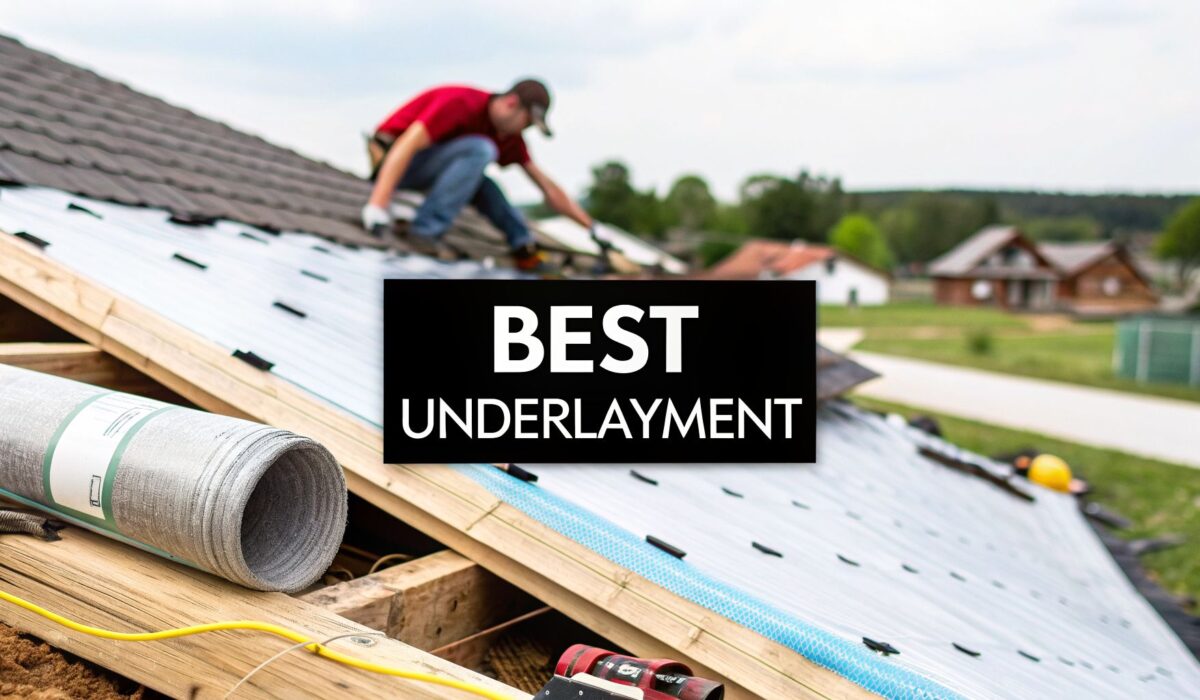
So, what’s the best underlayment for a metal roof? If you want the short answer, it's a high-temperature synthetic underlayment. It’s built to handle the intense heat that builds up under metal panels, offering the durability and water resistance needed to last as long as the roof itself. Getting this choice right is absolutely essential for protecting your investment.
Choosing The Best Underlayment For Your Metal Roof
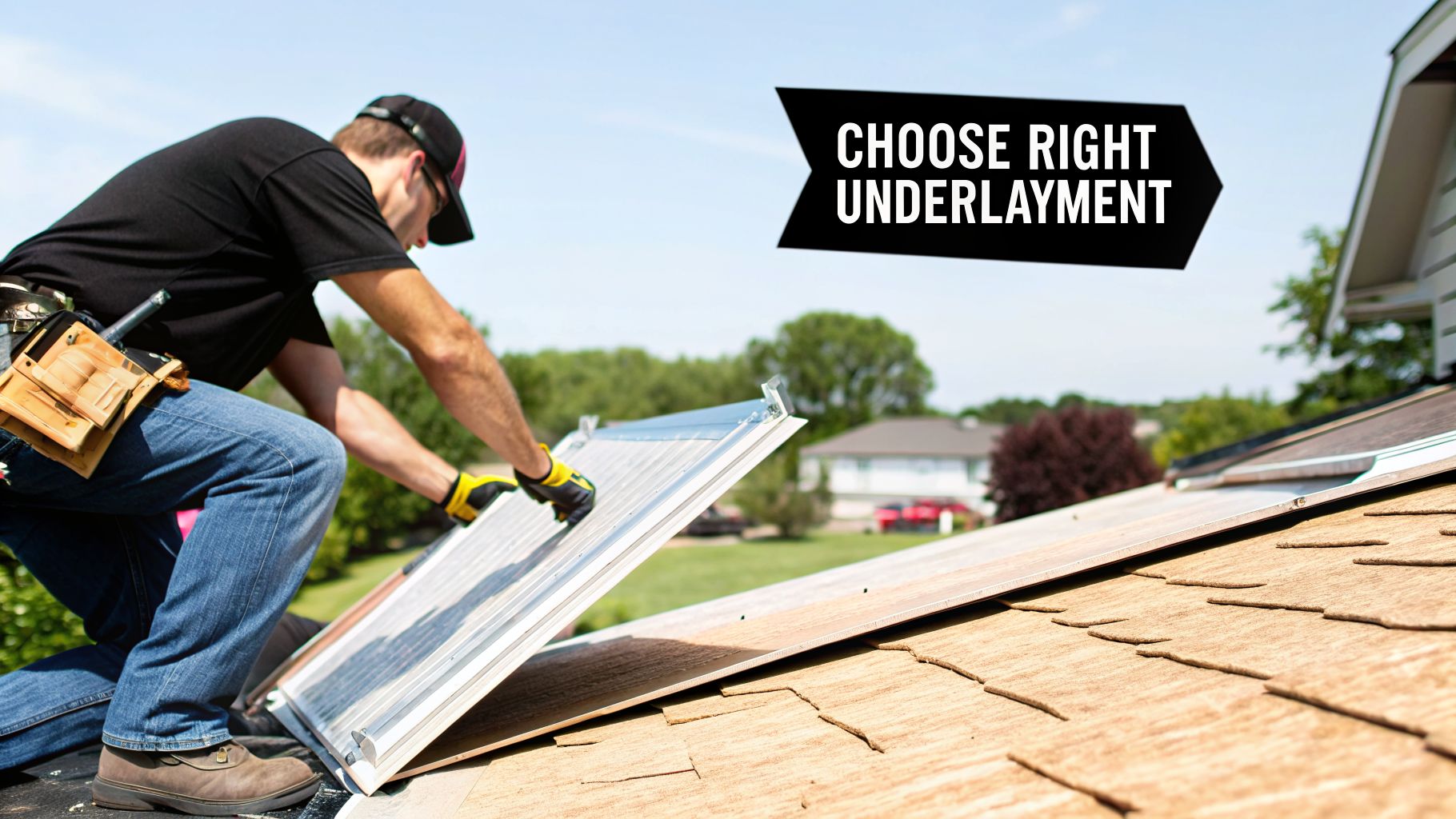
A metal roof is a lifetime purchase, but its performance hinges on a component you’ll never see: the underlayment. This layer is your roof's last line of defense. It’s what stands between your wooden roof deck and any moisture that gets past the metal, whether from wind-driven rain or the condensation that naturally forms on the underside of the panels.
While there are a few types of underlayment on the market, not all are created equal—especially when paired with metal. Picking the right one is one of the most critical decisions you'll make for the entire roofing system. You can get a deeper dive into its role in our guide explaining what roof underlayment is.
Why Your Choice Matters More Than You Think
The global market for roofing underlayment was valued at around USD 29.75 billion in 2024, and it's no surprise that synthetics are leading the pack for modern roofs. Industry studies confirm that a quality synthetic underlayment can provide up to 50% better moisture resistance than old-school asphalt felt. That’s a massive advantage under a metal system.
Making the wrong choice here isn't a small mistake; it can cause some serious headaches down the road.
- Premature Failure: Traditional felt paper simply can't take the heat. It dries out, becomes brittle, and can literally disintegrate under a metal roof, failing decades before the panels do.
- Trapped Moisture: If the underlayment fails or isn't breathable, it will trap condensation. This leads to mold, rot in your roof deck, and can even cause the metal panels to corrode from the underside.
- Voided Warranties: Many metal roofing manufacturers will void their warranties if the system is installed with an incompatible or substandard underlayment.
To give you a quick comparison of the main options, here’s a simple breakdown of how they stack up.
| Underlayment Type | Primary Benefit | Best Use Case for Metal Roofs |
|---|---|---|
| Synthetic | High-temp tolerance & durability | The standard for most modern installations. |
| Self-Adhered | Maximum water & ice protection | Eaves, valleys, and low-slope areas. |
| Asphalt Felt | Low initial cost | Not recommended for metal roofing. |
The Old Way vs. The Right Way: A Brief History of Underlayment
For years, the go-to underlayment for almost any roof was standard black asphalt-saturated felt, what most of us know as “tar paper.” It was cheap, easy to find, and did an adequate job under asphalt shingles, which didn't last much longer than the felt itself. It was the only real option on the table.
But then metal roofing came along and changed the game. Suddenly, we had roofing systems designed to last 50 years or more, and that old tar paper just couldn't keep up. A major flaw in the old way of thinking became glaringly obvious: the underlayment was failing decades before the metal panels it was meant to protect.
Why Tar Paper and Metal Don't Mix
Putting traditional felt under a metal roof is a recipe for failure. The space between the metal panels and the roof deck can get incredibly hot, essentially baking the asphalt in the felt day after day. This constant thermal stress causes it to dry out, become brittle, and eventually disintegrate.
For homeowners, this breakdown led to a cascade of problems:
- Easy Tears and Damage: Brittle felt rips incredibly easily. We've seen it tear just from installers walking on it, compromising the water barrier before the metal panels are even fastened down.
- Wrinkling and Trapped Moisture: Unlike modern materials, asphalt felt can absorb moisture from the air. This causes it to wrinkle and warp, creating an uneven surface that can trap water against the sheathing and kickstart rot and mold.
- Complete Disintegration: Over time, the felt paper would simply crumble away. This left the roof deck completely vulnerable to condensation, which is common under metal, and any wind-driven rain that might sneak past the panels.
The Shift to High-Performance Synthetics
The bottom line was clear: a 50-year roof needs a 50-year underlayment. This realization, coupled with tougher building codes and some hard lessons from major storms, pushed the industry to develop the modern synthetic underlayments we use today. These aren't paper-based at all; they're tough, engineered fabrics made from polymers like polypropylene.
The real wake-up call came after Hurricane Katrina hit in 2005. When experts analyzed the storm's aftermath, they found that older felt underlayments had failed at rates three times higher than their synthetic counterparts. This powerfully highlighted the need for more resilient materials that could handle extreme stress.
This move from organic felt to engineered synthetics wasn't just an upgrade—it was a complete shift in how professional roofers approach their craft. The numbers tell the story. Back in 2000, synthetics were used in just 15% of projects. By 2025, that number is expected to hit over 70% in major U.S. markets. You can dig deeper into these market trends to understand the industry's direction and see why advanced materials have taken over.
Modern synthetics were born directly from the failures of felt paper. They were specifically designed to deliver the high-temperature tolerance, superior tear strength, and unwavering water resistance that a metal roof demands. That’s why choosing the best underlayment for metal roofing today is all about matching the performance and lifespan of the metal itself.
Comparing The Top Metal Roof Underlayment Options
When you're installing a metal roof designed to last for half a century, the material you put underneath it matters just as much as the metal itself. Choosing the right underlayment isn't just a box to check—it’s about creating a secondary line of defense that can stand up to the unique demands of a metal system. The main players are modern synthetics, old-school asphalt-saturated felt, and high-performance self-adhered membranes.
Each one has its place, but they are far from interchangeable. The real trick is knowing which one fits your specific roof, climate, and budget. Let’s break down what works, what doesn't, and why it's so critical to get this choice right from the start.
Synthetic Underlayments: The Modern Standard
These days, a quality synthetic underlayment is the go-to for almost any metal roofing project. Unlike old-fashioned felt paper, synthetics are engineered products, typically woven from tough polymers like polypropylene. This construction is what gives them their biggest advantage.
Their exceptional tear strength is a game-changer on the job site. Asphalt felt can rip with one misplaced step or a strong gust of wind, but synthetics hold up to foot traffic and fasteners beautifully. This toughness means your roof deck is actually protected during the most vulnerable phase of installation.
Plus, synthetics don’t absorb water, so they won't wrinkle or buckle when exposed to moisture. They just lay flat and do their job, which is a huge factor in preventing water from getting trapped down the road.
Asphalt-Saturated Felt: The Outdated Option
For generations, asphalt-saturated felt (or "tar paper") was the only option available. It's just a mat of organic material soaked in asphalt, and while it's certainly cheap, its performance under a metal roof is a serious problem.
The killer is its low high-temperature tolerance. On a hot, sunny day, the air gap under your metal panels can easily soar past 200°F. This intense, sustained heat essentially cooks the asphalt in the felt paper, making it brittle and causing it to crack and fall apart.
A metal roof is expected to last 50 years or more. Asphalt felt under the same conditions may fail in as little as 10 to 15 years, creating a critical weak point in the system. This lifespan mismatch is the single biggest reason professionals advise against its use with metal.
Once that happens, the underlayment is useless. Your roof sheathing is left completely vulnerable to condensation or any wind-driven rain that might find its way under the panels, long before the metal itself shows any age.
Self-Adhered Membranes: The Premium Protector
For the absolute best protection, nothing beats a self-adhered membrane, often called an "ice and water shield." These are peel-and-stick sheets with a rubberized asphalt adhesive that bonds directly to the roof deck, creating a seamless, waterproof barrier.
Their most impressive feature is the ability to seal around fastener penetrations. When a screw or nail goes through the membrane, the sticky, rubberized material actually closes in around the fastener shaft, forming a watertight gasket. This is something no other underlayment can do.
Because they're a premium product, you typically don’t cover an entire roof with them. Instead, we use them strategically in the most critical areas:
- Eaves, to prevent water damage from ice dams.
- Valleys, which handle huge volumes of water runoff.
- Roof Penetrations like chimneys, vents, and skylights.
- Low-Slope Sections (any pitch below a 3/12) where water is slow to drain.
A deeper dive into the properties of various metal cladding types can also be helpful, as the principles of creating a high-performance, integrated building envelope apply to both roofing and siding.
Head-to-Head Performance Breakdown
To make the decision clearer, here's a direct comparison of how these materials stack up against each other.
The market data backs up what we see in the field every day. Experts project that non-bitumen synthetics will drive 60% of the market's growth, pushing it toward USD 48.17 billion globally by 2032. With the North American residential re-roofing market making up 28% of that volume, it's clear where the industry is heading. Homeowners and contractors are moving away from materials that can't keep up.
The table below shows exactly why this shift is happening.
Underlayment Performance Comparison For Metal Roofs
This table gives you a side-by-side look at the key performance differences between the three main underlayment options for your metal roof.
| Feature | Synthetic Underlayment | Asphalt-Saturated Felt | Self-Adhered Membrane |
|---|---|---|---|
| Durability & Tear Strength | Excellent (Resists tears from fasteners and foot traffic) | Poor (Brittle, tears easily, degrades under UV) | Very Good (Tough but can be punctured) |
| High-Temperature Tolerance | Excellent (Rated for 240°F or higher) | Poor (Degrades and becomes brittle in high heat) | Good to Excellent (Varies by product) |
| Water Resistance | Excellent (Hydrophobic material repels water) | Fair (Becomes less effective as it degrades) | Superior (Creates a fully waterproof seal) |
| Installation Safety | Good (Lightweight, non-slip surface) | Poor (Heavy, slippery when wet) | Good (Peel-and-stick, but can be difficult to reposition) |
| Lifespan with Metal | 50+ Years (Matches the roof's lifespan) | 10-15 Years (Fails decades before the metal) | 50+ Years (Designed for long-term use) |
| Cost Per Square Foot | $0.25 – $0.75 | $0.10 – $0.20 | $0.80 – $2.00+ |
As you can see, asphalt felt just doesn't make sense for a long-term investment like a metal roof due to its risk of premature failure. While a self-adhered membrane offers top-tier waterproofing, its cost makes it ideal for targeted, high-risk areas. For the main expanse of the roof, a high-quality synthetic underlayment delivers the perfect balance of durability, heat resistance, and cost-effectiveness, making it the clear winner for most metal roofing systems today.
Matching Underlayment to Climate and Roof Design
Picking the right underlayment for a metal roof isn’t as simple as grabbing a roll off the shelf. The best choice for your home comes down to two things: your local weather and the specific design of your roof. A material that works wonders in a dry, sunny climate could be a total failure here in Ohio or Pennsylvania, where we see humid summers and brutal winters.
Think of it this way: your underlayment is the dedicated shield beneath the armor of your metal panels. It needs to be perfectly suited to defend against the specific threats your home will face, year after year.
Adapting Underlayment Choices to Regional Climates
Your local climate is the biggest piece of the puzzle. While a high-quality synthetic underlayment is a fantastic starting point for almost any project, certain weather patterns demand more specialized protection in key areas.
For instance, in humid regions with big temperature swings—exactly what we experience from spring through fall—condensation is a major enemy. When the metal panels cool down at night, moisture from the warmer air in your attic can condense on the underside of the metal. If that moisture gets trapped, you’re looking at a recipe for rot, mold, and even corrosion.
This is where a breathable synthetic underlayment becomes critical. It’s designed to let water vapor pass right through it, allowing the entire roof system to breathe. This simple feature prevents condensation from building up and causing hidden damage to your roof deck and panels.
Now, shift gears to winter. Areas that get heavy snow and ice face a different primary threat: ice dams. These thick ridges of ice form at the roof's edge, blocking melting snow from draining. The water has nowhere to go but backward, up under the metal panels, where it can refreeze, thaw, and eventually leak into your home.
This decision flowchart breaks down how your climate should guide your choices.
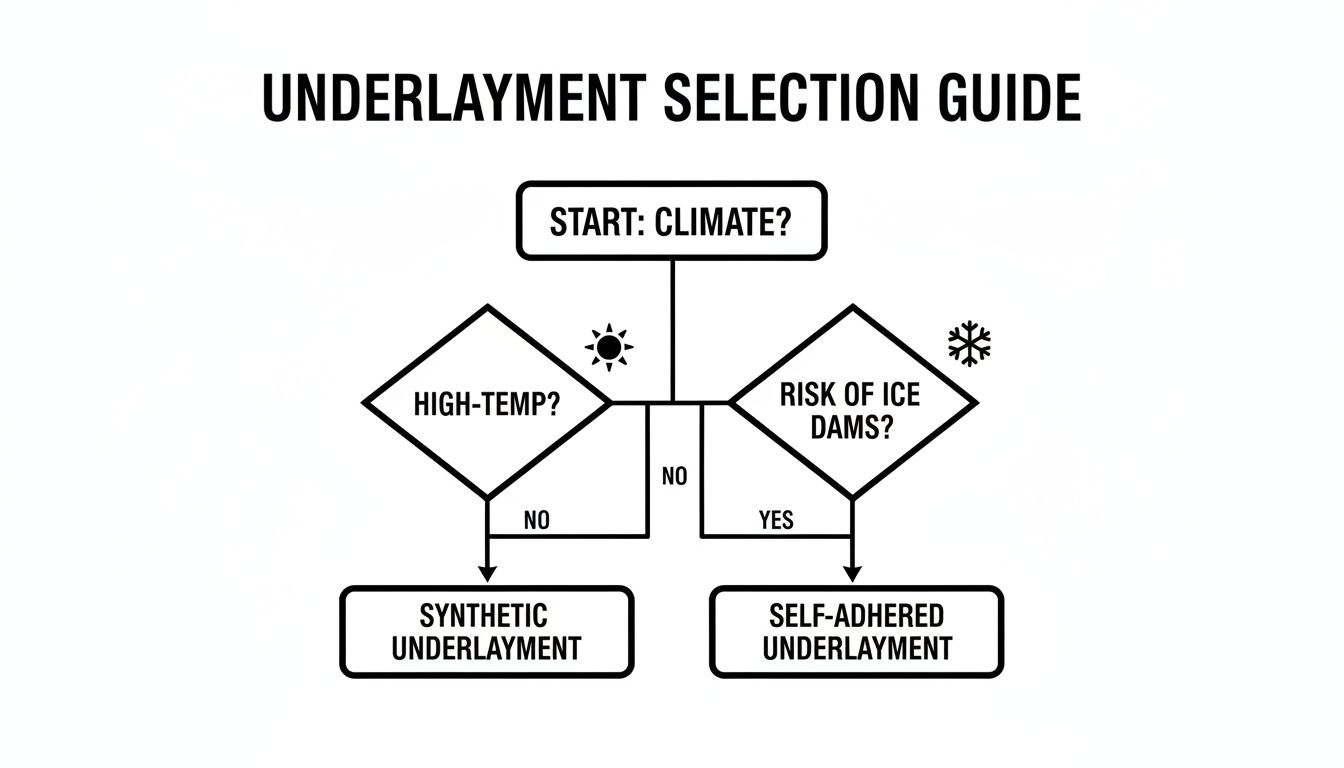
The takeaway is clear: while synthetics are great for handling heat, the minute you introduce the risk of ice, a self-adhered membrane becomes non-negotiable for the most vulnerable parts of your roof.
The Non-Negotiable Role of Ice and Water Shields
In climates with freezing winters, a self-adhered membrane—often called an "ice and water shield"—isn't just a good idea. It's an absolute necessity. This peel-and-stick material bonds directly to the roof deck, creating a seamless, waterproof barrier that water simply can't get through.
We always install it in the high-risk zones, no exceptions. This includes:
- Eaves and Gables: The first three to six feet of the roof edge where ice dams are most likely to form.
- Valleys: These channels collect a huge volume of water and are notorious leak spots.
- Roof-to-Wall Transitions: Any place a roof meets a vertical wall needs a watertight seal.
- Around Penetrations: Chimneys, skylights, and vent pipes are weak points that require the robust protection of a self-adhered membrane.
For homeowners in snowy regions, it's worth learning about all the strategies for how to prevent ice dams. Using an ice and water shield is the first and most important step in that process.
How Roof Pitch Influences Underlayment Selection
After climate, your roof's pitch—its slope—is the next factor to consider. Water behaves very differently on a steep roof compared to a low-slope one, and your underlayment has to be chosen accordingly.
A steep-slope roof (anything with a pitch of 4/12 or greater) sheds water and snow very effectively. For these roofs, a high-quality breathable synthetic underlayment is perfect for providing that secondary layer of defense against wind-driven rain and condensation.
But a low-slope roof (with a pitch between 2/12 and 4/12) is a completely different ballgame. Water moves much more slowly, giving it more time to probe for weaknesses in panel seams or around fasteners. For these jobs, the best practice is often to apply a full layer of a self-adhered membrane across the entire roof deck. It creates an unbroken waterproof barrier that can handle slow-draining water without breaking a sweat.
Ultimately, choosing the best underlayment for a metal roof is all about a careful, situational analysis. By taking your climate and roof design into account, you and your contractor can build a system with a secondary defense that's perfectly matched to your home, ensuring decades of reliable performance.
Key Installation And Ventilation Best Practices
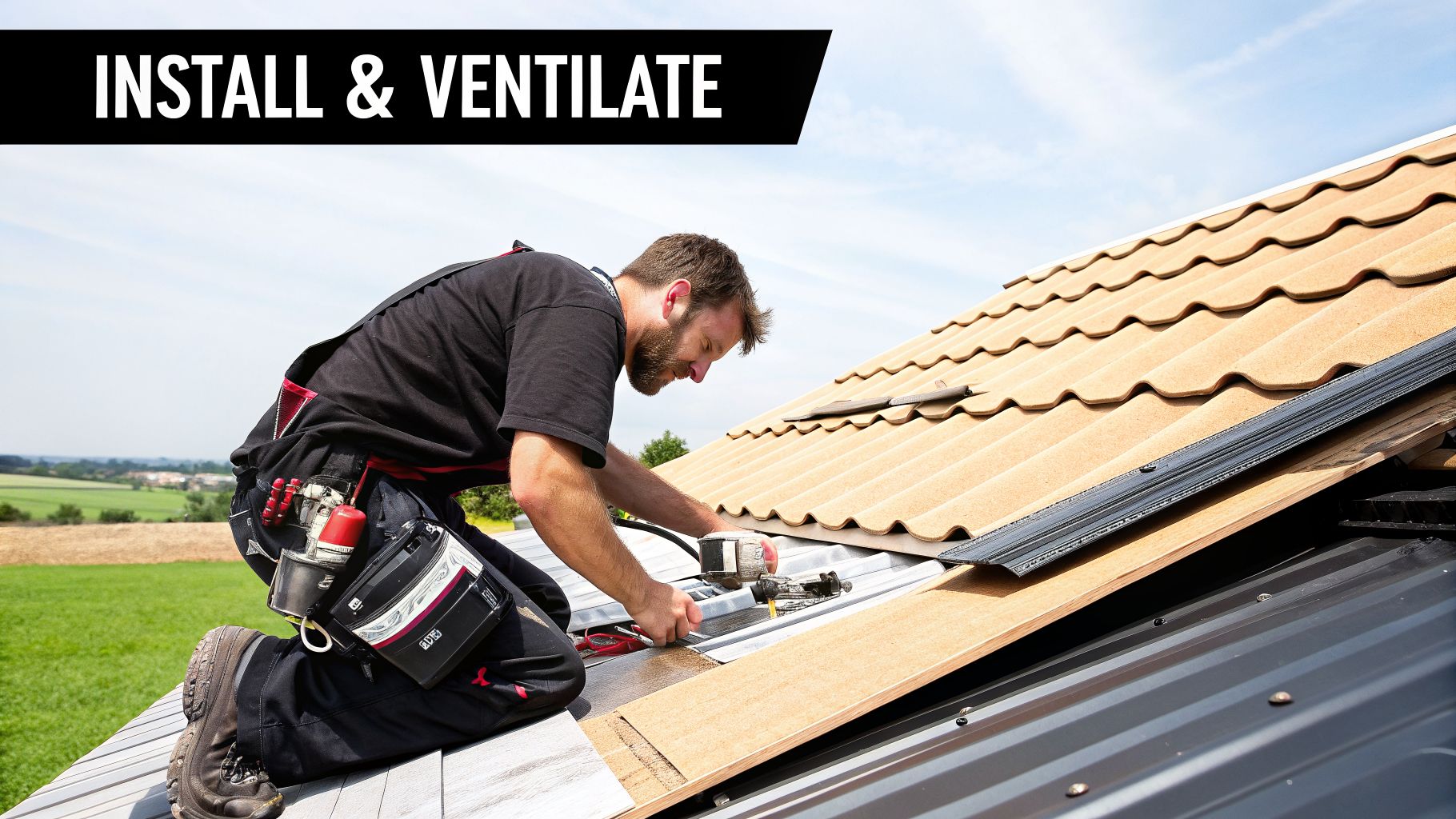
Even the best underlayment for a metal roof is only as good as its installation. The material itself is just one piece of the puzzle. It’s the professional techniques—the small but critical details of fastening, lapping, and flashing integration—that truly create a bulletproof secondary water barrier for your home.
A proper installation is all about creating a continuous, uninterrupted shield. We always start at the lowest point of the roof, the eave, and work our way up to the ridge. Each new course of underlayment overlaps the one below it, creating a shingled effect that forces any water that might sneak under the metal panels to flow down and off the roof, never inward.
Fastening it down correctly is just as important. Using the right fasteners, like cap nails or cap staples for synthetics, is non-negotiable. This prevents the material from tearing in the wind before the metal panels are installed and ensures it stays put for the life of the roof.
The Underlayment and Ventilation Partnership
One of the most common spots where we see roof systems fail is the interplay between the underlayment and the attic ventilation. Metal roofs get incredibly hot during the day and cool off fast at night. This swing in temperature is a perfect recipe for condensation on the underside of the panels, which can drip down and wreak havoc on your roof deck.
This is where your underlayment and ventilation need to function as a team. A quality breathable synthetic underlayment is designed to let moisture vapor from inside the attic escape. But it can't do its job if the air in the attic is stagnant. There needs to be a steady flow of air to carry that moisture out.
A common mistake is pairing a high-performance breathable underlayment with a poorly ventilated attic. Without proper airflow from soffit and ridge vents, moisture-laden air gets trapped, saturating the roof deck and leading to mold and rot, defeating the purpose of the breathable membrane entirely.
Critical Installation Details That Matter
Getting the basics right is one thing, but it’s the fine-tuned details that separate an expert job from an average one. These are the techniques that ensure a truly watertight system for decades. For an even deeper dive, check out our complete metal roofing installation guide.
Here are a few best practices any professional crew worth their salt will follow:
- Proper Overlaps: We treat the manufacturer's specs as the bare minimum. In our region, especially on lower-sloped roofs or areas exposed to heavy, wind-driven rain, we increase the horizontal and vertical overlaps for extra security.
- Integrating with Flashings: Underlayment must be layered correctly with all flashings around walls, chimneys, and in valleys. The rule is simple: underlayment goes under the flashing on the uphill side and over it on the downhill side, always directing water away.
- Sealing Penetrations: Every pipe, vent, and skylight is a potential weak spot. A pro seals these meticulously, often using a tough self-adhered membrane as a primary seal and then installing specialized flashing boots over it for a durable, watertight finish.
Ultimately, the underlayment isn't just a roll of material; it's a critical component of a larger system. When installed with an eye for detail and paired with effective ventilation, it provides the reliable secondary defense your metal roof needs to protect your investment for years to come.
Making The Right Choice For Your Home
So, after looking at all the options, what’s our final call? For homeowners putting their trust and money into a new metal roof, we believe a high-performance synthetic underlayment is the only professional-grade choice. It's what we recommend for the vast majority of our projects because it delivers the right mix of durability, water protection, and long-term value.
Here’s the simple reason why: old-school asphalt felt just can’t keep up. We've seen it break down and become brittle in as little as ten years under the high heat a metal roof can generate. In contrast, a quality synthetic underlayment is engineered to last for 50 years or more. This is critical—it ensures your roof’s secondary water barrier has the same lifespan as the metal panels it’s protecting.
Your Final Checklist For A Protected Home
When you're finalizing your roofing plan, remember that a modern synthetic underlayment solves the biggest risks. Its incredible water resistance is your best defense against wind-driven rain, and its breathability lets moisture vapor escape so you don't have to worry about the sheathing underneath rotting away.
For a truly bulletproof system, we pair that synthetic layer with a self-adhered ice and water shield in the most vulnerable spots, like the eaves and valleys. This combination provides an unmatched defense against leaks and ice dams.
Choosing a high-performance synthetic isn't just about picking a product off a shelf; it's a commitment to a quality system. It’s about making sure your roof's hidden line of defense is just as tough and resilient as the metal you see every day.
Of course, the underlayment is just one piece of the puzzle. The overall health of your home's roof system also depends on things like proper insulation, which is key for energy efficiency and preventing condensation issues. A well-built roof works as a complete system to protect your home from the top down.
Ultimately, choosing the best underlayment for a metal roof is about making sure there are no weak links in your home's armor. By insisting on a modern, high-temperature synthetic material, you're making the smartest investment for your home's future.
Frequently Asked Questions About Metal Roof Underlayment
It's completely normal to have questions when you're digging into the details of a new metal roof. Here are some straightforward answers from our roofing experts to the most common questions we hear from homeowners about underlayment.
Can I Use Standard Roofing Felt Under A Metal Roof?
You could, but you really, really shouldn't. We strongly advise against using standard asphalt-saturated felt for virtually any modern metal roof. The reason is simple: it just can't take the heat.
A metal roof gets incredibly hot, and that intense heat will bake the asphalt felt underneath. It becomes brittle, cracks, and can completely disintegrate in a fraction of the time your metal panels will last. When it fails, it traps moisture against your roof deck, creating a perfect environment for rot, mold, and even causing the underside of your new metal roof to corrode.
Is A Breathable Synthetic Underlayment Always The Best Choice?
For most pitched roofs in climates like ours with four distinct seasons, a high-quality breathable synthetic is absolutely the top choice. Its main job is to let water vapor from inside your home escape, which is critical for preventing condensation from getting trapped and rotting your roof's structure.
But that doesn't mean it's the only tool in the toolbox. On low-slope roofs or in high-risk areas—like your eaves where ice dams form, in valleys, or around chimneys—a non-breathable, self-adhered "ice and water shield" is non-negotiable. In fact, the most durable and well-protected roofing systems use a combination of both, strategically placing each type where it will perform best.
How Much Does Metal Roof Underlayment Cost?
The cost can swing quite a bit depending on the material, but it's crucial to look at the long-term value, not just the sticker price. Here’s a rough breakdown of what you can expect:
- Asphalt Felt: This is the cheapest option by far, usually running $0.10 to $0.20 per square foot. Given its short lifespan under metal, it's a poor investment that will cost you more later.
- Synthetic Underlayment: This is the sweet spot for value and performance, typically costing between $0.25 and $0.75 per square foot. It’s engineered to last as long as the metal panels on top of it.
- Self-Adhered Membranes: As the premium choice, these range from $0.80 to $2.00+ per square foot. Their unbeatable waterproofing makes them perfect for those critical, leak-prone zones.
While synthetic materials require a slightly higher initial investment than outdated felt, they deliver immense long-term savings by preventing costly repairs, protecting your roof deck from rot, and ensuring your entire roofing system performs as intended for its full 50-year lifespan.
Choosing the right materials is the first step toward a secure and long-lasting roof. At Penn Ohio Roofing & Siding Group, our experts can help you design a complete system tailored to your home and climate. Contact us today to get a free, no-obligation estimate for your project at https://pennohiorc.com.