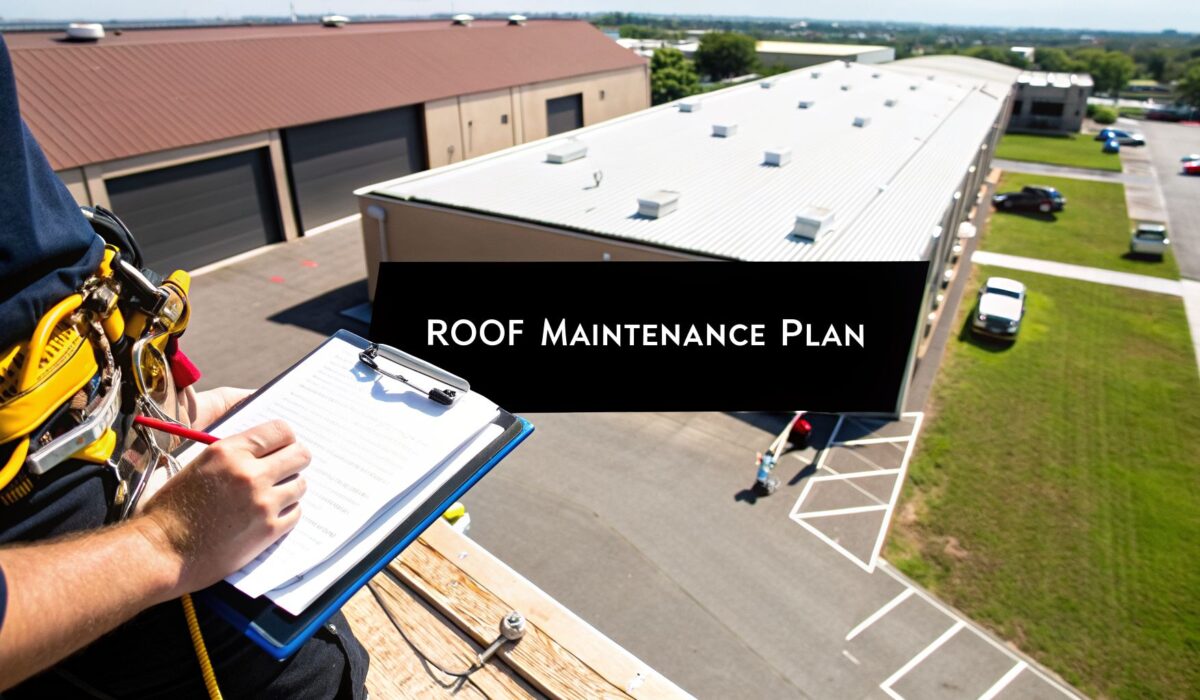
Think of a commercial roof maintenance plan as a health and wellness program for your building's most critical asset. It’s a proactive strategy for inspecting, maintaining, and repairing your roof to stop minor issues before they become catastrophic, budget-breaking failures. This approach not only extends your roof's life but also keeps you compliant with your warranty and turns unpredictable emergency costs into a planned, manageable expense.
The True Cost of a Leaky Roof
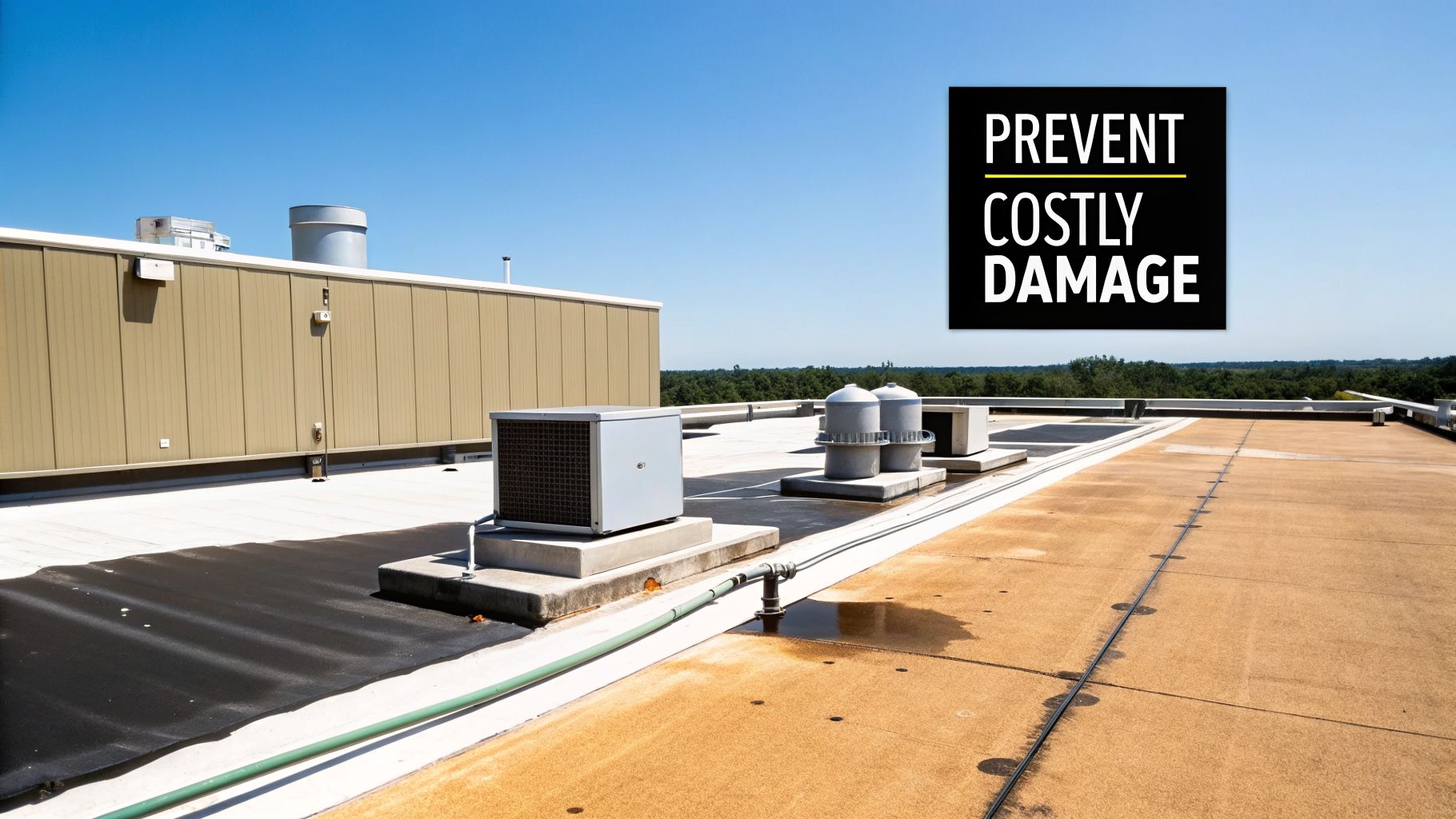
Let's be real—that small drip you noticed in the corner of the warehouse is never just a drip. For a business owner, it’s a warning sign. It’s the first symptom of a much bigger, more expensive problem brewing just out of sight. Ignoring your roof doesn’t save you a dime; it just delays an inevitable and much larger bill.
The financial fallout from a failing roof snowballs quickly, going far beyond a simple patch job. Think about the domino effect: a persistent leak can destroy inventory, short out expensive machinery, and create dangerous slip-and-fall hazards for your team. Those are just the immediate, obvious costs.
Beyond the Repair Bill
What many facility managers don't see is the quiet destruction happening inside the roof system. Water doesn't just drip straight down. It travels, seeping through tiny cracks and saturating entire sections of insulation. Once wet, that insulation is useless—its R-value plummets, and your energy bills climb. Over time, that moisture corrodes metal decking and can even threaten the structural integrity of your building.
This is how a small, fixable problem spirals into a full-blown crisis. I’ve seen it happen countless times. One client, a distribution center owner, put off routine maintenance, figuring their 10-year-old roof was in good shape. A few clogged drains and some cracked seam tape went ignored. After one of our tough Pennsylvania winters, the trapped water had frozen, expanded, and completely destroyed huge sections of the roof. The only option was a full, six-figure replacement, a decade ahead of schedule.
The Numbers Don't Lie
This story isn't unique. In fact, it's frighteningly common. According to the National Roofing Contractors Association (NRCA), a staggering 80% of all commercial roofs are replaced prematurely simply because they weren’t properly maintained. A roof that should have lasted 25 years gets torn off after just 15, forcing a massive, unplanned capital expense on a business. You can read more about NRCA's findings on roof longevity and maintenance.
A commercial roof maintenance plan isn't an expense. It's an investment that directly protects your property's value, operational continuity, and bottom line.
By catching small issues early, you completely sidestep that domino effect. A proactive strategy gives you the upper hand in several ways that a reactive approach never can:
- Predictable Budgeting: Emergency calls are a thing of the past. Instead, you have a planned, manageable line item for roof care.
- Operational Stability: You prevent the costly downtime that comes with major leaks, which can halt production or even force you to close your doors temporarily.
- Asset Longevity: You squeeze every last year of service out of your current roof, pushing that enormous replacement cost as far down the road as possible.
Ultimately, the choice is pretty clear. You can either invest a small, predictable amount in proactive care, or you can roll the dice and wait for a much larger, chaotic bill for emergency repairs and a premature roof replacement. For any serious property owner, a dedicated maintenance plan is the smartest financial decision you can make.
Alright, let's get down to brass tacks. We've covered why you need to care for your commercial roof; now it’s time to build a real-world game plan to actually get it done. This isn't about aimless check-ins. It's about creating a systematic defense for one of your building's most critical and expensive assets.
A good plan turns roof care from a reactive fire drill into a predictable, manageable part of your operations. If you’re looking for a technical deep dive into structuring this process, a PPM preventive maintenance framework offers a great blueprint. Without this kind of organized approach, your efforts will be inconsistent, and you’ll inevitably miss the small problems that fester into five-figure disasters.
Setting Your Inspection Cadence
Here’s the rule of thumb we've seen work best over decades in the field: get a professional on your roof twice a year. No exceptions. The best times are spring and fall, and there's a good reason for that.
The spring visit is all about triage. We’re looking for the damage winter left behind—the toll from heavy snow, ice dams, and the constant freeze-thaw cycle. The fall inspection is about preparation. It’s your chance to button everything up and make sure the roof is ready for whatever the next winter throws at it.
But your inspection schedule can't just be about the calendar. You absolutely need a professional assessment after any major weather event. Think of it as an emergency check-up. We're talking about:
- Severe hailstorms: Even small hail can create bruises and micro-fractures in a roof membrane that you can't see from the ground.
- High winds: You'd be surprised how easily strong gusts can lift the edges of a membrane or compromise the flashing around rooftop equipment.
- Heavy snowfall: The sheer weight of snow, especially when it melts and refreezes, puts an incredible strain on the structure and drainage systems.
A trained eye isn't just looking for an active leak. They're trained to spot the subtle clues that point to a future failure.
Your roof's warranty isn't an unconditional guarantee. It's a contract. Neglecting the maintenance clauses is one of the fastest ways to void it, leaving you fully exposed to the cost of a catastrophic failure.
What the Pros Are Really Looking For
When an experienced roofer inspects your roof, they're on a mission to find the quiet culprits that cause most major failures. An untrained person walking the roof will miss these 9 times out of 10.
They’re focused on high-risk areas like:
- Compromised Flashings: The seals around pipes, vents, and HVAC units are hands-down the most common failure point on any commercial roof.
- Tiny Punctures or Tears: Often no bigger than a screw head, these little breaches from dropped tools, foot traffic, or debris are direct invitations for water intrusion.
- Clogged Drains and Scuppers: A handful of leaves and debris is all it takes to block a drain. This leads to ponding water, which adds immense weight and dramatically accelerates the aging of the roof membrane.
A pro will also be checking for brittle or shrinking membranes, failing sealants, and seams that are starting to pull apart. Finding these things when they are minor, low-cost fixes is the entire point of a maintenance plan.
The Warranty Mandate: Don't Get Caught Out
This is the part many building owners and property managers learn the hard way. Your expensive manufacturer's warranty isn't a "get out of jail free" card. Dig into the fine print, and you'll find that nearly every single one mandates regular, documented maintenance by a qualified roofing professional.
This detail shifts proactive care from a smart idea to a contractual obligation.
If your roof fails and you can't produce a logbook of professional inspections and timely repairs, the manufacturer has every right to void your warranty. Suddenly, a problem that should have been covered becomes a massive, unbudgeted capital expense. Your maintenance plan isn't just protecting a roof—it's protecting your investment and ensuring the warranty you paid good money for is worth more than the paper it's printed on.
Customizing Checklists for Your Roof Type
When it comes to your commercial roof maintenance plan, a one-size-fits-all checklist is a fast track to missed problems and unexpected costs. The simple truth is that the vulnerabilities of a flat TPO roof are worlds apart from those of a standing seam metal system. For your inspections to be worth the time, they have to be tailored to the specific roof over your head.
Think of it this way: you wouldn’t use the same maintenance schedule for a delivery van and a forklift. Each has unique parts and common failure points. The same logic applies to your roof. A checklist built for your roof type helps your team zero in on the most likely trouble spots, making every inspection quicker and exponentially more effective. It also gives you the language to accurately describe what you're seeing when you call in a professional.
The Flat Roof Inspection Checklist
Flat and low-slope roofs—like TPO, EPDM, and PVC systems—are the workhorses of the commercial building world. Their biggest enemy is, without a doubt, standing water. Because of this, everything comes down to proper drainage and the integrity of the roof membrane.
When you're walking a flat roof, these are the non-negotiables for your checklist:
- Ponding Water: Keep an eye out for any puddles that stick around for more than 48 hours after it rains. That’s a red flag for a drainage issue and will drastically shorten the life of your roof membrane.
- Seam Integrity: Get a close look at every seam where the roofing material is welded or glued together. Any separation, cracking, or peeling is a potential leak just waiting to happen. These are the most common entry points for water.
- Membrane Condition: Scan the entire field of the roof for blisters, bubbles, cracks, or punctures. A single dropped screw or tool can create a tiny hole that leads to massive, hidden water damage underneath.
- Flashings and Penetrations: The seals around HVAC units, pipes, vents, and drains are famous for failing first. Meticulously check these areas for cracked sealant, gaps, or any sign the flashing is pulling away.
Catching these issues early is the difference between a minor repair and a major system failure.
The Metal Roof Inspection Checklist
Metal roofs are tough and built to last, but they aren't invincible. Their maintenance needs are entirely different, revolving around the thousands of fasteners, sealants, and the constant threat of corrosion. A solid maintenance plan for a metal roof is all about keeping it secure and watertight.
Your inspection checklist should focus on these specifics:
- Fasteners: Are any screws loose, backing out, or missing altogether? Each compromised fastener is a tiny funnel directing water right where you don't want it. It can also cause panels to shift and create bigger problems.
- Signs of Corrosion: Look for any hint of rust, especially around panel edges, seams, or anywhere the finish might have been scratched. If you catch rust early, you can treat it before it eats through the panel.
- Sealant Condition: Examine the sealants and butyl tape at panel laps and around every penetration. If it looks dried out, cracked, or is pulling away, it's no longer doing its job.
- Panel Damage: Scan for dents from hail or even careless foot traffic. Also, look for "oil canning," which is a wavy distortion in the flat part of the panel that could signal fastening or thermal movement issues.
A regular, thorough check of these areas is what keeps a metal roof performing for decades. The goal is to build a proactive framework that combines these detailed inspections with a smart schedule and an understanding of your warranty.
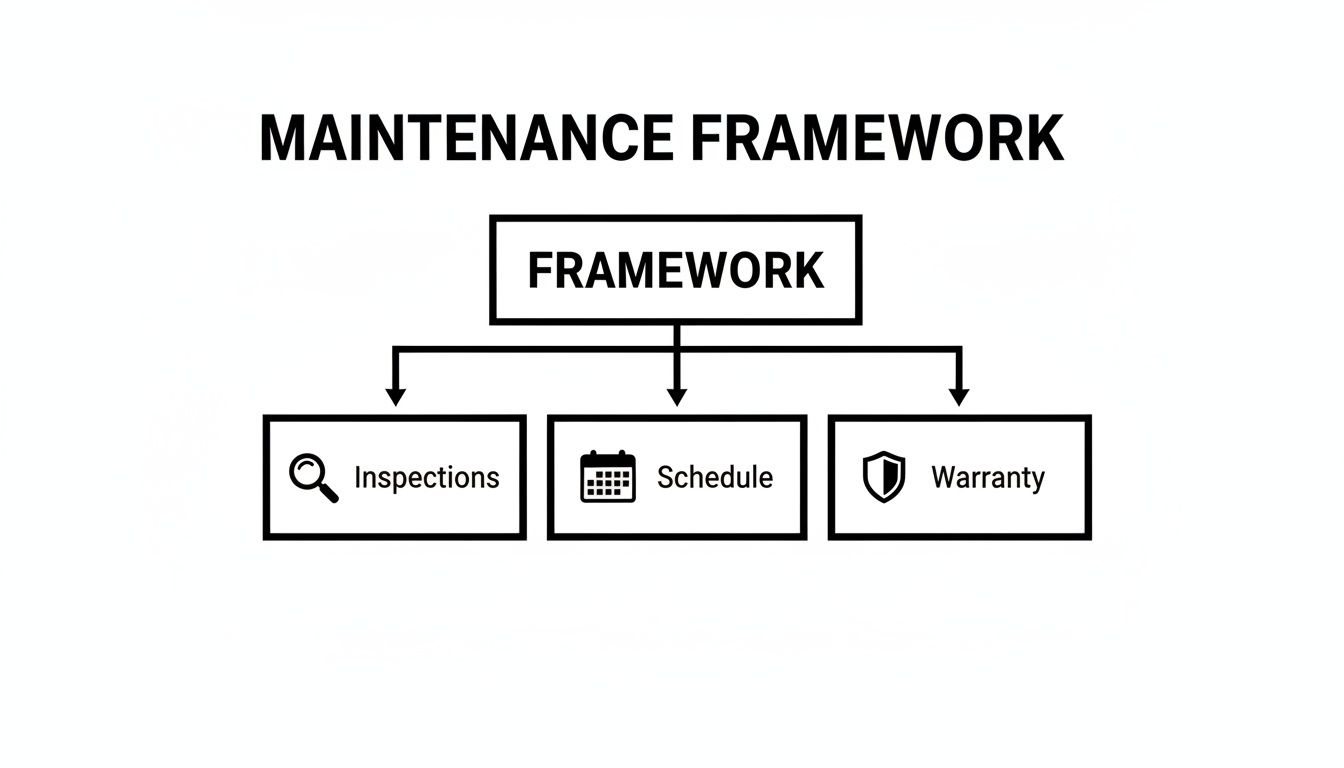
This simple breakdown shows how these elements work together. It’s not just about looking for problems; it’s about creating a system to prevent them.
The Tile Roof Inspection Checklist
While you won't see them on massive warehouses, tile roofs are common on commercial properties like apartment complexes, retail centers, and professional office parks. With these systems, the danger lies not just with the tiles themselves, but with the critical underlayment they protect.
On a tile roof, the clay or concrete tiles are just the armor. The real waterproofing shield is the underlayment beneath, and protecting it is the number one priority.
A specialized checklist is absolutely essential. Your team should be looking for:
- Cracked or Slipped Tiles: Scan the roof plane for any tiles that are obviously broken, chipped, or have slid out of position. A single gap exposes the delicate underlayment to UV rays and rain, causing it to break down fast.
- Debris in Valleys: Roof valleys are natural collection points for leaves, twigs, and other debris. If this gunk is allowed to build up, it acts like a dam, forcing water to move sideways and get underneath the tiles.
- Mortar and Flashing: On ridges and hips, check the mortar holding the cap tiles in place. If it's cracking or falling out, those tiles can become loose. Also, give the metal flashing in valleys and around vents a close look for any damage or lifting.
Focusing on these key areas helps you maintain the integrity of the entire tile roof system, from the armor on top to the shield underneath. By tailoring your approach to your specific roof, you turn maintenance from a chore into a smart strategy that protects your building and your budget.
Documenting and Budgeting for Success
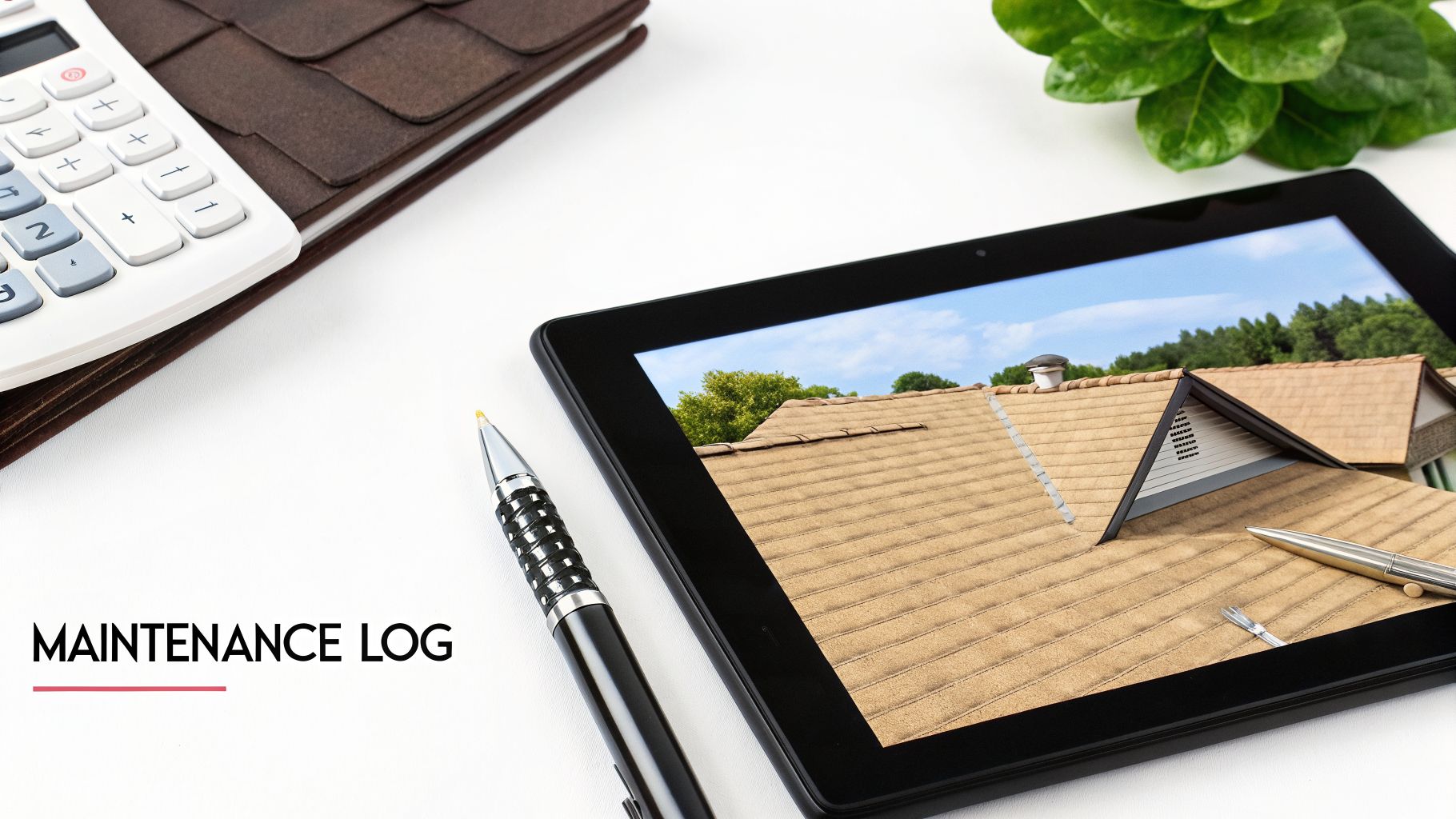
A vague idea about "checking the roof sometimes" won't prevent a leak or help you in a warranty dispute. When it comes to managing commercial properties, there's a simple rule: if it isn't written down, it never happened. A maintenance plan is only as good as its documentation and the budget that backs it up.
This isn't just about creating a paper trail. You're building a complete history of your roof, turning it from a potential liability into a predictable, manageable asset. This record becomes the single source of truth for every inspection, every repair, and every dollar spent—crucial for proving you've done your due diligence.
Creating an Ironclad Maintenance Log
Think of your maintenance log as your roof's medical chart. It's the historical record that will save you during a warranty claim and help you forecast future costs with surprising accuracy. A simple notebook just won't do the job; you need a structured system that captures the critical details every single time someone is on that roof.
Each entry should be a clear snapshot of your roof's health on a specific day. After years in this business, I can tell you that a log is useless unless it contains, at a minimum:
- Date and Time of Inspection: Exactly when the work was done.
- Personnel on Roof: Who was up there? In-house staff or a specific contractor?
- Detailed Findings: Don't just write "looks okay." Be specific. "Ponding water observed near Drain #4 on the west corner." "1-inch puncture in membrane 10 feet south of HVAC unit #2."
- Before-and-After Photos: This is non-negotiable. A picture of a debris-clogged drain before and after it’s been cleared is undeniable proof of work.
- Actions Taken: What did you do about the findings? "Cleared leaves and debris from northwest drain." "Applied compatible sealant to flashing around vent pipe #3."
- Associated Costs: A clear record of labor hours and material costs for every task.
This level of detail is your best defense. Almost every manufacturer's warranty requires documented, regular maintenance. Your log is the proof.
Shifting from Reactive Costs to Proactive Budgets
Once you have a solid documentation process, you can finally get ahead of the financials. No more surprise five-figure invoices for emergency repairs. You can now move your roof care from the "emergency fund" column to "planned operational expense" on the books.
So, what should you budget? A good rule of thumb, based on industry data, is to plan for $0.10 to $0.25 per square foot annually for proactive maintenance. This isn't a random number; it's what decades of experience have shown it costs to keep a roof healthy versus the astronomical price of neglect.
For a 100,000-square-foot roof, that’s a predictable annual budget of $10,000 to $25,000. This investment covers professional inspections, small repairs, and preventative tasks—a tiny fraction of the $1,000,000+ you might spend on a premature roof replacement.
This approach transforms roof maintenance into a standard operational line item, one that your finance team will appreciate for its predictability. The budget-destroying emergencies that stem from neglect simply disappear. If you manage multiple properties or complex systems, getting a handle on these numbers is essential. A deeper understanding of the factors that determine flat roof repair costs can give you even more context for building an accurate budget.
For more complex portfolios, specialized tools can make your financial planning much more precise. Many in the industry use resources like Exayard roofing estimating software to create detailed cost projections for both routine maintenance and future capital projects. When you combine the historical data from your log with accurate cost projections, you build an airtight case for proactive maintenance, showing a clear ROI through longer asset life and reduced risk.
Working With a Professional Roofing Partner
Your facility manager’s regular walk-throughs are a fantastic first line of defense. But even the most diligent in-house checks have their limits. The real game-changer in any commercial roof maintenance plan is knowing exactly when a small problem your team can monitor becomes a serious issue that needs a professional’s touch—right now.
Some warning signs are subtle, but others are screaming for immediate attention. If your team spots any of these during an inspection, it’s time to pick up the phone and call in the experts.
- Significant Water Staining: See those dark, ugly stains on your ceiling tiles? That’s not just a cosmetic issue. By the time a leak makes its way inside, it’s likely been soaking your insulation and decking for weeks, if not months. This is an active leak that needs to be found and fixed.
- Visible Membrane Tears or Punctures: Any hole, rip, or puncture in your roof's membrane is an open door for water. It doesn't matter if it was caused by high winds or a dropped tool—it needs a professional patch to create a permanent, watertight seal.
- Structural Sagging: If you see any noticeable dips or low spots on the roof surface, especially if water is ponding there, you could be looking at a structural problem. This is a major safety hazard and requires an immediate professional evaluation, no exceptions.
What to Expect From a Quality Maintenance Program
Moving from reactive, one-off repairs to a dedicated maintenance program is how you truly protect your building. A top-notch program is more than just a vague promise to "check on the roof." It’s a transparent, structured partnership designed to give you total clarity and peace of mind.
Here’s what any comprehensive program should deliver:
- Detailed Digital Reports with Photos: After every visit, you should get a straightforward report that shows you exactly what was found. This isn't complete without high-resolution photos documenting the roof's condition before and after any work was done.
- A Transparent Service History Log: Your roofing partner should keep a complete and accessible record of every inspection, repair, and maintenance task. This log becomes an invaluable asset for capital planning and especially for warranty claims down the road.
- Priority Service Scheduling: As a maintenance partner, you jump to the front of the line. This means you get priority scheduling for routine work and, most critically, for emergency calls.
A professional roofing partner isn't just a vendor; they're the guardian of one of your most critical assets. Their job is to bring the expertise, documentation, and prompt service you need to extend your roof’s life and avoid those budget-destroying emergencies.
Understanding Your Service Agreement
The service agreement is the bedrock of your relationship. It’s where all the expectations, responsibilities, and guarantees are put in writing to protect your investment. Before you sign anything, make sure it clearly defines not just the scope of work, but the guaranteed response times.
Look for two distinct categories. First, routine service calls for non-urgent issues should have a clear timeline, like a commitment to be on-site within 3-5 business days. More importantly, the agreement must lock in a guaranteed response time for emergency calls—like an active leak during a storm. A reliable partner will commit to having a crew on-site within hours, not days, to start mitigating the damage.
Building this relationship with a trusted contractor transforms how you manage your property. It takes the stress and panic out of finding a roofer during an emergency and replaces it with the confidence of knowing an expert is already on your side, ready to go. For more tips on vetting potential partners, our guide on how to choose a roofing contractor offers some practical, real-world advice. This partnership is what keeps your roof a well-maintained asset, not a constant source of worry.
Answering Your Top Questions About Roof Maintenance
Even with the best plan in hand, you're bound to have some questions. That’s a good thing—it means you’re taking this seriously. As a roofer, I get asked the same set of questions by property owners all the time. Let's tackle some of the most common concerns to help you protect your building and your budget.
What Should I Really Be Budgeting for This?
Let's talk numbers. Proactive maintenance is always, always cheaper than a middle-of-the-night emergency call. Based on what we see in the industry, a solid maintenance plan will typically run you between $0.10 and $0.25 per square foot for the year. So, for a standard 50,000-square-foot roof, you’re looking at an investment of about $5,000 to $12,500 annually.
That number covers regular, professional check-ups, small-scale repairs, and preventive measures. Now, compare that to the cost of neglect. An emergency repair can easily cost 5-10 times more than a planned one. Worse yet, skipping maintenance can cut your roof's lifespan by up to 50%, forcing you into a six-figure replacement years ahead of schedule. It's a classic "pay now or pay a lot more later" scenario.
Does a Maintenance Plan Actually Affect My Roof's Warranty?
It doesn't just affect it—it's essential for keeping it valid. This is a point many people miss. Nearly every commercial roofing manufacturer makes regular, documented maintenance a non-negotiable condition of their warranty. If a problem crops up and you can't show proof of routine inspections and care, they have every right to void the warranty.
Imagine a major seam failure happens. Without that proof of maintenance, the manufacturer could deny the claim, sticking you with the entire bill. Think of your documented plan as your warranty's own insurance policy. It's the record that proves you've held up your end of the bargain.
Can't My Own Maintenance Crew Handle This?
Your on-site staff absolutely has a role to play. They should be your first line of defense, doing quick visual scans from the ground or another safe spot. Looking for piled-up leaves, clogged drains, or obvious damage after a storm is incredibly valuable.
But when it comes to getting on the roof, that’s a job for trained and insured professionals. There are significant safety risks involved, and frankly, a pro knows what to look for.
We often find issues that are invisible to the untrained eye—subtle things like failing seams, hidden moisture trapped under the membrane, or tiny gaps in flashing that will eventually cause major leaks.
Hiring a professional roofer not only ensures safety and catches problems early but also provides the official documentation you need for that all-important warranty compliance.
What’s the Difference Between Maintaining a Flat Roof and a Metal One?
The game plan changes completely depending on the type of roof you have. Their weak points are totally different.
-
Flat Roofs (TPO, EPDM, etc.): It's all about water. The number one priority is ensuring positive drainage so water can’t sit and form ponds. Ponding water is incredibly heavy and breaks down roofing materials over time. We focus our inspections on the seams, looking for any punctures from foot traffic, and checking the integrity of flashings around vents, pipes, and HVAC units.
-
Metal Roofs: Here, the enemies are rust and loose fasteners. Our maintenance checks are centered on finding any signs of corrosion, making sure every fastener is tight and properly sealed, and inspecting the sealant used on panel seams. It's amazing how many leaks are caused by a few backed-out screws. Scratches and dents also need attention, as they can breach the protective coating and invite rust.
How Often Do You Really Need to Inspect a Commercial Roof?
The golden rule is a minimum of twice a year. We recommend a professional inspection every spring and fall. In the spring, we're looking for any damage that the winter ice and snow left behind. In the fall, we're buttoning everything up to make sure the roof is ready for whatever winter throws at it.
Beyond that, you absolutely must get an inspection after any major weather event. Don't wait. Call a professional after:
- Hailstorms
- High-wind events (like a derecho or tropical storm)
- An unusually heavy snowfall or ice storm
This two-pronged approach—seasonal checks plus post-storm inspections—is the best way to catch minor issues before they have a chance to become major catastrophes.
Ready to stop reacting to roof problems and start preventing them? A proactive commercial roof maintenance plan is the smartest investment you can make in your property's long-term health. We create custom plans that are designed to maximize your roof's life, protect your warranty, and transform unpredictable repair bills into a stable, manageable budget item. Let our experienced team give you one less thing to worry about. Contact us today for a free estimate.