

You’re probably at the stage where the old deck feels like more work than enjoyment. Boards are cupping, fasteners are backing out, and every wet spring or hard winter in Grove City seems to make it worse. That’s usually when homeowners start looking at composite and asking the right question. Not just what looks good, but what will hold up here.
Composite decking installation Grove City PA isn’t the same job as building a deck in a milder climate. Mercer County gives you snow, humidity, freeze-thaw movement, and permit requirements that punish shortcuts. If the layout is off, if the framing isn’t right, or if the first board starts crooked, the whole project shows it.
A good composite deck looks clean on day one. A properly built one still looks and performs the way it should years later. That comes down to planning, installation discipline, and understanding how the deck ties into the rest of the house.
Planning Your Grove City Composite Deck Project
A composite deck project usually starts with style questions. Color, railing choice, board width, maybe whether you want stairs off the back or the side. Those matter, but they shouldn’t be the first decisions.
In Grove City, the first job is figuring out whether the site and structure can handle local conditions. Snow load, frost depth, drainage, and permit requirements all affect how the deck should be built long before anyone opens a box of fasteners.

Start with the yard, not the sample board
Western PA sites can fool you. A backyard may look level and solid in dry weather, then hold water after a storm or shift through a freeze-thaw cycle. That matters because composite boards are only as good as the frame and footings underneath them.
Look at these conditions before design gets finalized:
- Soil behavior: Clay-heavy ground can hold moisture and create movement around footings.
- Drainage path: Water should move away from the house and away from the deck support points.
- Sun and shade: Shaded areas stay damp longer, which affects airflow and cleanup needs.
- Connection points: Ledger attachment, siding transitions, door thresholds, and roof overhangs all need to be considered early.
If there’s an existing wood deck, critically assess the framing. Composite often outlasts old wood framing by a wide margin, so reusing tired structure just to save time usually creates a short-lived fix instead of a real upgrade.
Practical rule: If the frame already shows age, movement, or moisture damage, don’t build a long-life deck surface on a short-life structure.
Know what triggers permits in Grove City
A lot of frustration around deck projects has nothing to do with the decking itself. It comes from underestimating permit review, inspection timing, and local code expectations.
A frequently overlooked issue in Grove City composite decking installation is local compliance for raised designs and snow-load-ready framing. Grove City’s 2025 code updates require 50 psf live load minimums for composites, engineered joist spacing under 16" OC, permit timelines can run 2-4 weeks through Mercer County Planning, and footings require inspection below the 36" frost line, according to Grove City deck permitting guidance.
That means the planning phase should include more than a sketch. A solid permit package usually needs a clear layout, dimensions, footing locations, framing details, and connection details where the deck meets the house.
Design for winter load and year-round movement
Snow isn’t a side issue here. It’s part of the design load. If a homeowner treats the deck like a simple backyard platform and ignores structural requirements, the project can get delayed at review or underbuilt in the field.
A practical planning checklist looks like this:
- Confirm elevation and attachment method. Attached decks need careful attention at the ledger and wall assembly.
- Verify footing locations early. It’s easier to revise paper than re-dig concrete work.
- Set joist layout to the product and code. Composite is less forgiving than wood when spacing is too wide.
- Plan stairs, fascia, and edge boards from the start. Those finish details affect layout decisions.
- Coordinate other exterior work. If siding, trim, or roof drainage changes are coming, align the deck plan now.
Homeowners often save themselves headaches by thinking about how the finished space will be used before the build starts. If you’re already collecting layout inspiration, browsing deck decorating ideas can help you decide where furniture zones, dining space, and traffic flow should go, which makes the build plan more practical.
For homeowners comparing layouts, materials, and attachment options, it also helps to review examples of composite and outdoor deck projects so the design choices line up with how the deck will be built.
The Professional Installation Process From Frame to Finish
A Grove City deck can look fine in July and start showing problems by February if the install sequence was sloppy. I see the trouble in the same places every time. The frame is slightly out, the first course is rushed, drainage at the house is ignored, and the finish crew treats edges like trim instead of weather details.
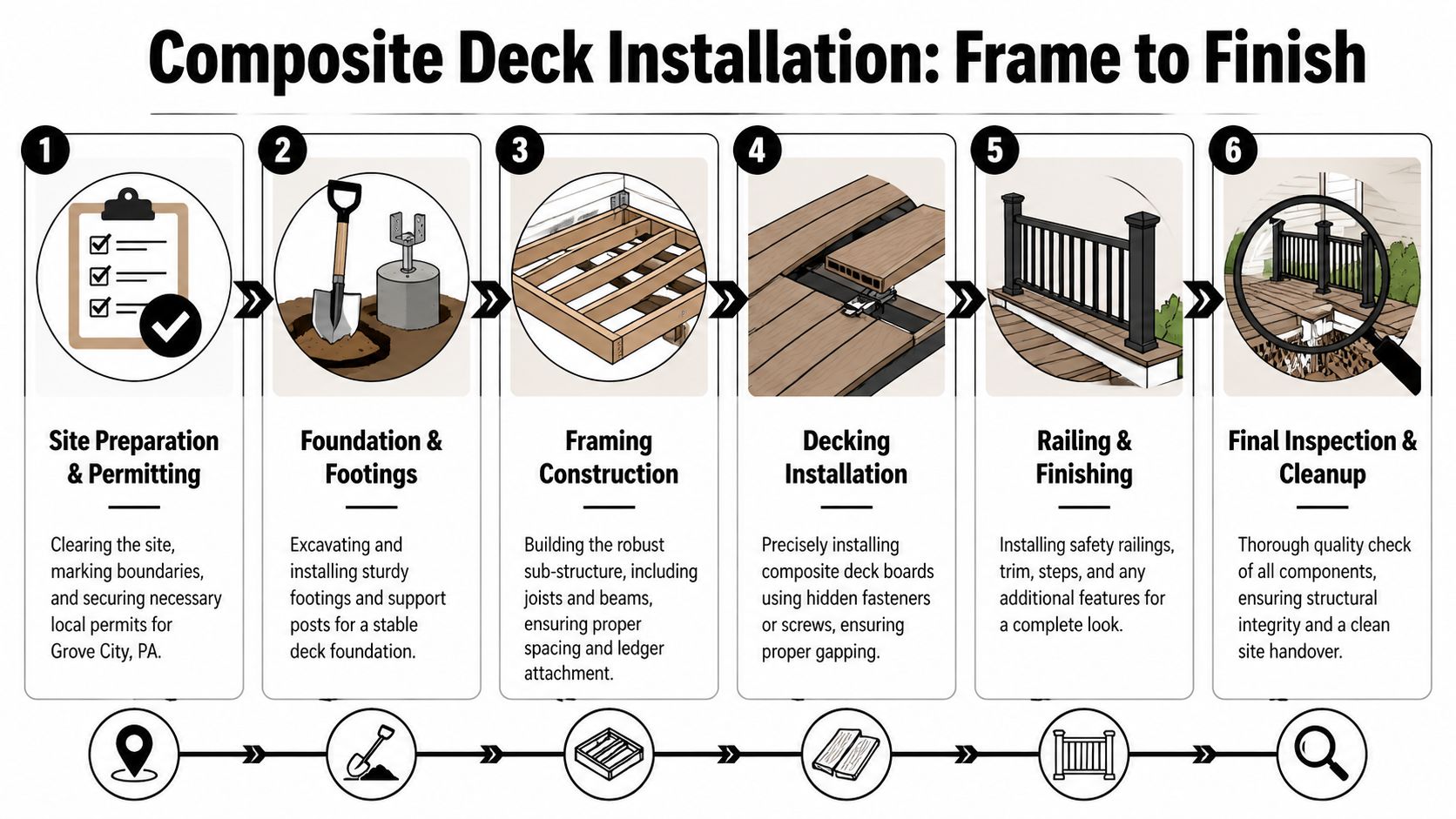
A professional install starts before the decking boards come off the pallet. In Mercer County, inspection approval depends on structure, attachment, and details that hold up under snow load. On attached decks, the work also has to cooperate with the house wrap, siding, flashing, door threshold, and roof runoff. Roofing and exterior contractors pay attention to that intersection because water problems often start where one trade assumed another trade handled it.
Build the structure like finish materials depend on it
Composite boards make framing errors obvious. They do not flatten humps, hide twisted joists, or forgive a rim that runs out of line.
On a replacement project, the right approach is to inspect the existing frame hard before talking about surface boards. That means checking joist condition, attachment points, bearing, hardware corrosion, and whether the layout matches the decking manufacturer’s span requirements. It also means checking airflow under the deck. Composite needs room to dry, and trapped moisture shortens the life of the framing below it.
The frame check usually comes down to four jobsite questions:
- Is the surface plane flat? Minor crowns and dips show up fast once composite goes down.
- Does joist spacing match the product? Some patterns and board directions need tighter spacing.
- Are the outer edges straight enough for fascia and picture-frame details? A wavy rim creates finish problems later.
- Will water get out of this assembly? Drainage under the deck and away from the house matters as much as the surface finish.
Set the first board from control lines, not from assumptions
The first board sets the run of the whole deck. If it starts out of square, the error carries across every course.
Good installers snap control lines and verify them against the frame. They do not assume the house wall is straight, because older homes in this part of Pennsylvania often are not. Siding lines can drift. Foundations move a little over time. The deck needs its own reference line.
Manufacturers also expect careful fastening at board ends and edges, especially where face screws are used instead of hidden clips. Trex installation guidance for decking and fascia covers the need for proper fastener location, approved screws, and pre-drilling in the right situations. In the field, that translates into a simple rule. Start square, keep checking, and do not try to fix layout drift at the end.
Install hidden fasteners with discipline
Hidden fasteners give composite decking its clean look, but the system only works when the framing is consistent and each clip is seated correctly. If the joists wander or the screws are overdriven, board spacing starts to look uneven and boards can bind during seasonal movement.
That is one of the trade-offs homeowners should understand. Hidden clips look better and reduce visible fasteners, but they demand tighter installation habits. Face-screwing selected boards near borders or final courses can still be the better move where access is limited or where the manufacturer calls for it.
A pro crew keeps the pattern controlled by doing the same things every few rows:
| Installation detail | Why it matters |
|---|---|
| Clip placement at every required joist | Keeps spacing consistent and supports the board correctly |
| Straight screw drive | Helps clips seat flat instead of twisting the board |
| Frequent layout checks | Catches drift before it shows at the perimeter |
Control the board run before the last row forces a compromise
A lot of installation mistakes do not show up until the middle or end of the deck. The crew starts clean, gets comfortable, then follows the previous board instead of the control line. By the time they reach the outside edge, the last course is too narrow, the border detail looks forced, or the fascia has to hide layout mistakes.
The fix is simple, but it takes discipline. Check for parallel lines throughout the install. Dry-fit problem areas early, especially around stairs, picture-frame borders, and breaker boards. If the deck ties into new siding work, stone veneer, or a roof drainage update, verify those transitions before trimming the final edges. That is how you avoid the common situation where a nice deck surface dumps water against fascia, skirting, or the foundation because nobody looked at the whole exterior system together.
Finish edges for weather, not just appearance
Edge work is where deck building overlaps with exterior envelope work. End cuts, fascia fastening, skirting gaps, and stair transitions affect how the deck sheds water and how the framing holds up through freeze-thaw cycles.
This part gets overlooked in Grove City. Snow sits. Meltwater refreezes. Wind drives moisture into small openings. A clean-looking edge that traps water is not a good detail.
The finishing sequence should include:
- A straight cut line across overhanging board ends.
- Trimming with a guide instead of freehand cuts.
- Proper fastening of the final board based on the manufacturer’s method.
- Fascia installed with the fastening pattern and spacing the product requires.
- A check of drainage near the house, stair landings, and any low spots around posts.
Field crews who also work on roofing and siding usually catch these problems earlier. They know a deck ledger, kickout flashing, gutter discharge, and siding termination all affect one another. That broader view matters on attached decks, especially on homes where exterior upgrades are happening in phases.
What a professional install actually looks like on site
Homeowners usually notice the finish boards. Inspectors and experienced contractors notice the sequence.
A well-run composite deck install in Grove City usually includes accurate framing corrections before decking starts, clear control lines, consistent fastening, clean perimeter cuts, and edge details that account for water and winter conditions. It also includes coordination with permit inspections instead of trying to patch details after the fact.
The end result should look crisp. More important, it should stay stable through wet springs, hot summers, leaf buildup in the fall, and snow loading in winter. That is the difference between a deck that only photographs well and one that is built to last.
Budgeting for Your Deck Cost and Long-Term Value
Composite usually costs more upfront than a basic wood deck surface. That part is obvious. What gets missed is how often homeowners compare only the purchase price and ignore the years after installation.
That’s the wrong comparison. A deck isn’t a weekend purchase. It’s a long-term exterior system.
Where the budget pressure usually shows up
Most deck budgets get squeezed in the same places. Demolition of an old deck, structural upgrades, permit work, stairs, railings, fascia details, and transitions at the house all add complexity. If the existing frame can’t be reused, that changes the project fast.
A realistic budget conversation should account for:
- Substructure condition: Old framing may not justify a resurfacing approach.
- Elevation and access: Higher decks and tighter yards increase labor difficulty.
- Finish scope: Stairs, skirting, fascia, and railing all move the number.
- Permit and inspection coordination: Time has a cost even when materials don’t change.
- Exterior tie-ins: Siding cuts, flashing work, and door threshold details matter.
Why homeowners still choose composite
Composite decking offers 25-50 years of typical service life and can reduce long-term maintenance costs by up to 70% compared to wood decks that often need annual sealing and repairs costing $500-$2,000 per year, according to composite deck lifespan and maintenance cost guidance.
That changes the math. Wood can look cheaper on the front end, then keep asking for money and time. Composite asks for more at the beginning, but it usually asks for far less after that.
Here’s the practical comparison:
| Consideration | Wood deck | Composite deck |
|---|---|---|
| Upfront cost | Usually lower | Usually higher |
| Ongoing upkeep | Regular sealing, repairs, board replacement | Lower routine maintenance |
| Long-term ownership | More labor and recurring expense | More predictable over time |
| Resale appeal | Depends heavily on condition | Stronger when well designed and maintained |
There’s also a property-value angle. The same source notes that this durability can enhance residential property values by 5-10% in markets like Grove City.
The right way to think about value
A deck budget shouldn’t be built around the cheapest way to finish the surface. It should be built around the longest-lasting way to solve the whole outdoor-living problem.
If you plan to stay in the house, lower maintenance matters. If you may sell later, a clean, durable exterior upgrade matters. And if your current deck already needs repeated repair, putting new money into old wood often becomes the expensive choice disguised as the cheaper one.
The Smart Choice DIY vs Vetting a Professional Contractor
Some homeowners can handle parts of a deck project well. Demo, site cleanup, maybe even portions of finish work. But a full composite build in Grove City asks for accuracy in places that don’t forgive guessing.
The hard part isn’t carrying boards. It’s getting every structural, layout, and weather-detail decision right the first time.

Where DIY usually goes off track
DIY projects rarely fail because the homeowner didn’t care. They fail because composite is less forgiving than people expect, and local requirements add another layer.
Common weak points include:
- Permit paperwork that doesn’t match what gets built
- Framing that’s close, but not precise enough for composite
- Improper first-board alignment
- Weak edge finishing and poor water management at the house
- Missed coordination with siding, roof runoff, or door transitions
A decent-looking deck can still have hidden problems. Water intrusion at the ledger, poor airflow below the surface, and sloppy tie-ins near cladding usually don’t announce themselves on day one.
If a contractor can only talk about deck boards and color samples, that’s not enough. The project also needs someone who understands the house.
Why multi-trade experience matters
Many homeowners make a better choice by hiring someone with broader exterior knowledge instead of a deck-only mindset. A deck doesn’t exist in isolation. It touches roofing drainage, siding termination, trim details, and the weather-exposed side of the home.
A key advantage of combining composite decking with roofing and siding expertise is that a unified exterior approach can reduce thermal bridging by up to 30% in cold climates and may extend manufacturer warranties by 15-20% when installed as a coordinated system, according to guidance on integrated composite decking with metal roofing and siding systems.
That matters in Western PA. Snow sits. Ice dams happen. Water finds transitions. A crew that understands flashing, cladding interfaces, and runoff control will usually see risks that a deck-only installer misses.
For homeowners researching what to ask local contractors, reviewing examples tied to Mercer County deck building work can help clarify what a qualified exterior-focused installer should already be discussing during the estimate.
How to vet a contractor without getting overwhelmed
You don’t need a giant checklist. You need the right questions.
Ask these:
How are you handling the connection to the house?
The answer should mention flashing, water management, and the wall assembly. Not just bolts.What’s your plan for layout and first-board control?
A pro should talk about reference lines, board sequencing, and final-board planning.How do you handle fascia and deck-edge weather protection?
If the answer is purely cosmetic, keep looking.Who manages permit coordination and inspections?
Clear responsibility matters. Assumptions cause delays.What happens if the existing frame isn’t suitable once opened up?
You want a direct answer, not a shrug.
A quick comparison that helps
| Question | DIY route | Professional route |
|---|---|---|
| Control over schedule | Higher, if everything goes smoothly | More structured, but dependent on contractor calendar |
| Risk of rework | Higher if layout or code details are missed | Lower when handled by an experienced crew |
| Permit and inspection confidence | Often stressful | Usually more organized |
| Integration with roofing and siding | Hard for most homeowners to manage well | Stronger with multi-trade expertise |
The smart choice isn’t always “never DIY.” It’s knowing which parts carry the most risk. For composite decking installation Grove City PA, the expensive mistakes are usually structural, alignment-related, or hidden behind finished surfaces. Those are the ones worth paying to avoid.
Keeping Your Composite Deck Pristine Through Pennsylvania Seasons
Composite is low-maintenance. It isn’t no-maintenance. Grove City gives decks a little bit of everything, wet springs, hot spells, falling leaves, and winter snow that sits where shade keeps it from melting off quickly.
The good news is that routine care is simple if you stay ahead of buildup.

What to do through the year
A seasonal rhythm works better than waiting for the deck to look dirty.
- Spring cleaning: Wash off winter residue with mild soap and water, and clear debris from board gaps so drainage stays open.
- Summer watch: Clean up food spills, pollen, and planters before residue sits too long in the surface texture.
- Fall cleanup: Don’t let wet leaves stay packed in corners or along fascia lines.
- Winter care: Use plastic tools for snow removal and avoid scraping the surface with metal edges.
That kind of maintenance is light, but it protects the appearance of the deck and helps you catch problems early around stairs, railings, and edge trim.
Material choice still matters after installation
In an area with big temperature swings, better-performing composite products make ownership easier. Materials with higher fire-resistance ratings, including Class A options listed by the California State Fire Marshal, are also described as performing well in freeze-thaw conditions and helping reduce the risk of cracking or long-term degradation, as noted in the WUI-listed composite product handbook.
That doesn’t mean every deck in Grove City needs a fire-driven specification. It means material quality shows up in real-world durability when temperatures swing and moisture cycles repeat.
Keep the surface clear, keep the gaps open, and don’t let organic debris sit for long. Most composite maintenance problems start with neglect, not with the board itself.
A few habits that prevent headaches
Some of the best maintenance advice is basic:
- Move furniture occasionally so trapped dirt and moisture don’t collect in the same spots all season.
- Use mats carefully and choose ones that don’t trap water against the deck surface.
- Trim back nearby shrubs if they block airflow and keep the deck damp.
- Inspect after winter for any movement at railings, stairs, or fascia connections.
Homeowners usually appreciate composite most after they’ve lived with it through a few Pennsylvania seasons. The work stays manageable, and you’re not spending every spring sanding, sealing, or replacing tired wood boards.
Your Next Step Towards a Flawless Grove City Deck
A strong deck project in Grove City comes down to a few essential elements. The site has to be evaluated for local conditions. The permit path has to be handled correctly. The framing and board layout have to be accurate. And the finished deck has to work with the house, not just sit behind it.
That’s where many projects either become a long-term asset or a recurring problem. A good-looking deck can still be underbuilt, poorly flashed, or awkwardly tied into siding and drainage. The homeowners who avoid those headaches are usually the ones who treat the project like part of the home’s full exterior system.
If you’re planning Composite decking installation Grove City PA, take the next step with someone who understands more than decking boards alone. Experience with roofing, siding, weather transitions, and full exterior planning gives a project a better chance of being built cleanly from the start. Homeowners who want that broader approach can learn more about working with a Mercer County home exterior contractor before finalizing their plans.
A deck should feel simple when it’s finished. Getting there usually isn’t simple at all. It takes the right design, the right installation sequence, and the right understanding of how Western PA weather affects every exterior detail.
If you’re ready to talk through a deck project with a contractor who understands Grove City conditions, structural tie-ins, and full exterior integration, reach out to Penn Ohio Roofing & Siding Group. They can help you evaluate your existing setup, discuss composite options, and plan a deck that fits your home the right way.