
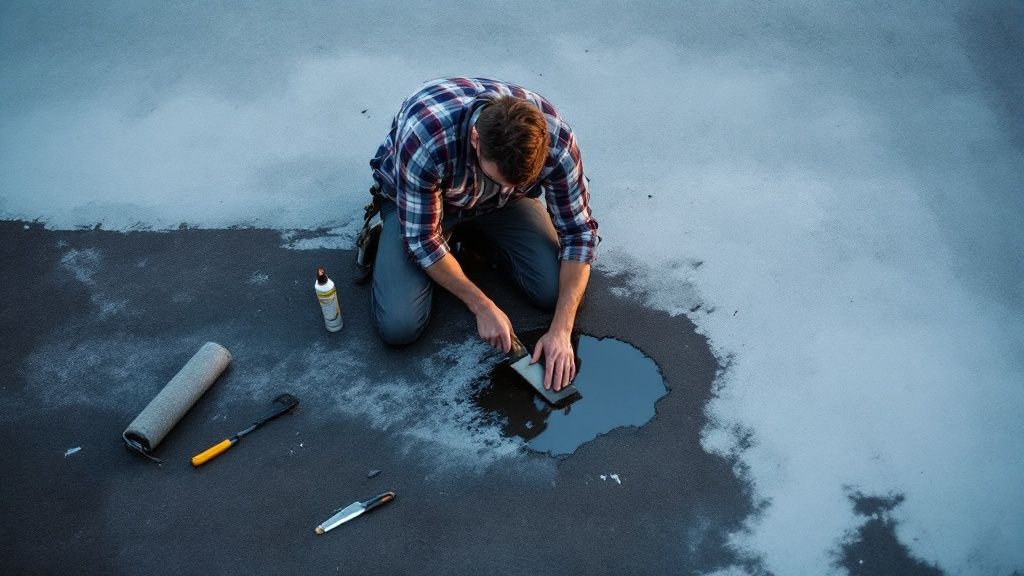
So, you've got a leak in your flat roof. The first step in fixing it is a proper inspection to pinpoint the real source of the problem. After that, it’s all about cleaning the area and applying the right patch or sealant.
Here's the most important thing to remember: the water damage you see inside is rarely directly below the actual entry point on the roof.
Finding the Source of Your Flat Roof Leak
We've all been there—that sinking feeling when you spot the first water stain on the ceiling. Your gut instinct is to think the leak is right above the stain, but flat roofs are tricky. Water is a master of disguise; it can sneak in one spot, travel sideways along the roof structure, and only show itself once it's soaked through your ceiling several feet away.
This means you need to play detective. Start your investigation inside the house. Grab a tape measure and note the distance from the water stain to two nearby walls. Then, head up to the roof and transfer those same measurements onto the surface. This little bit of triangulation gives you a solid search area instead of just guessing.
Common Culprits Behind Flat Roof Leaks
Once you're safely on the roof, you need to know what you're looking for. Most leaks aren't random; they happen at specific points of failure. Focus your search on these usual suspects:
- Punctures and Tears: Tiny holes from falling branches, hail, or even just someone walking on the roof can be tough to spot but let in a surprising amount of water.
- Failing Seams: The seams where roofing material overlaps are a weak link. Years of sun and temperature changes cause them to pull apart, creating a perfect entry point for rain.
- Damaged Flashing: Check the seals around anything that pokes through your roof—vents, pipes, skylights, and chimneys. The metal or rubber flashing here is notorious for cracking, rusting, or pulling away.
- Ponding Water: If you see puddles of water still standing 48 hours after it rains, you have a drainage issue. That constant water pressure is incredibly stressful for the roof membrane and will eventually find a way through.
Expert Tip: Don't just rely on your eyes. Gently press down on any areas that look suspicious. If the roof feels soft or spongy, it's a dead giveaway that the insulation and decking underneath are soaked. This tells you the leak has been active for a while. A good visual check is the bedrock of a successful repair.
The Cost of Ignoring Early Signs
Catching a leak early is more than just stopping a drip; it’s one of the smartest financial moves you can make as a homeowner. While the average cost for a simple roof leak repair hovers around $750, that number can skyrocket if you wait.
Once water gets into the structure, you're not just fixing a roof anymore. You could be looking at replacing soggy insulation, patching drywall, and even dealing with mold remediation.
A quick word of caution: if you have an older roof, you also need to be aware of how to identify asbestos in your home. It was a common component in older roofing materials, and you need to handle it safely. Taking the time to master this initial investigation is the single most important step you can take toward a permanent fix.
Gathering the Right Tools and Materials
Once you've tracked down the source of the leak, the success of your repair really comes down to having the right gear. Showing up on a roof with the wrong sealant or a flimsy tool is a recipe for frustration. It’s like trying to fix a burst pipe with duct tape—you might slow the drip for a minute, but you're setting yourself up for a much bigger mess down the road.
Your choice of materials is directly tied to the type of flat roof you're working on. This isn't just a friendly suggestion; a mismatch can actively damage your roof. For example, slapping an asphalt-based sealant onto a rubber EPDM roof can cause the membrane to swell, break down, and turn a small leak into a major problem. Material compatibility is everything.
Matching Materials To Your Roof Type
First things first, you need to know what you're working with. Most residential flat roofs fall into one of three categories: EPDM (a synthetic rubber membrane), TPO (a single-ply thermoplastic), or Modified Bitumen (an asphalt-based material). Each one needs a specific repair approach.
- For EPDM (Rubber) Roofs: Your best bet is a dedicated EPDM patch kit. These usually come with a primer to clean and prep the surface and a self-adhesive patch engineered to bond perfectly with the rubber.
- For TPO Roofs: TPO is heat-welded at the seams, which can make repairs a bit more involved. While pros use heat welders, a great DIY solution is a high-quality, TPO-compatible peel-and-stick patch. Just make sure the product specifically says it's for TPO.
- For Modified Bitumen or BUR (Built-Up Roofs): The classic fix here is roofing cement or mastic. It’s a thick, tar-like goo that you spread over the damaged area with a trowel to create a tough, waterproof seal.
The material you choose has a big impact on how long your repair will last.
As you can see, while roofing cement is easy on the wallet, a dedicated patch kit offers a much more durable, long-term solution. It’s often worth the extra investment.
Choosing the right materials can feel overwhelming, so it's crucial to match your repair product to your existing roof surface for a lasting bond.
Flat Roof Repair Material Compatibility
| Roof Material Type | Best Patching Solution | Recommended Sealant | Key Application Tip |
|---|---|---|---|
| EPDM (Rubber) | EPDM Peel & Stick Patch | EPDM Lap Sealant | Always use an EPDM primer first to clean and activate the surface for a strong bond. |
| TPO (Thermoplastic) | TPO Peel & Stick Patch | TPO-Compatible Sealant | Avoid asphalt-based products at all costs; they will damage the TPO membrane. |
| Modified Bitumen | Fabric-Reinforced Mastic | Asphalt-Based Roofing Cement | Apply in thin, even layers. A thick single coat is more likely to crack over time. |
| PVC (Vinyl) | PVC Peel & Stick Patch | PVC-Compatible Sealant | The surface must be exceptionally clean. Use a manufacturer-recommended cleaner. |
This table should give you a solid starting point. When in doubt, always read the product label—it will tell you exactly which surfaces it’s designed for.
Your Essential Toolkit Checklist
Nothing is more frustrating than having to climb down the ladder mid-repair because you forgot a tool. Get everything together before you start. It makes the job safer, faster, and a whole lot smoother.
Here’s what I keep on hand:
- Stiff-bristle brush and a bucket of soapy water for scrubbing the repair area clean.
- Utility knife (with plenty of extra blades) for cutting patches and trimming away damaged material.
- Trowel for spreading roofing cement.
- Caulking gun to apply sealants from a tube.
- Small hand roller (a J-roller is perfect) to press patches down and squeeze out air bubbles.
- Heavy-duty gloves and safety glasses to protect yourself.
For bigger jobs, or if you find yourself doing repairs often, having an organized mobile workshop solution is a game-changer. It lets you keep everything you need in one place and roll it right to where you're working.
Pro Tip: Don't skip the hand roller. I've seen countless repairs fail because the patch was just pressed on by hand. That leaves tiny air pockets that invite water right back in. A roller ensures 100% adhesion and a seal that will actually last.
The demand for good repair materials is only growing. The global flat roofing market was valued at USD 45.64 billion and is expected to climb to nearly USD 59.19 billion by 2030. This growth is all about the ongoing need for effective maintenance and repair—people are realizing that taking care of their roof is a smart investment. Choosing the right products is a huge part of that cycle.
Preparing the Roof Surface for a Lasting Patch
Ask any roofer worth their salt, and they'll tell you that a solid repair is 90% preparation and only 10% application. Honestly, rushing the prep work is the biggest mistake you can make when trying to fix a leaky flat roof. If you slap a patch onto a dirty, damp, or flaky surface, you're just asking for it to fail—and it probably will during the very next downpour.
Think of it like painting a dusty, peeling wall. You wouldn't just roll a new coat over the top and hope for the best. The same logic applies here, but a failed patch has much bigger consequences than a bad paint job. Good prep work gives your repair materials something clean and stable to grab onto, creating a powerful, waterproof bond that will actually last.
Cleaning the Repair Area Thoroughly
First things first: you need to create a completely clean workspace around the damaged area. The mission is to get rid of anything that could prevent your patch from making a perfect seal with the roof membrane.
Grab a broom and sweep away all the loose stuff—leaves, twigs, dirt, you name it. Next, get a stiff-bristle brush and a bucket of soapy water and give the area a good, hard scrub. You’re trying to lift out all the ground-in grime, moss, or algae, plus any old sealant that’s cracking and coming loose.
After scrubbing, rinse it all down with clean water. Then comes the most important part: let it dry. And I mean completely dry.
Expert Tip: Don't be fooled by a surface that just looks dry. Moisture can hide in the pores of the roofing material. It’s best to give it a few hours in direct sunlight. If you're in a hurry, you can use a leaf blower to help it along, but patience is your best tool here.
Addressing Blisters and Cracks
A spotless surface is a great start, but you also have to deal with any flaws in the membrane itself. If you just patch over them, you’re not really fixing the problem. The two most common culprits are blisters and cracks.
-
Roofing Blisters: These are raised bubbles caused by moisture or air trapped underneath the roofing membrane. Take a utility knife and carefully slice an "X" into the center of the blister, but don't cut so deep that you go through the layer below. Gently peel back the four flaps, let the area dry out, then apply a good layer of roofing cement underneath before pressing them down flat and firm.
-
Cracks and Seams: For small cracks or seams that are starting to separate, you need to give the new sealant something to bite into. Use a wire brush or some coarse sandpaper to scuff up the surface on both sides of the crack. This technique, called abrading, creates a rough texture that allows the repair material to form a much stronger mechanical bond.
This prep work isn't just about cleaning; it’s about reinforcing the entire roof system. To get a better sense of all the layers you’re protecting, it’s worth understanding what is roof underlayment and the critical job it does. Taking these extra few minutes now is what separates a temporary fix from a long-term solution.
Applying Your Patch to Seal the Leak
Alright, with the surface clean, dry, and prepped, it’s time for the most satisfying part: actually sealing that leak. All that prep work is about to pay off. Remember, the goal here isn't just to slap something over the hole. You're creating an integrated, seamless repair that becomes a new, strong part of your roof.
The exact technique will vary depending on what you're working with. Whether it's a bucket of roofing cement, a modern peel-and-stick patch, or a liquid membrane, precision is your best friend. A careful, methodical approach is what ensures the bond is strong, completely waterproof, and ready to face whatever the weather throws at it.
Mastering Different Application Techniques
The product you chose dictates the game plan. Let's walk through the most common methods so you can tackle this like someone who's done it a hundred times before.
-
Using a Trowel with Roofing Cement: If you're going old-school with asphalt-based roofing cement or mastic, scoop a liberal amount onto your trowel. You're not icing a cake, but you do want a smooth, even layer. Spread it over the damaged spot, making sure to extend the cement at least two to four inches past the edges of the actual hole or crack.
-
Installing a Peel-and-Stick Patch: These are a game-changer, especially for EPDM or TPO roofs. First, cut the patch so it generously overlaps the damaged area by at least three inches on all sides. Once you've applied any necessary primer, peel back the protective film and carefully place the patch. I always start from the center and smooth my way outward—this is the best way to push out any pesky air bubbles.
-
Applying a Liquid Membrane Sealant: For liquid-applied products, grab a paintbrush or a small roller. Put down a consistent first coat over the entire repair zone, really working it into any small cracks. You'll need to let it get tacky to the touch before moving on.
Insider Tip: If you're dealing with a larger crack or a busted seam, grab some reinforcing fabric (fiberglass mesh tape is perfect for this). While your first layer of cement or liquid sealant is still wet, embed a piece of the fabric right into it. Then, apply your second coat over the top. This one extra step adds incredible tensile strength and helps prevent the repair from splitting back open down the road.
The Art of Feathering Your Repair
Here’s a technique that separates the pros from the amateurs: feathering the edges. This simply means creating a smooth, tapered transition from your patch material back to the original roof surface. If you leave a thick, hard edge, you've essentially built a tiny dam that will trap water and create a brand new weak spot right next to your repair.
Use your trowel or brush to gently thin out the sealant around the perimeter. You want the edges to almost melt into the roof. The idea is to encourage water to flow right over the repair without a second thought. For a professional-grade fix that lasts, this is non-negotiable.
The roofing world is always changing, and that affects how we even approach a job like repairing a leaking flat roof. The global roofing market was valued at around $214 billion in 2023 and is expected to climb to $280 billion by 2029. This boom is driving innovation in everything from advanced sealants to better tools, making it easier for homeowners to achieve durable, long-lasting repairs. You can read more about roofing industry growth and its impact on homeowners.
Ensuring a Watertight Bond
Once the patch is down and you’ve feathered the edges, there's one last crucial step to lock it all in. If you used a peel-and-stick patch, it's time to grab your small hand roller.
With firm, steady pressure, roll over the entire surface of the patch. I always start in the middle and work my way to the edges in overlapping passes. This does two critical things: it forces out any trapped air bubbles and it powerfully presses the adhesive into every microscopic pore of the roofing membrane. This is what creates that permanent, waterproof bond. Don't be tempted to skip this—it’s the difference between a temporary fix and a permanent solution.
After the Repair: What to Check and How to Maintain It
With the patch securely in place, it’s tempting to pack up and call it a day. But hold on—this last step is what separates a quick fix from a lasting repair. You need to make absolutely sure the seal is perfect and then shift your mindset from reactive fixing to proactive roof care.
This follow-up is critical. It’s what ensures your hard work actually pays off, preventing that same frustrating leak from showing up again after the next big storm. More importantly, it helps extend the life of your entire roof.
How to Safely Water Test Your Repair
Once your repair material has had a chance to fully cure—and you absolutely must check the manufacturer's instructions for the exact time—it's time to put your work to the test. Don't wait for the next downpour to find out if you missed a tiny spot.
A simple water test is the best way to get some peace of mind. Grab a garden hose and gently flood the area around your patch, creating a shallow pool of water. Let it sit there for at least an hour. While it's pooling, keep a close eye on the ceiling and walls directly below for any new signs of moisture.
If everything stays bone-dry, congratulations—you've nailed the repair. But if a new drip appears, it just means a small section of your patch didn't get a perfect bond. No big deal. Just dry the roof surface thoroughly and reapply sealant to the specific edge that's failing.
Shifting to a Proactive Maintenance Mindset
Let's be honest: the best way to handle a leaking flat roof is to stop it from happening in the first place. Now that your roof is watertight again, a simple but consistent maintenance plan is your best defense against future headaches.
This doesn't have to be a huge, complicated chore. A seasonal inspection is often all it takes to catch small issues before they spiral into costly disasters. To really ensure the longevity of your repair and prevent future leaks, it's worth looking into comprehensive proactive maintenance solutions for your flat roof.
A well-maintained roof is your home’s first line of defense. A few minutes of prevention twice a year can save you thousands of dollars in water damage repairs down the road.
Your new routine should cover a few key tasks. By building these checks into a simple schedule, you dramatically reduce the risk of another unwelcome surprise.
Your Seasonal Flat Roof Checklist:
- Clear Debris: Sweep away all the leaves, twigs, and dirt, paying special attention to drains and scuppers. Clogged drainage is the number one cause of ponding water, which puts enormous stress on roofing materials over time.
- Inspect the Patch: Get up close and take a good look at the repair you made. Check for any signs of peeling, cracking, or lifting along the edges. A solid patch should look just as good a year later as it did on day one.
- Check All Seams and Flashing: Your patch isn't the only potential weak spot. Scan the rest of the roof, focusing on the seams where roofing material meets and the flashing around vents, skylights, and chimneys. These are always the most common failure points.
Frequently Asked Questions About Flat Roof Repair
No matter how well you plan, you’re going to have questions when you tackle a leaking flat roof. It’s just the nature of the beast. Getting the right answers can be the difference between a patch that holds and one that has you climbing the ladder again next season. Let's dig into some of the most common questions I hear from homeowners.
How Long Does a DIY Flat Roof Patch Actually Last?
This one comes down to two things: how well you prep the roof and what materials you use. A patch done right—I’m talking proper cleaning and a top-notch sealant or membrane kit—can genuinely last you 5 to 10 years. It becomes a solid part of your roof.
But if you just slap on some basic roofing cement as a quick fix, you might only buy yourself a year or two before it dries, shrinks, and cracks. Think of any patch as a strong, but ultimately temporary, solution until you can get a pro in for a permanent repair.
What Is the Best Weather for Repairing a Flat Roof?
The weather isn't just a suggestion; it's a critical part of the job. You absolutely need a clear, dry day with as little wind as possible. No exceptions.
Most of the good sealants and adhesives need the temperature to stay above 40-50°F (or 5-10°C) to cure and bond properly. If you try to do the work when it's too cold, the material just won't stick the way it's supposed to. More importantly, it will fail if the surface is even slightly damp. You have to be patient and wait for the roof to dry completely after it rains. Always read the back of the product can for its specific rules on temperature.
The most common reason a DIY patch fails isn't the material—it's the application. Putting a patch on a damp, cold, or dirty roof is a surefire way to see it peel or bubble up within a year, and you’ll be right back where you started.
When Should I Repair Versus Replace My Flat Roof?
A good patch is perfect for an isolated problem, like a single puncture from a fallen branch or a small seam that’s starting to give way. But at some point, patching becomes throwing good money after bad, and a full replacement is the smarter financial move.
It’s probably time for a replacement if you’re seeing:
- Widespread Cracking: Large sections of the roof have that "alligator skin" look.
- Numerous Blisters: Finding more than a few bubbles is a red flag for widespread trapped moisture.
- Constant Leaks: You fix one leak, and another one pops up a few months later in a different spot.
- Advanced Age: Most flat roofs last 15-25 years. If yours is getting up there and constantly needs repairs, it's telling you its time is up.
While a single patch is straightforward, dealing with multiple issues can get expensive. We cover this in more detail in our guide to flat roof repair costs.
Is It Truly Safe for Me to Walk on My Flat Roof?
For the most part, yes, but you have to be smart about it. Always wear soft-soled shoes to avoid damaging the membrane—no work boots. Keep a safe distance from the edges and stay away from skylights. Most importantly, pay attention to how the roof feels under your feet. If you step on a spot that feels soft or spongy, that could mean the decking underneath is rotted.
If the roof is wet, icy, or you just don't feel comfortable, the safest bet is always to stay off it and call a professional.
When a flat roof problem is bigger than a simple patch, or if you just want the confidence that comes with a professional job, we are here to help. Contact us for a free estimate and expert service you can trust at https://pennohiorc.com.