
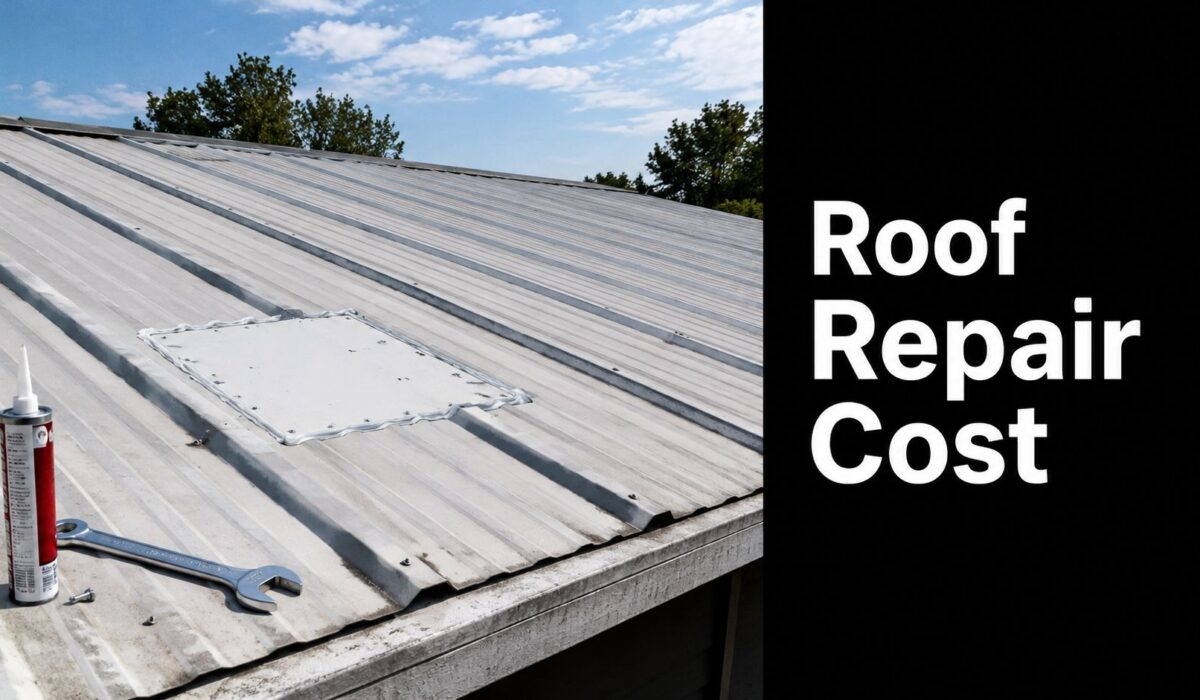
Most common metal roof repair jobs land around $600 to $3,200, and smaller fixes often start around $300 when the problem is limited and caught early. If your issue is a loose fastener, an open seam, or a small leak, the metal roof repair cost is usually far closer to a modest repair bill than a full replacement.
That matters when you're standing in the driveway after a rainstorm, looking up at a metal roof that was supposed to be the low-maintenance choice. Maybe you saw a water spot in an upstairs bedroom. Maybe a tenant called about a drip near a vent. Maybe a few screws have backed out on an older exposed-fastener system. In Sharon, Pittsburgh, Erie, and across Western Pennsylvania, that moment usually comes with the same question first. How bad is this going to be?
In most cases, less bad than people fear. Localized metal roof problems often stay in the low-thousands, not the five-figure range, if someone finds the cause and fixes it correctly. The bigger issue isn't only the repair price. It's knowing when a repair still makes sense and when you're spending money on a roof section that's already telling you it's near the end of the road.
Table of Contents
- Understanding Your Metal Roof Repair Cost in 2026
- What Determines the Final Cost of Your Repair?
- Common Metal Roof Repairs and Their Price Tags
- When Is a Repair a Better Choice Than Replacement?
- The Tradeoffs of DIY Metal Roof Repair
- How to Manage Costs and Hire the Right Contractor
- Get a Free Metal Roof Repair Estimate in Pennsylvania
Understanding Your Metal Roof Repair Cost in 2026
A metal roof leak rarely starts with a dramatic failure. More often, it's a stain on drywall, damp insulation in the attic, or a section where fasteners have started to work loose after years of movement. By the time a homeowner calls, the stress is usually coming from uncertainty more than the leak itself.
National cost guides put that uncertainty into a more realistic range. One major guide places the typical metal roof repair range at $639 to $3,195, with an average of $1,917, while another independent 2026 guide reports $300 to $1,500 on average, which supports the point that most localized repairs stay well below replacement pricing according to HomeAdvisor's metal roof repair cost guide.
For a homeowner in Sharon or a property manager in Pittsburgh, that usually means the first job is diagnosis, not panic. Metal roofs fail in specific places. Screws back out. Seams open. Flashing around penetrations loses its seal. Panels can rust in isolated sections. Those aren't all the same repair, and they shouldn't be priced like they are.
Practical rule: If the problem is isolated to one area and the surrounding metal is still sound, repair usually deserves a hard look before anyone starts talking about full replacement.
A careful estimate should answer three things clearly:
- Where the water is getting in: The visible stain inside isn't always directly below the failure point.
- How wide the problem really is: A small leak can come from a very small defect, or it can be the first visible symptom of a broader issue.
- Whether the surrounding roof still has value: That's the part that decides if you're paying for a repair or delaying a larger project.
Homeowners don't need a lecture when water is coming in. They need a straight answer. Most metal roof repair costs are manageable when the issue is caught early, and the smartest next step is an inspection that separates a fixable defect from a roof system that's failing in multiple places.
What Determines the Final Cost of Your Repair?
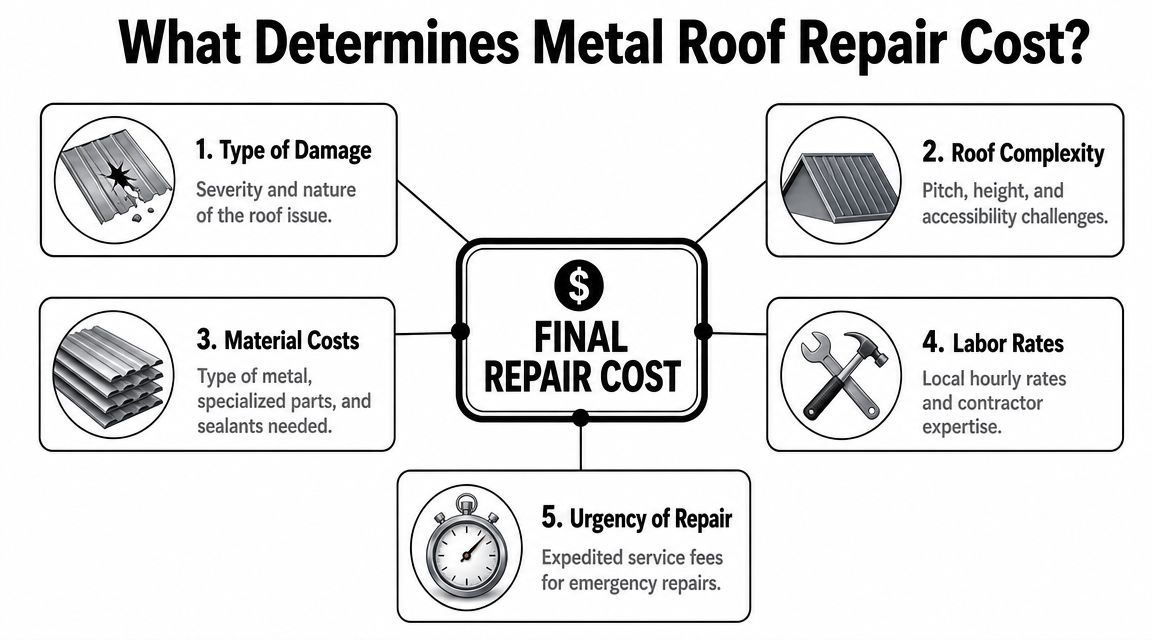
The final invoice doesn't come from one number on a chart. It comes from a handful of job conditions that either keep the repair simple or turn it into a longer, more specialized project.
Damage type changes everything
A backed-out screw and an open horizontal seam can both leak, but they don't take the same time to find or fix. Fastener issues often involve checking a broader field of panels because one loose screw is rarely the only one. Seam problems may require more cleaning, resealing, and inspection around adjacent joints to make sure the leak path is fully closed.
If corrosion is present, the repair gets more expensive because the crew has to decide whether the metal still holds a seal. Sealant won't solve a panel that's too deteriorated to support it. The same goes for flashing around skylights, chimneys, pipes, and wall transitions. Those details are where many "mystery leaks" start, and they're often more labor-intensive than homeowners expect.
Roof access and complexity affect labor
The roof itself can make a small repair feel larger. A low, simple roof over a garage is one thing. A steep section over landscaping, multiple levels, or tight access between structures is another.
Labor tends to rise when crews need more setup time, more safety equipment, or more care moving across the roof without damaging panels. On metal roofing, that matters. A contractor who doesn't know where to step, how the panels are attached, or how the seams are configured can create more problems while trying to fix the first one.
A repair estimate should reflect the roof's real working conditions, not just the size of the leak.
Materials, urgency, and local scope
Material matching affects both cost and appearance. Exposed-fastener systems, standing seam systems, trim profiles, butyl tapes, closure strips, and sealants all need to be selected to fit the existing roof. If the repair requires a panel swap, matching profile and finish can take more effort than the actual installation.
Urgency matters too. Emergency response after a storm or active interior leak can change scheduling and labor planning. The faster the response window, the fewer options a contractor has for routing the work efficiently.
A good way to read any quote is to look for these five drivers:
- Failure point: Is it a fastener issue, seam issue, flashing failure, puncture, rust section, or panel damage?
- Repair spread: Is the problem confined to one area, or does the crew need to inspect and correct similar defects across the roof?
- Access conditions: Height, pitch, obstacles, and safe walking paths all affect labor.
- Material compatibility: Matching metal profile, coating, sealant, and trim parts can raise the scope.
- Timing: Emergency service usually costs more than scheduled service.
For homeowners comparing bids, consistency matters more than the lowest line item. If one estimate includes seam resealing, fastener replacement, and flashing work, while another only lists "patch leak," those aren't the same job.
Common Metal Roof Repairs and Their Price Tags
A homeowner usually calls after seeing the same warning signs. A drip at the chimney after heavy rain. A loose screw line near the eave. Rust starting around an old pipe boot. Those problems do not carry the same price, and they should not be priced the same way.
Typical repair items homeowners ask about
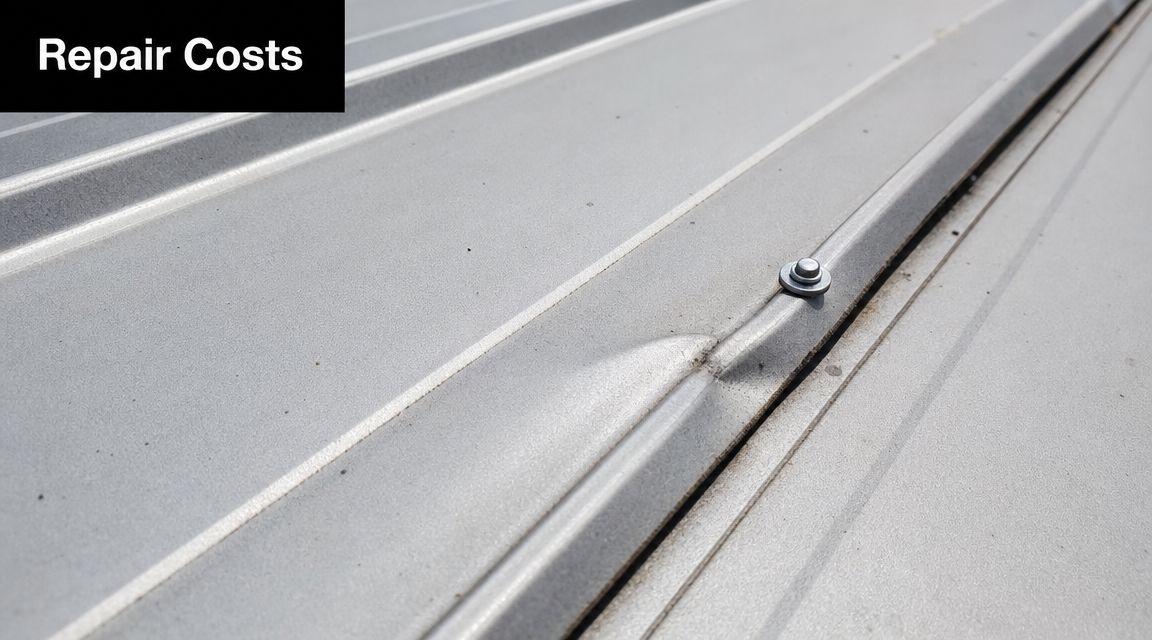
The lowest-cost metal roof repairs are usually targeted service calls. A contractor finds one leak source, corrects it, tests the area, and the rest of the roof remains in decent shape. HomeAdvisor's cited benchmarks put replacing screws at $150 to $1,000 and resealing seams at $250 to $1,100, which tracks with what crews see in the field on older exposed-fastener and standing seam roofs.
That said, the repair name alone does not set the bill. "Replace screws" can mean tightening up a few backed-out fasteners at one trouble spot, or it can mean chasing widespread fastener failure across multiple elevations. "Reseal seams" can mean one split lap joint, or several weak seams plus trim and penetration details that failed for the same reason.
| Repair Type | Typical Cost Range |
|---|---|
| Replacing screws | $150 to $1,000 |
| Resealing seams | $250 to $1,100 |
| Typical overall metal roof repair range | $639 to $3,195 |
| Average reported repair cost | $1,917 |
| Broader average benchmark | $300 to $1,500 |
Use that table as a sorting tool, not a promise.
If the quote stays near the low end, the problem is usually isolated and accessible. Once the price starts pushing into the upper end of the general repair range, the job often includes several related fixes in one visit. That is common on Pennsylvania roofs where freeze-thaw cycles, snow load, and years of thermal movement have stressed seams, fasteners, and flashing at the same time.
Flashing work is where homeowners often underestimate labor. Leaks around chimneys, rising walls, skylights, and vent penetrations take more time because the crew has to remove and rebuild details without creating a new weak point. If you want a clearer sense of those detail-driven costs, this guide on flashing repair cost explains why transition areas price differently from a simple panel or fastener fix.
When the job shifts from repair to restoration
There is a practical threshold homeowners should watch for. If one contained repair solves the issue and the surrounding roof is still holding up, repair is usually money well spent. If the contractor finds repeated seam failure, widespread fastener fatigue, coating wear, and multiple leak points in separate areas, the roof may be past the point where another small repair gives good value.
For larger restoration over an existing metal roof, commercial coating and recovery options can change the math. West Roofing Systems' ballpark commercial metal roof restoration costs place fluid-applied restoration at $3.50 to $10 per sq. ft., with silicone coating systems around $3.50 to $7 per sq. ft. and spray polyurethane foam plus coating around $5 to $10 per sq. ft.
That middle category matters on aging commercial and agricultural buildings. If the metal deck or panels are still structurally sound, restoration can cost less than full tear-off while correcting more than a one-spot repair ever will. If the metal itself is failing, though, restoration only delays a replacement decision.
When Is a Repair a Better Choice Than Replacement?
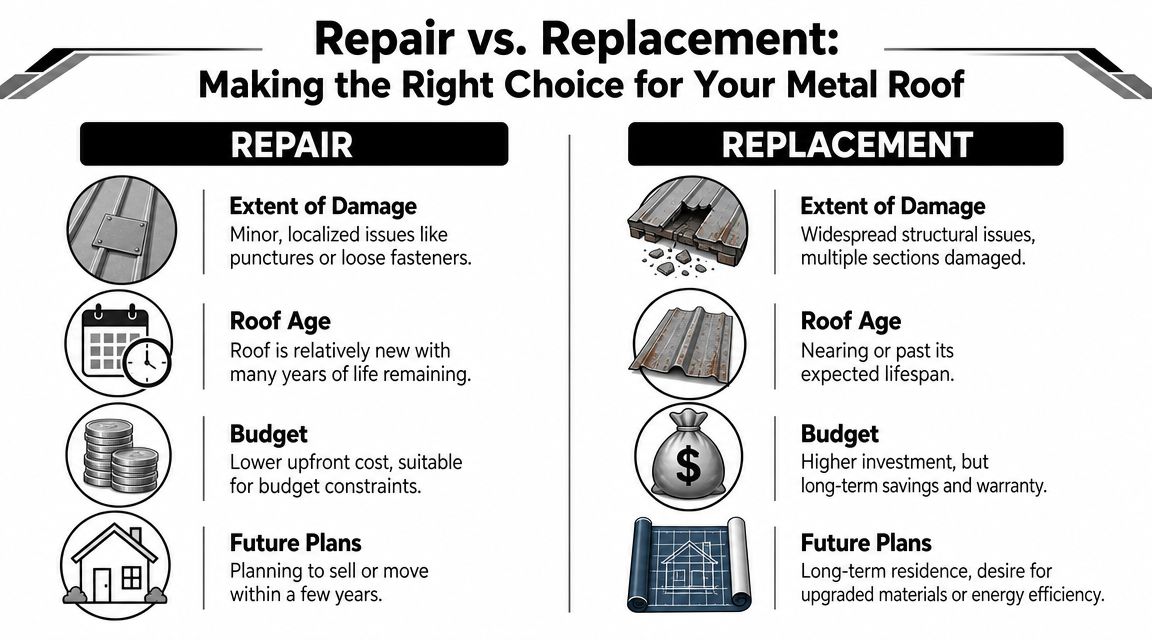
A repair is the better choice when it solves the actual problem and leaves you with a roof section that's still worth owning. That's the threshold that matters.
Repair makes sense when the problem is contained
The clearest repair candidates have a few things in common. The leak is localized. The surrounding panels are still solid. Fastener failure, seam separation, or flashing deterioration is limited to a manageable area. The roof hasn't developed a pattern of repeated service calls in different sections.
For those situations, repair stays attractive because the upfront spend remains controlled. Angi notes that repairs can range from $200 for minor fixes to over $1,500 per square for larger jobs, which shows how quickly the equation changes once the affected area expands, according to Angi's repair versus replacement cost discussion.
A practical homeowner checklist looks like this:
- One problem area: The issue is confined to a specific section rather than scattered across the roof.
- Sound surrounding metal: Panels, seams, and attachment points near the repair still hold integrity.
- No repair pattern: You haven't been fixing a new leak every season.
- Near-term plans: If you're planning a sale or a larger property update, a well-executed repair may be the sensible bridge.
Replacement becomes the smarter spend when patterns repeat
Replacement starts to make more financial sense when you're paying for access, setup, troubleshooting, and repair labor over and over again. At that point, you aren't buying one fix. You're funding recurring disruption.
Angi puts full replacement averages far higher, at $11,700 to $28,700, but that doesn't mean repair is always cheaper in the long run. It only means the entry cost is lower. If widespread fastener issues, storm damage across multiple elevations, corrosion, or repeated leaks keep pushing new invoices your way, the lower upfront cost can become the more expensive path.
The break-even point isn't one magic number. It's the moment repeated repairs stop restoring confidence in the roof.
Here is the framework I use in practice:
- Map the failures. If defects are concentrated in one area, repair is usually still on the table.
- Look for repetition. If different parts of the roof keep failing for the same reason, the system is telling you more than one repair can fix.
- Judge substrate condition. If the underlying metal is still structurally sound, restoration may be worth exploring before tear-off.
- Compare certainty. A replacement costs more up front, but it can remove the uncertainty of ongoing leak hunting.
Homeowners in Sharon, Erie, and Pittsburgh usually feel this decision before they can articulate it. If each repair buys peace of mind, keep repairing. If each repair only buys time until the next call, replacement deserves a serious estimate.
The Tradeoffs of DIY Metal Roof Repair
DIY is tempting because metal roof leaks often look simple from the ground. A loose screw. A tiny gap at a seam. A dab of sealant around a flashing edge. The problem is that metal roofing punishes bad shortcuts.
What homeowners can reasonably do
A homeowner can often do safe, useful observation from the ground or from inside the attic. You can document stain locations, note when the leak appears, photograph visible panel damage from a distance, and keep gutters and roof drainage paths clear if they can be reached safely.
Those steps help. They make the inspection faster and can reduce the chance that a small issue gets ignored for months. They also keep you from guessing where the leak started, which is how many DIY repairs go wrong.
- Document the symptom: Take photos after rain, especially where water first appears indoors.
- Track timing: Note whether the leak shows up during wind-driven rain, heavy rain, or thaw cycles.
- Stay off the roof unless you're trained: Metal roofs can be slippery, easy to dent, and unforgiving underfoot.
What should stay in professional hands
Leak tracing, fastener replacement across active roof sections, seam repair, flashing repair, panel removal, and anything structural belong with a qualified roofer. The reason isn't only safety. It's compatibility.
Wrong sealant, wrong screw, wrong washer, wrong panel handling, or incorrect foot traffic can create a second repair from the first one. On some roofs, improvised patching also makes later professional repair harder because the crew has to remove failed caulk or incompatible materials before they can install a lasting fix.
A metal roof repair should solve water entry without creating cosmetic damage, coating damage, or a warranty problem somewhere else.
If the issue is minor, a contractor may confirm that quickly. If it isn't, you haven't lost anything by avoiding a patch that looked cheap on day one and expensive by the next storm.
How to Manage Costs and Hire the Right Contractor
The cheapest way to manage metal roof repair cost is to keep a repair from turning into a spread-out problem. That starts with response time, but it also depends on who diagnoses the roof.
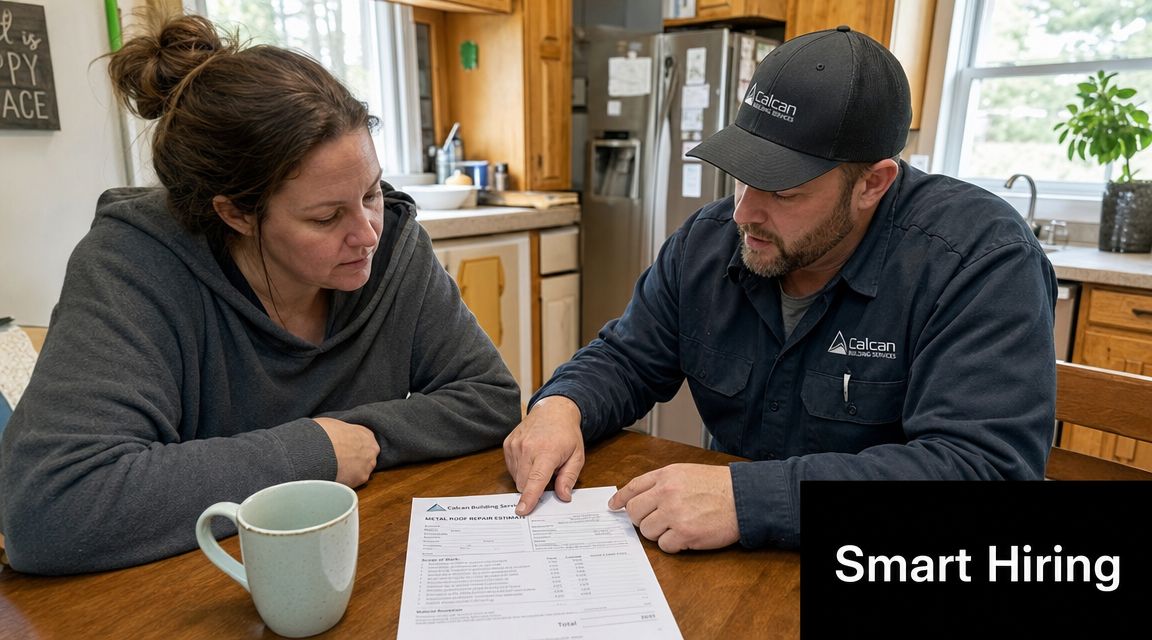
Ways to keep the repair from growing
Metal roofs reward attention. They don't reward neglect. When a homeowner waits through multiple storms because the leak seems minor, the bill often grows not because the original defect was huge, but because water had time to travel.
A few practical habits help control cost:
- Call when the leak is first confirmed: Early service gives the contractor a better chance to fix one defect instead of chasing secondary damage.
- Keep records: Prior invoices, roof age, panel type, and photos help identify recurring trouble spots.
- Ask about warranty and insurance: Some failures may intersect with prior workmanship coverage, manufacturer terms, or storm-related claims.
- Request a scope, not just a price: You want to know what is being repaired, what isn't, and what conditions could change the quote after close inspection.
For homeowners comparing companies, a contractor selection checklist like this guide on how to choose a roofing contractor is worth reviewing before you schedule work.
Questions worth asking before you sign anything
Not every roofer works comfortably on metal systems. That's the first thing to verify. Metal roofs require different repair habits than shingles, especially around seams, clips, penetrations, and panel movement.
Ask direct questions:
- What kind of metal roofs do you repair most often? Exposed-fastener and standing seam repairs aren't the same.
- What do you think is causing this leak? A clear answer beats a vague promise to "seal it up."
- Will you repair the cause or just the symptom? Those are very different scopes.
- How do you match materials? Fasteners, washers, tapes, and sealants need to fit the roof system.
- What workmanship warranty do you offer on the repair? Get the answer in writing.
- What would make you recommend replacement instead? A candid contractor should be able to explain that threshold.
Penn Ohio Roofing & Siding Group offers metal roofing contractor services in Western Pennsylvania for homeowners and commercial properties that need metal roof inspection, repair, or replacement evaluation.
A strong estimate should leave you less confused than before the appointment. If it doesn't, keep asking questions.
Get a Free Metal Roof Repair Estimate in Pennsylvania
A Pennsylvania homeowner usually calls at the same point. The bucket is back, the stain has spread, and they want to know whether this is a few-hundred-dollar repair or the beginning of a full replacement conversation.
A good estimate should answer that directly. It should show where the roof failed, what the repair needs to include, and whether the rest of the metal system still has enough life left to justify spending repair money on it. If a contractor cannot explain that threshold, the estimate is missing the part that matters most.
Penn Ohio Roofing & Siding Group serves property owners across Western Pennsylvania and handles inspections for homes, farm buildings, and commercial roofs. If you need a local contractor with experience in metal systems, their metal roofing contractor services in Western Pennsylvania are one option to consider.
Here is the practical standard I use. If the problem is isolated, the panels are still sound, and the fastener or flashing issue can be corrected without chasing failures across the roof, repair usually makes sense. If leaks are showing up in multiple areas, oxidation is advanced, panels are loose or damaged, or past patch jobs are stacking up, replacement often becomes the cheaper decision over the next few years.
That is why an estimate should do more than quote a price. It should help you decide whether this repair buys real service life or only delays a larger bill.
If your metal roof is leaking or showing its age, schedule a free estimate and ask for a repair recommendation with a clear replace-if threshold. That gives you a usable answer before the next storm forces the decision.