If you're reading this, there's a good chance your roof has started forcing the issue. Maybe snow sat too long last winter and you noticed staining on a bedroom ceiling. Maybe spring wind lifted shingles at the ridge. Maybe you're tired of patching the same problem spots every year and want a roof that makes more sense for Western Pennsylvania weather.
That’s usually the turning point. Homeowners in Mercer, Beaver, and Lawrence counties don’t need a roof that only looks good on estimate day. They need one that handles freeze-thaw cycles, humid summers, wind-driven rain, and the kind of snow load that finds every weak detail. Choosing a metal roofing contractor Western PA homeowners can trust means looking past sales talk and focusing on installation quality, local experience, and whether the crew understands how roofs fail in this region.
Why Western PA Homeowners Are Choosing Metal Roofs
A roof in Western PA takes a beating. Snow piles up, ice dams back water uphill, and summer humidity tests every seam, flashing, and vent penetration. That’s why more property owners are looking at metal as a long-term roofing system instead of just another replacement cycle.
The broader market reflects that demand. Pennsylvania’s roofing contractor industry had 3,759 businesses operating as of 2026, according to IBISWorld’s Pennsylvania roofing contractors industry data. That kind of growth tells you two things. First, homeowners are still investing in roofing work. Second, experience matters more, not less, because a crowded market always includes crews with very different skill levels.
Why metal fits this region
Metal works here because it addresses local problems directly. Snow shedding matters on a Western PA roof. So does resistance to repeated expansion and contraction through hard temperature swings. A properly chosen and properly installed metal system also gives homeowners a cleaner, lower-maintenance roofline than many aging shingle roofs can provide after years of weather exposure.
There’s also the practical side. Homeowners aren’t shopping for a roof because they’re excited about roofing materials. They’re trying to stop recurring repairs, reduce worry during storms, and avoid replacing the same roof again too soon. That’s where metal starts to look less like an upgrade and more like a sensible long-range decision.
For a closer look at the practical advantages, Penn Ohio Roofing & Siding Group’s page on the benefits of metal roofing is a useful starting point.
What homeowners often get wrong
The mistake I see most often is treating all metal roofs like the same product. They aren’t. The panel style, gauge, trim details, fastening method, and installer’s experience all matter. A metal roof can perform exceptionally well in this climate, but only when the system matches the house and the crew knows how to build for local weather.
A metal roof is not a shortcut. It’s a precision system. In Western PA, precision is what separates a long-lasting roof from an expensive headache.
Evaluating Your Metal Roofing Contractor in Western PA
Finding a contractor is easy. Finding one who can install metal correctly, communicate clearly, and handle the realities of a Western PA job is the hard part. Homeowners then need a filter, not a sales pitch.
Start with the non-negotiables
Ask direct questions. You’re not being difficult. You’re doing basic due diligence.
- Licensing and registration: Ask whether the contractor is properly registered to work in Pennsylvania and whether they pull permits in the municipalities where they work.
- Insurance: Confirm they carry liability coverage and workers’ compensation. Ask for proof, not just a verbal yes.
- Crew structure: Find out who installs the roof. A company may sell the job locally but send a subcontracted crew with uneven metal experience.
- Metal-specific training: Ask what systems they install most often and what manufacturer training or certifications they hold.
- Written scope: The proposal should define tear-off, underlayment, flashing work, ventilation details, trim, cleanup, and how unexpected decking repairs are handled.
If a contractor gets vague on any of those points, slow down.
Ask questions that reveal real experience
Good homeowners ask better questions than “How much is it?” Try these instead:
How do you handle valleys, chimneys, and dormers on a metal roof?
Complex roof geometry is where weak crews get exposed.What do you do if tear-off reveals bad decking?
A seasoned contractor will have a clear process, not a shrug.How do you manage expansion and contraction?
Metal moves. The installer should be able to explain how the system accounts for that.What kind of workmanship warranty do you provide?
Material warranties matter, but installation errors are a separate issue.Who handles permits and inspections?
You want one accountable party.
Watch how they inspect the house
A reliable estimator doesn’t stay in the driveway. They inspect the roof, look at transitions, note pitch, check attic-related ventilation concerns when relevant, and talk through drainage patterns and trouble spots. They should also ask about leak history, past repairs, and whether the existing roof has multiple layers.
That process matters because metal roofing isn’t just panel installation. It’s edge metal, penetrations, underlayment, trim fabrication, fastening strategy, and water control.
Red flag: A contractor who gives a fast price without inspecting roof complexity, flashing conditions, or access is guessing. Guessing usually becomes a change order later.
Local fit matters more than a polished pitch
Western PA projects have local wrinkles. One township may be straightforward on permits. Another may want specific paperwork, timing, or inspection coordination. A contractor who works regularly in this part of the state is less likely to get hung up on those details and delay your job.
A local contractor should also understand practical scheduling. Around here, weather moves jobs around. Good contractors talk openly about that. They don’t promise a perfect calendar they can’t control.
For homeowners comparing bids, Penn Ohio Roofing & Siding Group has a helpful guide on how to choose a roofing contractor.
Red flags that should stop the conversation
Avoid this: High-pressure sales tactics, demands for large cash deposits, vague paperwork, or anyone pushing you to sign before you’ve compared scopes.
If the contractor talks more about “today only” pricing than flashing details, that tells you where their priorities are.
What a strong estimate should include
A good proposal is specific enough that you can compare it against another one line by line.
- Roof system details: Panel type, gauge range if applicable, underlayment, trim package, fastener approach, and finish details.
- Jobsite logistics: Tear-off plan, dumpster or debris handling, property protection, and cleanup expectations.
- Responsibility for extras: How rotten decking, hidden damage, or ventilation corrections are priced.
- Closeout items: Final inspection, documentation, and warranty terms.
That’s how you evaluate a metal roofing contractor Western PA homeowners can trust. Not by who talks the smoothest, but by who explains the work clearly and builds confidence in the details.
Decoding Metal Roof Costs and Materials for Our Climate
A lot of Western PA homeowners start with one question. Why is one metal roof bid $12,000 apart from another when the houses look similar from the street?
The short answer is scope, not sales talk.
In Western Pennsylvania, the average cost of a new metal roof installation is about $20,000, with a typical range of $6,000 to $42,000, or roughly $6.00 to $12.00 per square foot, according to metal roofing cost data for the Pittsburgh market from MHI Roof. That spread is normal. Roof pricing changes fast once you factor in slope, roof shape, tear-off conditions, trim work, and access around the home.
What actually drives metal roof pricing
Material is only one piece of the number. Panel style, steel thickness, finish quality, underlayment, pipe boots, snow retention, trim, and flashing details all affect cost. Labor can be just as important, especially on steep roofs or homes with dormers, skylights, chimneys, and a lot of transitions.
Then there is tear-off and repair work. A clean deck keeps a job moving. Soft spots, bad fascia, wet insulation, or damaged sheathing add time and material. On older homes around Allegheny, Beaver, Butler, and Washington counties, that is not rare.
Municipal requirements can add cost too. One township may issue a roofing permit with basic paperwork. Another may want manufacturer specs, contractor registration, or a tighter inspection window. The permit fee itself is usually not the budget breaker. The coordination can be.
Storm damage claims also affect the budget conversation. If the roof was hit by hail or wind, the contractor should help document panel damage, collateral hits to gutters or soft metals, and any interior staining tied to the loss. Insurance may cover more than the homeowner expects, or less. It depends on the policy and how well the damage is documented at the start.
Standing seam and exposed fastener are not interchangeable
For a house in our climate, the panel system matters as much as the metal itself.
Standing seam costs more up front, but it is usually the better fit for a primary residence. The fasteners are concealed, the finished look is cleaner, and the system generally handles expansion, contraction, snow, and freeze-thaw cycles better over time when the details are done right. That matters on long roof runs and homes exposed to open wind.
Exposed fastener panels have their place. They can be a reasonable choice on garages, pole buildings, workshops, and simple rooflines where budget is driving the decision. On a cut-up residential roof with valleys, walls, and penetrations, they leave less room for installation mistakes and more maintenance responsibility down the road.
Complicated roofs punish cheap systems first.
Gauge, panel profile, and finish deserve closer attention
Western PA roofs deal with wet snow, ice, wind-driven rain, summer heat, and big temperature swings in the shoulder seasons. That is why I tell homeowners to ask harder questions than, "What color do I want?"
Steel gauge matters. So does panel profile. A thinner panel may lower the bid, but that does not automatically make it a better buy for a house that takes weather from every direction. The finish matters too. Better paint systems hold color and chalk resistance longer, which becomes more noticeable after years of sun exposure on the south and west sides of the home.
The underlayment and trim package also deserve a careful look. A strong metal roof system is not just the field panels. It is the pipe flashings, valley metal, eave treatment, wall transitions, ridge vent details, and the way the installer handles snow and water at problem areas.
Metal Roofing Material Comparison for Western PA Homes
| Material Type | Average Cost (per sq. ft. installed) | Typical Lifespan | Best For… | Considerations |
|---|---|---|---|---|
| Standing seam steel | $6.00 to $12.00 | Long-term roofing use | Primary residences, low-maintenance ownership, cleaner appearance | Higher upfront investment, demands experienced installation |
| Exposed fastener steel | $6.00 to $12.00 | Long service life when well maintained | Simpler rooflines, garages, barns, utility-focused projects | More visible fasteners, less forgiving on complex homes |
| Premium coated metal systems | $6.00 to $12.00 | Long-term roofing use | Owners focused on finish durability and appearance retention | Product and finish choice need close review |
The installed cost range above reflects the same Western PA market data cited earlier. Final pricing inside that range usually comes down to roof complexity, access, panel choice, and how much detail work the house requires.
A note on coatings and energy-minded upgrades
Some homeowners ask about specialty finishes after a summer upstairs bedroom runs hot or after they have dealt with repeated fading on an older roof. That is a fair question. If you want background on how specialty surface treatments differ from standard paint finishes, this overview of ceramic coatings is a useful starting point.
That said, coatings do not fix a poor panel choice or weak flashing package. The roof system still has to match the house and the weather exposure.
How to compare bids without missing the expensive parts
A low number on page one does not tell you much by itself. A more telling sign is whether the estimate spells out the parts of the job that tend to get glossed over. Wall flashing. Chimney work. Underlayment type. Edge metal. Decking replacement terms. Cleanup. Disposal. Protection for siding, shrubs, porches, and driveways.
If storm damage is part of the project, the bid should also make clear what is insurance work and what is owner-paid upgrade work. That keeps the claim cleaner and helps avoid fights later over supplements or excluded items.
Homeowners who want a better feel for local pricing can compare their proposal against Penn Ohio Roofing & Siding Group’s guide to metal roof installation cost. The best value is rarely the cheapest panel or the lowest proposal. It is the system that fits the roof, the house, and how long you plan to live under it.
Permits Project Timelines and What to Expect During Installation
A lot of Western PA homeowners call after the same kind of storm. Shingles blew off on a Sunday night, the insurance adjuster is coming, and now they want to know three things fast. Do we need a permit, how long is this going to take, and what is my house going to look like while the crew is here?
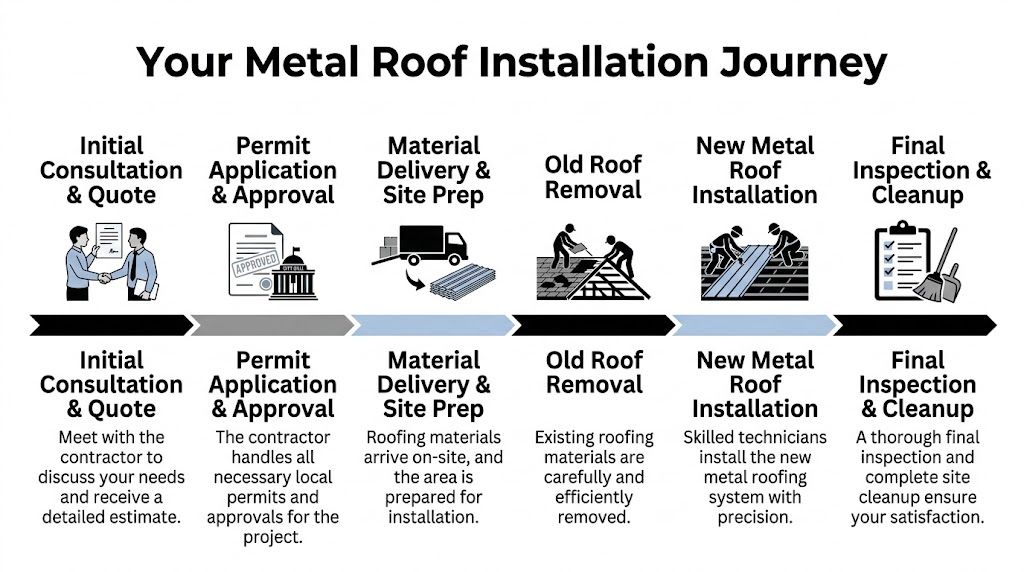
Before the crew arrives
Permit rules are not identical from one borough or township to the next. In Allegheny, Beaver, Butler, Washington, and surrounding counties, one municipality may issue a permit over the counter while another wants drawings, product details, or an inspection slot scheduled in advance. The contractor should know that process and handle it for you, aside from any owner signature the local office requires.
That paperwork affects timing more than homeowners expect.
If the roof is part of an insurance claim, get the scope lined up before materials are dropped. The contractor and adjuster do not need to agree on every line item on day one, but they do need clarity on what the carrier is paying for, what counts as code-required work, and what upgrades are owner-paid. That keeps the job from stalling halfway through over decking, flashing, or underlayment disputes.
A few days before install, the contractor should confirm access, staging, and protection details. Dump trailer location matters on narrow Western PA driveways. So does where panel bundles will be loaded, how shrubs and porches will be protected, and whether overhead service lines or detached garages create loading problems.
How long a metal roof project usually takes
A simple ranch with good access moves much faster than a steep two-story with valleys, dormers, skylights, and a chimney that needs rebuilt flashing. Weather also has more say here than many homeowners realize. Morning fog, wet decking, high wind on exposed ridges, and pop-up thunderstorms can all slow panel work, even when the forecast looked decent the night before.
Good contractors build that into the schedule instead of promising a finish date they cannot hold.
In this part of Pennsylvania, rain timing matters almost as much as rain totals. Tear-off days have to be chosen carefully. If the old roof comes off and the deck is wet, production slows down and the risk goes up. A one-day delay before starting is usually better than forcing a bad start and trying to recover from it all week.
What happens once installation starts
Day one is usually the loudest and messiest. The crew protects siding, windows, decks, AC units, and landscaping, sets up fall protection, places debris containers, and starts tear-off. If your old roof has multiple layers or hidden patchwork from past leaks, that part can take longer than expected.
Once the roof deck is exposed, the crew checks the wood, not just the surface appearance. Soft spots around chimneys, pipe boots, valleys, and eaves are common in older Western PA homes. If damaged wood turns up, you want photos, a clear explanation, and a repair price before the crew covers it.
Then the roof gets built back in the right order. Underlayment goes on. Flashing locations are laid out. Panels are installed with attention to alignment, fastening pattern, trim fit, and water flow at transitions.
That order matters.
Metal roofing has less forgiveness than homeowners think. If the first lines are off, the error carries across the roof. If trim is forced to fit instead of being cut and detailed correctly, you usually see it later around gables, walls, skylights, and penetrations. As noted earlier, installation discipline matters as much as panel selection.
Details that separate a careful install from a fast one
A professional crew pays attention to the parts you may never notice from the yard. Panel layout has to stay true. Flashings have to shed water cleanly. Areas where the metal expands and contracts need room to move without oil-canning, fastener stress, or trim distortion. The roof also needs the right underlayment and closure details for our freeze-thaw cycles, wind-driven rain, and snow that can sit at transitions longer than it should.
On homes with low-slope sections, porches, or additions tied into older framing, these details get more important. Western PA roofs often have additions built in different decades, and those transitions are where rushed work shows up first.
Good metal work is quiet, straight, and deliberate. The crew should never look like it is making the roof up as it goes.
What you should expect each day
- Morning setup: Crew arrival, material staging, ladder and safety setup, and a quick review of the day’s work area.
- Active install hours: Tear-off, deck repairs if needed, underlayment, panel installation, trim work, and a lot of overhead noise.
- Daily closeout: Loose debris picked up, magnet sweep around the house, exposed areas dried in if the roof is not finished, and the site checked before the crew leaves.
Ask one simple question at the end of each day. Is the house fully weather-tight tonight? A good contractor answers that clearly.
What can change the timeline
Weather is the obvious factor, but permit inspection timing, late material arrivals, hidden deck damage, masonry work at chimneys, and insurance approval on supplements can also extend the job. That is especially true after hail or wind events, when suppliers, adjusters, and municipal offices are all backed up at once.
The best approach is steady communication. Homeowners should know who their point of contact is, when change orders will be discussed, and how photo documentation will be shared if storm damage or rotten decking is found. That is how you keep a roofing project organized instead of reactive.
By the final day, the roof should be complete, flashings finished, job debris removed, and the grounds cleaned well. You should also get a walkthrough, material and color confirmation, and a clear explanation of what was installed, what the permit covered, and what paperwork to keep for warranty and insurance records.
Maximizing Your Investment with Proper Maintenance and Warranties
A metal roof doesn’t need constant attention, but it shouldn’t be ignored either. Homeowners get the best value when they treat it like a durable system that still benefits from periodic checks, especially after rough weather.
Simple maintenance that actually matters
Most routine care is basic. Keep valleys and gutters clear so water can drain. Trim back branches that can scrape the finish or drop debris onto the roof. After major storms, inspect the roof from the ground for lifted trim, damaged flashing, fallen limbs, or anything that looks out of place.
If you suspect a problem, don’t send somebody up there casually. Metal roofs can be damaged by careless foot traffic, and steep roofs in particular should be inspected by trained professionals.
Know the difference between the two warranties
Homeowners often hear “lifetime warranty” and assume that covers everything. It doesn’t.
A manufacturer’s material warranty usually addresses the roofing product itself, such as finish performance or material defects. A workmanship warranty covers installation-related errors, which is why contractor quality matters so much. If flashing was built poorly or trim was installed incorrectly, that’s not the same as a product defect.
Read both. Ask who to call first if there’s a problem. Good paperwork avoids confusion later.
What to do after hail or wind damage
A common challenge for many homeowners involves storm damage claims. Homeowners in Western PA regularly ask about storm damage claims on metal roofs, and the process can be more frustrating than they expect. As noted in this Western PA metal roof repair guide discussing insurance claim concerns, it’s important to verify coverage under standard HO-3 policies, document damage carefully, and work with an experienced contractor who can help coordinate with the adjuster.
Here’s the practical sequence:
- Document first. Take clear photos of visible damage, interior staining, fallen debris, and any related gutter or siding impact.
- Prevent further damage. If emergency protection is needed, arrange temporary measures and keep records.
- Review your policy. Check deductible, exclusions, and whether cosmetic versus functional damage language matters.
- File promptly. Don’t wait and give the carrier room to argue about timing.
- Meet the adjuster prepared. Have your contractor present if possible so roof-specific details don’t get missed.
Metal roofs can face extra scrutiny in claims because adjusters may view them as tougher systems. That makes documentation and a clear contractor assessment especially important.
Keep records like they matter
Save your contract, color information, panel specifications, warranty documents, repair receipts, and photos from installation day if you have them. If you sell the house or need a later repair, that paperwork helps the next decision go much faster.
Maintenance on a metal roof isn’t complicated. Consistency is what counts.
Why Choose Penn Ohio Roofing & Siding Group
After you’ve sorted through contractor qualifications, material choices, permits, jobsite expectations, and warranty issues, the central question becomes simpler. Who can execute the work correctly on a Western PA home?
Penn Ohio Roofing & Siding Group is a family-owned and operated roofing company serving Hermitage and surrounding areas in Mercer, Beaver, and Lawrence counties, with over 25 years of experience in residential and commercial roofing. The company is licensed, bonded, and insured, offers free estimates, provides emergency service availability, and works on metal roofing along with other roofing types. Those are practical facts, not marketing fluff, and they matter because roofing problems in this region are rarely one-size-fits-all.
Why experience matters on metal
Metal roofing rewards precision. It punishes shortcuts. That’s why contractor selection shouldn’t come down to who can order panels.
A proper installation methodology is critical for long-term performance. According to this metal roofing cost and installation methodology guide, labor can make up 40 to 60 percent of total project cost, and only experienced, certified installers who follow precise steps for panel alignment, sealing, and fastener placement can deliver a system that resists leaks and lasts three times longer than premium asphalt.
How that applies to local homeowners
For a homeowner in Western PA, that translates into a few practical advantages:
- Better diagnosis before the job starts: Older homes in this region often have additions, patched areas, odd framing transitions, or ventilation issues that need to be caught early.
- Cleaner handling of details: Chimneys, valleys, porch roofs, dormers, and wall flashings are where experience shows.
- More realistic scheduling: Local jobs don’t happen in laboratory conditions. A contractor with roots in the area knows weather, municipal expectations, and common site complications.
- Stronger communication during surprises: If tear-off exposes damaged decking, you want a contractor who can explain the issue and fix it without chaos.
A grounded standard for choosing
No homeowner needs hype. They need a contractor who shows up prepared, explains the work clearly, installs the roof safely, and stands behind the finished job. That’s the standard any serious company should meet.
The best roofing relationship is a straightforward one. Clear scope. Skilled crew. No guessing about who is responsible for what.
If you’re comparing metal roofing contractor Western PA options, the useful question isn’t who has the flashiest pitch. It’s who has the experience, local footing, and installation discipline to handle the roof you have.
Your Metal Roofing Questions Answered
Can a metal roof go over old shingles
Sometimes, yes. Whether it should depends on the existing roof, local code requirements, deck condition, and the metal system being installed. If the old roof is hiding soft decking, moisture issues, or uneven surfaces, a full tear-off is usually the smarter path because it lets the contractor inspect the structure and build the new system on a clean base.
Is a metal roof loud when it rains
In a properly built residential assembly over solid decking, modern underlayment, and insulation, it usually isn’t the issue people expect. Noise concerns tend to get overstated. What matters more is how the roof system is assembled, not the fact that the surface is metal.
How do I know if I need repair or replacement
Look at the pattern, not just one symptom. If the roof has repeated leak points, worn flashings, visible age-related deterioration, or storm damage across multiple areas, replacement may make more sense than another patch. If the problem is isolated and the system is otherwise in good shape, repair may be enough.
What should I ask during the estimate
Ask who installs the roof, who pulls permits, how decking repairs are handled, what warranty covers workmanship, and how the crew will flash transitions like chimneys and valleys. Those answers tell you far more than a polished brochure.
What if storm damage happens after installation
Start with documentation. Take photos, note the date of the storm, and contact your contractor before making assumptions about the scope of damage. If an insurance claim may be involved, keep all communication organized and ask for a roof inspection that distinguishes cosmetic issues from functional damage.
How long does the project take
That depends on roof size, complexity, weather, and whether tear-off reveals hidden repairs. A simple roof moves much differently than a steep house with dormers, porches, and multiple transitions. The important thing is not the fastest promise. It’s whether the contractor has a realistic plan and communicates changes quickly.
If your roof is starting to fail, or you want a clear opinion before spending money, Penn Ohio Roofing & Siding Group can help you sort through the practical decisions that matter, from metal roof options and installation scope to storm damage documentation and next-step planning for homes in Western PA.