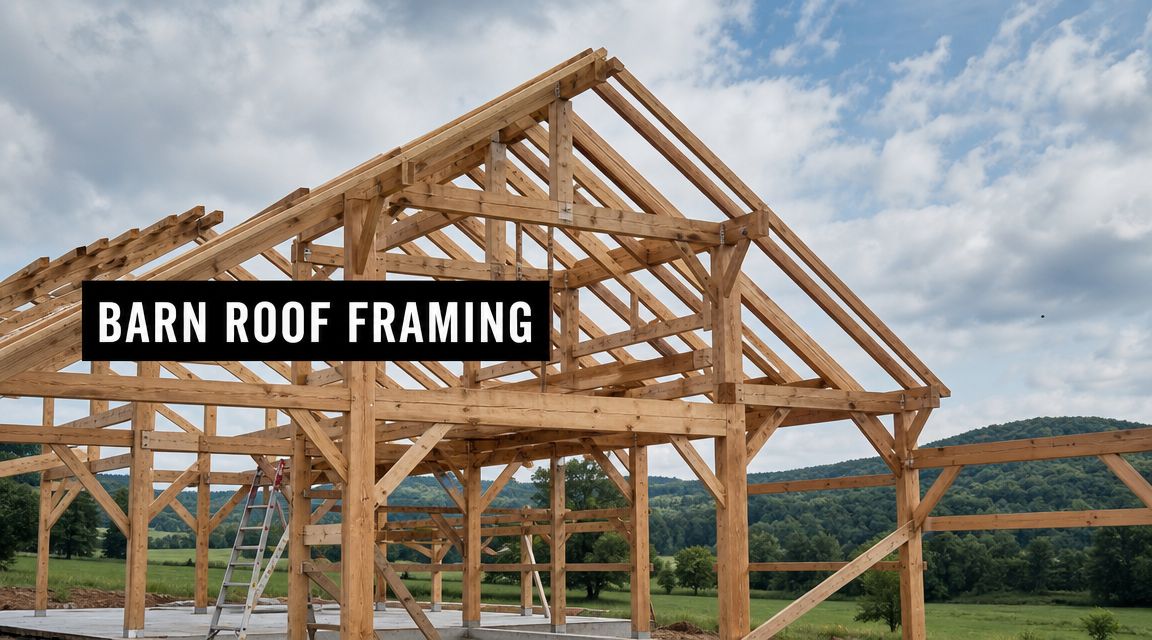
You're probably looking at a barn-style roof for one of three reasons. You want the look. You want the upper volume. Or you've got a practical use in mind, like a workshop, garage, equipment building, or hybrid living space, and a plain gable just doesn't give you enough room where it counts.
In Pennsylvania, that decision isn't just about curb appeal. A barn roof that looks right in Sharon, Pittsburgh, or Erie also has to stand up to wet winters, drifting snow, spring wind, and years of expansion and contraction. The shape matters, but the framing matters more. Good barn style roof framing isn't a sketch on a napkin. It's a load path, a connection strategy, and a weathering plan built to last.
Table of Contents
- Why Barn Style Roofs Are a Timeless Choice in Pennsylvania
- The Two Main Types of Barn Style Roofs
- The Anatomy of a Barn Roof Structure
- Choosing Materials for Your Roof Frame and Finish
- Planning for Span, Load, and Pennsylvania Weather
- What to Expect for Costs and Hiring a Contractor
- Frequently Asked Questions About Barn Roof Framing
Why Barn Style Roofs Are a Timeless Choice in Pennsylvania
A lot of homeowners start with the silhouette. They've seen an old gambrel barn outside town, or they want a detached garage that doesn't look like a basic box with a lid on it. Then the practical questions show up fast. Will the loft be usable? Will it work near the city as well as it does on open land? Can it be framed to hold up through Pennsylvania winters?
That's why this roof style keeps showing up well beyond old farm country. A building-industry source notes that common gambrel pole-barn sizes range from 30×40 to 60×100, while common monitor-barn footprints run from 36×60 to 60×120, which tells you these aren't novelty buildings. They scale from modest outbuildings to large structures built for real use (modern barn style size ranges).
For homeowners thinking beyond the roof alone, it also helps to spend some time understanding barndominium construction, because the roof form, wall system, and interior use all affect one another.
Why the style still works here
Pennsylvania is a good fit for barn roofs because the form solves more than one problem at once. It gives you recognizable character, but it also creates functional upper space for storage, a shop mezzanine, or future finish-out. Around Pittsburgh, that might mean a workshop behind the house. In Sharon, it might be a detached garage with room overhead. Near Erie, it might be a larger agricultural or utility building where snow handling becomes part of the design conversation from day one.
Barn roofs stay popular because they do useful work. The appearance is a bonus.
What homeowners often miss at the start
The mistake is assuming the roof shape is the project. It isn't. The framing geometry changes how loads travel into the walls, and that affects everything from member layout to bracing to connector selection. A barn roof can last for decades, but only if the framing matches the use, the span, and the local weather exposure.
That's the difference between a roof that looks like a barn and one that performs like a professionally built structure.
The Two Main Types of Barn Style Roofs
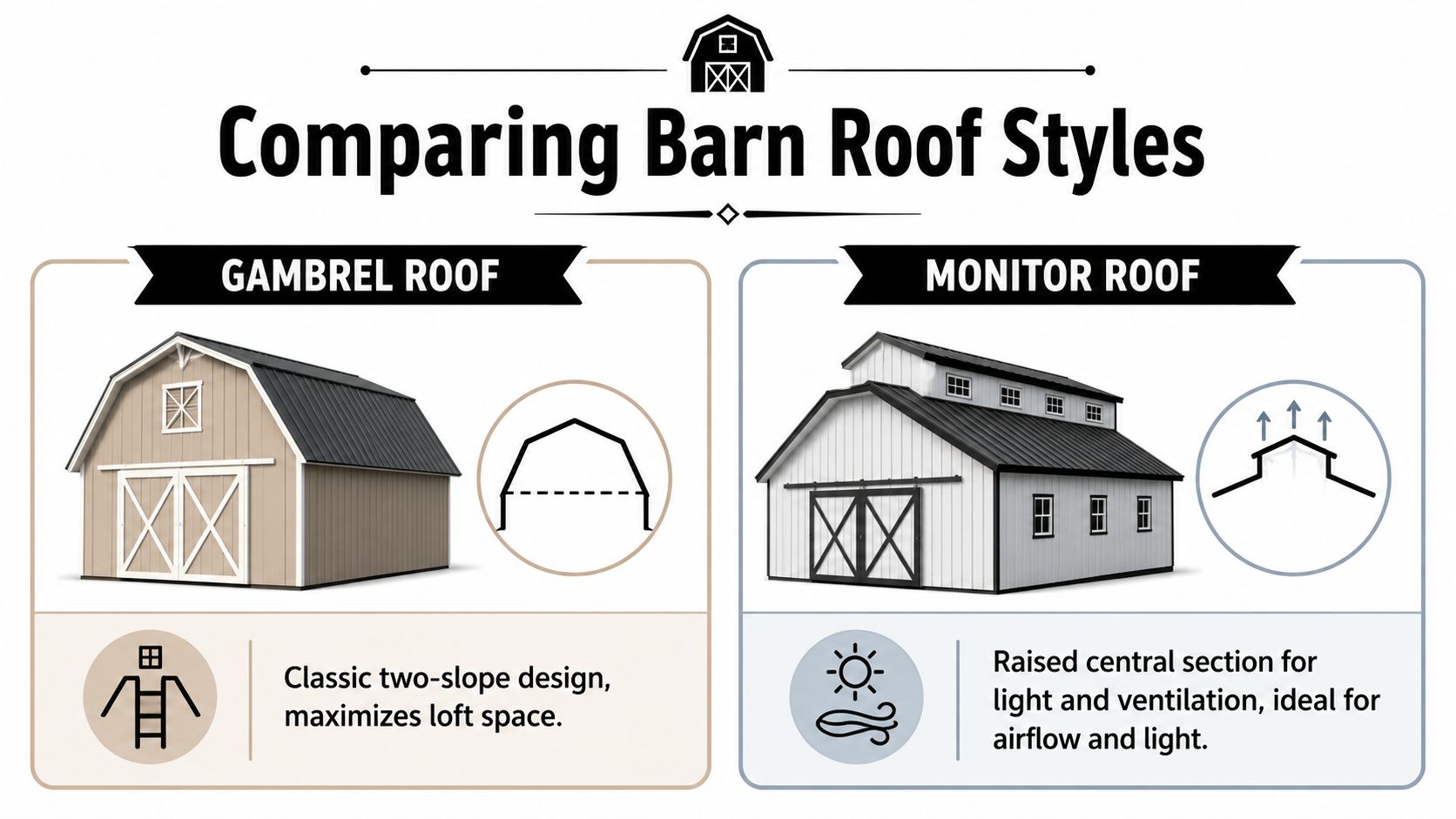
The term “barn roof” is often used as a catchall term, but in practice there are two main profiles homeowners usually mean: gambrel and monitor. They do different jobs, and the right choice depends on what you need the building to do.
Gambrel roof
The gambrel roof is the classic barn shape. It has two slopes on each side, with the lower slope steeper than the upper slope. GAF notes this form was already common in 18th-century North American Dutch colonial homes, and one of the practical reasons it has stayed relevant is that it can add up to 800 sq ft of usable interior area compared with a simple gable (gambrel roof history and interior space).
That extra space is the main draw. If you want a loft that feels usable instead of cramped, the gambrel usually gets you there more efficiently than a simple gable at the same footprint.
The trade-off is framing complexity. The break in slope creates a transition point that has to be laid out accurately. That joint isn't where you want guesswork. Roof angles, heel details, and sheathing support all need to be coordinated. If you're comparing proportions, this guide to gambrel roof angles is useful because angle decisions affect both appearance and framing behavior.
Monitor roof
A monitor roof has a raised center section above the main roof planes. Think of a long central cap sitting above lower flanking roofs. Traditionally, that raised section was used for light and ventilation, and that's still the reason to choose it.
A monitor roof makes sense when airflow, daylight, and a more open central interior matter more than maximizing loft volume. It's a practical choice for some workshops, equestrian structures, and larger utility buildings where the center bay needs breathing room.
A simple comparison helps:
| Roof type | Best use | Main benefit | Main trade-off |
|---|---|---|---|
| Gambrel | Lofted garages, storage buildings, barn-inspired homes | More usable upper volume | More complicated slope transition |
| Monitor | Work buildings, light-commercial, utility and agricultural spaces | Natural light and ventilation potential | More roof intersections and weathering details |
The short version is this. If your priority is upper-level space, most homeowners are really talking about a gambrel. If your priority is center-aisle function, light, and ventilation, monitor starts to make more sense.
The Anatomy of a Barn Roof Structure
A barn roof works like a skeleton. The shape gets the attention, but the bones do the work. If one part is undersized, poorly connected, or laid out out of plane, the whole assembly starts fighting itself.
The core members that carry the roof
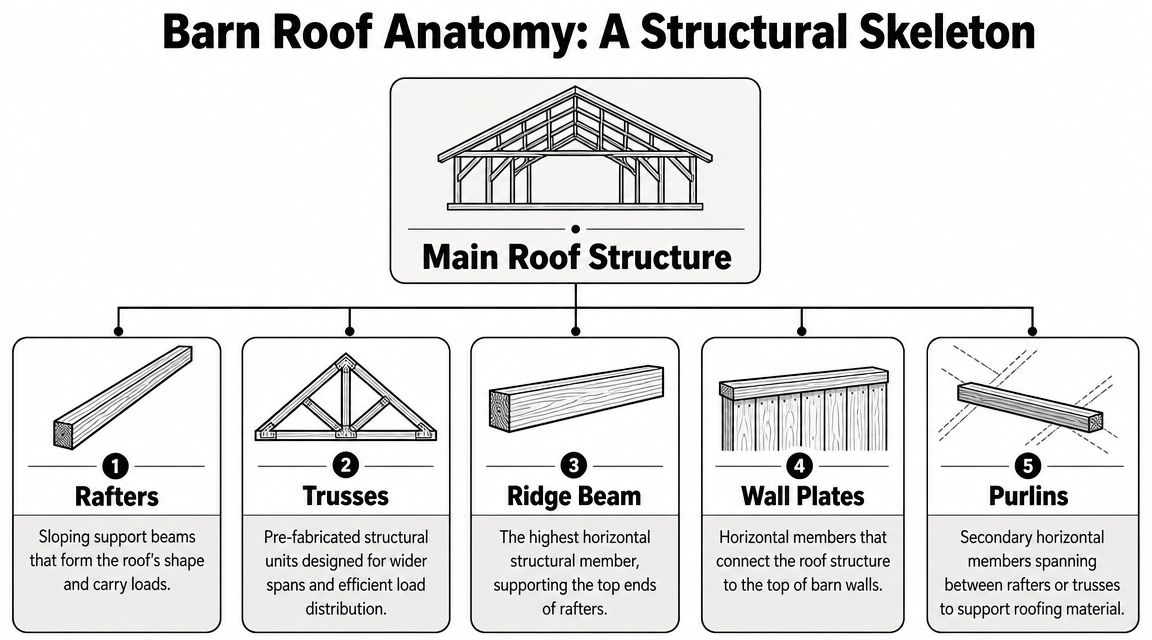
Start at the bottom. The wall plates receive the roof loads and hand them into the wall system. Above that, rafters or trusses form the main sloped structure. At the peak or upper meeting point, the assembly may include a ridge beam or a ridge board depending on the structural design. Purlins act as secondary horizontal members that support roofing or transfer load between primary framing elements.
On a gambrel, the framing gets more demanding at the slope break. That change in pitch has to stay straight across the building. If the layout wanders, the roof surface won't plane cleanly, and the finish work starts telegraphing every error.
A few parts deserve special attention:
- Rafters carry roof loads down the slope into supports.
- Trusses package that work into engineered shapes that span efficiently.
- Purlins help support the roof covering and distribute loads.
- Collar ties or other restraint details help control movement where the design requires them.
- Sheathing locks the surface together and contributes to diaphragm behavior when installed correctly.
If you want a cleaner understanding of how the roof edge finishes tie into ventilation and drainage, this article on soffit and fascia explained helps connect the framing to the finished exterior details.
Practical rule: The roof frame and the roof edge details should be planned together. A sharp-looking fascia line won't stay sharp if the framing under it is inconsistent.
Stick framing versus trusses
For barn style roof framing, the big construction choice is usually stick-built rafters versus prefabricated trusses.
Stick framing gives more field flexibility. It's useful when the building has unusual conditions, when a crew is matching an existing structure, or when custom detailing matters more than speed. But it demands a higher skill level. Every cut has to be right, and every repeated member has to stay consistent. On a gambrel, the compound geometry exposes sloppy work fast.
Prefabricated trusses are often the better route for straightforward new construction. They arrive with the geometry established, they reduce field cutting, and they can simplify layout on larger projects. In practical builds, gambrel roof framing is commonly spaced at 16 in. on center for higher stiffness, though 24 in. on center is sometimes used where loads are lower and the sheathing is designed for it (common gambrel framing spacing).
Here's how the choice usually plays out:
| Framing method | Works well when | Watch for |
|---|---|---|
| Stick-built rafters | Custom geometry, remodel work, visual timber character | Layout error, slower labor, inconsistent cuts |
| Prefabricated trusses | New builds, repeatable geometry, faster installation | Delivery access, crane planning, less field modification |
What separates a professional build from a weekend attempt isn't just the cut quality. It's alignment, bearing, fastening sequence, temporary bracing during erection, and knowing where the structure can't be improvised.
Choosing Materials for Your Roof Frame and Finish
Material selection is where a lot of projects drift off course. Someone picks a roof covering for looks, then tries to make the frame fit afterward. That backwards process causes problems. The frame and finish need to be chosen as one system.
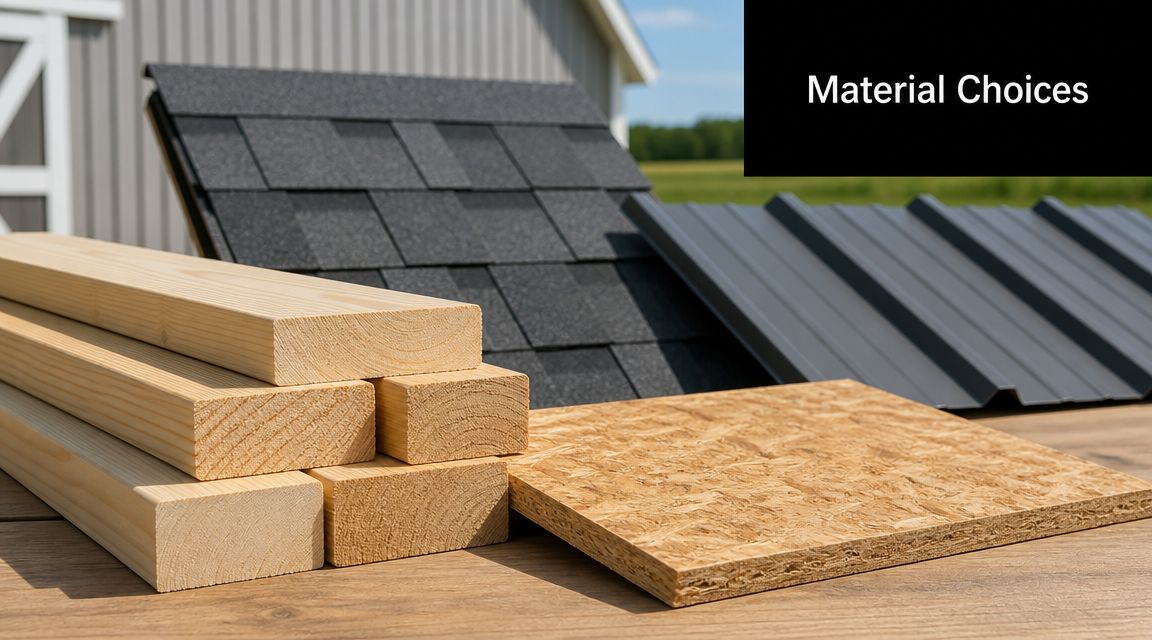
Frame material choices
Most residential-scale barn style roof framing uses dimensional lumber or engineered wood products. Traditional sawn lumber is familiar, available, and workable in the field. Engineered components can help when straightness, consistency, or longer members matter.
Steel framing also has a place, especially in larger agricultural or light-commercial buildings, but it changes the detailing. Fastener types, bearing conditions, thermal movement, and condensation control all become more important. It's not a drop-in substitute for wood. It's a different system.
Good builders choose frame materials based on the actual job:
- Dimensional lumber fits many detached garages, shops, and smaller barns.
- Engineered components help when design consistency and prefabrication matter.
- Steel systems can suit larger clear-span or commercial-style structures, but they need matching details at every connection and penetration.
Roof covering changes the framing plan
The roof finish affects weight, fastening, underlayment choices, edge details, and sometimes slope requirements. Standing seam metal is a common choice on barn-style structures because it fits the look and handles long runs well. Asphalt shingles can work too, especially on residential barn-inspired buildings, but the underlying roof geometry has to support a clean install at the slope transitions.
The key is to decide early whether the project is being framed for metal, shingles, or another covering. That decision affects sheathing choices, ventilation detailing, trim layout, and flashing strategy around ridges, eaves, and wall intersections.
For homeowners weighing appearance against long-term service needs, this review of metal roofing pros and cons is worth reading before finalizing the framing package.
A roof covering doesn't just sit on the frame. It asks things of the frame. Weight, movement, fastening pattern, and water management all start below the surface.
What doesn't work is mixing an agricultural-style frame, residential finish expectations, and vague detailing. That combination usually creates callbacks at the trim, leaks at transitions, or uneven roof lines that were avoidable on paper.
Planning for Span, Load, and Pennsylvania Weather
Pennsylvania weather is where barn roof ideas get tested. A roof that looks fine in a rendering can struggle in the field if the framing wasn't built around actual local conditions. That matters in every part of the state, but it becomes especially important where winter loading and wind exposure are more demanding, including around Erie.
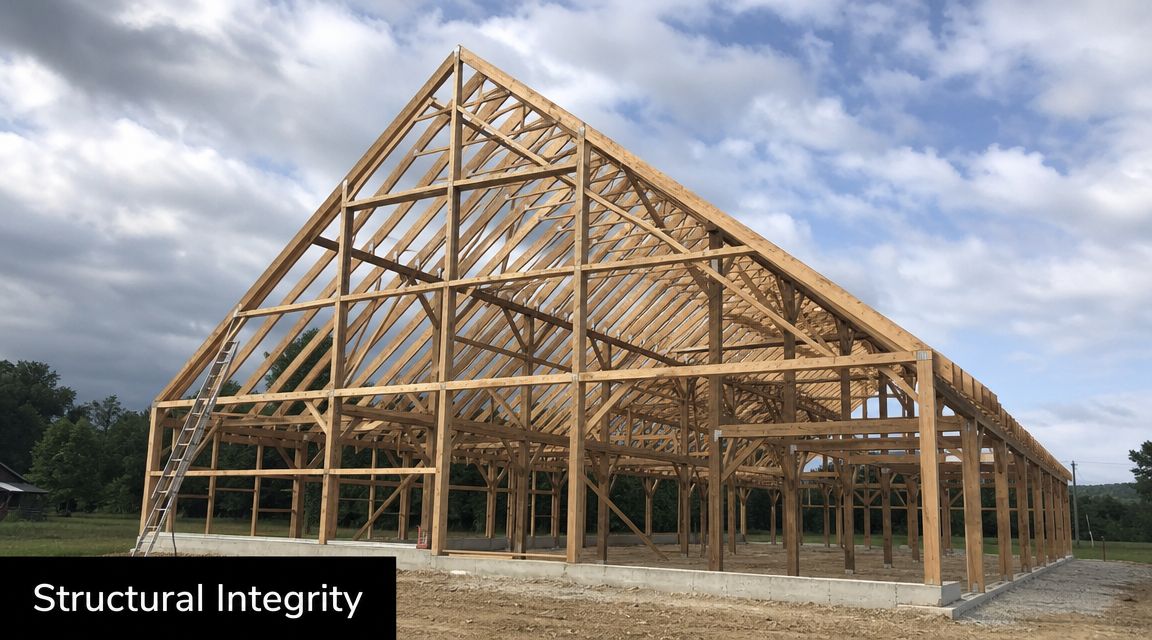
Why local loading matters
Span changes everything. As a building gets wider, the roof framing has to carry loads farther, control deflection better, and hand those loads down cleanly into the supporting walls and foundation. That's true whether the building is a detached garage in Sharon or a larger workshop outside Pittsburgh.
The trouble with many basic how-to discussions is that they stop at geometry. They show the outline and the cuts, but they don't explain the structural chain underneath. A critical gap in many barn-style framing guides is connector and uplift detailing. One source specifically notes that many public guides focus on layout but don't explain the code-based connector strategy needed to create a continuous load path for wind and snow resistance, especially in higher-wind or heavy-snow regions (connector and uplift detailing for gambrel roofs).
That point matters more than most homeowners realize. The roof doesn't fail only from weight pushing down. It can also fail when wind tries to lift it, rack it sideways, or stress weak joints at the slope break and roof-to-wall connection.
What separates a code-ready build from a DIY roof
A durable barn roof has to move loads from the roof skin to the sheathing, into rafters or trusses, through connectors, into wall plates, down the wall structure, and finally into the foundation. If one link in that chain is weak, the whole system is compromised.
That's why wall design can't be treated as a separate topic. If you need a plain-language refresher on how support travels through a structure, this guide to understanding structural walls is helpful.
Here's what professionals pay attention to that DIY builds often miss:
- Connector selection: Not every hanger, strap, or tie is appropriate for every load path.
- Uplift resistance: Roof-to-wall connections need to be specified, not guessed.
- Bracing during installation: Temporary bracing keeps the frame stable before the assembly is fully locked together.
- Sheathing layout: Panel edges, fastening pattern, and continuity all matter for stiffness and weather resistance.
- Local review: Permit and inspection requirements aren't paperwork for its own sake. They force the structure to be checked against actual site conditions.
If a builder can explain the roof shape but can't explain the load path, the conversation isn't finished.
In Pennsylvania, that level of planning isn't overbuilding. It's what keeps a barn roof from becoming a chronic leak point, a sagging profile, or a winter problem waiting to happen.
What to Expect for Costs and Hiring a Contractor
A barn roof that looks right from the driveway can still fail where it counts. In Pennsylvania, the expensive mistakes usually show up after the first hard winter, when snow load, ice, wind-driven rain, and freeze-thaw cycling start testing every framing joint and flashing break. Cost has to be judged against service life, repair exposure, and whether the roof was built to pass inspection without shortcuts.
Pricing varies because barn-style roofs are detail-heavy assemblies. A gambrel usually takes more layout time, more cut work, and more attention at the slope break than a basic gable. A monitor roof can add framed wall sections, additional flashing lines, and more opportunities for leaks if the transitions are handled poorly. On paper, two estimates can look close. In the field, they may be pricing very different scopes.
What drives cost
The main cost drivers are usually easy to identify once the plans are specific:
- Building size and span: Bigger buildings need more framing, more sheathing, and often stronger members or engineered components.
- Roof geometry: Gambrel and monitor roofs both add labor, but in different places. Gambrels increase layout and framing complexity. Monitor roofs add transitions, vertical surfaces, and flashing work.
- Structural package: Stick framing, site-built rafters, attic trusses, and engineered trusses do not price the same, and they do not place loads on the walls in the same way.
- Roofing system: Metal, shingles, synthetic underlayments, ice protection, trim packages, and ventilation details all affect final cost.
- Site and tear-off conditions: Access for material delivery, disposal, staging, and weather delays can move labor costs more than homeowners expect.
- Permit and engineering needs: If the job requires stamped drawings, permit revisions, or structural review, that belongs in the budget from the start.
The cheapest number often leaves out the parts that keep the roof dry and code-compliant.
That usually means underspecified flashing, vague framing language, no mention of ice-barrier coverage, or no clear responsibility for permits and inspections. In Pennsylvania, those omissions matter because the roof has to do more than shed a summer rain. It has to resist uplift, carry seasonal loading, and stay watertight at the details that barn profiles create.
What to review before you sign
A solid proposal should let you see exactly what is being built and who is responsible for each part. If the estimate stays general, expect change orders or arguments once the roof is open.
Review these items in writing:
- Framing method: Are they using trusses, site-built rafters, or modifying an existing structure?
- Design responsibility: Who is providing the structural layout if span, loading, or connection details need engineering review?
- Sheathing and underlayment: Thickness, panel type, fastening pattern, underlayment type, and ice protection should be listed.
- Flashing and trim scope: Monitor walls, gambrel breaks, valleys, curbs, and eaves need specified metalwork.
- Ventilation plan: Intake and exhaust should be addressed, especially where barn geometry creates tight transition zones.
- Permit and inspection responsibility: Someone should own submittals, approvals, and correction work if the inspector calls for changes.
- Insurance coverage: Get current proof of liability and workers' compensation coverage.
- Change-order process: The contract should state how hidden damage, framing corrections, or code-required upgrades will be priced.
If you want a practical screening tool before the first meeting, this checklist of questions to ask roofers is a useful place to start.
For local homeowners, Penn Ohio Roofing & Siding Group is one company operating in this market. The same standard applies whether you call them or another contractor. Ask who is handling the structural scope, who is handling the weatherproofing details, and who is accountable when the inspector asks for documentation or corrections.
A professional bid is usually more specific, not more polished. Clear scope, clear exclusions, and clear responsibility lines are what protect the budget on a barn roof project.
Frequently Asked Questions About Barn Roof Framing
Can an existing gable roof be converted to a barn-style roof
Sometimes, but it's rarely a cosmetic swap. Converting a gable to a gambrel changes geometry, load paths, and wall reactions. The existing walls, top plates, and foundation may or may not be suitable for the new roof form. A contractor or engineer needs to review the whole structure before anyone promises that conversion is practical.
Which is better for a workshop, gambrel or monitor
It depends on how you'll use the upper volume and the center of the building. If you want loft storage or future finished space, gambrel usually makes more sense. If daylight and airflow through a taller center section matter more, monitor may be the stronger fit. The right answer comes from use, not style alone.
Does a barn-style roof need special maintenance
Yes, mostly at the details. The places to watch are transitions, flashing, ridge conditions, fasteners, and any area where snow and water can sit longer than expected. On metal roofs, inspect trim and exposed fasteners where applicable. On shingled roofs, watch the break lines and penetrations. Early maintenance is a lot cheaper than structural repairs caused by long-term moisture.
Are gutters and ventilation more important on barn roofs
They can be. Barn roof geometry creates strong water movement, and some profiles dump water quickly at eaves and lower roof sections. Gutters need to be sized and fastened for that runoff pattern, and attic or roof-cavity ventilation needs to match the framing and insulation strategy. A good-looking roof edge is not enough if moisture gets trapped behind it.
If you're planning a gambrel or other barn-style roof in Sharon, Pittsburgh, Erie, or the surrounding region, Penn Ohio Roofing & Siding Group can help you evaluate the framing, roofing, and weatherproofing side of the project so you can move forward with a build that's designed to last, not just look the part.