
If you're pricing continuous run gutters for a standard Pennsylvania home, aluminum usually lands between $1,200 and $4,000 for about 200 linear feet. Nationally, continuous run aluminum typically runs $6 to $20 per linear foot installed, and that's the right baseline for homes in places like Sharon, Pittsburgh, and Erie.
If you're reading this, there's a good chance your current gutters are leaking at the seams, pulling away from the fascia, or dumping water right where you don't want it. Most homeowners don't start shopping for gutters because it sounds fun. They start when they see overflow by the front porch, mulch washing out, or water creeping too close to the foundation.
Here's my straight answer. One-piece gutters cost more up front than sectional gutters, but they usually make more sense. The problem is that most online price guides stay too broad. They'll throw out a national number and stop there. That doesn't help much when your house sits in western Pennsylvania, your roof has multiple angles, and your installer has to work around a steep pitch, landscaping, or second-story access.
This guide cuts through that. You'll see the actual gutter cost, what drives it higher, where homeowners get surprised, and how to budget for the job without guessing.
Table of Contents
- What Is the Real Seamless Gutter Cost in 2026
- Breaking Down the Per-Foot Cost of Seamless Gutters
- Factors That Drive Your Final Gutter Installation Price
- Sample Gutter Estimates for Pennsylvania Homes
- Hidden Costs and Add-Ons for Your Gutter System
- How to Get a Firm Seamless Gutter Quote in PA
- Are Seamless Gutters a Smart Investment for Your Home
What Is the Real Seamless Gutter Cost in 2026
When gutters fail, the first question is always the same. What's this really going to cost me?
For Pennsylvania homeowners, the cleanest starting point is this: aluminum gutters cost between $6 and $20 per linear foot installed nationally, with material alone at $4 to $9 per foot, and a standard 2,000-square-foot home in Pittsburgh, Sharon, or Erie needing about 200 feet of guttering typically averages $1,200 to $4,000 according to Pennsylvania seamless gutter pricing data.
That range is wide for a reason. A simple one-story home with easy access sits at the lower end. A taller house, more corners, more downspouts, or a trickier roofline pushes the price up. Homeowners get in trouble when they hear a low number and assume it applies to every house.
What that baseline really means
Think of the $1,200 to $4,000 range as your budgeting lane, not your final invoice. It tells you whether your project is basic, moderate, or complex.
A basic job usually means:
- Simple roofline: Fewer angles and easier measurements
- Single-story access: Faster install and safer setup
- Standard aluminum system: The most common and budget-friendly option
A higher quote usually means the contractor has to deal with more site-specific work. That's not padding. That's reality.
Practical rule: If two homes have the same linear footage but one has a steep roof and multiple returns, they are not the same gutter job.
Why Pennsylvania homeowners need local context
National averages help, but they don't tell the whole story in western Pennsylvania. Homes in Sharon, Pittsburgh, and Erie often deal with tree debris, older fascia conditions, and roof shapes that aren't especially installer-friendly. That's why local quotes can feel higher than the broad online averages you'll see elsewhere.
If you want to budget smart, start with the base range, then assume your roof design and access will decide where you land inside it. That's a much better approach than chasing the cheapest advertised price.
Breaking Down the Per-Foot Cost of Seamless Gutters
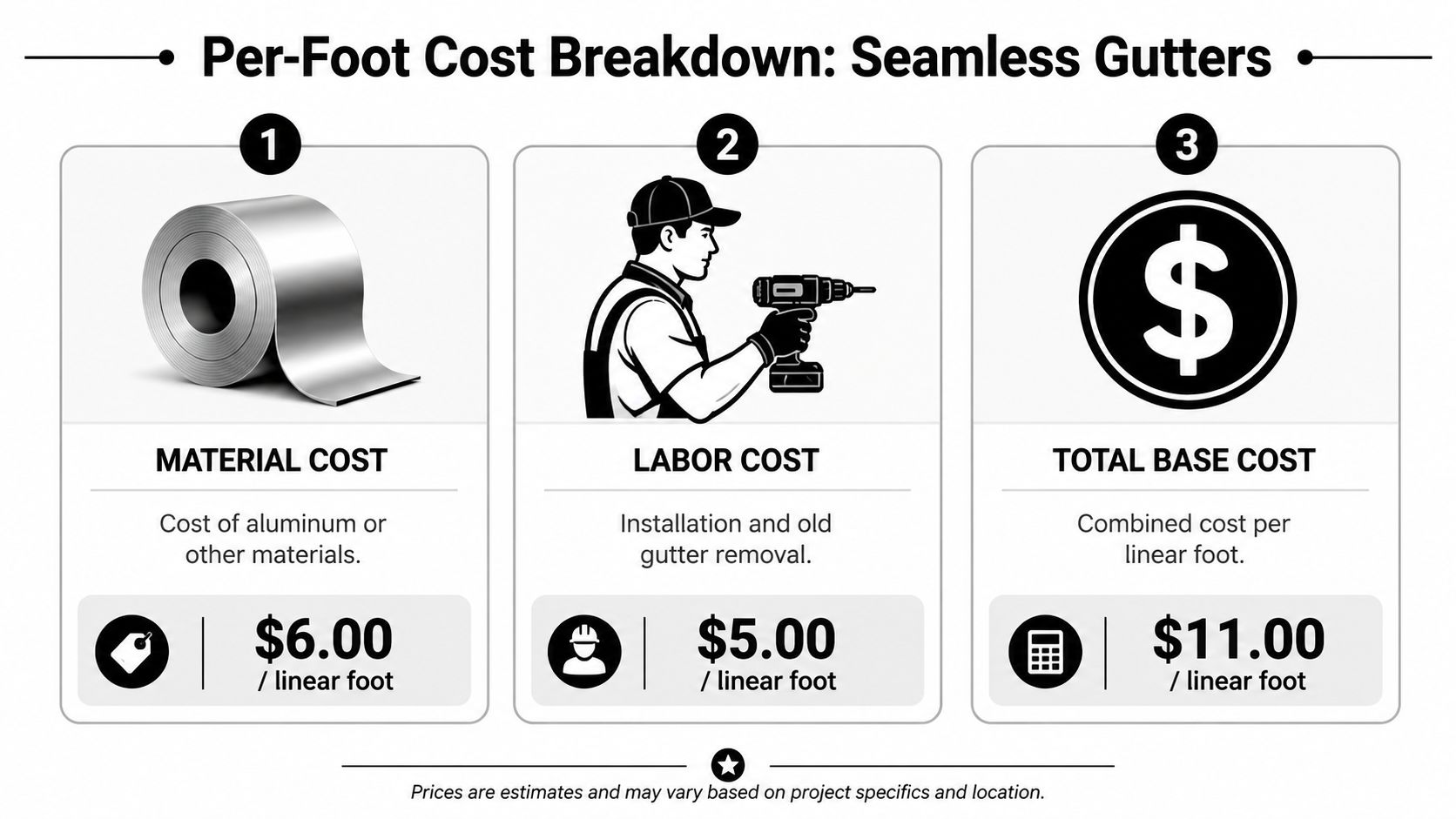
Most contractors price gutters by linear foot because that's the simplest way to measure the actual work. If you've never bought gutters before, the pricing is similar to flooring by square foot. The unit price sounds small until you multiply it across the full house.
The national baseline for 2026 puts average continuous gutter installation across major U.S. markets at $1,150 to $1,700, with aluminum continuous gutters at $4 to $9 per linear foot and premium copper at $29 to $50 per linear foot based on 2026 seamless gutter cost data from HomeGuide.
Two buckets make up the price
Your quote usually comes down to two big pieces.
- Materials: Aluminum is the common choice because it keeps cost under control and performs well for most homes.
- Labor: The crew measures the house, forms the gutters on-site, cuts corners, hangs the runs, and makes sure water flows correctly.
That per-foot thinking shows up in other trades too. If you want a good example of how linear-foot pricing works outside roofing, this TruTec crack sealing cost analysis breaks down a similar pricing model in a very practical way.
Material comparison that actually matters
Here's the simple version. The metal you choose has the biggest impact on price.
| Material | Cost range | What it means for you |
|---|---|---|
| Aluminum | $4 to $9 per linear foot | Best fit for most homeowners who want solid performance without overspending |
| Copper | $29 to $50 per linear foot | Premium look, premium price, usually reserved for high-end homes |
| Steel | Higher than aluminum, lower than premium copper in many jobs | Strong option when durability is the priority |
Steel and specialty systems can make sense, but most homeowners still end up in aluminum because the value is hard to beat. If you're comparing the gutter assembly with trim, fascia, or soffit work, it also helps to understand how the full exterior package fits together on a home through this gutter, soffit, and fascia service overview.
The per-foot number matters, but it never tells the whole story by itself. The roof decides the rest.
Factors That Drive Your Final Gutter Installation Price
The per-foot number gets you in the ballpark. Your house decides the final bill.
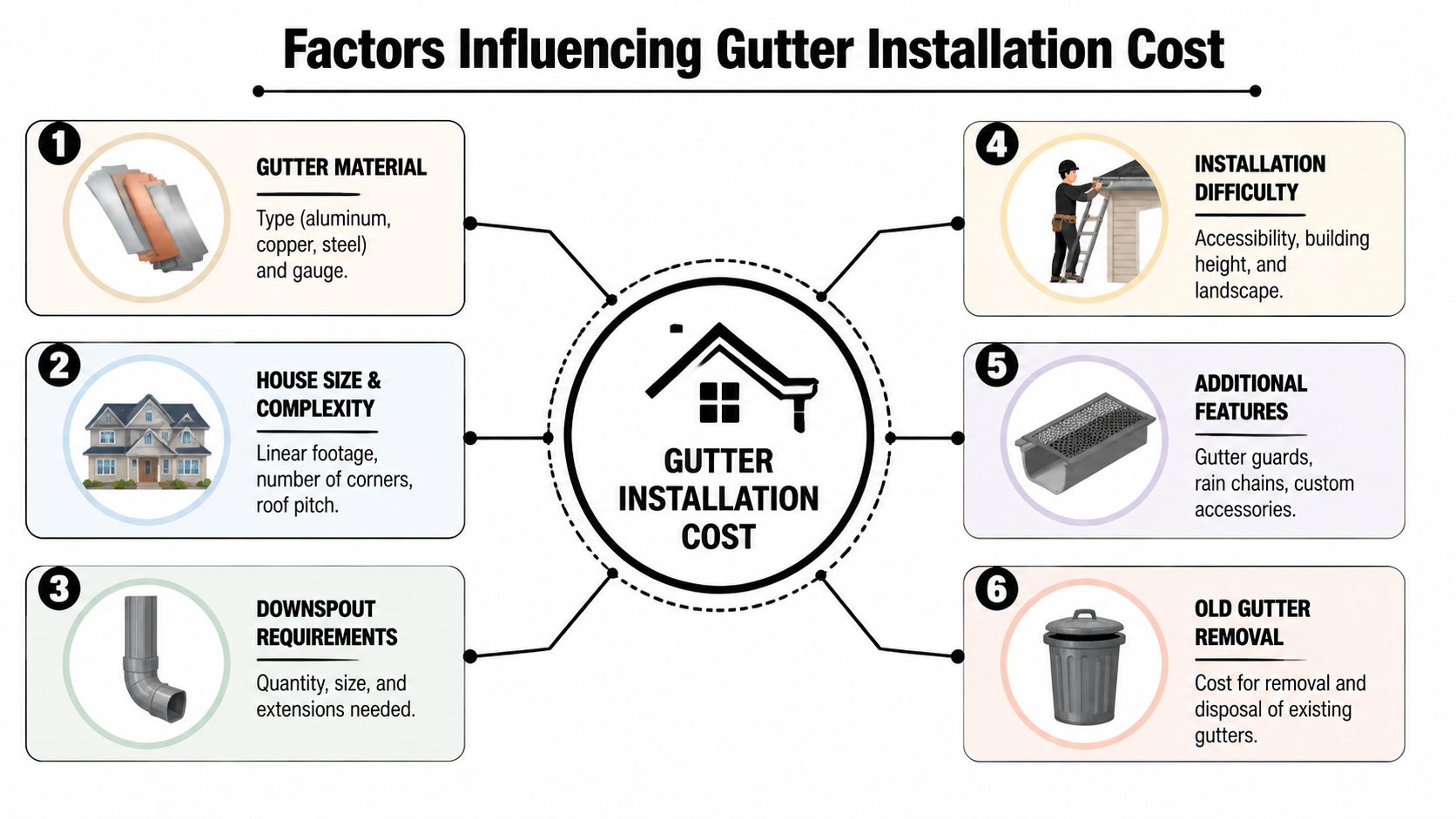
A lot of homeowners assume gutter pricing is just length times price. That's too simple. In Pennsylvania, cost often comes from the conditions around the job. Roof pitch, height, corners, and access can change labor in a hurry.
Material choice changes everything
If you choose aluminum, you're buying the most common residential option for a reason. It keeps the project manageable and still gives you the benefit of a custom-formed continuous run.
If you move into copper or heavier specialty metals, the quote jumps fast. That isn't just because the raw material costs more. The handling, fabrication, and finishing get more demanding too.
Pennsylvania roof complexity is real
This is where generic internet advice falls apart. Data shows a standard home in Iowa can cost $1,300 to $2,200, while a complex home in Pennsylvania can reach $3,000 to $8,500 for the same linear footage because of higher labor rates at $60 to $80 per hour and steep roof challenges, based on this regional pricing example for complex Pennsylvania gutter work.
That's the regional complexity multiplier in plain English.
Older homes around Pittsburgh often have more architectural detail. Some Erie-area homes have steep sections that slow the crew down. Homes with multiple gables, valleys, and returns need more cutting, more setup, and more time on ladders or staging.
If your house has a simple rectangle roofline, you're buying gutters. If your house has lots of turns and height changes, you're buying labor.
Height and access affect labor
A one-story ranch is faster and safer to work on than a two-story home with landscaping, decks, or tight side-yard access. That's why two houses with similar gutter footage can still get different quotes.
Here's what commonly makes labor climb:
- Second-story work: More setup time and more care during installation
- Steep pitches: Slower movement and more safety planning
- Tight access: Fences, shrubs, patios, or slopes can complicate placement of ladders and equipment
Corners downspouts and layout details add up
Homeowners focus on the long gutter runs because they're easy to picture. Installers know the details are what change the job.
More corners mean more fabrication and more sealing points. More downspouts mean more material and more routing decisions. A house that needs drainage directed around porches, garages, or walkways takes more thought than a plain four-corner box.
A reliable quote should account for:
- Total linear footage
- Number of corners
- Downspout count and placement
- Roof height and pitch
- Site access
- Condition of the fascia where the gutters attach
If a contractor skips those details and throws out a number from the driveway, I wouldn't trust the quote. Continuous gutter cost is house-specific. It has to be measured that way.
Sample Gutter Estimates for Pennsylvania Homes
Abstract numbers only help so much. It's easier to budget when you can compare your home to a real-world type of house.
A straightforward ranch in Hermitage
Take a single-story ranch with a clean roofline, easy ladder access, and standard aluminum gutters. This is the kind of job that usually stays closer to the lower end of the normal range because the crew can move efficiently and the gutter runs are uncomplicated.
If you own a house like this, your quote usually feels predictable. There are fewer surprises, and the measurement process is simpler. If you're selling or buying, pairing the project with a roof inspection for real estate decisions can help catch related drainage issues before closing.
A two-story colonial outside Erie
Now change the house. Make it a two-story colonial outside Erie with several roof returns, more corners, and taller access points. Use the same general aluminum system, but add the labor that comes with height and layout complexity.
That house is still buying gutters, but it's also buying more setup time, more fabrication time, and more routing work. It won't price like the ranch.
A clean estimate should reflect the house you actually have, not the house from a national pricing article.
How to use these examples without fooling yourself
Don't copy a sample number and assume it's yours. Use examples the right way.
- Match the home shape: Ranch, colonial, cape, and multi-gable homes price differently
- Match the height: One-story and two-story installs are different jobs
- Match the goals: Basic replacement and full drainage improvement aren't the same scope
If you're in Sharon, Pittsburgh, or Erie, the smart move is to identify which example your home most closely resembles, then expect the final quote to tighten up once someone measures the actual roofline on site.
Hidden Costs and Add-Ons for Your Gutter System
A lot of gutter articles stop at the install price. That's incomplete advice.
The installed system might be the main expense, but it may not be the final expense. Homeowners usually get surprised by two things. Old gutter removal and gutter guards.
The cost most homeowners forget
The biggest blind spot is debris management. Continuous gutters reduce joint-related leak points, but they don't stop leaves, pine needles, and seed pods from landing in the trough.
That matters in Pennsylvania neighborhoods with mature trees. Adding gutter guards often costs $12 to $16 per foot, and for many homes that can dramatically increase the total system price, as noted in this gutter guard cost discussion for seamless systems.
If your house sits under heavy tree cover, guards may be worth it. If your lot is fairly open, they may not be urgent. Don't treat them like an automatic yes or no. Treat them like a site-specific choice.
Base system versus add-ons
Here's a simple way to look at it.
| Item | Typical Cost Range (per foot) | Purpose |
|---|---|---|
| Seamless aluminum gutter installation | Varies by home and quote | Main water collection and drainage system |
| Old gutter removal | Varies by home and quote | Removes failing system before replacement |
| Gutter guards | $12 to $16 per foot | Helps reduce debris buildup from leaves and needles |
What I'd recommend
For budgeting, separate your project into two categories:
- Must-have work: The actual continuous gutter system, proper drainage layout, and any necessary removal
- Situational upgrades: Guards and other accessories that depend on tree coverage and maintenance goals
Budget advice: Ask for one quote with the base gutter system and one quote with guards added. It's the fastest way to see the true total cost of ownership.
The wrong move is assuming the first gutter number you hear is the whole project. It often isn't. Good budgeting means pricing the full drainage setup you'll live with.
How to Get a Firm Seamless Gutter Quote in PA
A real quote happens on site. Anything else is just a rough guess.
You can get a loose range over the phone, but nobody can give you a trustworthy final number without seeing the roofline, checking the fascia, and measuring the actual runs. In Pennsylvania markets like Pittsburgh, Sharon, and Erie, labor typically runs $4 to $10 per linear foot and accounts for 50% to 60% of total project cost, while old gutter removal adds $3 to $13 per linear foot, according to Pennsylvania gutter labor and removal pricing.
What a good estimator should actually do
A proper visit should include more than a tape measure.
- Measure the full roofline. Not just the front of the house.
- Check the fascia condition where the new gutters will mount.
- Count corners and downspout locations so water can be moved away correctly.
- Review height and access issues that affect labor and crew setup.
- Talk through material and color choices so the quote matches the finish you want.
If the discussion stays vague, the quote will too.
How to compare quotes without getting fooled
The cheapest quote isn't always cheaper. Sometimes it just leaves things out.
Look for:
- Scope clarity: Does the proposal say whether old gutters are removed?
- Material clarity: Does it specify the gutter material being installed?
- Labor clarity: Does it reflect the actual height and complexity of your home?
If the price is difficult to manage, ask about financing options for exterior projects. That can make sense when the gutter replacement is part of a larger roof or exterior protection plan.
A firm quote should feel specific. If it reads like a placeholder, it probably is.
Are Seamless Gutters a Smart Investment for Your Home
Yes, in most cases they are.
I'd say that plainly because gutters aren't decorative trim. They protect siding, fascia, landscaping, and the area around your foundation. When water control fails, the damage doesn't stay limited to the gutter itself.
Gutter systems that are custom-formed to the house make sense because they have fewer joint-related weak points than sectional systems. That doesn't mean they're maintenance-free. It does mean they're usually the better long-term choice for homeowners who want fewer leak problems and a cleaner-looking install.
If you're evaluating the work quality side of the decision, safety matters too. Homeowners rarely think about the ladder, setup, and access side of gutter installation, but crews do. This guide for contractors on ladders is a useful reminder that proper equipment and safe access are part of what you're paying for.
My opinion is simple. If your current gutters are failing, replacing them with a properly designed continuous system is usually the smart move. Spend your energy on getting the layout, material, and installation right. That's where the value lives.
If you're in Sharon, Pittsburgh, Erie, or the surrounding parts of western Pennsylvania and want a clear, no-pressure assessment, Penn Ohio Roofing & Siding Group offers free estimates and can help you sort out what your home needs before you commit to a gutter project.