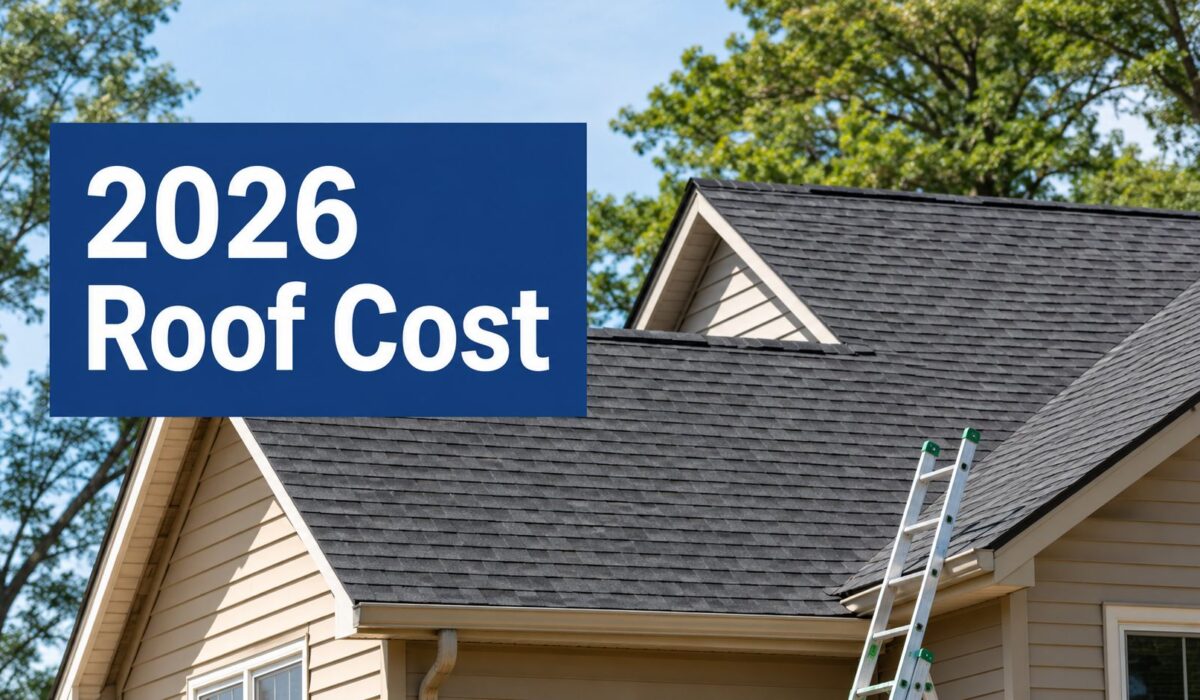
A full shingle roof replacement in 2026 usually runs $8,000 to $17,000 for a standard 2,000-square-foot home with common architectural asphalt shingles. If you go with basic 3-tab shingles, you're generally looking at $7,000 to $10,000, while higher-end shingle options can push the total much higher.
If you're reading this, there's a good chance you've already seen the warning signs. Maybe you spotted a water stain on the ceiling after a hard rain. Maybe you found granules in the gutter, or you've noticed curling shingles when you pull into the driveway. At that point, most homeowners in Sharon, Pittsburgh, Erie, and the rest of Western Pennsylvania want the same thing. A straight answer on what a new roof is going to cost.
That answer starts with roof size and shingle type, but it doesn't end there. Tear-off, labor, roof pitch, flashing details, and local market conditions in Mercer, Beaver, and Lawrence counties all move the final number. The good news is that you can get a reliable budget range before you ever sign a contract.
Table of Contents
- Understanding Your 2026 Roof Replacement Investment
- Shingle Types and Their Costs Explained
- The Anatomy of a Roofing Quote Material Labor and Tear-Off
- Regional Price Adjustments for Mercer Beaver and Lawrence Counties
- Sample Roof Replacement Estimates for Common Home Sizes
- Repair or Replace The 25 Percent Rule and Smart Savings
- How to Get Your Free Local Roofing Estimate
Understanding Your 2026 Roof Replacement Investment
You spot a water stain on the ceiling after a hard Western Pennsylvania storm. Then the estimate comes in, and a critical question hits fast. Are you paying for a manageable fix, or are you buying a full roof replacement?
That decision gets expensive quickly, which is why homeowners in Mercer, Beaver, and Lawrence counties need more than a national price range. You need a local way to judge the quote in front of you, the condition of your roof, and whether a repair still makes financial sense.
For most homes, the final price comes down to a short list of job-specific details, not a generic online average. A simple ranch with one layer of shingles is one kind of project. A steep roof with multiple valleys, flashing points, and damaged decking is another.
What actually changes the price
Roofing quotes usually rise or fall based on the same factors:
- Roof size: Bigger roofs need more material, more labor, and more dump space.
- Roof shape and pitch: Steep sections, dormers, valleys, skylights, and chimneys slow the crew down and raise labor cost.
- Shingle selection: Budget shingles keep the upfront price lower. Architectural shingles cost more, but they are the better choice for most homes in this region.
- Tear-off condition: If old shingles come off and the wood deck underneath is soft or rotted, the scope changes.
- Access and disposal: Tight driveways, landscaping protection, and dump fees affect the total.
- County and township requirements: Permit rules and inspection requirements can vary across local municipalities.
If you want a broader homeowner-friendly breakdown of factors affecting roof replacement price, that resource does a good job showing why two roofs with similar square footage can still price very differently.
One more point matters here. A low quote can hide missing pieces. If tear-off, flashing, underlayment, ventilation adjustments, or deck repair are vague, the price is incomplete.
Good advice: Compare roofing estimates line by line. Check what shingles are specified, how many layers are being removed, what flashing is replaced, and how rotten decking is billed if the crew finds it.
For homeowners in Western Pennsylvania, the smartest way to judge the investment is to pair the quote with the roof's condition. That is where the 25% damage rule becomes useful. If a large portion of the roof is failing, pouring money into repeated repairs usually costs more than replacing it once and being done with it.
A solid estimate should answer clear questions. What materials are going on the house? Is it a full tear-off? What labor and cleanup are included? What could change the final bill after the old roof comes off?
Those are the questions that protect your budget.
Shingle Types and Their Costs Explained
A homeowner in Mercer, Beaver, or Lawrence County usually asks the same question first. Which shingle gives me the best roof for the money without paying for upgrades I do not need?
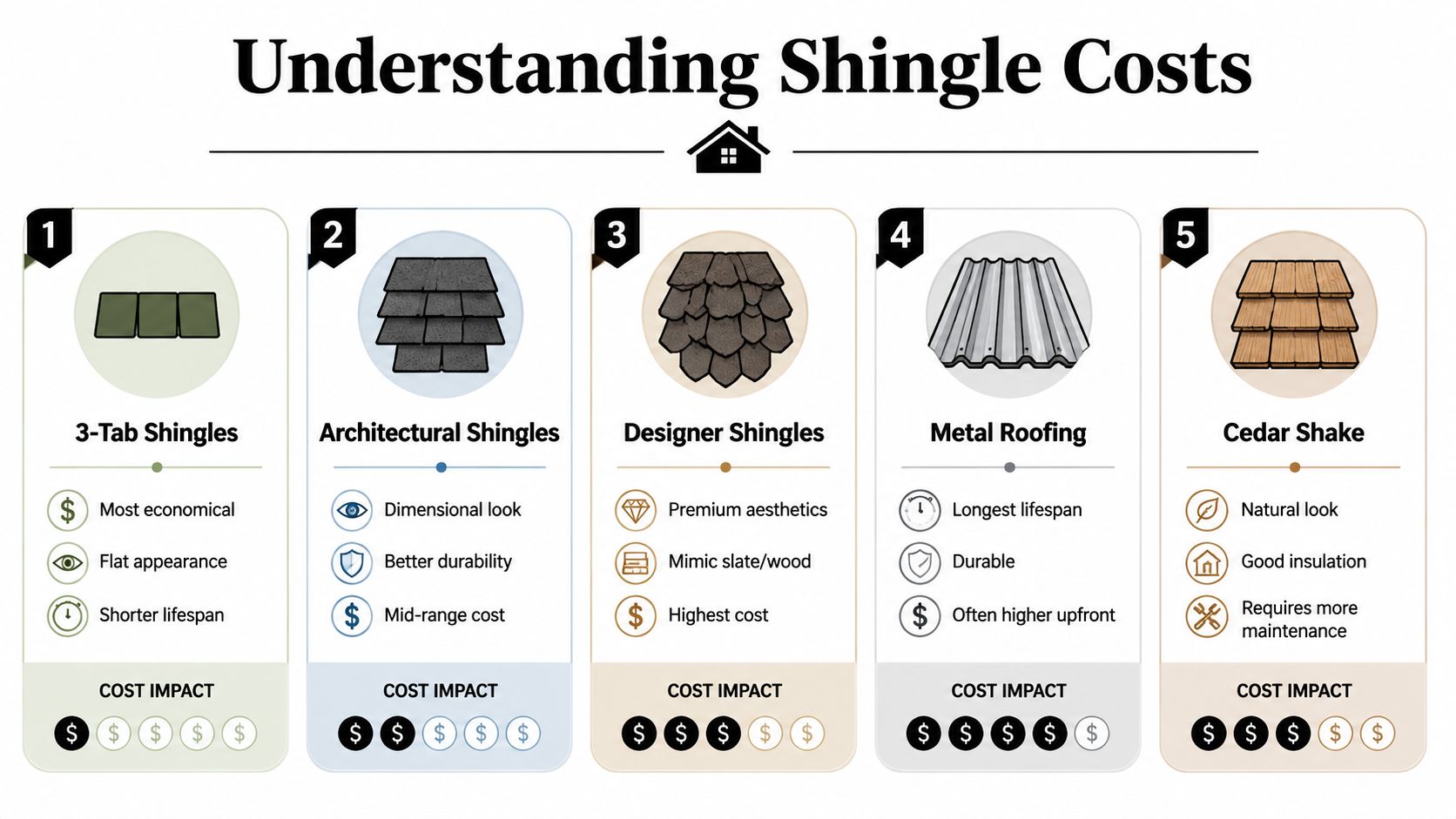
For most houses here, the choice is simple. Standard 3 tab asphalt or architectural asphalt. Both are common. Both can protect a home well when the roof system is installed correctly. But they are not equal buys.
The two asphalt options that matter most
As noted earlier, national pricing for 2026 puts 3 tab shingles at the low end of the asphalt market, with architectural shingles costing more but giving homeowners a stronger overall product.
That price gap matters, but so does what you get for it. In Western Pennsylvania, I recommend architectural shingles for most full replacements. The labor, tear-off, cleanup, flashing work, and setup cost a lot no matter which shingle goes on top. Saving a little on the visible layer often turns into a decision homeowners regret.
| Shingle type | Cost range | Best fit |
|---|---|---|
| 3-tab asphalt | Lower-cost asphalt option | Tight budgets, simpler homes, lowest upfront cost |
| Architectural asphalt | Mid-range asphalt option | Best overall value for most homeowners |
3-tab shingles
3 tab shingles are the entry-level choice. They have a flatter, more uniform look and a lower upfront price.
Pros
- Lower purchase cost: They are the cheapest path to a full asphalt replacement.
- Clean, simple appearance: They fit basic home styles without drawing much attention.
Cons
- Less dimension from the street: The roof looks flatter and less substantial.
- Weaker long-term value: If you plan to stay in the home, the small savings up front often do not feel worth it later.
I usually only recommend 3 tab when the budget is tight and the homeowner needs a sound replacement now, not a cosmetic upgrade.
Architectural shingles
Architectural shingles are the better pick for most homes in this part of Pennsylvania. They look better, they usually hold up better, and they make more sense once you consider the full job cost instead of just the shingle bundle price.
Pros
- Better curb appeal: The thicker, layered profile gives the roof more depth.
- Stronger value for the money: The upgrade cost is usually reasonable compared with the total replacement bill.
- A better fit for local homes: They suit the neighborhoods and weather conditions common across Mercer, Beaver, and Lawrence counties.
Cons
- Higher upfront cost: You will pay more than 3 tab.
- Product quality varies by brand: The proposal should spell out the exact manufacturer and shingle line.
If a roof already has widespread wear, missing shingles, and repeated leak repairs, this is usually not the moment to cut to the cheapest material. The 25% damage rule matters here. Once enough of the roof is failing, a full replacement with a better shingle is often the smarter spend than another round of patchwork.
What about designer, impact-resistant, and other premium options
Designer shingles, impact-resistant products, cedar, and metal all have their place. They also push the budget into a different category. For most homeowners comparing practical replacement costs in Western Pennsylvania, asphalt remains the baseline because it matches the house, the budget, and the resale expectations in this market.
If you want to understand how the full asphalt system goes together before comparing bids, this guide to an asphalt shingle roof is worth a look.
Some homeowners also compare other systems for long-term roof protection for homes, especially when they are thinking beyond shingles and looking at the whole building envelope.
The Anatomy of a Roofing Quote Material Labor and Tear-Off
A roofing quote shouldn't feel like a magic trick. If the estimate has one big number and no real detail, that's a problem.
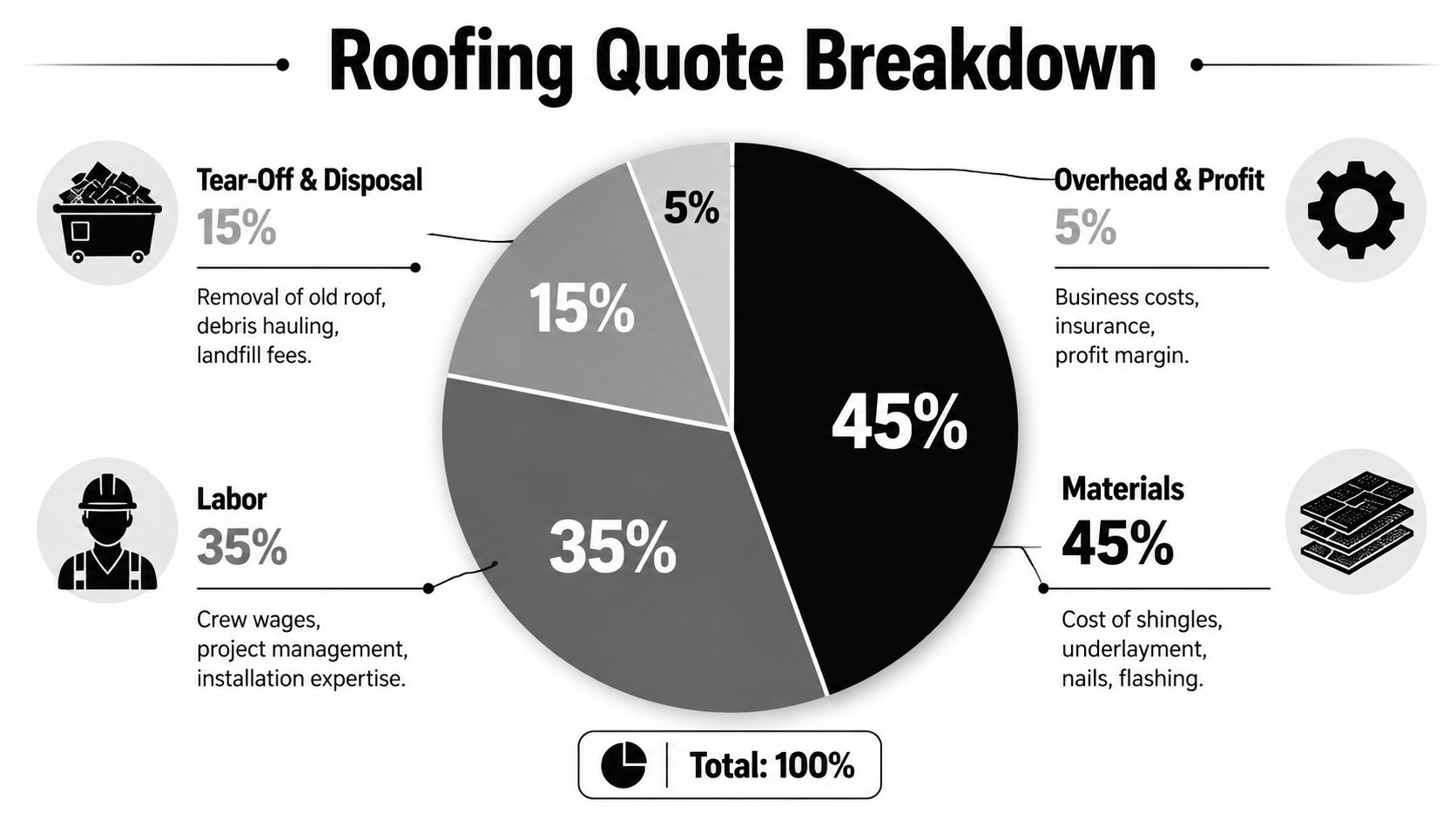
Most professional quotes break into three practical buckets. Materials. Labor. Tear-off and disposal. Then there may be a few smaller line items depending on the house and what the crew finds.
Labor is the biggest line item
Labor costs to install roof shingles account for approximately 60% of the total project cost, averaging around $6,300 and ranging from $4,500 to $10,800 depending on location and job complexity, according to Angi's shingle roof cost breakdown.
That surprises people, but it shouldn't. Roofing is hard, skilled, physical work. A good crew doesn't just nail on shingles. They protect landscaping, stage materials, tear off the old roof safely, install underlayment correctly, flash penetrations, manage cleanup, and keep the job moving before weather changes.
What materials usually cover
Materials are more than the shingles themselves. A proper quote should account for the full roofing system.
- Shingles: The visible outer layer you picked.
- Underlayment: The water-shedding layer under the shingles.
- Flashing pieces: Metal details around chimneys, walls, vents, and valleys.
- Fasteners and accessories: Nails, starter strips, ridge components, and related parts.
If an estimate talks a lot about “premium shingles” but says almost nothing about flashing or underlayment, slow down. Many leaks come from details, not from the field shingles.
Tear-off and the hidden costs homeowners miss
Tear-off matters because it tells you whether the contractor is removing the old roof properly or just covering over problems. Disposal matters because old shingles, felt, and damaged wood all have to go somewhere.
Here's what can change the bill after the job starts:
| Potential add-on | Why it happens |
|---|---|
| Deck repair | The crew finds soft or rotted wood after tear-off |
| Permit-related requirements | Local code or permit steps add scope |
| Flashing replacement | Existing metal is too worn to reuse |
| Access issues | Landscaping, height, or tight lot conditions slow the job |
If a quote looks unusually cheap, it often means something has been left out, not that the contractor discovered a secret way to roof houses for less.
A good quote doesn't promise zero surprises. It tells you where surprises are most likely.
Regional Price Adjustments for Mercer Beaver and Lawrence Counties
Online averages are useful, but they're not your final answer. A homeowner in Sharon or Hermitage shouldn't expect the exact same pricing pressure as a homeowner in downtown Pittsburgh, and someone near Erie may face different market conditions again.
The importance of local context becomes apparent.
Pittsburgh and Erie give you a realistic local frame
For a standard 2,000-square-foot home in Pittsburgh, Pennsylvania, most homeowners pay between $10,000 and $16,000 for a full architectural asphalt shingle roof replacement, with a typical project near $13,500, based on this Pittsburgh roof replacement cost guide.
That number matters because Pittsburgh is one of the clearest nearby pricing anchors for Western Pennsylvania. It reflects a real local market, not a broad national average that may or may not match our region.
Why Mercer, Beaver, and Lawrence County quotes can differ
Homes in Mercer, Beaver, and Lawrence counties sit inside the same broad Western Pennsylvania roofing economy, but local quotes still shift for practical reasons.
- Labor availability: Crew scheduling and local demand affect pricing.
- Material delivery: Distance and logistics can nudge costs.
- Home style: Older homes in established neighborhoods often have more roof details.
- Municipal differences: Permit and code expectations can vary by town.
That's why a homeowner in Sharon may not get the same quote as someone in Pittsburgh or Erie, even for similar square footage. Local roof shape, access, and inspection findings matter more than a zip-code average.
If your home is in Mercer County and you're trying to compare repair versus replacement before calling for quotes, this page on Mercer PA roof repair gives helpful local context.
The right local estimate starts with boots on the roof. Satellite measurements and online calculators are useful, but they don't see damaged decking, weak flashing, or steep rear slopes.
Sample Roof Replacement Estimates for Common Home Sizes
A homeowner in Mercer County usually starts with a simple question. “What should a new shingle roof cost on a house like mine?” That is the right question, because roof quotes make more sense when you tie them to real home sizes and real Western Pennsylvania conditions.
The numbers below are ballpark examples for architectural asphalt shingles. They help you set a realistic budget before you schedule a professional roof inspection for an exact replacement estimate.
Three common examples homeowners can relate to
Smaller ranch home
A one-story ranch often lands at the lower end of the local price range because access is easier and the roofline is usually simpler. If the roof has one main gable, limited flashing, and no major decking problems, the quote stays more manageable. Add a steep pitch, a chimney, or several valleys, and the price climbs fast.
Mid-size two-story home
This is the house type many families own across Mercer, Beaver, and Lawrence counties. It is also where homeowners get tripped up by online averages. A two-story home may not look oversized from the ground, but the roof can still carry more slope, more waste, and more labor than expected. That is why two homes with similar square footage can produce very different bids.
Larger home with more roof area
Bigger homes cost more for an obvious reason. There is more roof to tear off, load, install, and clean up. They also tend to have more hips, ridges, dormers, plumbing vents, and flashing details. Labor rises with every one of those details, not just material.
What changes the estimate besides size
House size gets you close. Roof design sets the actual price.
A simple 1,800-square-foot roof can cost more than a larger home if it is steep, heavily cut up, or has old problem areas hidden under the shingles. The National Association of Realtors notes that roofing costs are shaped by materials, labor, and the complexity of the job, which matches what homeowners see in real estimates every day in this region.
Keep these factors in mind:
- Pitch: Steeper roofs take longer, require more safety setup, and slow installation.
- Cut-up design: Valleys, hips, and intersecting sections create more waste and more labor.
- Chimneys and skylights: Penetrations raise flashing time and leak risk if handled poorly.
- Tear-off condition: Soft decking, multiple old layers, or rotted edges add repair work before new shingles go on.
- Garage and porch tie-ins: Connected roof sections can make a “small” home act like a much larger project.
The practical takeaway is simple. A ranch, colonial, or larger family home gives you a starting point. The final number depends on how straightforward the roof is to replace on that specific house in Western Pennsylvania.
Repair or Replace The 25 Percent Rule and Smart Savings
Most homeowners don't struggle with obvious failures. If the roof is actively leaking in several places, the answer is usually clear. The harder decision is the aging roof that still looks “repairable” from the ground.
Many people waste money here.
The 25 percent rule
If damage affects more than 25% of the roof surface, cumulative repair costs, hidden storm damage risk, and weaker long-term value usually make full replacement the smarter choice, based on NerdWallet's guidance on replacing roof shingles.
That's the rule I'd want any homeowner to remember.
If a contractor is proposing another patch on a roof with widespread wear, missing sections, or repeated leak history, you need to stop and ask whether you're buying time or throwing good money after bad.
When repair still makes sense
A repair is still the right call in some cases.
- Isolated damage: One limited problem area after a storm can often be repaired responsibly.
- Newer roof system: If the surrounding roof is still in solid condition, patching can be reasonable.
- No broader failure signs: If there's no pattern of curling, granule loss, or repeated leaks, repair may hold up well.
When replacement is the smarter financial move
Replacement makes more sense when the roof has entered the stage where every fix reveals another issue.
Patching an old roof can feel cheaper in the moment, but repeated repairs often cost more because they never solve the larger problem.
Here's how to save money without making a bad decision:
- Get a full inspection first: Don't approve repairs based only on what's visible from the ground.
- Ask whether damage is isolated or systemic: That answer changes everything.
- Read the quote for scope, not just price: Cheap patchwork can hide major future expense.
- Use insurance when storm damage qualifies: If the damage is covered, the financial decision changes fast.
The smart homeowner thinks like an investor here. If more than a quarter of the roof is compromised, replacement usually protects your money better than another repair bill.
How to Get Your Free Local Roofing Estimate
By the time you're ready to ask for quotes, you should already know two things. First, what shingle type fits your house. Second, whether you're dealing with a repair problem or a replacement problem.
That makes the estimate process much easier.
Common questions homeowners ask first
Can homeowner's insurance help?
Sometimes, yes. If storm damage caused the issue, insurance may apply. The right first step is documentation and a professional inspection that clearly identifies storm-related damage versus normal aging.
What if I need financing?
Many homeowners use financing for roof replacements because the roof often can't wait. The key is to focus on total project quality first. A cheap roof financed poorly is still a bad deal, and an underbuilt roof financed conveniently is still an underbuilt roof.
How long will the replacement take?
The answer depends on roof size, weather, access, and complexity. A trustworthy contractor should give you a realistic schedule, not a rushed promise meant to win the job.
A proper inspection is what turns all of those questions into useful answers. If you need a starting point, a professional roof inspection helps identify whether you're dealing with missing shingles, flashing failure, deck issues, or broader replacement conditions.
Here's a look at a local residential roofing resource homeowners often review before booking an estimate.
What to ask for when you request a quote
Don't just ask, “How much for a new roof?” Ask for a complete written estimate.
- Material details: Ask for the exact shingle type and system components.
- Scope of work: Confirm tear-off, disposal, and flashing work are included.
- Wood replacement language: Ask how deck repairs are handled if damaged sheathing is found.
- Timeline and cleanup: Make sure site protection and debris removal are clearly addressed.
A good roofing estimate should feel calm, specific, and easy to understand. No pressure. No vague allowances. No disappearing details.
If you own a home in Sharon, Pittsburgh, Erie, or anywhere in Mercer, Beaver, or Lawrence counties, the next step is simple. Contact Penn Ohio Roofing & Siding Group for a free local estimate and get a clear, honest assessment of your roof without the sales pressure.