Picking the right roofing contractor in Hermitage, PA, is a big deal. It’s not just about patching a leak; it's about protecting your home, your family, and one of your largest investments. This decision will impact your home's integrity for years to come, so it’s worth getting right.
Finding a Trusted Roofing Pro in Hermitage PA
Let's be honest, the thought of hiring a roofer can be stressful. Your roof is what keeps the harsh Pennsylvania weather out, and trusting that job to the wrong person can lead to a world of expensive, frustrating problems down the road. You need someone who takes pride in their work and understands that quality matters.
This guide is designed to help you navigate the process. We'll skip the fluff and give you practical, actionable advice for vetting and hiring a contractor you can depend on in the Hermitage area.
Your Roadmap to a Secure Roof
Think of yourself as the project manager for your home. Taking the time to do your homework now will save you from major headaches later. We'll cover the essential ground—from checking credentials to making sense of quotes.
Here's what you need to focus on:
- Vetting Credentials: We'll show you exactly what licenses and insurance policies are non-negotiable and how you can easily verify them.
- Comparing Quotes: It's about more than just the bottom-line price. You'll learn how to read between the lines to see which estimate offers the best long-term value.
- Avoiding Red Flags: I'll point out the common warning signs that scream "stay away," helping you dodge unqualified or untrustworthy operators.
Following these steps isn't just about avoiding a bad experience; it’s about making a smart investment. A little diligence now pays off in a big way.
For a deeper look into the vetting process, you can explore our detailed guide on how to choose a roofing contractor to ensure you cover all your bases.
Ultimately, what you're after is peace of mind. You want to know, without a doubt, that your roof was installed correctly with quality materials by a crew that stands by their work. This guide is your first step.
Building Your Shortlist of Local Roofers
Finding the right roofer in Hermitage, PA, isn't about just picking a name from a Google search. The best place to start is often right in your own neighborhood. Ask around—chat with neighbors, family, or friends who've had roof work done recently.
You’ll get the kind of honest, unfiltered feedback you simply can't find in an ad. They can tell you if the crew was professional, if they showed up on time, and most importantly, how the roof has held up.

Here's an inside tip: call a few local roofing supply houses. They know exactly which contractors are busy, do quality work, and pay their bills on time. That last part is a huge indicator of a stable, well-run business.
Sizing Up Their Online Presence
Once you have a few names, it's time to do some digital digging. A professional website is table stakes these days. Does it look clean and provide clear information? One of the first things I look for is a real, physical business address in or near Hermitage. If you can't find one, that's a major red flag—it could signal a fly-by-night operation.
A solid digital footprint should also include:
- A Project Portfolio: Look for high-resolution photos of finished jobs in our area. It proves they have local experience.
- Real Customer Reviews: Check for detailed testimonials on their website, but also look at third-party sites like Google and the Better Business Bureau (BBB).
- Easy-to-Find Contact Info: A legitimate company wants you to be able to reach them.
The U.S. roofing industry is massive—worth about $59.2 billion—so it's no surprise that there are plenty of companies vying for your business. The competition is stiff, which makes it even more crucial to separate the seasoned pros from the rest. You can actually read the full research on roofing industry statistics to get a sense of the market's scale.
How to Spot Red Flags from a Mile Away
As you talk to potential roofers, your gut instinct is a powerful tool. Be on high alert for anyone using aggressive, high-pressure sales tactics. If you hear things like "this price is only good for today," it’s time to show them the door. A true professional will give you a detailed quote and the space you need to make a decision.
Key Takeaway: The goal here is to narrow down your list to three to five solid contenders. Doing the homework now will save you a world of frustration and costly mistakes down the road.
An unusually low bid is another giant warning sign. Yes, everyone loves a good deal, but a price that dramatically undercuts everyone else often means they're cutting corners. This could be with cheap materials, uninsured workers, or an inexperienced crew. When it comes to your roof, if an offer seems too good to be true, it almost always is. By carefully evaluating each potential roofing contractor Hermitage PA has on your list, you'll be ready for the next step: comparing quotes.
Alright, you've got your shortlist of potential roofers. Now it's time to dig deeper and separate the pros from the rest. This is where you move past nice websites and friendly handshakes to the hard facts—the stuff that truly protects you and your home.
Think of this as your due diligence phase. Skipping it is like buying a car without checking under the hood. You just don't do it.
Confirming Licenses, Insurance, and Credentials
Here in Pennsylvania, any contractor doing more than $5,000 of work in a year is required by law to have a Home Improvement Contractor (HIC) registration number. This isn't optional; it's a state requirement.
The very first thing you should ask a potential roofer is for their HIC number. A legitimate professional will have it ready. Once you have it, pop over to the PA Attorney General's website and verify it yourself. It takes two minutes and tells you immediately if you're dealing with a registered business.
This quick infographic breaks down the essential checks every homeowner in Hermitage should perform.
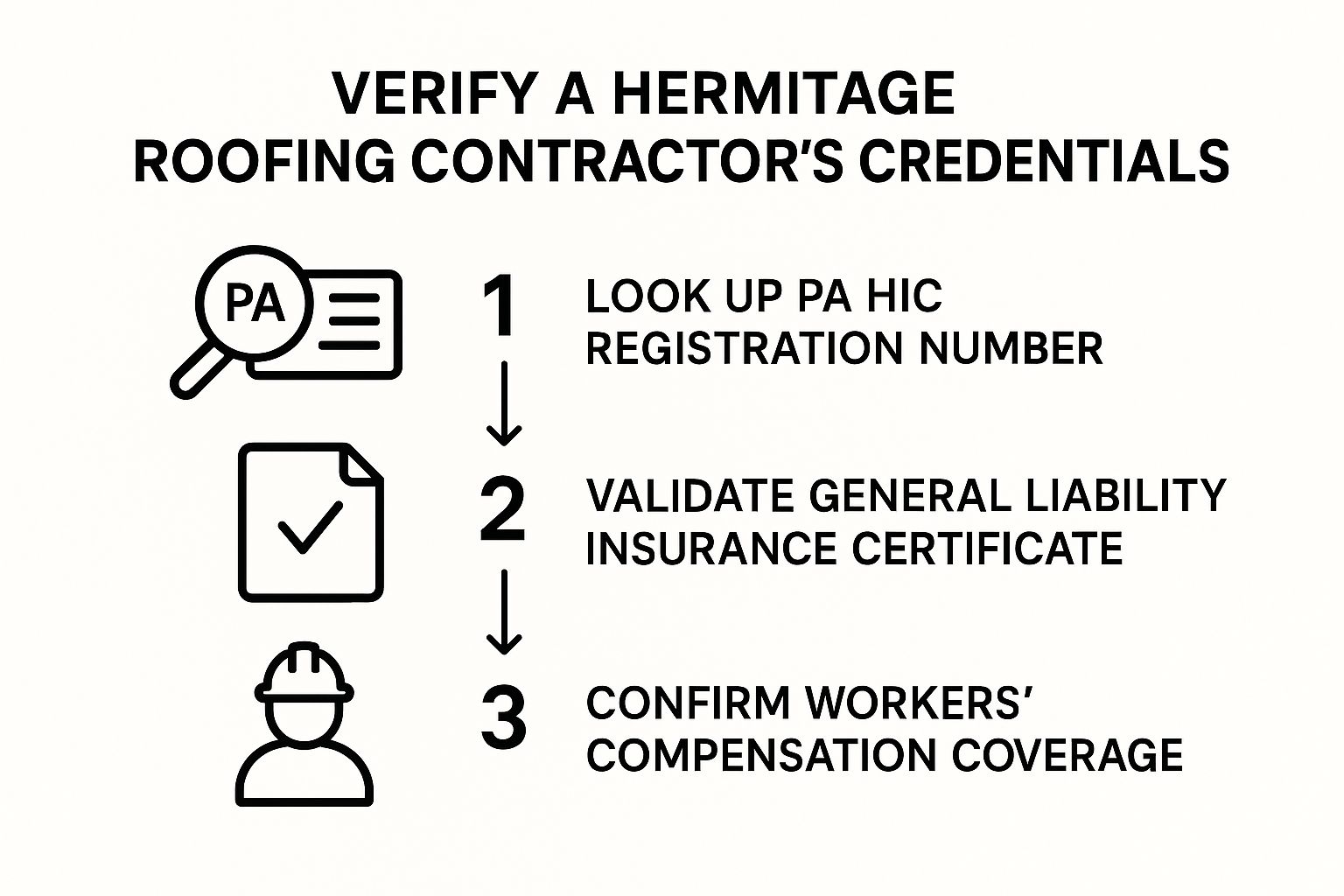
Nailing down these three things—HIC number, general liability, and workers' comp—is your best defense against potential financial and legal headaches down the road.
Why Insurance Is a Deal-Breaker
Let’s be clear: contractor insurance is for your protection, not just theirs. It's the safety net that catches the "what ifs."
What if a ladder falls and smashes your neighbor's windshield? What if a bundle of shingles slides off the roof and damages your new air conditioning unit? Without the right insurance, you could be the one footing the bill for those accidents.
You need to verify two specific types of coverage:
- General Liability: This is what covers accidental damage to your property or a third party’s. A roofer absolutely must carry adequate general liability insurance to shield you from these kinds of costly mishaps.
- Workers' Compensation: This is crucial. It covers the crew working on your house. If a roofer gets hurt on your property and their employer doesn't have workers' comp, you could find yourself on the hook for their medical expenses and lost wages. It happens more often than you'd think.
How to Actually Verify Their Coverage
Never, ever just take a contractor's word for it when they say, "Yeah, we're insured." Ask them to prove it. A true professional will have zero problems providing you with their certificate of insurance (COI) for both policies.
Pro Tip: Getting the certificate is only step one. Don't just glance at it and file it away. Find the insurance agent's phone number on the document and call them directly. Confirm that the policy is active and that the coverage is sufficient for a project of your size. This one phone call can save you from a world of hurt.
If a contractor gets defensive, makes excuses, or flat-out refuses to provide these documents, that’s your sign to walk away. No exceptions. It's a massive red flag. The standards for a licensed roofer in nearby Sharon, PA, are just as strict, underscoring how important these credentials are across the region.
How to Decode and Compare Roofing Quotes
So, you've done your homework and narrowed down your list of contractors. Now comes the part that trips up a lot of homeowners: the quotes start rolling in. It's incredibly tempting to just glance at the bottom line and pick the lowest number.
Don't do it.
A surprisingly cheap quote is often a massive red flag. A real pro's estimate isn't just a number; it's a detailed game plan for your entire roofing project. You need to look past the final price and focus on the details—or the lack thereof.

If you get a vague, one-page quote that just says "New Roof: $12,000," toss it. That kind of ambiguity is a license for them to cut corners or hit you with surprise charges later on.
What a Professional Quote Must Include
Any quote worth its salt will be itemized, showing you exactly where your money is going. This transparency is your best protection and the only way to genuinely compare one contractor's offer to another.
Here are the absolute must-haves on any quote you consider:
- Specific Materials: It’s not enough to say "architectural shingles." Is it a premium line or a budget-friendly builder grade? The quote needs to name the manufacturer and specific product for every component: shingles, underlayment, flashing, and vents.
- Labor Costs: This should be its own line item, reflecting the cost of the skilled crew doing the work.
- Tear-Off and Disposal: The price for removing your old roof and legally disposing of all that debris should be clearly stated. Don’t let this become a surprise cost.
- Permit Fees: If a permit is required in Hermitage for your project, the contractor should handle pulling it, and the cost should be noted on the estimate.
- Project Timeline: You need a realistic idea of when they can start and how long the job is expected to take.
The need for this level of detail is more important than ever. The roofing industry has been hit hard by an increasing number of severe weather events, especially here in Pennsylvania. As you can discover in roofing industry insights on ibisworld.com, this has put immense pressure on contractors, making it crucial to pick one who is thorough and prepared.
Comparing Apples to Apples, Not Apples to Oranges
With a few detailed quotes in hand, you can finally make a fair comparison. This is when you’ll see why that low-ball offer was so cheap. It's almost always missing key elements that a better contractor includes as standard practice.
For example, a solid quote might specify a premium ice and water shield for the eaves and valleys—an absolute necessity to fight off our brutal Pennsylvania winters. The cheaper guy might skip this entirely. One contractor might include new ridge vent ventilation to improve your attic's airflow and extend your roof's lifespan, while the low bidder just reuses your old, dented vents.
These aren't just minor upgrades; they're critical for the health and longevity of your roof.
Key Takeaway: Your goal isn't to find the cheapest roofer. It's to find the best value. Paying a bit more upfront for top-tier materials and expert installation will save you a fortune in repairs and stress down the road.
When you're looking at different materials, especially something like metal roofing, the price tag can seem high at first. But it's all about the long-term value. We break this down further in our guide to metal roof installation costs. A great way to gauge a contractor's expertise is to ask them why they chose certain products for your specific home. Their answer will tell you if they're focused on quality or just trying to win the job with a low price.
To make this easier, use a simple checklist to compare the core components of each quote side-by-side.
Roofing Quote Comparison Checklist
This table will help you spot the differences in materials, labor, and warranties at a glance, ensuring you’re comparing offers on an equal footing.
| Quote Component | Contractor A | Contractor B | Contractor C |
|---|---|---|---|
| Shingle Brand & Model | Specified Premium Brand | Specified Standard Brand | "Architectural" (Vague) |
| Underlayment Type | Synthetic Felt | Standard Felt Paper | Not Specified |
| Ice & Water Shield | Included | Included | Additional Cost |
| Ventilation System | New Ridge Vent | Reuse Old Vents | Box Vents |
| Flashing Replacement | All New Metal | Flash Chimney Only | "As Needed" |
| Tear-Off & Disposal | Included | Included | Included |
| Workmanship Warranty | 10 Years | 5 Years | 1 Year |
| Manufacturer Warranty | Enhanced | Standard | Standard |
| Permit Included? | Yes | Yes | No |
| Total Price | $15,500 | $14,200 | $11,800 |
By laying it all out like this, the "best" choice becomes much clearer. Contractor C might be the cheapest, but the lack of detail and shorter warranty period are major risks. Contractor A, while the most expensive, is offering superior materials and a much better warranty, representing the strongest long-term value.
Making Sense of the Paperwork: Contracts and Warranties
You've done the hard work of vetting contractors and comparing quotes. Now comes the final, crucial step before the hammers start swinging: the contract. Don't treat this as just a formality. This piece of paper is the single most important document that protects you, your home, and your investment.
A handshake deal or a simple verbal agreement? That's asking for trouble. Any professional roofing contractor in Hermitage PA worth their salt will insist on a detailed, written contract. It takes all the conversations and line items from the estimate and puts them into a binding agreement, making sure there are no surprises or "he said, she said" arguments later on.
The Anatomy of a Good Roofing Contract
Before you even think about signing, grab a cup of coffee and read through the entire document. You're looking for a few non-negotiable details. If something is missing, don't be shy about asking the contractor to add it. A roofer who stands by their word will have zero problems putting it in writing.
Here’s what absolutely must be in there:
- The Full Scope of Work: This should read like a playbook for the project, detailing everything from tearing off the old shingles to the final magnetic sweep for nails.
- Specific Materials List: Vague terms like "high-quality shingles" won't cut it. The contract needs to list the exact manufacturer and product names for everything—shingles, underlayment, flashing, vents, everything.
- Clear Payment Schedule: You need to see the total cost, how much is due for a deposit, and the schedule for any progress payments. A massive red flag is a demand to never pay for the entire job upfront.
- Project Timeline: An estimated start date and a reasonable completion date are essential. It should also mention how the schedule will be adjusted for things nobody can control, like a week of solid rain.
- A "Change Order" Process: Sometimes, unexpected issues pop up once the old roof is off. This clause outlines exactly how any extra work will be documented, priced, and approved by you before they do it.
Here's a pro tip I always share with homeowners: Never, ever sign a contract with blank spaces. Those empty lines can easily be filled in after you’ve signed, and not in your favor. Make sure every section is filled out or marked as "N/A" before your pen touches the paper.
Think of this document as your shield. It ensures everyone is on the same page, from the exact brand of shingles being installed to when that final check is due.
Cracking the Code on Warranties
Finally, let's clear up the confusion around warranties. It's actually pretty straightforward once you realize you're getting two different guarantees for your new roof.
One comes from the manufacturer of the materials, and the other comes from your contractor.
The manufacturer's warranty is all about the stuff—the shingles, the underlayment, etc. It protects you against defects in the products themselves. So, if a batch of shingles was made improperly and starts to curl and fail a few years in, this warranty kicks in to cover the cost of new materials. These can range widely, with some high-end roofing systems offering coverage for up to 50 years.
The contractor’s workmanship warranty is, in my experience, the one that matters most. This warranty covers the installation—the actual work done by the crew on your roof. Industry insiders will tell you that the overwhelming majority of roof failures, easily over 90%, aren't because of bad shingles, but because of bad installation. This warranty is your safety net against leaks, blow-offs, and other problems caused by sloppy work.
A contractor who is truly confident in their team's skills will offer a strong workmanship warranty, often between 5 and 10 years, sometimes even longer. It’s one of the clearest signals that you're hiring a company that takes pride in its craft and is willing to stand behind it for years to come.
Common Questions About Hiring a Hermitage Roofer
Even after doing your homework, it's natural to have a few lingering questions. That's a good thing! Choosing a roofing contractor is a major decision, and you should feel completely confident before signing on the dotted line. Here are a few of the most common questions we hear from homeowners around Hermitage, PA.
How Long Should a New Roof Last Here?
In our area, a roof's lifespan really comes down to two things: the materials used and how well they were installed. For a standard asphalt shingle roof, which is what you see on most homes, you should expect to get 20 to 30 years of service when it's put on by a skilled crew.
Of course, our local weather has a big say in the matter. Heavy snow, winter ice dams, and those summer thunderstorms can really beat up a roof over time. If you're looking for a longer-term solution, upgrading to something like a metal roof can easily push that lifespan to 50 years or more. It’s a bigger investment upfront, but the long-term value is undeniable.
What Happens If My Property Is Damaged During the Job?
This is exactly why you checked for that general liability insurance certificate earlier. Any professional roofing contractor in Hermitage PA will carry a robust policy to cover accidental damage to your property. We're talking about everything from a stray shingle breaking a window to a ladder scuffing up your siding or a truck damaging the lawn.
If an accident happens, don't panic. Just follow these steps:
- Document everything right away. Snap clear photos from a few different angles.
- Tell your contractor in writing. An email is perfect because it creates a clear record.
- Let their insurance do its job. A pro will immediately get the ball rolling on a claim, and their policy should cover the full cost of any repairs or replacements.
Think of this as your non-negotiable safety net. If a roofer hesitates to show you proof of insurance, that's your cue to walk away.
Is It Normal to Pay for the Whole Job Upfront?
No, absolutely not. Paying for the entire roof replacement before a single nail has been hammered is one of the brightest red flags you'll ever see. It strips the contractor of any incentive to complete the work properly and on schedule.
A legitimate, professional roofer will always have a fair and transparent payment structure.
A standard payment schedule looks like this: A reasonable deposit of 10% to 30% is collected to order materials. The final, much larger payment is only due after the job is 100% complete and you've done a final walkthrough to confirm you're happy with the work.
This structure protects both you and the contractor. It ensures they stay motivated to deliver the quality they promised.
Sometimes during an inspection, a roofer might find related problems. For example, a slow leak you never knew about could have created moisture issues in your attic. Discovering attic mold isn't uncommon, as it often points to a ventilation or leak problem that needs addressing. If that happens, this attic mold removal guide is an excellent resource.
When you're ready to protect your home with a roof built to withstand our local weather, trust the experts who live here and stand by their work. Contact Penn Ohio Roofing & Siding Group today for a free, no-obligation estimate and feel the difference that true professionalism makes. Visit us at https://pennohiorc.com.