A lot of Hermitage homeowners end up reading about roof repair at the same moment they're moving a bucket under a ceiling stain, checking the attic with a flashlight, or wondering whether that shingle they saw in the yard came from their house. In Western Pennsylvania, roof problems rarely show up at a convenient time. A hard rain, a freeze overnight, or a windy storm can turn a small weak spot into an urgent decision.
The stress usually comes from not knowing two things. First, is this a manageable repair or the start of a bigger problem? Second, if you call someone out, what happens next? That uncertainty is common in Hermitage, Sharon, Pittsburgh, and Erie because the weather is tough on roofs and online advice is often too generic to help.
Table of Contents
- Your Trusted Guide to Roof Repair in Hermitage PA
- Signs Your Roof Needs Immediate Attention
- DIY Triage vs Calling a Professional Roofer
- The Professional Roof Repair Process Step by Step
- Understanding Roof Repair Costs in Hermitage
- Navigating Insurance Claims for Storm Damage
- How to Choose a Licensed and Insured Roofer in PA
- Frequently Asked Questions About Roof Repairs
Your Trusted Guide to Roof Repair in Hermitage PA
A Hermitage homeowner wakes up after a hard overnight rain, sees a ceiling stain in the hallway, and hopes it is just a small shingle issue. By afternoon, the temperature drops, the wet area tightens up in the cold, and the next thaw opens that same path for water again. That pattern is common in western Pennsylvania, and it is one reason roof repairs here need to be evaluated with local weather in mind.
Roof repair in Hermitage PA starts with finding the full path of failure, not just the spot where water finally shows up inside. Heavy rain can push water under lifted shingles. Freeze-thaw cycles can widen small cracks around flashing, pipe boots, and exposed fasteners. A repair that looks fine in mild weather may not hold through a Mercer County winter if the underlying movement was missed.
Penn Ohio Roofing & Siding Group has served the Hermitage area for more than 25 years and has earned the GAF Triple Excellence Award. Emergency service is available for urgent storm damage. That local experience is useful because homes across Mercer County wear differently. Houses in Hermitage, Sharon, older neighborhoods near Pittsburgh, and lake-influenced areas closer to Erie often show similar leak symptoms, but the repair details can change based on roof age, ventilation, slope, and how much freeze-thaw stress the roof has already taken.
Why local roof judgment matters
Some repairs stay contained to one area. Others spread farther than the ceiling stain suggests.
Water often travels along decking, rafters, or insulation before it appears on drywall, so the visible leak point inside is only part of the story. On Hermitage homes, I pay close attention to flashing transitions, shingle seal strips that have lost adhesion after winter cycles, and low-slope sections where slow drainage gives heavy rain more time to work inward. Those are the spots where a quick patch often fails early.
Insurance paperwork has changed, too. Mercer County insurers now commonly ask for dated photos, elevation-specific damage notes, a storm-event timeline, and documentation that separates old wear from recent storm impact. Contractors who skip that step leave homeowners with a weaker claim file and more back-and-forth with adjusters.
If you want to catch wear before the next storm exposes it, a seasonal roof maintenance checklist for Pennsylvania homes is a practical place to start.
Signs Your Roof Needs Immediate Attention
Some roof problems can wait a few days for a scheduled inspection. Others shouldn't. The difference usually comes down to active water entry, visible structural movement, or damage that will spread quickly with the next round of weather.
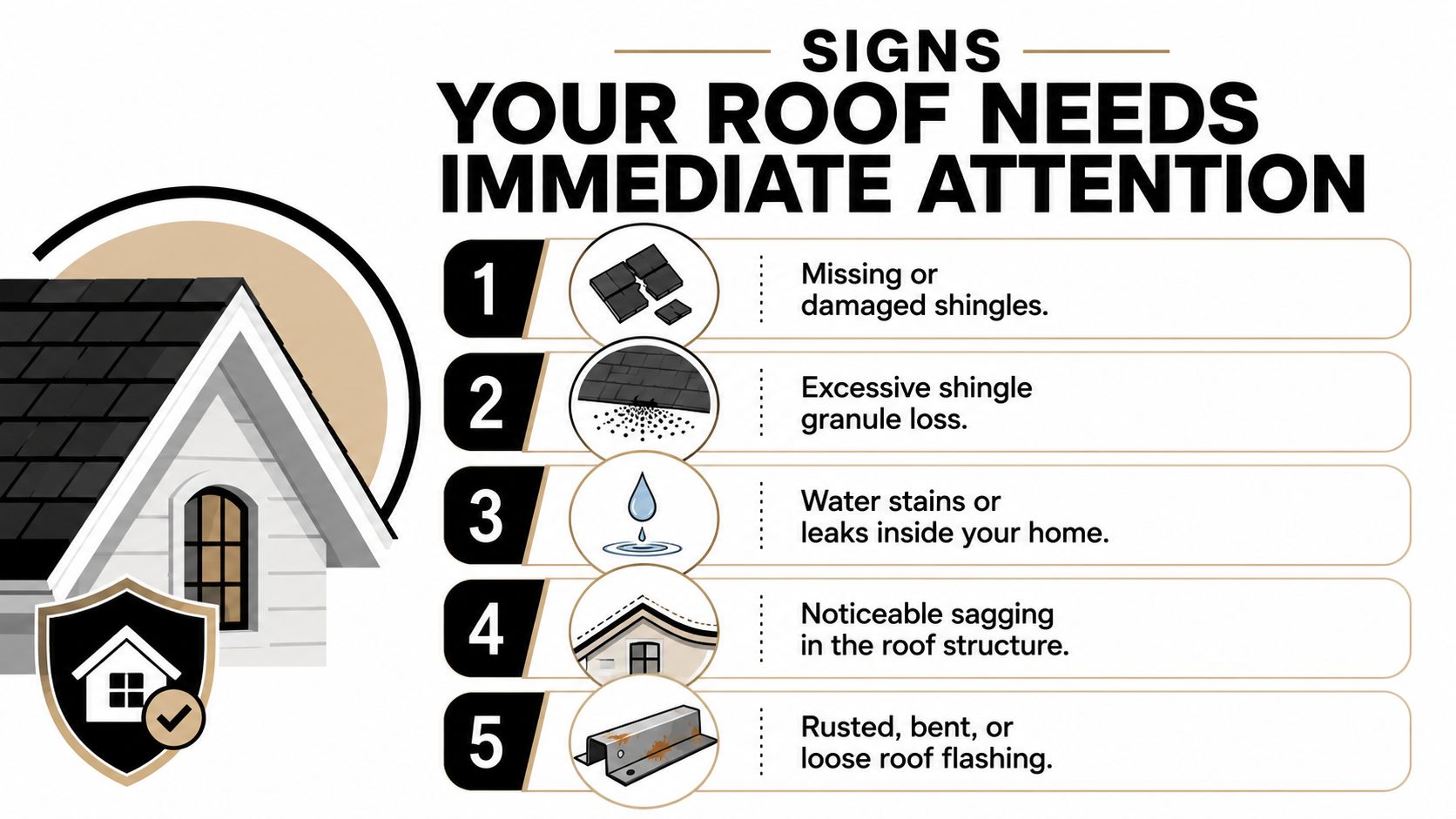
This quick visual can help you spot the red flags fast.
What to check from the ground
Start outside. Don't climb up. Walk the property and look from different angles.
- Missing shingles: If tabs are gone after wind, the roof surface is exposed and water can work into the underlayment and deck.
- Curling or cracked shingles: These often show that the repair area may not be limited to one small spot.
- Granules in gutters or at downspouts: Heavy granule loss usually means the shingles are wearing and becoming more vulnerable to rain and freeze-thaw stress.
- Bent or loose flashing: Metal around chimneys, walls, and penetrations often fails before field shingles do.
- Sagging roofline: Any visible dip or uneven line deserves prompt attention because it can signal decking or framing trouble.
A sagging section is different from cosmetic aging. If the roofline looks off from the street, treat it as a structural warning sign, not a minor maintenance issue.
What your home is telling you inside
Interior signs are often the first thing people notice, especially in finished homes where the roof itself isn't easy to see.
Look for these clues:
- Fresh water stains on ceilings or walls. New discoloration after rain usually means active water movement.
- Attic moisture or damp insulation. If insulation feels heavy, clumped, or wet, the leak has likely been there longer than you thought.
- Musty smell near upper rooms or attic access. That odor often points to trapped moisture rather than a one-time drip.
- Daylight showing through the attic. If light is getting in around penetrations or roof edges, water usually can too.
Practical rule: If you see active dripping, a visible sag, or interior water after a storm, that's no longer a watch-and-wait situation.
Damage patterns common in Western Pennsylvania
Hermitage roofs deal with a rough combination of rain, snow, freeze-thaw movement, and wind-driven water. That creates a few repeat problem areas:
| Area of roof | Common issue | Why it matters |
|---|---|---|
| Valleys | Water concentration | Small failures spread quickly |
| Chimney flashing | Separation or rust | Leaks often show up inside far from chimney |
| Eaves | Ice dam backup | Water can move under shingles |
| Pipe boots | Cracking around penetration | Often causes “mystery” leaks in bathrooms or hallways |
Homes in Sharon, Pittsburgh, and Erie face similar patterns, but Hermitage homeowners often get caught by the combination of repeated freezing nights and soaking rain. When a roof is already vulnerable, that weather exposes it fast.
DIY Triage vs Calling a Professional Roofer
The first job for a homeowner is damage control, not roof repair. That distinction matters. A safe response can limit interior damage. A rushed DIY patch on a wet or cold roof can make the problem worse and put you at risk.
What you can do safely right now
If water is entering the house, focus on protecting the inside.
- Move contents out of the leak path: Furniture, electronics, rugs, and anything porous should be moved first.
- Catch water and relieve bulging drywall carefully: If a ceiling bubble is forming, controlled drainage may reduce a larger collapse, but do it cautiously.
- Document what you see: Take clear photos of stains, drips, wet insulation, and exterior debris from the ground.
- Check the attic if it's safe: A flashlight inspection can help identify whether water is coming in around a vent, valley, or chimney area.
That's triage. It buys time and limits damage.
What you should not do is get on a steep roof with a tube of sealant and a guess. That's where simple leaks become recurring leaks.
Why patch kits often fail in Pennsylvania
Pennsylvania roofs expand and contract more than many homeowners realize. In this climate zone, asphalt shingle repairs must account for thermal movement, and a 60°F temperature swing can cause deck expansion that dislodges improperly sealed nails according to Pennsylvania roofing specifications for thermal movement and repair materials.
Professionals address that movement with elastomeric roofing cement rated for -40°F to 200°F exposure, which is a very different standard from many off-the-shelf patch products in hardware stores. A repair that ignores that movement might look fine on the day it's done and fail after the next hard weather shift.
Most bad roof repairs don't fail because someone forgot the leak. They fail because the repair material and method didn't match the climate.
There's another trade-off homeowners often miss. A temporary surface patch can trap moisture, hide the entry point, or shift water to another weak spot. On slate roofs, spot work has its own material and fastening requirements. On asphalt roofs, nail placement and sealing details matter more than the patch itself.
When the handoff should happen
Call a roofer if any of these apply:
- Active leaking is ongoing
- Shingles or flashing are visibly missing
- The roof is steep, high, or wet
- The leak may involve decking or structural soft spots
- You may need insurance documentation later
DIY is for the room below the leak. Professional work is for the roof above it.
The Professional Roof Repair Process Step by Step
A Hermitage leak often shows up after a familiar sequence. Rain gets under a lifted shingle, the temperature drops overnight, that moisture freezes, and the next thaw opens the gap a little wider. By the time water stains a ceiling, the repair needs to address more than the visible entry point.
Penn Ohio Roofing & Siding Group has worked in the Hermitage area for more than 25 years, with GAF Triple Excellence recognition and 24/7 emergency service for storm damage. Experience matters here because repairs that hold up in milder climates can fail early in western Pennsylvania if the crew does not account for freeze-thaw movement, wind-driven rain, and repeated saturation around flashing.
What happens before work starts
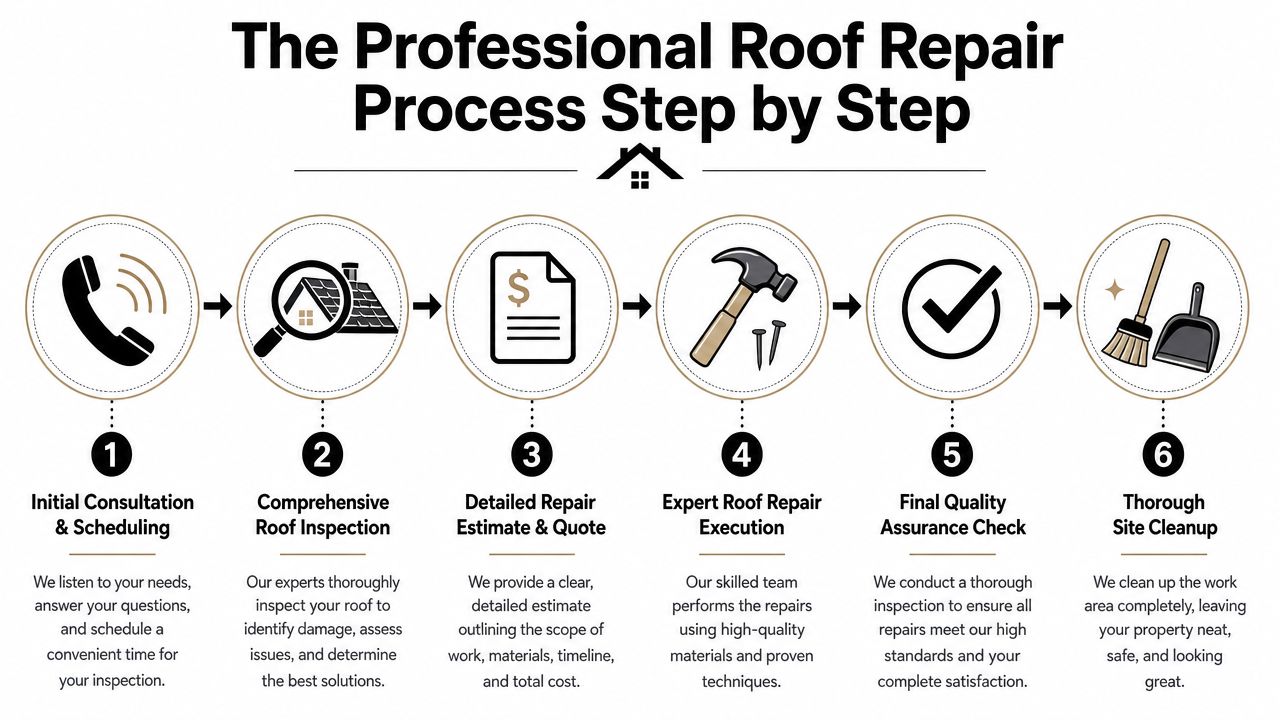
The first call should narrow down the pattern of the leak. Did it show up only during heavy rain, after snow melt, or after a windstorm? Does it happen around a chimney, wall flashing, plumbing vent, or valley? Those details help separate a small exposed-area repair from a problem that has been traveling under the roof covering for a while.
The inspection should confirm that pattern, not guess at it from the ground. A proper repair visit checks the damaged area, the surrounding roof section, flashing transitions, fasteners, sealant condition, and any signs that water has moved into the decking or attic. On larger homes or roofs with multiple slopes, drone roof inspection services for steep or hard-to-see sections can document conditions clearly and give the homeowner photos that match the repair recommendation.
This documentation step also matters for insurance. Mercer County carriers often want date-stamped photos, measurements of the damaged slope, close-ups of affected shingles or flashing, interior water staining photos, and notes that tie the damage to a specific weather event when possible. Contractors who skip that paperwork can leave homeowners with a weaker claim file later.
What a solid estimate should include
A good estimate should explain the repair method in plain language. Homeowners need to know what will be removed, what will stay in place, and what could change once the roof is opened.
Look for these details:
- Repair area and method: Which section is being repaired and whether the fix involves shingles, flashing, underlayment, decking, or a combination
- Material matching: How the contractor will handle shingle color, profile, flashing metal, and sealants that can handle Hermitage weather swings
- Water-related contingencies: What happens if wet decking, rotted fascia, or hidden underlayment damage appears during the repair
- Insurance documentation: Whether the crew will provide photos, scope notes, and condition records the homeowner can keep for a claim
- Property protection and cleanup: How landscaping, siding, gutters, and driveways will be protected and cleaned
A one-line quote usually creates problems. A detailed quote gives both sides a clear scope and reduces disagreements once the work starts.
What happens on repair day
Repair day starts with access and protection. Tarps, magnetic sweepers, ladder placement, and debris control should be set up before materials come off the roof.
Then the crew opens the affected area carefully enough to see the full water path. On Hermitage roofs, that path often extends beyond the visible stain because repeated freezing and thawing can pull water sideways at flashing edges or under shingle tabs. Good crews check whether the leak came from a failed component, a fastening issue, a flashing detail, or softened decking that no longer holds nails properly.
The repair itself is layered work. Damaged shingles or flashing come off. Wet or deteriorated substrate gets replaced if needed. Underlayment is restored. New roofing materials are installed with attention to fastening, sealing, overlap, and tie-ins to the surrounding roof system.
That sequence matters. A patch addressing only the symptom but leaves compromised underlayment or rusted step flashing in place usually does not last through another season of hard rain and winter temperature swings.
The final checks that affect repair longevity
Before the crew leaves, the repaired area should be checked for fit, seal, drainage path, and tie-in quality. These small details decide whether the repair lasts one storm or several years. Misplaced nails, loose flashing corners, exposed fasteners, and poor shingle alignment are common reasons a “finished” repair leaks again.
Cleanup is part of the job too. Old shingles, nails, sealant tubes, and metal scraps should be removed from the roofline, beds, lawn, and driveway. Homeowners should also receive photos or a short summary of the completed work, especially if storm damage documentation may be needed for a Mercer County insurance file.
Understanding Roof Repair Costs in Hermitage
Price is one of the first questions homeowners ask, and for good reason. Roof work can range from a fairly contained patch to a repair that uncovers broader damage. In Hermitage, the local cost picture is a little higher than many national articles suggest, so broad internet estimates often create false expectations.
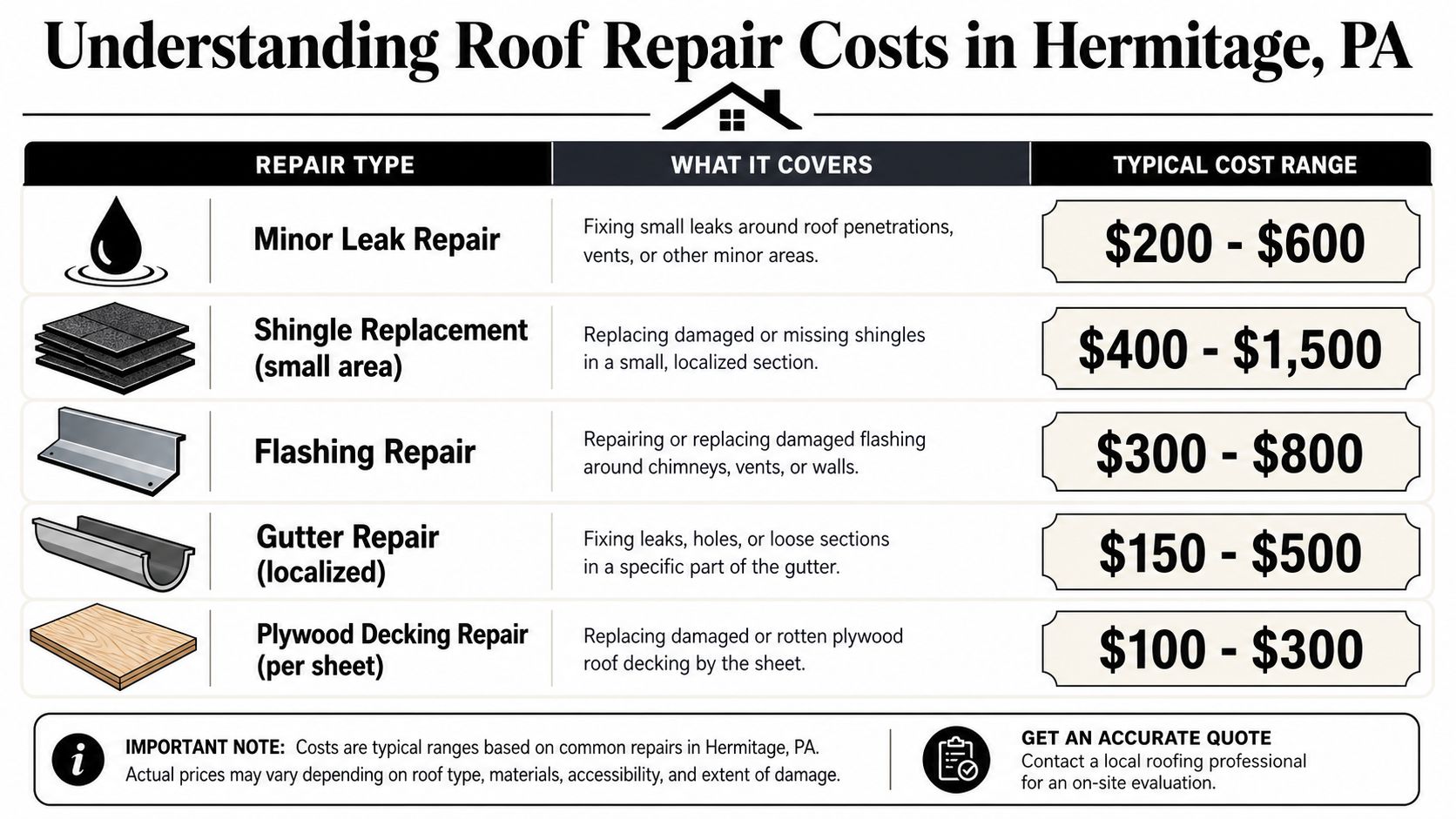
Typical repair ranges in Hermitage
In Hermitage, common roof repairs typically range from $1,089 to $2,429, and minor patch repairs might cost between $300 and $1,000, according to Hermitage roof repair pricing data from The Roofer Finder. That same source notes that full residential roof replacements in Hermitage commonly range from $12,656 to $17,867, while architectural shingle replacements range from $8,000 to $12,000 and metal roof installations can reach $12,000 to $20,000.
Here's a simple way to think about those ranges:
| Type of work | Typical Hermitage range |
|---|---|
| Minor patch repair | $300 to $1,000 |
| Common roof repair | $1,089 to $2,429 |
| Full residential replacement | $12,656 to $17,867 |
The same Hermitage pricing source also states that most homeowners spend approximately $1,100 on a single repair project.
Why one roof repair quote is higher than another
Two repair estimates can look very different even when both describe a leak. That usually comes down to conditions, not just contractor pricing.
Common cost drivers include:
- Roof material: Asphalt, metal, and tile all repair differently.
- Access difficulty: A steep, high, or obstructed roof takes more setup and labor.
- Damage severity: A flashing fix is one thing. Wet decking under the leak is another.
- Location of the repair: Valleys, chimneys, and roof-to-wall transitions often take more detail work.
The local benchmark also matters. The same Hermitage pricing source says national averages for roof repair sit between $386 and $1,875, which means Hermitage homeowners often see costs that are somewhat higher than broader national figures.
A suspiciously low roofing quote usually means one of two things. The contractor missed part of the problem, or the scope is thin.
What homeowners should take from these numbers
Use pricing data as a budgeting baseline, not a promise. The right number depends on what's damaged once the repair area is opened up.
A fair estimate should show enough detail that you can tell whether you're paying for a real repair or just a surface patch that may need to be redone later.
Navigating Insurance Claims for Storm Damage
Storm claims used to be more straightforward. A homeowner saw damage, a roofer took photos, an adjuster looked things over, and the decision followed from there. In Mercer County, that's no longer the whole story.
Many homeowners run into trouble because they assume visible storm damage is enough. Often, it isn't.
What adjusters want now
A key challenge for Hermitage homeowners is meeting insurance claim requirements. Many Mercer County insurers now mandate thermal imaging + moisture mapping reports to validate hidden water intrusion before approving claims, according to Mercer County storm-damage roofing documentation guidance.
That's a major shift from the old photo-only approach. If water has moved beneath the visible roof surface or into insulation and decking, insurers may want evidence that goes beyond what can be seen in exterior images.
This changes the homeowner's job in an important way. Choosing a roofer isn't only about who can replace shingles. It's also about who can document the loss correctly.
How homeowners make claims harder by accident
A few common mistakes cause avoidable delays:
- Waiting too long to document interior moisture: Stains change, surfaces dry, and evidence gets less clear.
- Throwing away damaged materials immediately: A missing shingle or broken flashing piece can help support the timeline.
- Accepting a simple visual opinion as full documentation: That may not satisfy the insurer's standard.
- Starting permanent repairs before the claim path is clear: Emergency protection is one thing. Full undocumented repair work can complicate review.
If your roof took storm damage and you need prompt mitigation before the next weather event, emergency storm damage roof repair support is often the first practical step while the documentation process moves forward.
Insurance approval often turns on documentation quality, not just damage severity.
Repair claim or replacement claim
Homeowners often assume the insurer decides between repair and replacement based only on visible square footage. In practice, the supporting record matters. Moisture spread, hidden intrusion, and whether the roof system can be restored properly all affect the outcome.
That's why calm documentation beats rushed assumptions. If the file is thin, even a real loss can become a disputed one.
How to Choose a Licensed and Insured Roofer in PA
Roofing is one of those trades where paperwork tells you a lot. A neat truck and a fast estimate don't prove much. The legal and insurance documents do.
The documents that matter
In Pennsylvania, any contractor performing over $5,000 of home improvement work annually must have a Home Improvement Contractor (HIC) registration number from the Attorney General's Office, and homeowners should verify that number before signing a contract according to Pennsylvania HIC registration guidance for roofers.
That HIC number should appear in advertisements, contracts, and estimates when the contractor falls under that requirement. If it's missing, ask why.
There's also an insurance baseline behind registration. To register as a Pennsylvania home improvement contractor, applicants must provide proof of general liability insurance with at least $50,000 coverage for personal injury and property damage, pay a $50 registration fee, and re-register every two years, according to Pennsylvania contractor licensing and insurance requirements.
A simple vetting checklist
Use this before you sign anything:
- Verify the HIC number: Don't just read it. Confirm it.
- Ask for current insurance proof: Make sure the policy is active now, not from an old file.
- Match the contract to the conversation: If flashing, cleanup, or permit handling were discussed, they should be written down.
- Check how the company presents itself locally: Strong visibility isn't proof of quality, but it can help you evaluate professionalism. Homeowners who want to understand how contractors build that presence can read about contractor local search dominance in a broader local marketing context.
Pennsylvania also has permit realities homeowners should know. Many municipalities require roofing permits for full replacements, structural changes, different roofing materials, or additions like skylights, according to Pennsylvania roofing permit guidance. Separate local guidance also notes that many municipalities use a 25% threshold as a permit boundary for repair scope rather than an automatic replacement trigger, based on Pennsylvania roofing permit threshold discussion.
If a contractor gets irritated when you ask for license and insurance documents, keep looking.
Frequently Asked Questions About Roof Repairs
A lot of roof repair questions come up after the first call, not before it. These are the ones homeowners in Hermitage ask most often when they're trying to make a practical decision.
How long does a patch repair last
It depends on what was repaired and whether the method matched the roof system and weather exposure. A correctly diagnosed repair can hold well. A surface patch placed over the wrong entry point usually doesn't. In Hermitage, freeze-thaw movement and long wet periods are hard on shortcuts.
What if more damage shows up during the repair
That happens sometimes, especially when water has been moving under shingles or around flashing for a while. The important part is how it's handled. You should get photos, an explanation of what changed, and a clear update before additional work moves forward.
Is a small leak an emergency
Sometimes yes. A leak that seems small on the ceiling can still be reaching insulation, decking, or framing. If water is actively entering the home, if the leak followed a storm, or if the attic shows wet materials, treat it as urgent even if the drip itself looks minor.
Can repairs be scheduled in cold weather
Yes, but method matters. Cold-weather work requires the right sealants, handling, and expectations. Some materials stiffen, some adhesives don't perform the same way, and crews need to account for thermal movement. That's one reason winter roof work shouldn't be treated like a summer patch with the same materials.
Will the repaired area match the rest of the roof
Often it can be blended reasonably well, especially on newer roofs with commonly available shingle lines. Perfect color matching is harder on older roofs that have weathered unevenly. A good contractor should be direct about appearance before the work starts.
Should I call for an inspection if I only see granules or one lifted shingle
Yes. Those are often early signs, not isolated curiosities. It's easier and less expensive to catch a repairable issue before water starts moving into the house.
If you need clear answers about roof repair in Hermitage PA, Penn Ohio Roofing & Siding Group offers homeowners a practical next step. You can request a free estimate, get the roof inspected, and find out whether you're dealing with a limited repair, storm-related claim documentation, or a broader roofing issue that needs a more complete plan.