You hear wind all night, then spend the next morning looking up at the roof from the driveway, trying to decide whether you're seeing real damage or just worrying. That's a common spot for homeowners in Sharon, Pittsburgh, Erie, and smaller towns around Hermitage. You know the roof matters. You also know that getting someone up there isn't always simple, fast, or cheap.
That's where drone roof inspection services make sense. They give property owners a way to check roof condition without sending a person across shingles, metal panels, or flat membranes just to get basic answers. If the service is done right, you get clear imagery, a better record of what's present, and a report that's useful for repairs, maintenance planning, real estate decisions, or an insurance conversation.
In Pennsylvania, the practical question isn't whether drones are interesting technology. It's whether they solve a real problem on your property. Sometimes they do. Sometimes they need to be paired with a hands-on roofing inspection. The difference comes down to what you need the inspection to prove.
Table of Contents
- What Is a Drone Roof Inspection
- The Drone Inspection Process and Technology Explained
- Key Benefits of Drone Inspections Over Traditional Methods
- Common Use Cases for Drone Roof Inspections
- Understanding Drone Roof Inspection Costs in Pennsylvania
- How to Choose a Qualified Provider in the Hermitage Area
- Frequently Asked Questions About Drone Inspections
What Is a Drone Roof Inspection
A drone roof inspection is a roof evaluation performed with an unmanned aircraft equipped with cameras instead of starting with a ladder walk. In plain terms, the operator flies the roof, captures detailed images, and turns that flight into a usable record of the roof's condition.
For a homeowner, that usually means less disruption and less guesswork. You don't have someone walking all over older shingles, brittle slate, wet metal, or a steep surface just to decide whether there's damage. You get a top-down view, close-angle visuals, and often a more complete look at hard-to-see sections like upper ridges, valleys, dormers, flashing lines, and transitions.
Why property owners are turning to it
The value is straightforward. A good drone inspection can help answer questions such as:
- Did the storm damage the roof
- Is there visible wear around flashing, seams, or penetrations
- Are there spots that need repair now instead of six months from now
- Do you need a basic repair estimate, deeper testing, or a full replacement discussion
This isn't a niche idea anymore. The global drone roof inspection market is projected to grow from USD 0.3 billion in 2026 to USD 1.2 billion in 2036, expanding at a CAGR of 14.9%, which reflects wider use across residential, commercial, and industrial property assessment according to Fact.MR's drone roof inspection market analysis.
Practical rule: A drone inspection is best when you need a safe, fast, visual record of roof condition. It is not automatically the same thing as a full forensic damage analysis.
What you usually get
Most drone roof inspection services produce some combination of:
- High-resolution roof photos that show visible defects and overall condition
- Thermal imagery when hidden moisture or insulation issues are part of the concern
- Annotated reports that point out damage locations and repair priorities
- A broader roof overview that helps homeowners, property managers, and buyers understand what they're dealing with
For many properties in places like Sharon or Pittsburgh, that's enough to move from uncertainty to a decision. For other situations, especially insurance disputes or larger commercial claims, the drone flight is only the first layer of documentation.
The Drone Inspection Process and Technology Explained
One might picture a pilot showing up, launching a drone, and emailing photos later. A professional inspection is more structured than that.
What happens before the drone leaves the ground
The work starts with the property details. The operator needs the roof type, building height, obstacles, nearby trees, service lines, and the reason for the inspection. A storm-damage check is different from a pre-sale inspection. A flat commercial roof in Erie is different from a steep residential roof in a wooded Hermitage neighborhood.
Then comes pre-flight planning. Good operators don't free-fly randomly and hope they caught everything. They map the structure, define the scan area, set image overlap, and choose the capture pattern based on the roof shape. That's how the final output becomes consistent enough to review and use.
What the drone captures and why it matters
Most inspections rely on an RGB camera for visible-light imagery. If the project calls for it, the operator may also use thermal imaging to flag moisture intrusion or insulation gaps that standard photos can't show clearly.
The technical side matters because it affects what the report can find. Modern commercial drone roof inspection systems can achieve sub-centimeter spatial resolution, typically 0.5 to 0.8 cm per pixel, which helps detect membrane cracks and failed sealant joints, according to Hammer Missions' commercial drone roof inspection guide. The same source notes that for a 50,000 sq ft commercial roof, dual-pass visible-light and thermal data collection can be completed in under 90 minutes.
That precision is the difference between seeing “general wear” and spotting a specific defect line near a seam or penetration.
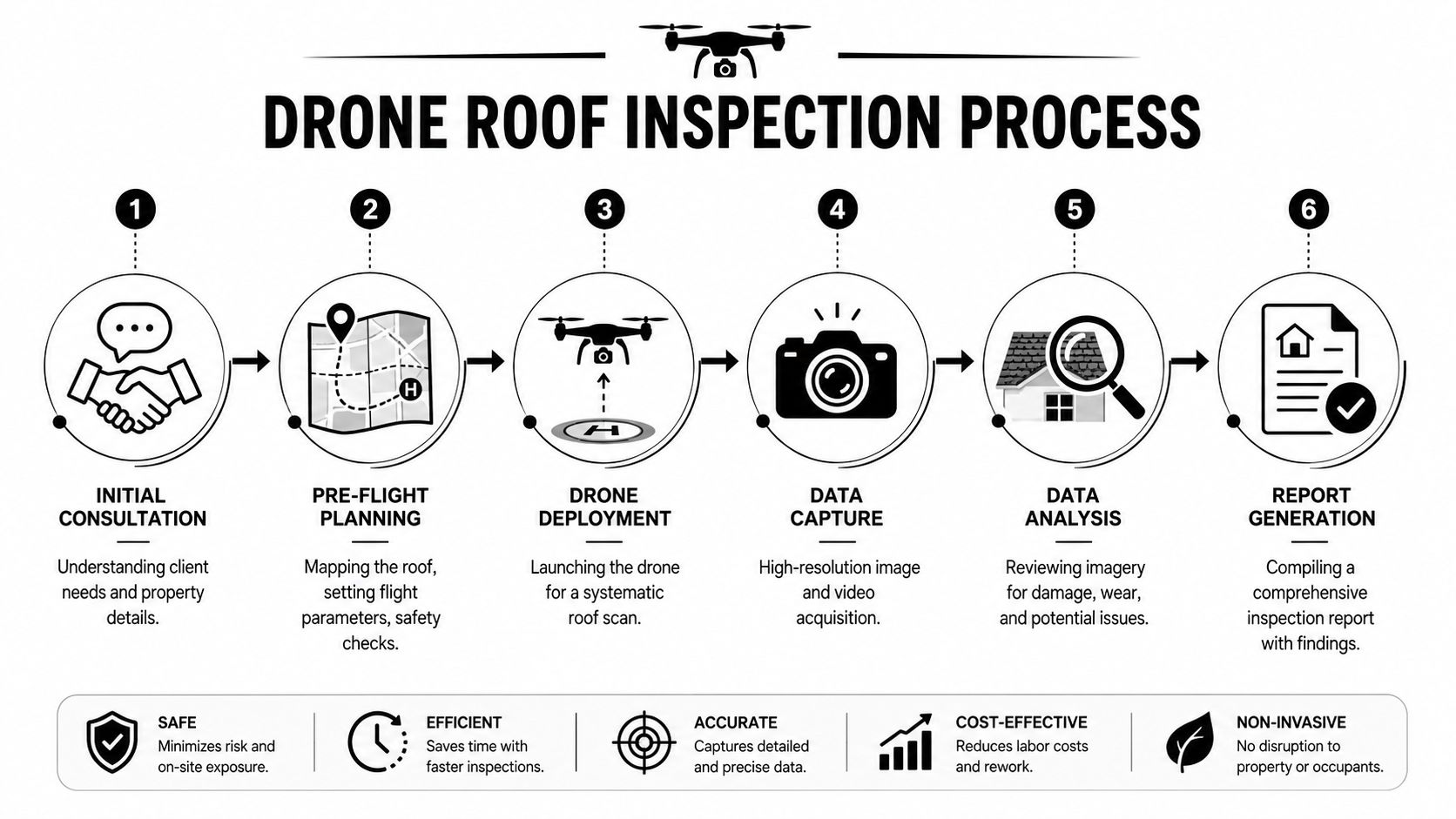
A typical workflow looks like this:
Consultation and scope setting
The provider identifies whether you need a simple visual scan, thermal review, or measurement-grade output.Pre-flight safety and route planning
The pilot checks airspace, obstacles, weather, and the best image path for full roof coverage.Systematic flight capture
The drone follows a planned route and records overlapping images rather than a handful of random snapshots.Processing and review
The imagery is sorted, stitched, and evaluated for visible issues.Report delivery
You receive findings in a format that should match the reason you ordered the inspection in the first place.
A well-run drone inspection feels less like someone taking aerial pictures and more like a measurement and documentation job.
The practical takeaway is simple. Better process produces better evidence. If you only get a folder full of unlabeled images, the technology was underused.
Key Benefits of Drone Inspections Over Traditional Methods
A traditional roof inspection still has a place. Some situations require hands-on probing, physical moisture testing, or close material examination. But for many property owners, drones solve the biggest problems first.
Where drones clearly win
The first advantage is safety. Keeping people off steep, slick, fragile, or storm-damaged roofs reduces exposure to falls and can also reduce accidental roof damage from foot traffic. That matters on older shingles, tile, slate, and certain metal systems.
The second is speed. Drone roof inspections can cost between $150 and $400, are roughly half the price of traditional methods, and can reduce inspection times by as much as 90%, according to Skyebrowse's roof inspection cost breakdown. That time savings matters when a homeowner in Sharon needs answers after hail, or when a property manager in Pittsburgh needs to review several buildings without tying up crews for days.
The third is documentation quality. A drone creates a visual record that can be reviewed later by the owner, roofer, buyer, or adjuster. That's often better than relying on someone's field notes and a few phone pictures taken while balancing on a slope.
Skyebrowse also notes that PricewaterhouseCoopers estimates drone adoption could save the insurance industry up to $6.8 billion annually. That number matters because it shows why carriers and adjusters have become more comfortable with drone-based workflows.
Drone vs. Traditional Roof Inspection
| Feature | Drone Inspection | Traditional Inspection |
|---|---|---|
| Roof access | No one needs to walk the roof for the initial visual review | Inspector typically needs ladder access and roof movement |
| Typical residential cost | $150 to $400 | About $300 to $600 |
| Speed | Can reduce inspection time by as much as 90% | Slower setup and roof access |
| Safety profile | Reduces direct exposure to roof hazards | More fall exposure and more contact with the roof |
| Documentation | Aerial imagery and organized visual record | Notes and manual photos, quality varies by inspector |
| Best use | Fast assessment, storm review, difficult access, broad documentation | Hands-on testing, close material verification, physical probing |
Bottom line: Drones are strongest at access, speed, and visual documentation. Traditional inspections are strongest when someone must physically test or handle the roof system.
That's why the best contractors don't treat this as an all-or-nothing choice. They use the drone first, then decide whether the roof needs boots on the surface.
Common Use Cases for Drone Roof Inspections
A drone inspection becomes useful when it solves a specific problem. The technology is impressive, but its true utility is in the decision it helps you make.
Residential homeowners after storms or during routine maintenance
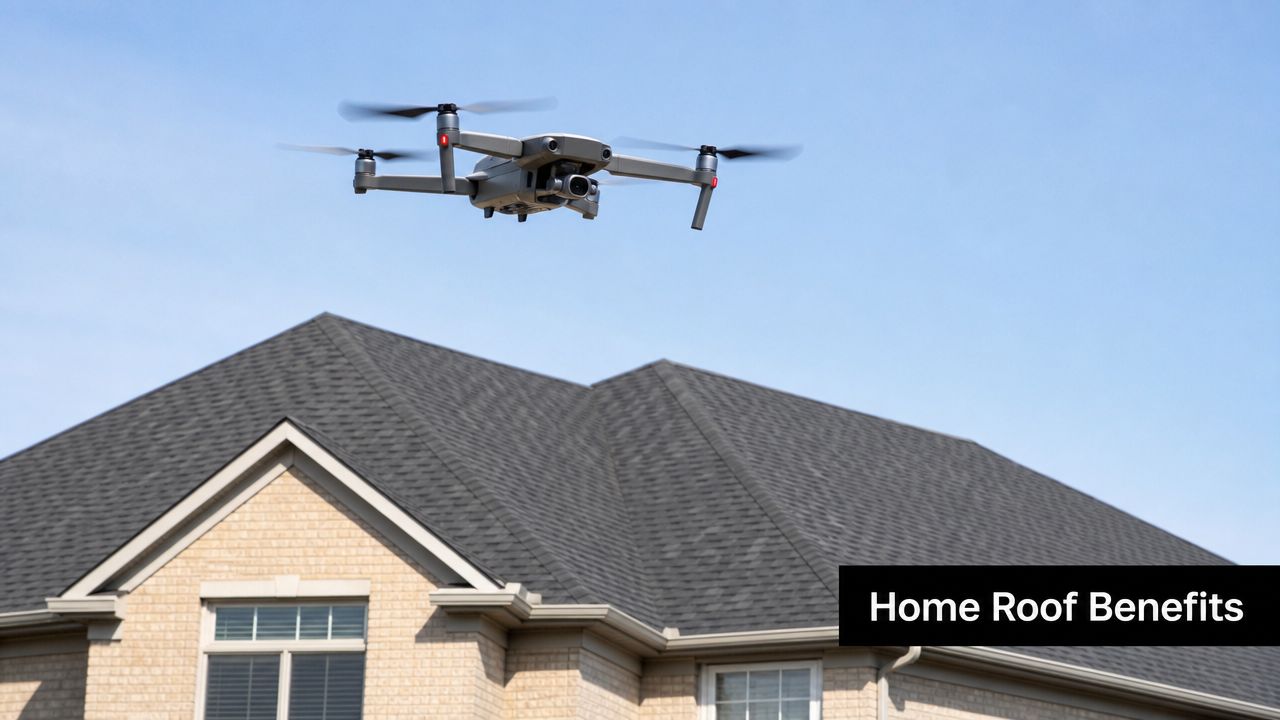
For homeowners, the most common trigger is weather. After high winds or hail, you want to know whether the roof has missing shingles, displaced flashing, impact marks, or debris damage. A drone gives a fast roof-wide view without waiting for a full manual walkthrough just to confirm whether there's a problem.
Routine maintenance is the other strong use case. If a roof is aging but not obviously failing, a drone inspection can help spot areas that deserve repair before water gets inside. That's often more useful than waiting for an interior leak.
For contractors handling broader storm-response work, this restoration guide for contractors is a helpful reference on how inspection findings fit into the larger restoration process after severe weather.
Commercial buildings insurance work and real estate decisions
Commercial roofs benefit because they're large, repetitive, and expensive to access manually. A drone can scan broad membrane areas, edge details, rooftop units, drains, and seams with less disruption to the building. That's especially useful for warehouses, retail properties, and multi-unit buildings in cities like Erie and Pittsburgh.
Insurance-related use is also growing. Adjusters and owners need documentation fast after a storm event, and a drone can provide a cleaner initial record than a rushed manual visit. The key is making sure the report format matches the claim requirement, which comes up again in the FAQ section below.
Real estate agents and buyers use drone inspections differently. They're trying to reduce surprises before closing. A seller can document roof condition before listing. A buyer can use the report to support repair requests or negotiate intelligently. For transaction-related evaluations, a focused real estate roof inspection resource can help clarify what kind of roof documentation is most useful before a sale closes.
A few examples where drone roof inspection services fit well:
- A homeowner in Sharon who wants to check for storm damage without risking more foot traffic on an older roof.
- A property manager in Pittsburgh who needs roof imagery across multiple buildings for maintenance planning.
- An insurance professional who needs fast visual evidence before deciding whether more detailed documentation is required.
- A real estate agent in Erie who wants a clearer roof-condition record during a sale.
The important part is matching the inspection type to the decision. A maintenance check, a claims package, and a pre-listing review are not the same assignment.
Understanding Drone Roof Inspection Costs in Pennsylvania
Price is one of the first questions homeowners ask, and it should be. The range is wide enough that you need to know what you're paying for before you compare quotes.
What affects the final price
The biggest factor is roof size. A small, simple roof takes less flight time and less review time than a larger house with multiple ridges, valleys, dormers, and elevation changes.
Scope also changes the price. A standard visual inspection is one thing. Thermal imaging, more detailed reporting, or measurement-focused outputs can push the cost higher. Accessibility, surrounding trees, and nearby structures can also make the job more involved even when the square footage looks modest on paper.
Another common pricing mistake is assuming the flight itself is the whole product. It isn't. The report quality, labeling, image organization, and whether the output is useful for a contractor, buyer, or insurer all affect value.
What Pennsylvania homeowners can expect
For Pennsylvania homeowners, a residential drone roof inspection typically costs $150 to $400 for standard visual inspections, according to Pennsylvania drone roof inspection pricing details. The same pricing reference notes that homes under 1,500 sq ft average $150 to $250, while homes between 2,500 and 3,000 sq ft range from $400 to $600.
That gives you a realistic budgeting range whether you're in Hermitage, Sharon, or a Pittsburgh suburb with larger homes and more roof complexity.
A practical way to think about the quote is this:
Smaller home, simpler roof
Usually closer to the lower end of the range.Larger home, more facets or obstacles
Usually higher because the operator spends more time flying and reviewing.Visual-only report versus upgraded documentation
The base inspection may answer maintenance questions, but a more detailed package may be needed for a claim or a formal transaction.
If you're comparing providers, ask what the report includes, not just what the flight costs.
For many homeowners, the right question isn't “What's the cheapest drone inspection?” It's “Will this report be usable for the reason I'm ordering it?” Cheap visual scans can be fine for routine maintenance. They can be the wrong product if you need measurement-grade documentation.
How to Choose a Qualified Provider in the Hermitage Area
Not every company offering drone roof inspection services understands roofs. Some know how to fly. Some know how to inspect. You want both.
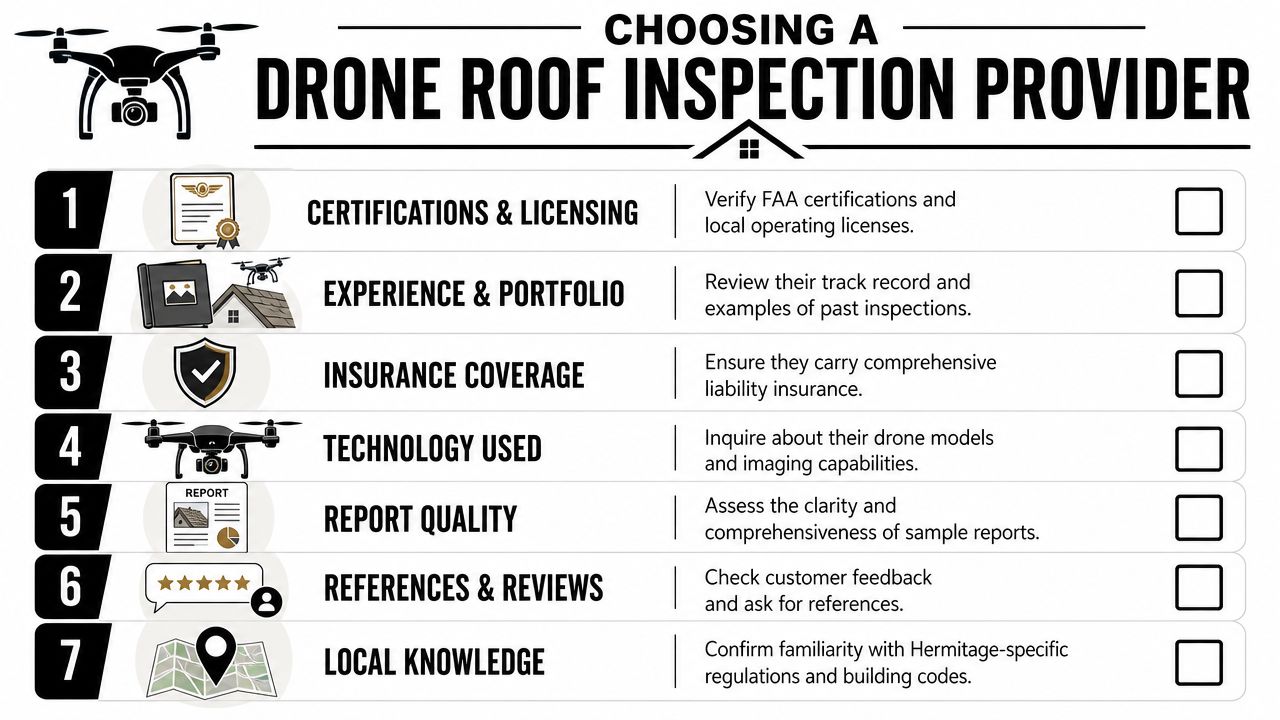
The checklist that matters
Start with legality. FAA Part 107 certification is required for commercial operators in the U.S., according to Aerially's drone roof inspection guide. If the provider can't confirm that, stop there.
Then check whether they carry proper insurance and whether they've worked with actual roofing systems, not just aerial photography. A pilot can capture sharp images and still miss what matters if they don't know how flashing failure, shingle lift, membrane seam issues, or drainage problems present on a roof.
The same Aerially guide notes that safety is a primary advantage, with drones reducing fall-risk incidents by over 90% in hazardous environments. That benefit only counts if the operator runs the work professionally.
Use this short hiring checklist:
- Verify FAA credentials so you know the flight is legal.
- Ask for sample reports to see how findings are labeled and explained.
- Confirm roofing knowledge because image quality alone doesn't diagnose roof issues.
- Check insurance coverage in case equipment causes damage.
- Ask what deliverable you'll receive so you don't end up with a gallery of photos and no usable conclusions.
- Review a professional inspection standard such as this professional roof inspection overview to understand what a serious report should help you evaluate.
Why local roofing knowledge still matters
Local experience matters more than many homeowners realize. A provider working around Hermitage, Sharon, Mercer County, Beaver County, and Lawrence County should understand the roof types common to the region, the weather patterns that create damage here, and the logistical issues that come with mature trees, narrow lots, and neighborhood spacing.
That roofing context helps with interpretation. Staining, granule loss, seam movement, flashing separation, and ponding indicators don't mean much if the person reviewing the images doesn't understand how those issues behave over time.
Hire the provider who can explain what they're seeing on the roof, not just the provider who owns the drone.
It also helps to choose a company that can communicate clearly with other stakeholders. If the images may end up in front of an adjuster, a buyer, or a property manager, the report should be organized enough that a non-roofer can follow it.
For roofing businesses that are trying to present inspection services clearly online, this article on roofer marketing strategies is a useful look at how companies communicate trust and technical capability. From a homeowner's perspective, that same lens helps you spot the difference between a polished website and a qualified provider.
Frequently Asked Questions About Drone Inspections
Will a drone report work for an insurance claim
Sometimes yes, sometimes no. A major point of confusion is that many insurers reject photo-only reports and require measurable orthomosaics or 3D models to quantify damage area, as explained in this discussion of drone inspections versus manual inspections for insurance documentation.
That means a basic drone flight can be useful but still not be claim-ready. If your goal is an insurance claim, ask before the flight whether the report includes measurable outputs and whether the provider has experience producing documentation that adjusters can effectively use.
What should you do before the flight
Keep the driveway and immediate work area clear if possible. Secure pets. Let the operator know about power lines, backyard obstacles, locked gates, or anything unusual around the property.
It also helps to be clear about your goal. If you want routine maintenance information, say that. If you need evidence for a claim, make that clear up front so the provider can recommend the right report level rather than a simple visual package.
Can drones fly in any weather
No. Rain, snow, and strong wind can delay a flight. Even when the drone could technically get airborne, poor conditions can reduce image quality and make the report less useful.
That's frustrating when you want answers fast after a storm, but it's still better to wait for a safe, clear capture than to pay for weak documentation.
Are drone inspections enough by themselves
Often, but not always. Drone inspections are excellent for visual review, access, and documentation. They may still need to be followed by a hands-on inspection when a roofer needs to test materials directly, check soft spots closely, or verify issues that imagery alone can't confirm.
That isn't a weakness. It's just the right use of the tool.
If you need practical help with roof inspection, repair planning, or storm-related roof concerns in Hermitage and surrounding Pennsylvania communities, Penn Ohio Roofing & Siding Group offers experienced roofing support backed by decades of residential and commercial work. Whether you need a clearer look at storm damage, a professional inspection, or guidance on the next step, their team can help you move from uncertainty to a solid plan.