
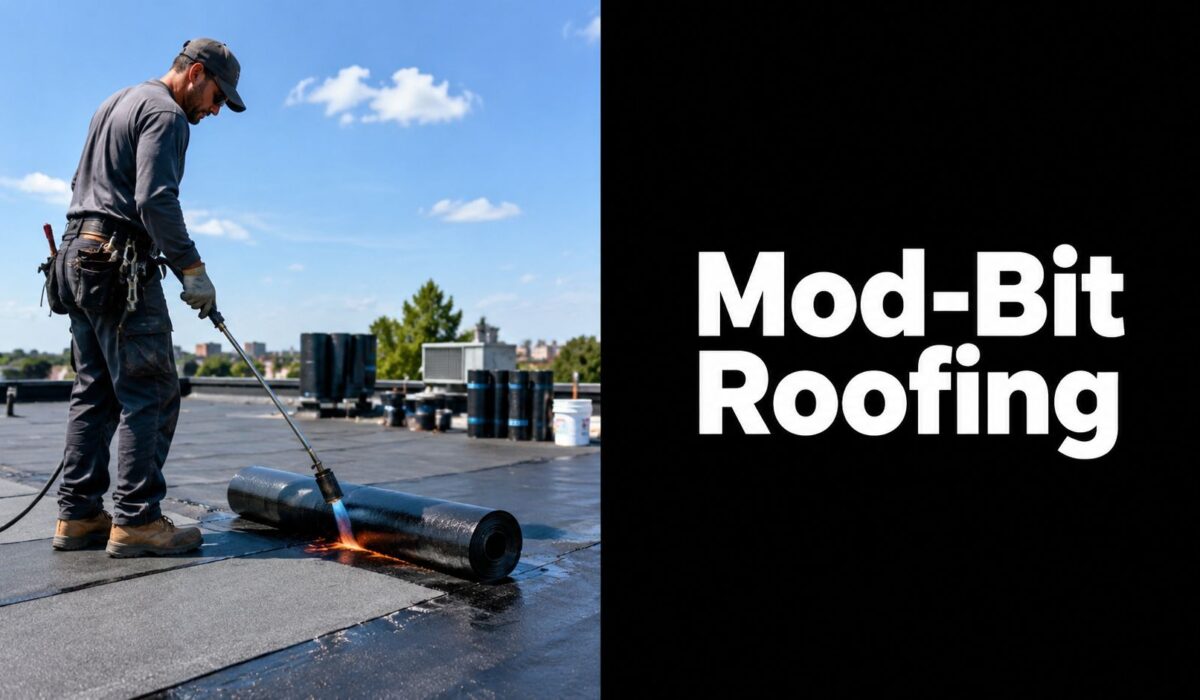
Modified bitumen roofing is a durable, asphalt-based roofing material made for low-slope or flat roofs, reinforced with polymers like rubber or plastic for added flexibility and strength. With proper installation and maintenance, it typically lasts 20 to 30 years, which is one reason so many property owners consider it for hard-working commercial and residential low-slope roofs.
If you're standing in a parking lot in Sharon, looking up at a flat roof after another Pennsylvania storm, you're probably not asking for roofing jargon. You want to know whether this roof can stop leaks, handle snow and ice, and hold up when winter freezes and spring thaws keep pulling materials apart.
That's where modified bitumen earns its place. It's the modern cousin of old tar-and-gravel roofing, built to give asphalt more stretch and recovery so it doesn't become as brittle under stress. For owners in Pittsburgh, Erie, and other parts of western Pennsylvania, that matters because roof materials here don't get a gentle life. They get cold snaps, wet seasons, rooftop service traffic, and temperature swings that expose weak spots fast.
Table of Contents
- An Introduction to Modified Bitumen Roofing
- The Building Blocks of a Mod-Bit Roof System
- Choosing Your Armor SBS vs APP Membranes
- How Modified Bitumen Roofs Are Installed
- The Benefits and Drawbacks of Modified Bitumen
- Lifespan Costs and Essential Maintenance
- How Mod-Bit Compares to TPO EPDM and PVC
- Trust the Experts for Your Roofing Project
An Introduction to Modified Bitumen Roofing
Modified bitumen roofing answers a simple problem. Traditional asphalt roofing works, but flat and low-slope roofs need something that can move without cracking when the building and weather put it under stress.
That's why people ask, what is modified bitumen roofing, and the plain answer is this: it's asphalt roofing that's been improved with polymer modifiers so it can flex more, recover better, and resist damage better than older asphalt-only systems. On a low-slope roof, that added movement matters because water drains slower, surfaces get more sun exposure, and seams have to stay tight through all kinds of weather.
In practical terms, think of it as an upgrade to older built-up roofing. Built-up roofing has been used on low-slope roofs for over a century, and modified bitumen grew out of that tradition instead of replacing it with something completely unrelated. According to Polyglass on the history of modified bitumen roofing, modified bitumen made its commercial debut in Europe during the mid-1960s, when asphalt was blended with styrene-butadiene-styrene (SBS) to create an elastomeric blend with significantly greater flexibility and recovery than other asphaltic systems at the time.
A flat roof in Pennsylvania doesn't fail because it looks flat. It fails when the material and the details can't handle movement, moisture, and time.
For property owners in Sharon, Pittsburgh, and Erie, that history matters because the material was developed to solve a real weakness in older asphalt roofing. It wasn't invented as a trend. It was built to make asphalt perform better where roofs expand, contract, and take a beating.
The Building Blocks of a Mod-Bit Roof System
A mod-bit roof works because it's a system, not just a roll of material.
The easiest way to understand it is to think about work jeans with stretch fabric in them. Regular denim is tough, but once you add a flexible material, it moves better and holds up better when you bend, kneel, and twist all day. Modified bitumen does the same thing for asphalt. The asphalt provides the waterproofing backbone, and the polymer modifier gives it the extra movement and toughness older systems lacked.
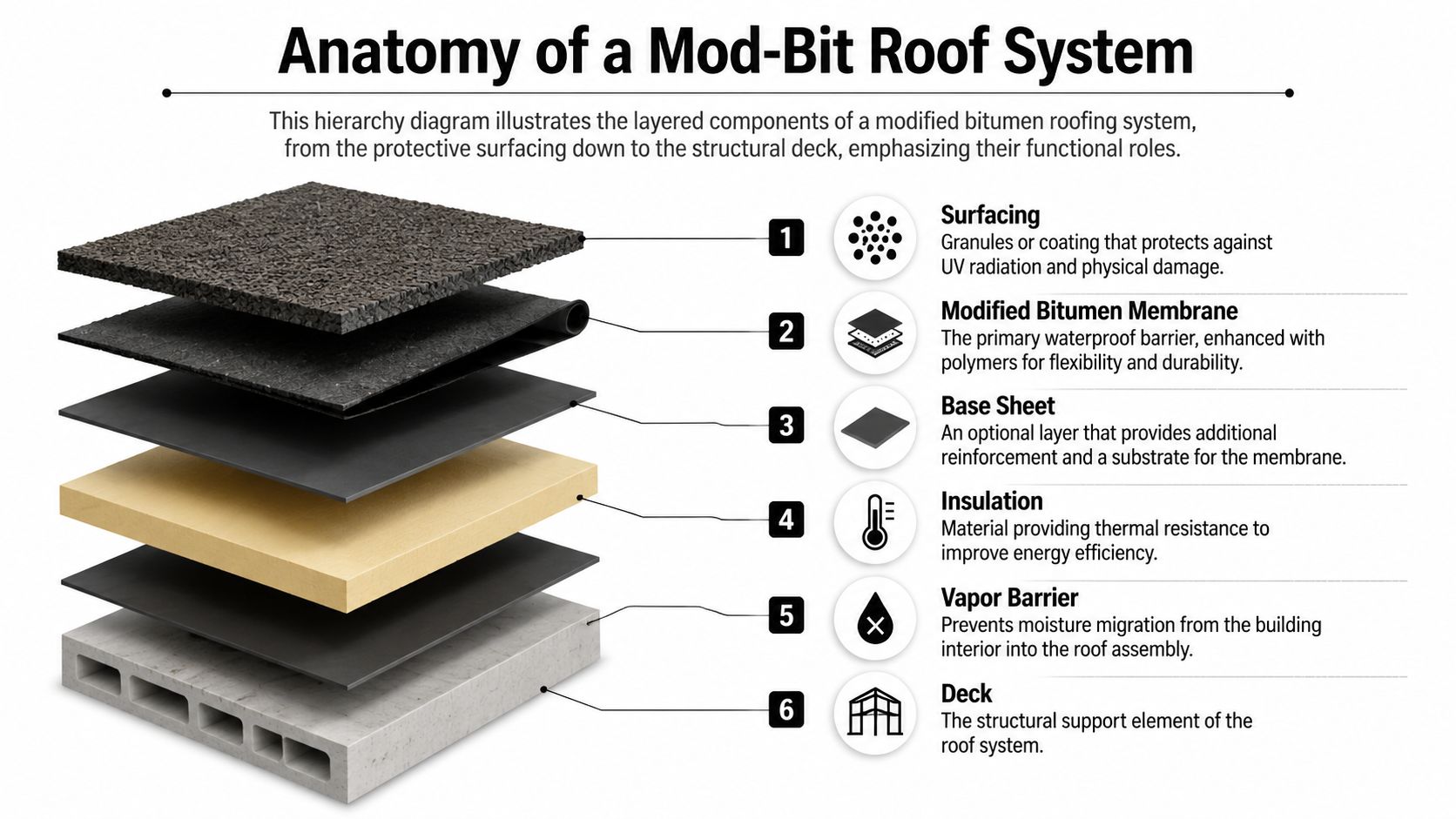
Here's the basic roof assembly at a glance:
What each layer does
A typical modified bitumen roof may include these components:
- Surfacing: This is the top layer you see. It may use granules or a coating to protect the membrane from sunlight and surface wear.
- Modified bitumen membrane: This is the main waterproofing layer. It's the part designed to keep water out while handling movement.
- Base sheet: This layer adds support and creates a sound surface for the membrane above.
- Insulation: This helps control heat flow through the roof assembly.
- Vapor barrier: This helps limit moisture moving up from inside the building into the roof system.
- Deck: This is the structural base everything sits on.
Why the layered design matters
Owners sometimes assume a flat roof should be judged by the top surface alone. That's a mistake. The performance of a mod-bit roof depends on how all the layers work together.
A good system should do more than repel rain. It should also:
- Handle movement from daily temperature changes.
- Resist punctures from foot traffic and service work.
- Protect the deck and insulation from trapped moisture.
- Give repair crews a clear, serviceable membrane when maintenance is needed.
Practical rule: If someone talks only about the cap sheet and ignores insulation, substrate condition, and seam detailing, they're not really talking about the whole roof.
That layered approach is one reason mod-bit remains popular on low-slope roofs that need durable waterproofing without giving up repairability.
Choosing Your Armor SBS vs APP Membranes
When people hear “modified bitumen,” they often assume it's one single material. It isn't. The two main versions are SBS and APP, and choosing between them can make a real difference in Pennsylvania.
SBS and APP in plain language
SBS stands for styrene-butadiene-styrene. In the field, most roofers describe it as the more rubber-like option. It's built to flex more.
APP stands for atactic polypropylene. It's usually described as more plastic-like, with a different feel and application style.
According to CSR Roofing's explanation of modified bitumen types, the most common type in the industry is SBS because its high flexibility allows stronger expansion and contraction. That's especially useful in Pennsylvania cities like Sharon, Pittsburgh, and Erie, where temperature swings can be rough on a low-slope roof.
If you own a building in western Pennsylvania, that flexibility isn't a minor detail. Freeze-thaw cycles keep asking the roof to move. Materials that can't handle that movement tend to show stress first around seams, penetrations, and transitions.
SBS vs. APP Modified Bitumen at a Glance
| Feature | SBS (Styrene-Butadiene-Styrene) | APP (Atactic Polypropylene) |
|---|---|---|
| Feel | More rubber-like | More plastic-like |
| Main strength | Flexibility and movement | UV resistance and heat-welded application style |
| Typical application | Often with hot asphalt or cold adhesive | Commonly heat-welded with a torch |
| Best fit | Areas with strong temperature swings | Projects where torch-applied installation is preferred |
| Pennsylvania takeaway | Often a strong match for freeze-thaw conditions | Can still be useful, but material choice should be project-specific |
Which one usually makes more sense in Pennsylvania
For a lot of low-slope roofs in this region, SBS is the one I'd want owners to ask about first. If your building sits in Erie lake-effect weather, Pittsburgh temperature swings, or the mixed winter conditions you see around Sharon, flexibility usually deserves more attention than people give it.
That doesn't mean APP is bad. It means the roof should match the climate and the building's use.
Ask these questions before approving a system:
- How much movement should this roof expect? Buildings with wide temperature variation need a membrane that can recover well.
- How will the membrane be applied? The installation method affects safety, detail work, and compatibility with the building.
- How much rooftop traffic is there? Service crews, HVAC access, and repeated walking all matter.
- What details are most vulnerable? Curbs, drains, edges, and penetrations deserve specific discussion.
A good contractor shouldn't just say “mod-bit is mod-bit.” They should tell you which modifier they're specifying and why it fits your building.
How Modified Bitumen Roofs Are Installed
Installation is where a solid material can turn into a weak roof if the crew cuts corners. Modified bitumen has a strong reputation, but it depends on clean substrate prep, proper overlap work, and the right application method for the job.
If you're planning a replacement, it helps to review the basics of a new roof installation process for low-slope systems before work begins. That gives you a better sense of how preparation, decking condition, and membrane attachment all affect the final result.
Torch-down application
Torch-down is the method many owners picture first. The installer uses heat to bond the membrane as it's rolled into place.
Why people like it:
- Strong bond: Heat-welding can create a tight, continuous attachment.
- Proven method: It's widely used and familiar on many low-slope projects.
- Good detail control: Skilled crews can shape and seal transitions well.
Why owners should pay attention:
- Fire risk: Open flame means this is not a casual application method.
- Crew skill matters: Bad technique can damage materials or leave weak seams.
- Building conditions matter: Some sites are more suitable for torch work than others.
Cold-applied systems
Cold-applied modified bitumen uses adhesives instead of open flame. For many buildings, that safety difference is the first reason to consider it.
Cold-applied systems often make sense when the project includes sensitive surroundings, occupied spaces, or owners who want to avoid torch application. The success of the roof still depends on surface preparation and proper adhesive use, but the process reduces one major installation hazard.
On an occupied property, the safest-looking option isn't always the best one, and the strongest-sounding option isn't always the smartest one. The right method depends on the building.
Self-adhered membranes
Self-adhered systems come with adhesive backing and are installed by removing the release film and pressing the sheet into place. They can simplify parts of the process, especially on certain project types.
Owners usually like self-adhered systems for these reasons:
- Cleaner application: Less equipment and fewer moving parts on the roof.
- No open flame: That can ease concerns on some buildings.
- Useful for select assemblies: They can be a practical fit when the substrate and conditions are right.
The catch is simple. Self-adhered doesn't mean foolproof. If the surface isn't ready, the weather isn't cooperating, or the laps aren't handled correctly, the roof can still underperform. On any method, the installer's discipline is what turns materials into a watertight system.
The Benefits and Drawbacks of Modified Bitumen
Modified bitumen is a strong low-slope roofing option, but it isn't magic. It has clear strengths, and it also has some drawbacks that property owners should understand before they sign a contract.
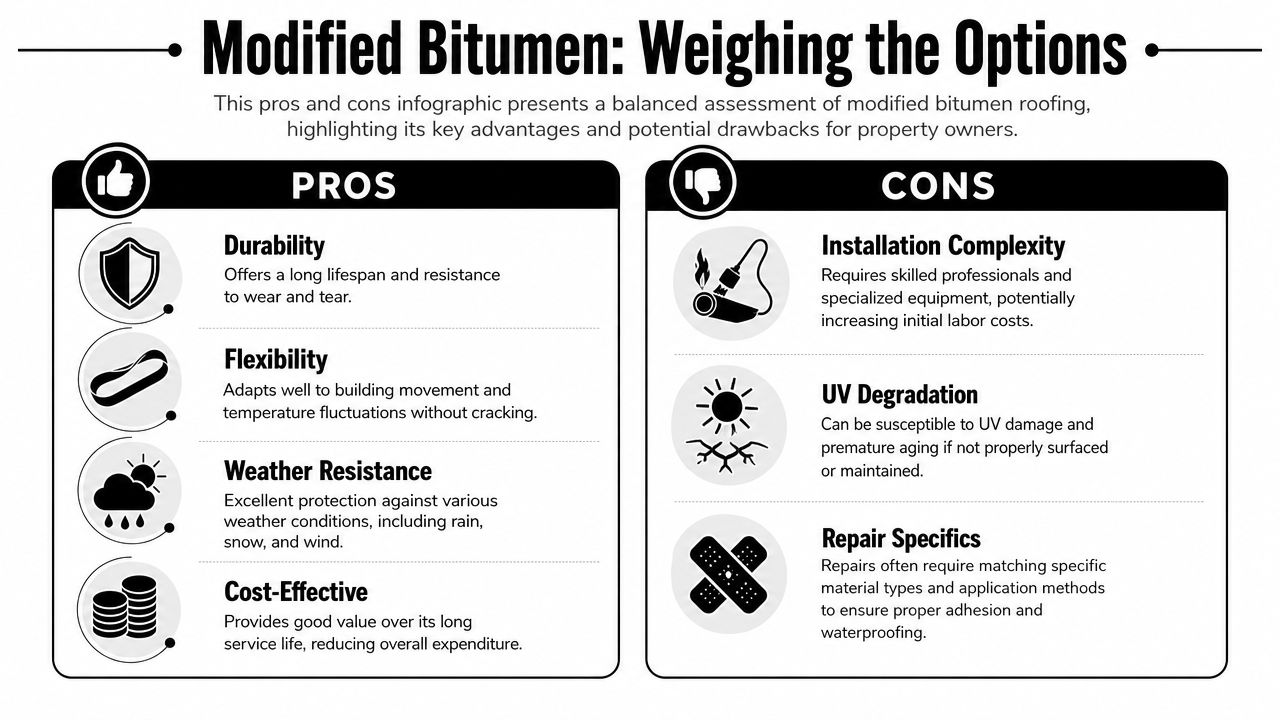
This visual gives the big picture quickly:
Where mod-bit shines
The biggest advantage is durability in a format that's familiar and serviceable. For low-slope roofs that see maintenance traffic, rooftop units, and weather exposure, mod-bit gives owners a membrane with substance. It doesn't feel thin, and that matters when crews have to get up there for HVAC work or inspections.
Another plus is its weather resistance. Properly assembled systems provide dependable waterproofing, and the material's flexibility helps it handle movement better than old-school asphalt systems did.
Owners also tend to like mod-bit because it fits a lot of practical situations:
- High-traffic roofs: The membrane generally holds up well where technicians need regular access.
- Repair-minded ownership: Many owners prefer a roof they can inspect and maintain rather than outright replace at the first issue.
- Tough climate use: In a state like Pennsylvania, resilience matters more than marketing language.
Where owners get caught off guard
The drawback that gets glossed over most often is heat absorption. A standard dark-surfaced modified bitumen roof can soak up a lot of summer heat. According to Reliable Roofing on modified bitumen pros and cons, dark-surfaced modified bitumen can increase summer cooling loads by up to 15% in commercial buildings compared to reflective single-ply systems, which is why cool-roof surfacing has become so important for modern energy-code compliance.
That doesn't make mod-bit a poor choice. It means owners shouldn't confuse “durable” with “maintenance-free” or “energy-optimized by default.”
Other drawbacks deserve honest attention too:
- Installation quality is critical: A sloppy crew can ruin a good material.
- UV exposure matters: Surface protection and upkeep aren't optional.
- Repairs need matching methods: You can't patch every issue the same way and expect a lasting seal.
Dark mod-bit without the right surfacing can protect against water while still working against your cooling budget.
If you want the toughness of modified bitumen without unnecessary heat gain, ask about reflective surfacing from the start, not after the roof is already aging.
Lifespan Costs and Essential Maintenance
When owners ask about value, they usually mean three things at once. How long will it last, what will it cost me over time, and what kind of upkeep will it need to stay out of trouble?
Modified bitumen has a good answer to that first question. According to RTG Solutions on modified roof system lifespan, modified bitumen roofing systems typically last 20 to 30 years with proper installation and maintenance, and many single-ply alternatives often need replacement in 15 years or less. In a Pennsylvania climate with freeze-thaw stress, that longer service window is a serious point in its favor.
What long service life really means
A long-lasting roof doesn't automatically mean a cheap roof. It means the roof may spread replacement cost over more years if the assembly is installed correctly and maintained on schedule.
That's an important difference. A roof that lasts longer but gets ignored can still become expensive if small defects turn into deck damage, insulation damage, or interior leaks.
For owners trying to budget responsibly, the smarter way to look at mod-bit is this:
- Initial work matters: Substrate prep, detailing, and membrane choice affect long-term value.
- Service access matters: If your roof sees regular foot traffic, durability becomes part of your cost control.
- Maintenance timing matters: Early repairs are usually simpler than late-stage water intrusion.
The maintenance point most owners miss
It is sometimes assumed that modified bitumen leaks because the whole roof gets old. That's too vague to be useful. According to Desert State Roofing on common modified bitumen leak causes, the primary cause of leaks is often seam failure, not general aging. The source explains that UV exposure over 10 to 15 years can make bitumen brittle, and that seam separation accounts for the majority of leaks.
That's the maintenance insight many generic guides skip.
Instead of treating the whole roof like a mystery, focus your attention where failure often begins:
- Inspect seams carefully: Look for separation, cracking, or changes at overlaps.
- Watch high-UV areas: South- and west-facing exposure can be rougher on roof surfaces.
- Check transitions and penetrations: Curbs, drains, edge metal, and flashing details deserve close inspection.
- Don't ignore small open laps: Water only needs one entry point.
Owner checklist: If your mod-bit roof is getting older, ask for a seam-focused inspection, not just a general “looks fine” walkaround.
As for costs, there isn't one honest number that fits every building. Roof size, tear-off requirements, insulation changes, deck repairs, surfacing choice, and access all influence price. The practical takeaway is that mod-bit often pays off when the building needs durability and the owner is willing to maintain seams and surface protection instead of waiting for interior leaks to force the issue.
How Mod-Bit Compares to TPO EPDM and PVC
A roof isn't “best” in the abstract. It's best for a particular building, budget, and set of headaches. Modified bitumen competes most often with TPO, EPDM, and PVC on low-slope projects, and each one has a different personality.
If you're comparing broader low-slope options, it helps to review single-ply roof installation and repair choices alongside asphalt-based systems. That gives you a cleaner apples-to-apples view of how membrane type affects repairs, reflectivity, and foot-traffic performance.
Best fit by building priority
Here's the straightforward version.
Choose modified bitumen when durability, a thicker-feeling roof assembly, and foot-traffic tolerance matter most. It's often a good match for buildings with regular service access, complex rooftop equipment, or owners who want a proven asphalt-based system.
Choose TPO when reflectivity and energy performance are high priorities. Many owners like it for bright, heat-reflective surfaces, especially on buildings where summer heat gain is a major concern.
Choose EPDM when you want a simple, widely used membrane with a long track record. It can be a practical option, especially on roofs with straightforward layouts.
Choose PVC when the project needs a single-ply system known for strong chemical resistance and durable seams. Some commercial properties benefit from that combination.
A short comparison helps:
| Roofing type | Often chosen for | Trade-off to consider |
|---|---|---|
| Modified bitumen | Toughness, puncture resistance, serviceable asphalt system | Can absorb more heat without reflective surfacing |
| TPO | Reflective surface and energy-conscious projects | Different wear profile than multi-layer asphalt systems |
| EPDM | Simplicity and familiarity | Not the same feel or traffic tolerance as mod-bit |
| PVC | Specialized commercial needs and durable welded seams | Material and project fit should be evaluated carefully |
For Pennsylvania owners, one point stands out. Modified bitumen typically lasts 20 to 30 years with proper installation and maintenance, and many single-ply alternatives often require replacement in 15 years or less, according to the lifespan guidance already cited earlier from RTG Solutions. If your roof in Sharon, Pittsburgh, or Erie gets hard use and regular weather stress, that durability can outweigh the appeal of a lighter single-ply membrane.
The right question isn't “Which roof is most popular?” It's “Which roof solves the problems this building has?”
Trust the Experts for Your Roofing Project
Modified bitumen is one of the better answers for low-slope roofs in Pennsylvania because it balances durability, repairability, and climate performance. But the material only performs as well as the crew installing it. Weak seams, poor flashing work, bad substrate prep, or careless torch application can shorten the life of a roof that should have served well for years.
That's why most owners are better off hiring an experienced commercial roofer than trying to manage a patchwork approach. If your property needs flat-roof service, replacement planning, or a detailed assessment, you can review commercial roofing services in western Pennsylvania before scheduling an estimate.
For owners in Sharon, Pittsburgh, Erie, and nearby communities, local experience matters. Snow load, freeze-thaw cycles, rooftop drainage behavior, and service traffic all affect what kind of roof assembly will hold up.
If you need straight answers about your flat or low-slope roof, Penn Ohio Roofing & Siding Group is a strong local choice. They're family-owned, have 25+ years of experience, and serve Hermitage and surrounding parts of Mercer, Beaver, and Lawrence counties with residential and commercial roofing services. If you want a roof inspection, repair plan, or replacement estimate from a team that understands Pennsylvania conditions, reach out and schedule a consultation.