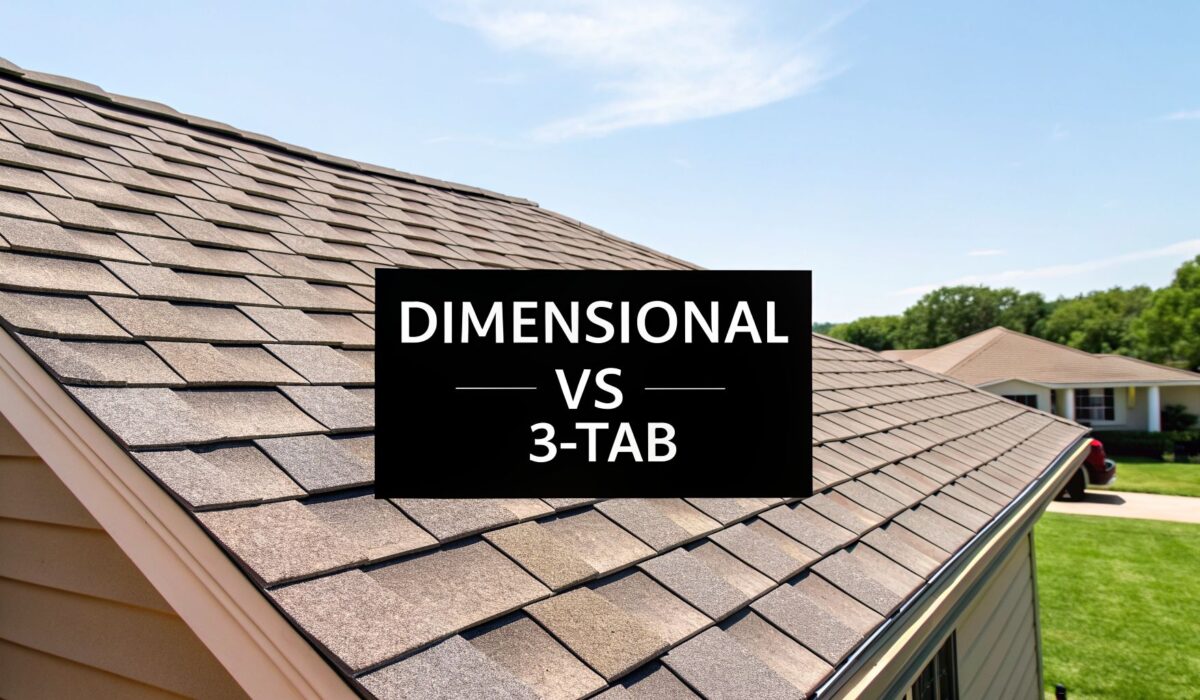
When it comes to choosing new roofing, the dimensional shingles vs 3 tab shingles debate really boils down to a simple trade-off. Are you looking for superior long-term durability and a modern, high-end look? Or is sticking to a tight budget the most important factor?
Dimensional shingles are a fantastic long-term investment, while 3-tab shingles remain the go-to traditional choice for homeowners needing a more affordable option upfront.
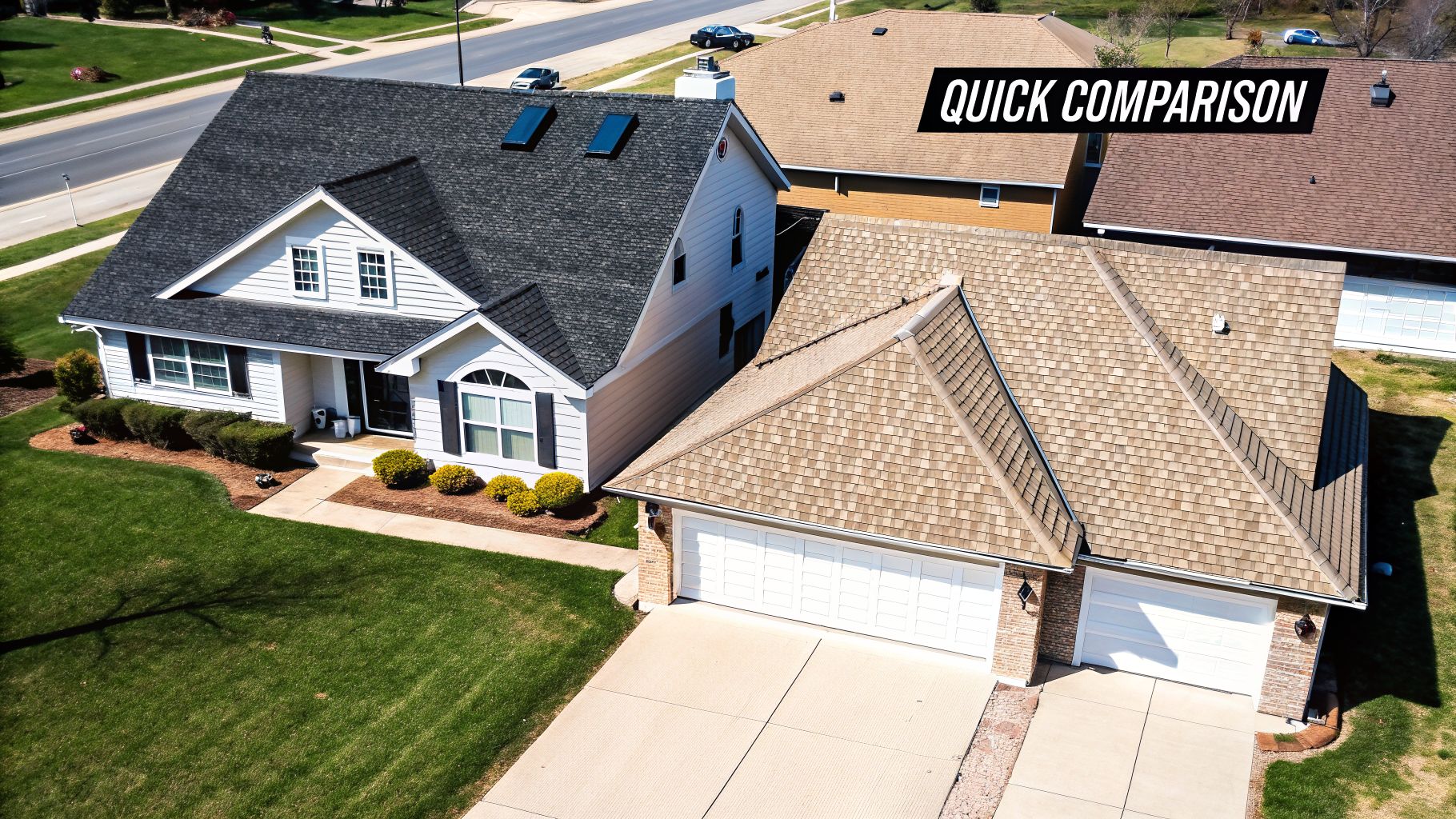
A Quick Comparison for Homeowners
Picking the right shingle is a huge decision. It doesn't just protect your home from the elements—it defines its curb appeal and can significantly impact its resale value. While both dimensional and 3-tab shingles are made from asphalt, the way they're constructed and how they perform couldn't be more different.
What Really Sets Them Apart?
Getting a handle on the core differences is the first step to making a choice you'll be happy with for years to come. This one decision affects everything from how your house looks from the street to how it holds up during a major storm.
There's a clear trend in the roofing world, and it's all pointing toward dimensional shingles (also known as architectural shingles). Homeowner preference has shifted so much that dimensionals are projected to make up 57.78% of the entire asphalt shingle market by 2025. They're simply outpacing traditional 3-tabs in popularity, growing at nearly double the rate because people love the upgraded look and better performance. You can dig into these shingle market statistics yourself to see how the industry is changing.
To help you see the differences clearly, we've put together a quick summary table.
Dimensional vs 3-Tab Shingles at a Glance
This table provides a high-level summary of the key differences between dimensional and 3-tab shingles to help homeowners make a quick, informed comparison.
| Feature | Dimensional Shingles | 3-Tab Shingles |
|---|---|---|
| Appearance | Textured, multi-dimensional look | Flat, uniform pattern |
| Durability | Excellent; laminated, multi-layer | Good; single layer |
| Wind Resistance | High (up to 130 mph) | Standard (up to 70 mph) |
| Lifespan | 25-30+ years | 15-20 years |
| Upfront Cost | Higher | Lower |
| Long-Term Value | Excellent | Fair |
As you can see, the trade-offs are pretty clear. While 3-tab shingles will save you money on the initial installation, dimensional shingles deliver far greater value and peace of mind over the life of your roof. In the following sections, we'll break down these differences even further to help you make the best call for your home and budget.
Analyzing Differences in Design and Curb Appeal
Your roof is one of the biggest players in your home's curb appeal, and it's often the first thing people notice. When you’re choosing between dimensional shingles vs 3-tab shingles, the difference in how they look comes down to how they’re made. The choice you make here really defines your home's character from the street.
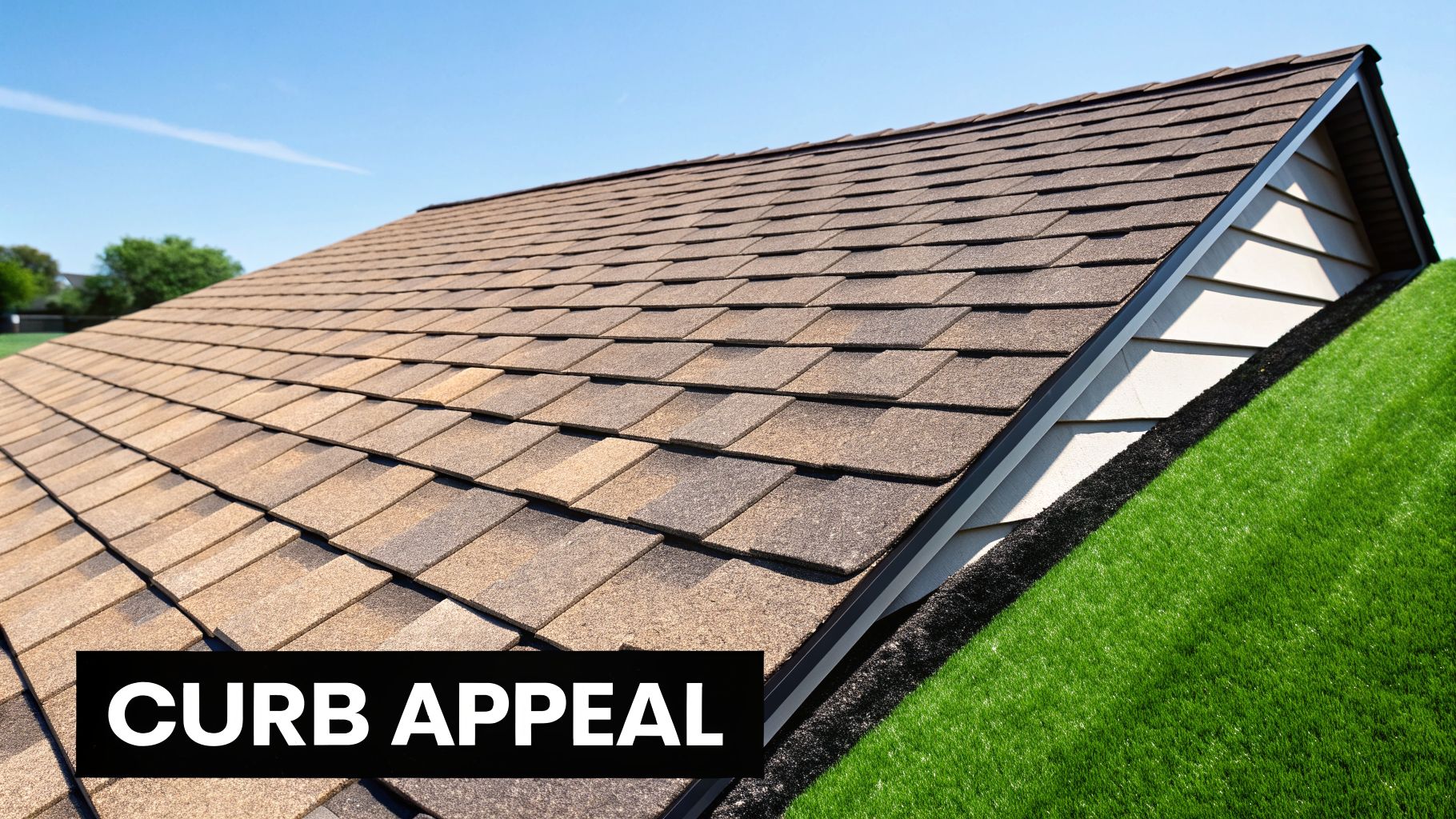
Let's break that down. A 3-tab shingle is essentially one flat layer of asphalt and fiberglass. The manufacturer makes cutouts in the shingle to create three uniform "tabs," which is what gives the roof that consistent, repeating pattern.
Dimensional shingles, which you’ll also hear called architectural shingles, are built differently. They are made by laminating two or more layers of shingle material together. This process creates a much thicker and more substantial shingle with tabs that appear more random, giving the roof a ton of texture and depth.
The Classic Look of 3-Tab Shingles
For a long time, 3-tab shingles were the standard. They offer a clean, simple look that works well on many traditional homes. Because they lay flat, they create a very straightforward, repeating pattern across the roof. If you want a no-fuss aesthetic that gets the job done without being the center of attention, this can be a solid choice.
The downside is that their single-layer construction means you don't get any of the shadow lines or visual pop that newer materials offer. While they are perfectly functional, the design can look a bit flat or even dated on homes aiming for a more modern, high-end appearance.
From a distance, the defining feature of a 3-tab roof is its uniformity. It creates a simple, brick-like pattern that’s classic but lacks the dynamic look of its dimensional cousin.
The Modern Appeal of Dimensional Shingles
This is where dimensional shingles really pull ahead in the looks department. Their laminated, multi-layer build gives them a textured appearance that does an incredible job of mimicking high-end materials like natural slate or cedar shakes, but without the hefty price tag. The staggered layers create deep shadow lines, giving the entire roof a rich, three-dimensional look.
That extra depth provides a serious boost to your curb appeal. When your roof can make up 40% of what people see from the street, a visual upgrade here makes a huge impact. For a deeper dive into this, check out our complete guide to architectural vs 3-tab shingles.
This aesthetic flexibility helps dimensional shingles fit in with almost any home style, from rustic farmhouses to sleek, contemporary houses. Homeowners also love that they come in a much wider array of color blends, making it far easier to coordinate your roof with your siding, trim, and other exterior finishes.
Comparing Durability and Weather Performance
A roof's number one job is simple: protect your home from the elements. When you're weighing dimensional shingles vs 3 tab shingles, you’re really asking which one does that job better. The answer comes down to how they’re built, because their performance in wind, rain, and hail is a direct result of their design.
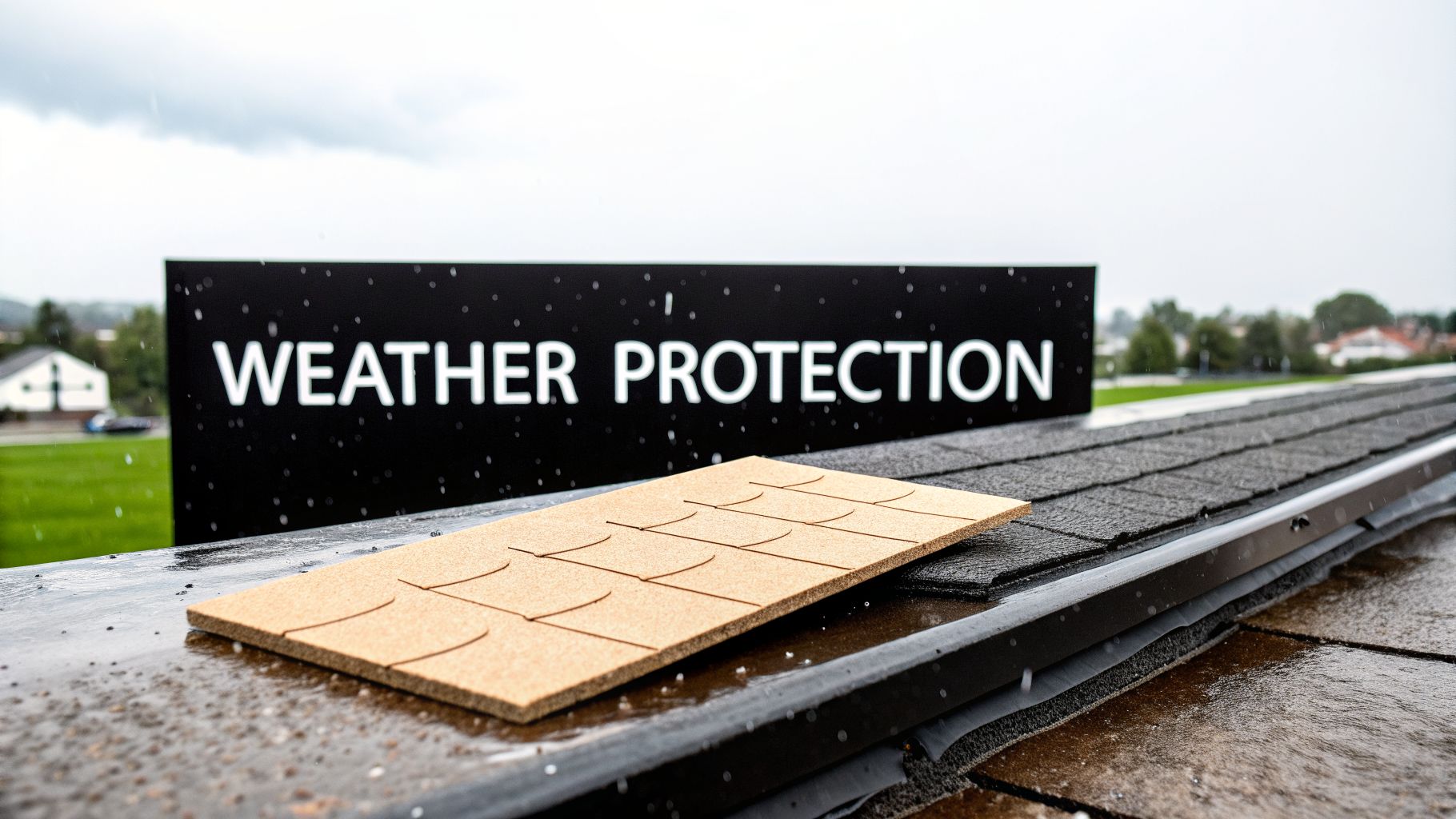
The core difference is lamination. Dimensional shingles are made by fusing multiple layers of asphalt and fiberglass together. This creates a much thicker, heavier, and more robust product. On the other hand, 3-tab shingles are just a single, flat layer, which makes them lighter and, frankly, much easier to damage.
Think of it this way: it’s the difference between wearing a thick winter coat and a light jacket during a blizzard. One is just built to handle more punishment.
Wind Resistance Showdown
High winds are a roofer’s worst enemy. The real test for any shingle is its ability to fight off wind uplift—that terrifying moment when wind gets under a shingle's edge and tries to rip it right off the roof deck.
- 3-Tab Shingles: Their flat, single-layer design creates uniform seams that give the wind a perfect place to grab hold. That's why they are typically only rated for winds of 60-80 mph. This might be fine in a perfectly calm climate, but it’s a significant risk during the serious storms we see here.
- Dimensional Shingles: Their fused, multi-layer construction results in a heavier, more solid surface with far fewer edges for the wind to catch. This beefier build earns them a much higher wind rating, usually between 110 mph to 130 mph.
The laminated, staggered pattern of dimensional shingles isn’t just for looks—it creates a structurally superior barrier that deflects wind. This drastically lowers the chances of shingles blowing off and leaving your roof deck exposed to water.
Performance Against Hail and Rain
It isn't just about wind. Your roof also has to stand up to the brute force of hail and the constant threat of water getting in during a downpour. Here again, the layered design of dimensional shingles gives them a clear upper hand.
That extra thickness provides much better impact resistance. When hailstones hit, a dimensional shingle is far less likely to crack or lose the protective granules that shield it from the sun.
Both shingle types are waterproof, of course, but the individual tabs on a 3-tab roof create more potential failure points for wind-driven rain to exploit over the years. Dimensional shingles present a more unified, cohesive shield. This is why they tend to last 20-25 years in tough climates, while a 3-tab roof often needs replacing after just 15 years. You can find out more about how shingle weight impacts durability and see why the investment pays off.
Evaluating Cost, Lifespan, and Long-Term Value
When you’re comparing dimensional shingles vs 3-tab shingles, the conversation almost always lands on money. But focusing just on the initial price tag is a classic homeowner mistake. The real value of a new roof isn't what you pay today, but what it costs you to own over its entire lifetime.
The main draw for 3-tab shingles is, without a doubt, their lower upfront cost. Their simpler, single-layer design makes them cheaper to manufacture, which means a lower cost can be passed along to you. It's an appealing choice if your main goal is to keep the immediate cost of a roof replacement as low as possible.
Dimensional shingles, on the other hand, are all about long-term return on investment. While they do cost more at the outset, their beefier construction and longer lifespan mean you'll spend far less on repairs and won't be facing another full replacement anytime soon.
Factoring in Lifespan and Replacement Cycles
How long your shingles are expected to last is a massive part of the cost equation. A roof that holds up for another decade means you get to put off the huge expense of another replacement, saving you thousands.
- 3-Tab Shingles: You can realistically expect a lifespan of about 15-20 years. In a 30-year timeframe, you might find yourself paying for a second complete roof replacement.
- Dimensional Shingles: These typically last 25-30 years, and often even longer. That extended service life means you install it once and get decades of protection without the looming cost of another big roofing job.
A roofing professional will tell you to think in terms of "cost per year of service," not just the initial quote. A dimensional roof that costs 20-30% more but lasts 50% longer is almost always the smarter financial move for your home.
The Hidden Value in Shingle Warranties
Warranties are another place where you see the true value, and the difference between these two shingle types is night and day. It's an often-overlooked detail that provides real financial protection.
Most 3-tab shingles are backed by a basic, pro-rated warranty. What this means is that the manufacturer's coverage shrinks every single year. If your roof fails in year 10, you might only get a tiny fraction of what you need to fix it.
By contrast, dimensional shingles usually come with much stronger lifetime limited warranties. These warranties provide more comprehensive coverage against manufacturing defects for a much longer time. This stronger backing from the manufacturer gives you serious peace of mind and better financial security. To see how these choices affect the bottom line, you can learn more about the cost to replace asphalt shingles and see how the numbers add up.
Making the Right Choice for Your Home and Budget
We've covered a lot of ground comparing appearance, durability, and cost. Now it’s time to put it all together. Choosing between dimensional and 3-tab shingles isn't about finding the single "best" option—it's about finding the right option for your home, your budget, and your long-term plans.
Ultimately, the decision boils down to one simple question: Are you prioritizing immediate, upfront savings, or are you investing for long-term performance and value? Answering that question will almost always point you in the right direction.
To make it even clearer, this chart shows how budget alone often steers the decision.
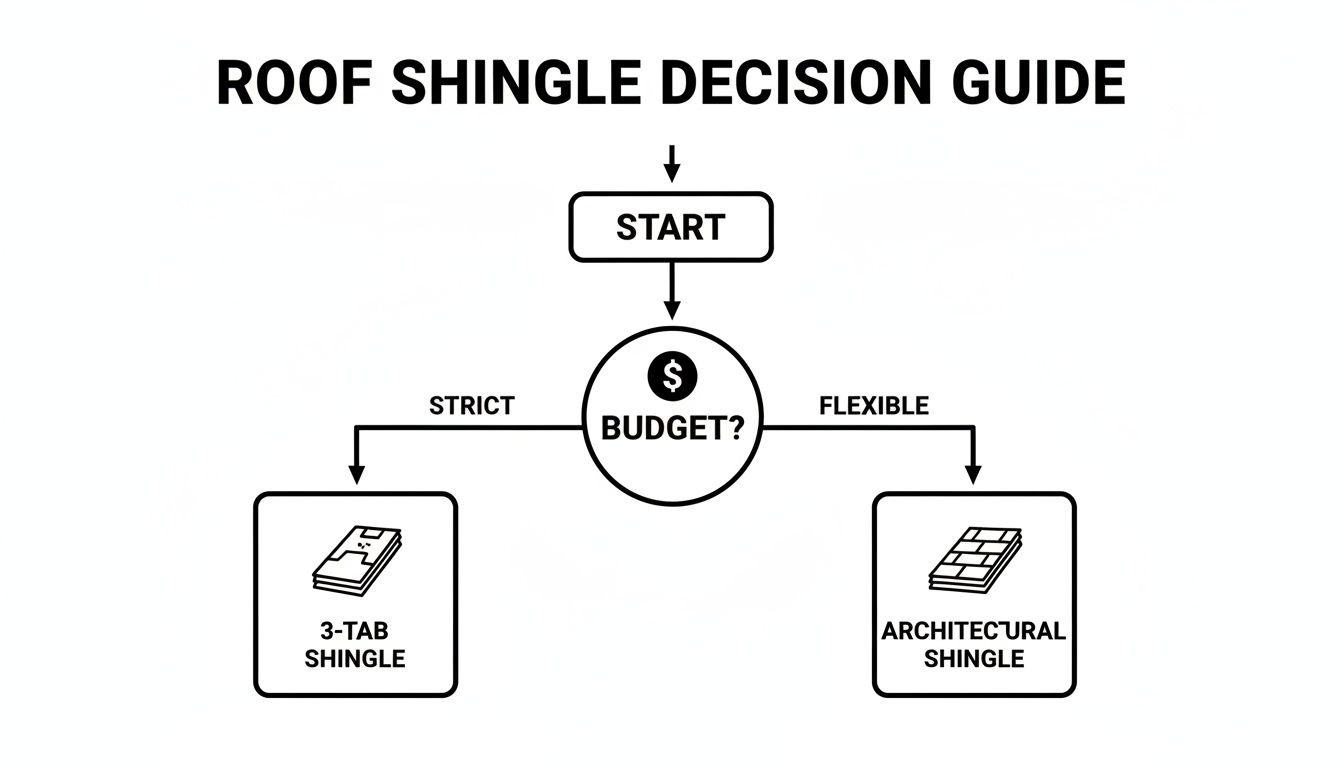
As you can see, budget is a huge factor. While having more flexibility opens up the conversation to dimensional shingles, a tight budget makes 3-tab the clear starting point. For most homeowners, this financial reality is the first piece of the puzzle.
When 3-Tab Shingles Are the Smart Choice
While dimensional shingles have become the modern standard, there are definitely situations where 3-tab shingles just make more sense. They're the practical, logical choice if you're in one of these scenarios:
- You're on a Tight Budget: If you need a new roof right away but your finances are limited, 3-tab shingles get the job done. They provide a reliable, code-compliant roof without the higher upfront cost.
- It's a Rental or Flip Property: For an investment property where minimizing initial repair costs is the main goal, the lower price point of 3-tab shingles can be a savvy financial move.
- You're Making a Small Repair: If you're just patching a small area on an existing 3-tab roof, the easiest and most cost-effective solution is to simply match the shingles you already have.
When to Invest in Dimensional Shingles
For a lot of homeowners, paying a bit more for dimensional shingles is an investment that truly pays off down the road. Upgrading to architectural shingles is the way to go if these are your priorities:
- Boosting Curb Appeal and Home Value: The rich, textured look of dimensional shingles is a major aesthetic upgrade. That visual impact can directly translate to a higher property value.
- Prioritizing Long-Term Performance: If this is your "forever home" or you plan on staying for many years, the superior durability and 25-30+ year lifespan offer incredible peace of mind and help you avoid future replacement costs.
- Living in a Tough Climate: For anyone in an area that sees high winds, hail, or nasty storms, the enhanced weather resistance of dimensional shingles isn't just a feature—it's essential protection for your biggest asset.
The bottom line is this: Choose 3-tab for immediate affordability; invest in dimensional for lasting resilience and home value. The choice you make today will affect your home's protection—and your finances—for decades.
How Professional Installation Maximizes Your Investment
You can spend weeks weighing the pros and cons of dimensional vs. 3-tab shingles, but here's the honest truth: the shingle you choose is only part of the equation. The single biggest factor that will determine how well your new roof performs and how long it lasts isn't the material—it's the installation quality.
It's a common sight in the industry: even the most expensive dimensional shingles will fail if they aren't put on correctly. A bad installation leads to leaks, blown-off shingles during the first major storm, and a voided warranty from the manufacturer. Your entire investment goes right out the window.
Whether you land on 3-tab or dimensional shingles, understanding the importance of quality installations is what protects your home and your wallet. A true professional doesn't just nail on shingles; they build an entire integrated system designed to work together.
It's More Than Just Shingles: The Whole System Matters
A professional job goes way beyond what you can see from the street. It’s about building a complete protective shield for your home, and that means paying close attention to the details that lie beneath the surface.
Here's what a proper installation really involves:
- Correct Underlayment: This is your roof's second line of defense. A high-quality, properly installed underlayment is critical for protecting your roof deck from wind-driven rain and ice dams, which are common culprits for slow leaks.
- Proper Fastening: Every shingle has a specified nailing pattern designed to meet its wind-resistance rating. Using too few nails, or putting them in the wrong spot, is the number one reason shingles get torn off in a storm.
- Balanced Ventilation: A well-ventilated attic is crucial. Without proper airflow, heat and moisture get trapped, essentially cooking your shingles from the inside out and causing them to age, curl, and fail prematurely.
A premium shingle installed poorly is worse than a basic shingle installed perfectly. The installer’s skill is what unlocks the performance, durability, and lifespan you’re paying for, regardless of which shingle you chose.
Ultimately, hiring an experienced and certified roofer is the only way to guarantee your roof is built to last. They ensure every component, from the drip edge to the ridge vent, is handled with precision. Learning how to choose a roofing contractor is just as important as choosing the shingle itself—it’s the step that protects your investment for decades.
Your Shingle Questions, Answered
Even after weighing the pros and cons, homeowners often have a few lingering questions. Let's tackle some of the most common ones to help you get a clearer picture of what to expect in the real world.
Do Dimensional Shingles Actually Increase Home Value More Than 3-Tab Shingles?
Absolutely. In almost every case, a new dimensional shingle roof adds more value to your home. Think about it from a buyer's perspective: the roof is one of the first things they see. The rich, multi-dimensional look of architectural shingles signals quality and modern appeal right from the curb.
Beyond just looks, a dimensional roof represents a long-term, durable asset. Buyers see a roof that won't need replacing anytime soon, which gives them serious peace of mind. That can make your home far more appealing than a comparable one with an older, flat-looking 3-tab roof that might be nearing the end of its life. It's an upgrade that often brings a solid return on investment.
Is the Installation Process Really That Different?
While the basic roofing principles are the same, the details for dimensional shingles are much less forgiving. Their weight and layered design mean they have a very specific "nailing zone." Hitting that mark with the right number of nails is critical to activating the manufacturer’s warranty and ensuring the roof can withstand high winds.
Getting the nailing pattern wrong on dimensional shingles is one of the most common—and costly—mistakes. It can slash the roof's lifespan and void the warranty entirely. This is exactly why you can't afford to hire anyone but a certified, experienced crew.
Three-tab shingles are a bit simpler to install due to their lighter weight, but don't be mistaken—a professional installation is still essential for a watertight, long-lasting roof, regardless of the shingle type.
Can I Just Install New Dimensional Shingles Over My Old 3-Tabs?
Technically, some local building codes might allow you to install one layer of shingles over another. However, as a professional, I can tell you this is a shortcut you should never take. It's a practice known as a "roof-over," and it’s a recipe for problems.
Placing heavy dimensional shingles over an old, uneven 3-tab surface prevents them from laying flat and sealing correctly. This almost always leads to major issues:
- Poor Wind Resistance: Unsealed shingles are easily lifted and torn off by wind.
- Voided Warranties: Shingle manufacturers will not stand behind their product if it's installed in a roof-over.
- Hidden Damage: You're just covering up potential rot, soft spots, or leaks, allowing them to get worse underneath.
To get the full performance and lifespan you're paying for, a complete tear-off of the old roof is the only way to go. It’s the right way to do the job, every time.
Choosing the right shingle is just step one—the quality of the installation is what truly protects your home and your investment. The experienced team at Penn Ohio Roofing & Siding Group installs every roof to meet the highest industry standards, ensuring you get maximum performance for decades to come. Contact us today for a free, no-obligation estimate.