
You step onto your deck to grill dinner, and the board under your shoe feels soft. The railing moves when you lean on it. Maybe a few boards are cracked, maybe the stairs feel uneven, or maybe the whole structure just looks tired after years of Western Pennsylvania weather. That’s usually when homeowners start searching for Deck replacement Hermitage PA and trying to answer one expensive question.
Should you repair what’s there, or stop patching it and rebuild the deck the right way?
That decision matters more in Hermitage than a lot of generic deck articles admit. Moisture, freeze-thaw movement, and code requirements all affect how long a repair will really last. A deck can look salvageable from the top and still have framing, footings, ledger connections, or stair issues underneath that make replacement the smarter call.
Is It Time for a Deck Replacement or Just a Repair
A lot of homeowners assume repair is always the cheaper path. Sometimes it is. Sometimes it isn’t even close.
In Hermitage, deck repairs can range from $1,000 to $10,000, and many repairs over $5,000 don’t hold up well long term in Pennsylvania’s climate, making full replacement the better investment in many cases, especially because replacement may qualify for full insurance claims where partial repairs may not (local repair cost guidance).
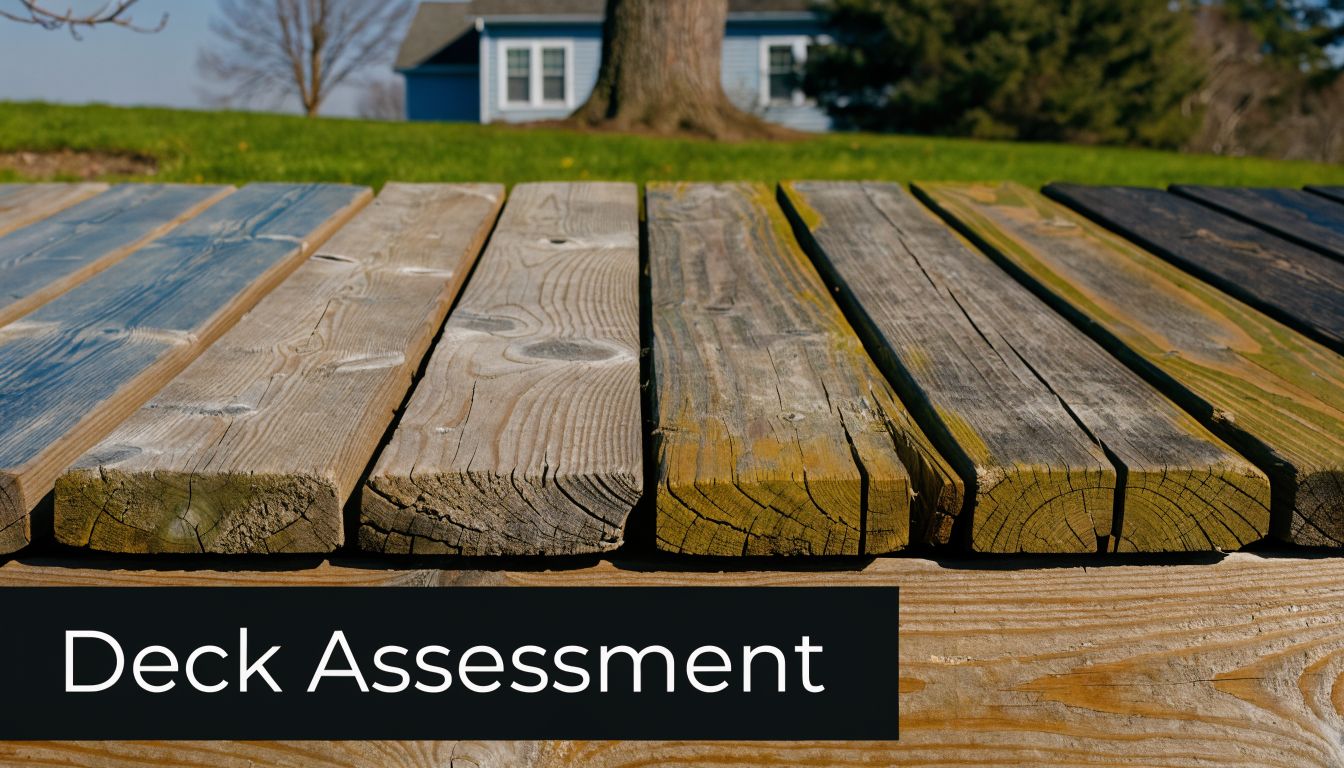
Signs that point to repair
Not every bad-looking deck needs a full tear-off. Some problems are still isolated and worth fixing.
- A few damaged surface boards: If the framing below is sound and the damage is limited to a small area, targeted board replacement can make sense.
- Loose rail sections: A shaky railing sometimes comes from failed fasteners or localized wood deterioration at connection points.
- Minor stair wear: Treads and riser areas can often be corrected if the stringers and landing support are still solid.
- Surface aging only: Fading, checking, and worn stain don’t automatically mean the deck structure is failing.
A deck with cosmetic wear but good bones can still be a repair candidate. The key is whether the weakness stops at the surface.
Signs replacement is usually the better call
When I look at older decks in this area, the biggest red flag isn’t the color of the boards. It’s when several systems are declining at the same time.
Practical rule: If you’re replacing decking, railings, stairs, and correcting frame movement all in one project, you’re often already in replacement territory.
Watch for these conditions:
- Soft wood at posts, joists, or ledger areas: That usually means moisture has been working below the visible surface.
- Repeated movement: If the deck sways, the railing wobbles, and stairs feel out of line, the issue is often structural rather than cosmetic.
- Rot spreading across multiple sections: Once decay is present in more than one area, patchwork repairs tend to keep multiplying.
- Previous repair layers: Sistered boards, mixed fasteners, patched footings, and old overlay work usually tell the story of a deck that has been nursed along too long.
One practical way to think about it is this. Repairs are best when they solve the root problem. They’re a poor investment when they only buy time.
The Hermitage climate changes the math
Pennsylvania weather is hard on decks. Moisture sits. Boards swell and dry out. Fasteners loosen. Winter movement exposes every shortcut in the original build.
That’s why some repairs that look fine in spring don’t age well after another cycle of rain, heat, freezing, and thawing. If you’ve also got concrete cracking around an outdoor living area, it helps to look at related surface failures too. Homeowners dealing with surrounding slab issues may find this guide on understanding pool deck crack issues useful for spotting when surface damage is cosmetic and when it points to movement below.
If replacement is clearly the better path, it helps to review a local contractor’s broader deck work before committing. A good starting point is this overview of deck construction and replacement options in Mercer County.
A simple decision filter
Use this as a practical gut check before spending money on another round of fixes:
| Condition | Usually repairable | Usually replace |
|---|---|---|
| Damage limited to a few boards | Yes | No |
| Railing loose but framing solid | Yes | No |
| Stairs, railings, and deck surface all failing together | No | Yes |
| Rot at structural supports or ledger area | No | Yes |
| Multiple past repairs already in place | Rarely | Usually |
If a contractor spends more time talking about covering up the symptoms than showing you the framing, that’s a warning sign.
Designing Your New Deck for Hermitage Weather
Once replacement is the right move, design matters as much as demolition. A new deck should fit the house, but it also has to survive local weather without turning into a maintenance burden.
In Hermitage, a typical deck replacement usually costs between $4,000 and $10,000, with pressure-treated wood starting around $15 per square foot and premium composite exceeding $35 per square foot, depending on size, material choice, and complexity (Hermitage deck replacement pricing).
What works best in this climate
The best decking material isn’t the one with the best showroom sample. It’s the one that matches how you plan to use the deck and how much upkeep you’re willing to do.
Pressure-treated wood is still the budget entry point. It’s familiar, workable, and easier on the front-end cost. But it needs regular care, and in a climate with wet seasons and winter movement, skipped maintenance catches up fast.
Composite is the common upgrade for homeowners who don’t want to fight splinters, staining, and frequent refinishing. It costs more up front, but it’s built for lower maintenance and better resistance to rot and weathering.
PVC fits the same low-maintenance conversation, especially where moisture resistance is a priority. The trade-off is usually price and, depending on the product, a different feel underfoot compared with wood.
Decking Material Comparison for Hermitage, PA Homes
| Material | Average Cost/Sq. Ft. (Installed) | Estimated Lifespan | Annual Maintenance |
|---|---|---|---|
| Pressure-treated wood | Around $15 per square foot and up | 10 to 15 years | Cleaning, sealing or staining, board and fastener checks |
| Composite | Can exceed $35 per square foot | 25 to 50 years | Basic cleaning and routine inspections |
| PVC | Qualitatively premium-priced | Qualitatively long-lasting | Basic cleaning and routine inspections |
The biggest trade-off is simple. Wood lowers the initial bill. Composite and PVC lower the maintenance burden and usually make more sense for homeowners who want a longer-term solution.
Design choices that change the budget fast
The material isn’t the only cost driver. Scope matters.
Projects in the standard residential range often land in that typical replacement bracket, but more involved work climbs quickly. Larger decks, custom layouts, built-in seating, and multi-level railing details push the price up. For larger projects over 300 square feet or custom builds, costs often go beyond $12,000 according to the same Hermitage replacement guidance already cited above.
Here’s where homeowners often misjudge the budget:
- Built-in features: Benches and custom details add labor and framing complexity.
- Level changes: Multi-level decks don’t just use more material. They require more layout, support work, and finishing detail.
- Removal and prep: Tearing off the old deck, hauling debris, and correcting the base condition all affect the final number.
- Permits and site conditions: Structural work in Hermitage requires permit compliance, and awkward access always increases labor time.
The cheapest deck on paper often becomes the expensive deck to own if it demands constant upkeep.
Design for use, not just appearance
A deck that looks good in a rendering can still disappoint in daily use. Think about traffic flow from the back door, stair placement into the yard, grill location, and whether railings will block the view from inside the house.
If low maintenance is your priority, composite deserves a close look. Homeowners comparing products and installation approaches can review composite decking installation options in Grove City and nearby areas for a practical sense of how these systems come together.
For Hermitage homes, the best design usually balances three things. A realistic budget, a material that matches the owner’s maintenance tolerance, and a frame layout built for local conditions.
Navigating Deck Permits and Building Codes in Hermitage
A deck replacement gets expensive fast when permit work is skipped. In Hermitage, any structural deck alteration requires a permit, and the City’s Building Official, Russell Penn, can be reached at 724-981-0800 for requirements. One critical local requirement is footing depth. Footings must go below the frost line, which is typically 36 to 42 inches in Mercer County, to prevent heaving (Hermitage permit and footing guidance).
What usually triggers a permit
If the work affects structure, support, framing, stairs, ledger attachment, or other load-bearing parts of the deck, treat it as permit work. Cosmetic work is one thing. Structural deck replacement is another.
That matters because a lot of failures don’t come from the decking boards. They come from what’s under them.
What the City typically wants to see
Permit review is smoother when the paperwork is complete from the start. For deck replacement work, that generally means having the application materials organized and clear.
- A completed application: Basic project details, property information, and scope of work.
- A site plan: Show location, house relationship, and the deck footprint.
- Workers’ compensation documentation when required: This matters for contractor-led projects.
- Code-based construction details: Footings, framing, and attachment details need to line up with local requirements.
The code details that matter most
The frost-depth requirement gets the most attention for a reason. Shallow support work can move in winter, and once movement starts, stairs, railings, and framing all begin showing symptoms.
Another area homeowners should pay attention to is railing compliance. If you want a plain-English reference before talking with your builder or inspector, this resource on understanding deck railing regulations is a useful companion to local code conversations.
Permit approval doesn’t guarantee a good build. It sets the minimum standard. The quality comes from how carefully the contractor follows through in the field.
A solid permit package also helps during resale, insurance questions, and future exterior work. A deck that was built legally and inspected properly creates fewer headaches later.
The Deck Replacement Process From Start to Finish
Good deck replacement work follows a sequence for a reason. The order protects the house, keeps the structure square, and prevents shortcuts from getting buried where nobody can see them.
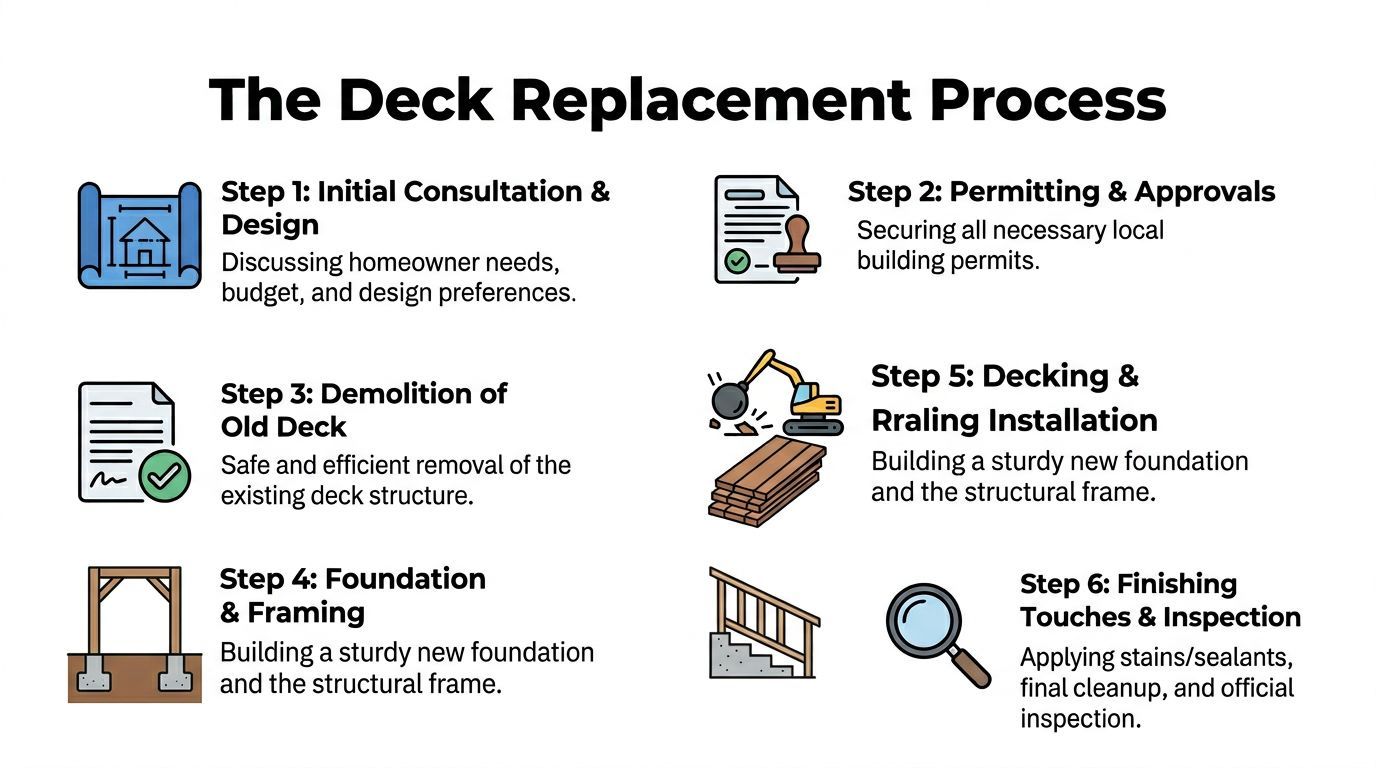
Removing the old deck without damaging what stays
Demolition isn’t just smashing lumber into a pile. Old boards come off first, then rails, stairs, and framing in a controlled order. Around the house connection, care matters. If the old ledger area is handled poorly, the siding, rim area, or house structure can be damaged before the rebuild even starts.
Crews usually use pry bars, hammers, and saws to break the deck down in manageable sections. The point is to expose everything cleanly so rot, failed fasteners, and hidden framing problems are visible.
Preparing the site and setting the foundation
Once the old structure is gone, the site needs to be cleaned up and leveled for the new build. Soil conditions, drainage, and footing placement matter here more than homeowners often realize.
The footing work is what keeps the deck from shifting later. In this area, that means digging to proper depth, setting concrete footings correctly, and laying out the support system so the framing above has a stable base.
A deck can have premium boards on top and still fail early if the support work below was rushed.
Framing the structure the right way
Craftsmanship is evident in the details. On a standard 16-foot deep deck, professional builders in Pennsylvania often use dual 16-foot beams for mid-deck stability. Stair stringers are commonly framed from 2×12 pressure-treated lumber with a 7.5-inch rise and 10-inch tread to comply with IRC standards. Ledger boards must be secured with 1/2-inch galvanized lag screws every 16 inches into the house rim joist (deck framing and stair details used by PA builders).
Those specs aren’t decoration. They’re the difference between a deck that feels solid and one that starts moving.
Important framing checkpoints include:
- Ledger attachment: The house connection has to be secure and properly flashed.
- Beam layout: Supports need to carry the load without overextending spans.
- Joist alignment: Crooked framing telegraphs upward into the finished surface.
- Stair consistency: Bad stair geometry is one of the first things people notice and one of the biggest safety issues.
Installing decking, railings, and the finish details
Once the frame passes inspection points, the surface boards go down. Fastener selection matters, especially outdoors where moisture works on every connection. Railings are installed after the main decking layout is locked in, and stairs get their final tread and railing work once the structure is confirmed level and stable.
Final cleanup and inspection aren’t a formality. This is when the contractor should be checking transitions, fastener finish, railing stiffness, and any small corrections before the job is considered complete.
Where mistakes usually happen
Some failures are easy to trace back to one bad decision:
- Shallow footings: They move.
- Poor ledger flashing: Water gets where it shouldn’t.
- Rushed framing checks: The finished deck ends up out of plane.
- Weak stair support: The stairs feel wrong from day one.
A proper replacement doesn’t rely on one strong part. Every phase has to support the next one.
Choosing and Vetting Your Deck Contractor in Hermitage
Most deck replacements shouldn’t be DIY projects. The risk isn’t just a crooked deck surface. It’s hidden structural errors, failed inspections, and money spent on a build that doesn’t last.
The safest hire usually isn’t the contractor with the lowest quote. It’s the one who can explain the build in plain language, show past work, and document how the project will meet local requirements.

What to verify before you sign anything
A solid contractor should make it easy to verify the basics.
- Insurance and business legitimacy: Ask for proof, not just verbal reassurance.
- Permit familiarity: They should know how Hermitage handles structural deck work.
- Portfolio quality: Look for clear framing, clean stair work, solid railing installation, and tidy finishes.
- Written scope: The proposal should explain what is being removed, rebuilt, and included.
If a quote is vague, that’s not flexibility. That’s exposure.
Questions worth asking in the estimate meeting
Don’t settle for “we build great decks.” Ask how.
Try questions like these:
- How do you handle demolition around the house connection?
- What’s your footing plan for this yard?
- How do you flash the ledger?
- What framing lumber and fasteners are you specifying?
- Who pulls the permit?
- What happens if you uncover hidden rot at the house?
A contractor who answers clearly usually works clearly.
Look for process, not just promises
One helpful way to judge a builder is to compare how serious contractors present custom deck work in other markets. For example, these Twin Cities custom deck services show the kind of project planning and design clarity homeowners should expect from any deck professional, even though the market is different.
You should also review whether the company has visible local deck experience rather than only broad exterior claims. A useful place to compare that kind of project focus is this collection of Mercer County deck builder project insights.
Good contractors don’t get defensive when you ask technical questions. They welcome them.
The red flags are usually obvious
Be careful if you hear any of the following:
- “You probably don’t need a permit.”
- “We’ll figure out the framing as we go.”
- “The old footings are probably fine.”
- “A written change order won’t be necessary.”
That kind of language usually leads to surprise costs, inspection trouble, or a deck that never feels fully right.
Your New Deck and Enjoying It for Years to Come
A successful deck replacement in Hermitage comes down to a few decisions made in the right order. First, be honest about whether the old deck is repairable or worn past the point of smart investment. Next, choose materials based on how you live and how much upkeep you want to take on. Then make sure the build follows local permit requirements and sound construction practices from the footings up.
After the build is done, maintenance gets simpler if you stay ahead of small issues. Keep the surface clean, watch for movement at railings and stairs, and inspect problem areas before seasonal weather has time to do damage. Wood decks need more attention. Composite and PVC usually ask less of you, but they still benefit from routine checks.
The best new decks feel uneventful in daily use. No bounce. No soft spots. No wobble at the rail. Just a solid outdoor space that fits the house and handles the seasons the way it should.
If you’re planning a Deck replacement Hermitage PA project and want a crew that understands exterior construction, code compliance, and long-term durability, Penn Ohio Roofing & Siding Group is a strong local choice. As a family-owned company with 25+ years of experience serving Hermitage and surrounding counties, they bring the same disciplined approach to exterior craftsmanship that homeowners already rely on for major home projects. Reach out for a free estimate and get clear guidance on replacing your deck the right way.