
Yes, you can put siding over stucco, and in many homes it's a practical upgrade. But it only works when the existing stucco is in good condition and the installer rebuilds the wall correctly, because installing over stucco typically costs about 5% to 10% more than a standard siding job while avoiding stucco removal that averages about $2,000.
If you're looking at a stucco house that feels dated, cracked in spots, or just hard to maintain, you're asking the right question. Homeowners usually want a simple yes or no here, but this is one of those projects where the answer is really yes, but only if the prep is right.
The biggest mistake I see is treating stucco like a flat, harmless surface you can just cover. It isn't. Stucco can hold moisture, and if a contractor traps that moisture behind new siding, the wall can start failing where you can't see it. The biggest success factor is the opposite approach: give the wall a way to drain and breathe.
That's what this article is about. Not just whether you can put siding over stucco, but how to tell the difference between a smart retrofit and a hidden problem waiting a year or two to show up.
Table of Contents
- The Short Answer and the Big Caveat
- Critical Pre-Installation Checks You Cannot Skip
- Hidden Dangers of Improper Installation
- How Professionals Correctly Install Siding Over Stucco
- Material Choices and Cost Considerations
- Making the Final Call Siding Over Stucco or Full Removal
- Trust Your Home to Proven Expertise
The Short Answer and the Big Caveat
If you're asking can you put siding over stucco, the practical answer is yes. It's a common retrofit approach for materials like vinyl and fiber cement, and it can make sense when the existing stucco is stable, dry, and not hiding active leaks.
The caveat is where homeowners get into trouble. Covering stucco is not the same as fixing a bad wall. If the stucco is already failing, or if water is getting in around windows, doors, or penetrations, adding siding can hide the problem instead of solving it.
When it makes sense
Siding over stucco usually works well when:
- The stucco is sound: No widespread crumbling, bulging, or loose sections.
- The wall is dry: No evidence of ongoing moisture intrusion.
- The installer plans for drainage: The wall assembly must be able to shed water.
- Openings can be detailed correctly: Windows and doors may need extensions because the wall gets thicker.
One contractor guide also notes that installers often add foam insulation between furring strips, but the foam shouldn't be thicker than the strips or the finished siding can telegraph an uneven surface. That same practical issue applies at windows and doors, where the deeper wall build-up often requires trim or extension work to keep drainage and appearance under control.
Bottom line: Siding over stucco is a good retrofit method. Siding over wet, damaged stucco is a cover-up.
When it doesn't
There are houses where full removal is the safer move. If the wall has active leaks, hidden deterioration, or major stucco failure, demolition gives the installer a chance to inspect and repair what's underneath before new cladding goes on.
That's why the right contractor won't start by talking about color samples. They'll start by talking about condition, fastening, drainage, and water management.
Critical Pre-Installation Checks You Cannot Skip
Before anyone orders siding, the house needs a serious inspection. This is the phase that tells you whether over-cladding is a smart decision or a gamble.
A good contractor should inspect the stucco itself, the trim transitions, and the vulnerable spots around windows, doors, hose bibs, lights, and roof-to-wall connections. If those areas have been letting in water, the question isn't what siding you want. The question is how much damage is already behind the wall.
What a contractor should check first
Here's what should be on the inspection list:
- Surface cracking: Hairline shrinkage cracks and larger movement cracks are not the same thing. Wider cracks, stair-step patterns, and repeated cracks around openings deserve closer attention.
- Bulges or soft spots: These can suggest delamination or failure beneath the finish.
- Loose areas: Tapping the wall can reveal hollow spots where stucco has separated from the substrate.
- Signs of moisture: Staining, efflorescence, peeling interior paint near exterior walls, musty odors, or swollen trim all point to a water problem.
- Window and door details: If flashing is poor or trim joints are failing, water may already be moving behind the stucco.
- Framing location: The installer needs a reliable fastening plan into studs, not guesses.
A moisture meter reading is also worth asking about when there are signs of trouble. It won't tell the whole story by itself, but it helps confirm whether the wall is dry enough to be covered.
Red flags homeowners shouldn't ignore
Some homeowners hear “we can just go over it” and assume that means less mess and lower risk. Sometimes it does. Sometimes it means the contractor is rushing past the most important step.
If a bidder doesn't spend much time inspecting the stucco, that's a warning sign. This job succeeds or fails before the first piece of siding goes up.
It also helps to understand the basics of moisture control and energy savings before you approve the project. You don't need to become a building scientist, but you do need to know why exterior layers have to manage water, air, and drying in the right order.
Questions worth asking on the estimate
Ask direct questions and listen for direct answers:
- Is the stucco dry and stable enough to cover?
- How will you verify stud locations for fastening?
- What happens if you find damaged sheathing or framing?
- How will you handle window and door extensions?
- What drainage path are you creating behind the siding?
A contractor who can answer those clearly usually understands the job. A contractor who keeps saying “it'll be fine” usually doesn't.
Hidden Dangers of Improper Installation
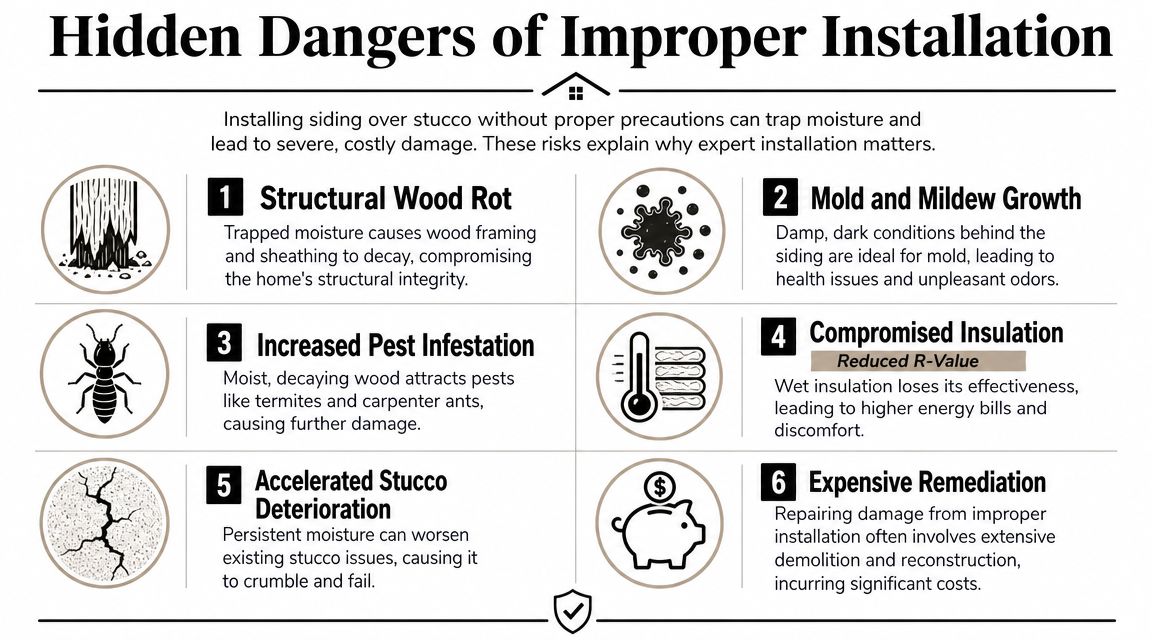
Most failures in siding-over-stucco jobs come from one bad assumption: that new siding alone keeps water out. It doesn't. Water always finds weak points around seams, penetrations, and trim. The system has to assume some moisture will get behind the cladding and give it a controlled path back out.
That's why direct-to-stucco installs are risky. In practice, installers need furring strips and a weather-resistant barrier to create a drainage and ventilation gap. Public guidance also warns that covering damaged or porous stucco without that gap can trap moisture, leading to mold or structural problems because the stucco can absorb and hold water rather than dry safely behind the new exterior (drainage and ventilation guidance for siding over stucco).
Why trapped moisture is so destructive
The easiest way to think about it is a wet sponge in a sealed bag. If the sponge can't dry, it stays damp. If a wall can't dry, the surrounding materials stay stressed.
That can lead to:
- Rot in sheathing and framing: Wood stays damp too long and starts to break down.
- Mold and mildew growth: Dark, enclosed wall cavities are ideal when moisture is present.
- Pest attraction: Damp wood attracts insects that prefer weakened material.
- Insulation problems: Wet insulation doesn't perform the way it should.
- Stucco deterioration: Existing weak areas can continue to degrade behind the new cladding.
- Expensive tear-outs later: Hidden failure often means opening the wall after the siding job is already finished.
Other ways the job goes wrong
Moisture is the biggest issue, but it's not the only one.
A contractor can also create trouble by fastening heavy siding as if the stucco were a structural base. It isn't. If the installer doesn't build a proper attachment plane into framing, the wall may not carry the load the way it should.
Another common problem is sloppy detailing at openings. Once you add thickness to the wall, trim, flashing, and sill details have to be adjusted. If they aren't, water can get driven to the exact place you were trying to protect.
A clean-looking siding job can still be a bad wall system. The failure usually starts behind the trim, not in the middle of the panel field.
Manufacturer requirements and local code expectations matter too. If the installation method ignores fastening and water-management requirements, the homeowner may end up with a system that looks finished but performs poorly.
How Professionals Correctly Install Siding Over Stucco
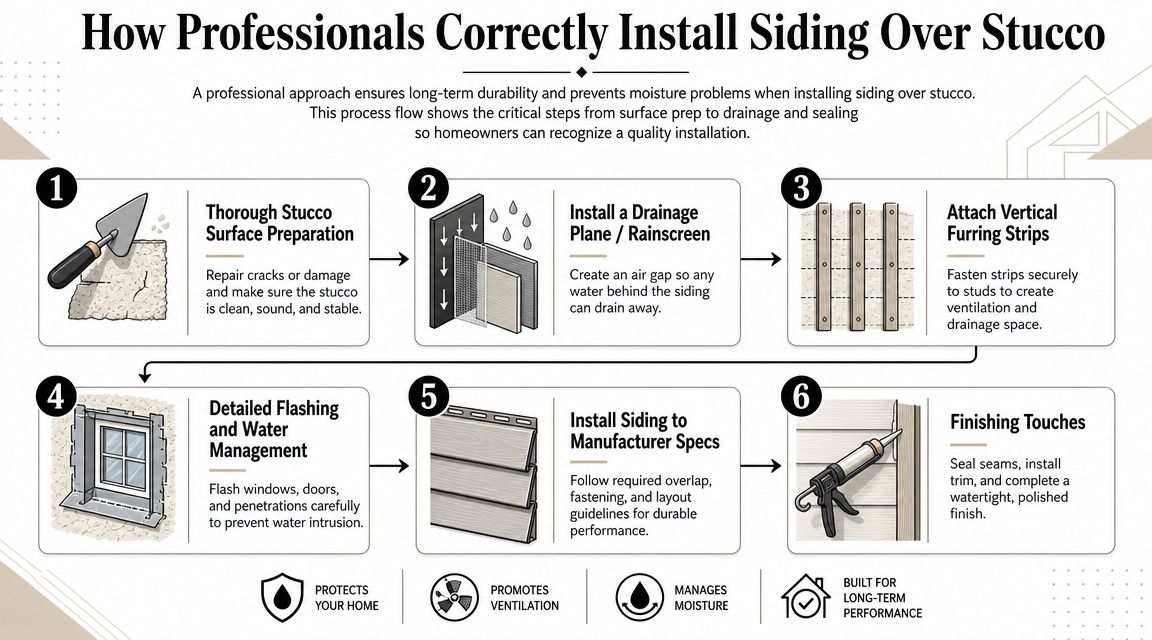
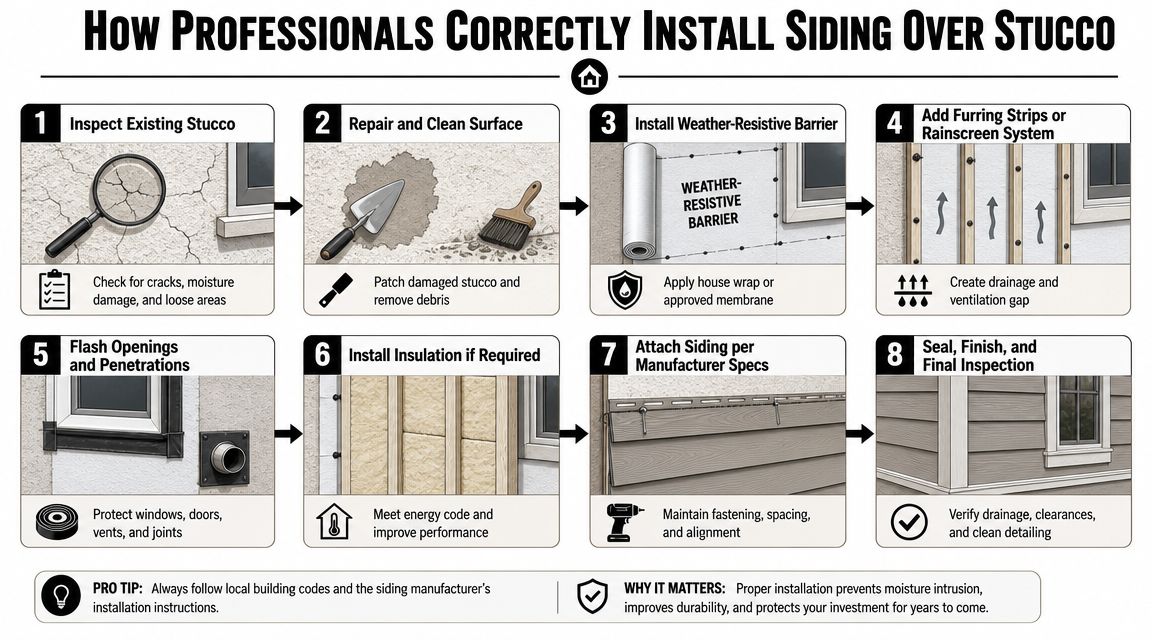
A proper install starts with the idea that the wall needs two things at the same time: a solid fastening base and a drainage space. That's why the accepted professional method is to add vertical furring strips through the stucco into the framing, creating a flat, ventilated base that allows drainage and helps prevent trapped moisture, mold, and rot (accepted method for installing siding over stucco).
What the correct sequence looks like
The steps should look something like this:
Inspect and repair the stucco surface
Loose or failed areas need attention before anything is covered. The wall has to be stable enough to serve as the existing substrate.Create the water-management layer
A weather-resistant barrier is integrated so water that gets behind the siding has a controlled path downward.Install vertical furring strips into framing
These strips flatten the plane and create the cavity that lets the wall breathe.Add insulation if the assembly allows it
Some installers place rigid foam between the strips. The key is keeping the build-up even so the finished siding stays straight.Extend and re-detail windows and doors
The added wall thickness changes trim depth, and those transitions must still shed water cleanly.Install the siding to manufacturer specs
Fastener placement, panel clearances, overlap, and trim details still matter just as much as they would on any other wall.
What homeowners should listen for
You don't need to know every fastener type to judge whether a contractor understands the work. You do need to hear the right concepts.
Listen for words like framing, ventilation gap, weather-resistant barrier, flashing, and window extension. If a contractor talks mostly about “covering the stucco” and not about rebuilding the wall assembly, that's the wrong mindset.
For homeowners comparing materials and methods, Penn Ohio Roofing & Siding Group offers vinyl siding installation in Hermitage, PA, which is one example of the kind of siding service involved in over-cladding projects when the wall conditions are appropriate.
Practical rule: The new siding should never depend on stucco alone for support, and the wall should never lose its ability to drain.
That's the difference between a cosmetic overlay and a professional retrofit.
Material Choices and Cost Considerations
Once the wall qualifies for over-cladding, the next question is what material belongs on it. In most retrofit conversations, the two most common options are vinyl siding and fiber cement.
They can both work. They just don't ask the same things from the wall or the installer.
Vinyl vs fiber cement over stucco
Vinyl is lighter and generally more forgiving in retrofit work. It still needs a flat attachment plane and careful detailing, but it places less dead load on the wall assembly.
Fiber cement is heavier and less forgiving. For that reason, fastening matters even more. Installers commonly fasten through the stucco and into structural framing using 1x strapping or furring members, because the stucco itself is not structural support. One real installation example used about 3/4-inch insulation plus pressure-treated 1x strapping screwed through the stucco into studs to create a level attachment plane (fiber cement fastening example through stucco into framing).
Cost comparison
The money side of this decision is where many homeowners pause. Over-cladding isn't free money. It involves extra prep, extra detailing, and more thought at openings. But it may still pencil out better than full demolition when the stucco is sound.
| Cost Factor | Siding-Over-Stucco | Full Stucco Removal & Siding |
|---|---|---|
| Demolition work | Avoids full stucco tear-off when existing stucco is suitable | Includes tear-off, disposal, and wall exposure |
| Prep complexity | Higher than standard siding because of furring, drainage details, and trim build-outs | High, but starts from an exposed substrate |
| Material suitability | Best when existing stucco is dry, stable, and worth keeping | Best when underlying conditions are uncertain or compromised |
| Disruption level | Usually less invasive than removing the whole stucco layer | More invasive and messier |
| Budget impact | Can be cost-effective when wall conditions are right | Often chosen when repairs behind stucco are likely necessary |
If you're trying to frame the budget before calling contractors, this guide to the average cost of new siding helps put siding pricing in context. The key, though, is matching the budget conversation to the wall condition conversation. Saving demolition cost only makes sense if you aren't burying damage.
Long-term value matters more than headline price
Cheaper isn't always cheaper later. A lighter product on a properly prepared wall often outperforms a premium product installed over bad prep.
For homeowners, the smarter question is usually this: which system gives me a stable attachment, reliable drainage, and details that can be reliably maintained over time?
Making the Final Call Siding Over Stucco or Full Removal
At decision time, this comes down to condition, not hope. If the stucco is dry, stable, and free of active leak issues, covering it can be a sensible route. If the wall shows moisture problems or widespread failure, removal is usually the cleaner answer.
When siding over stucco is the right call
This option makes sense when:
- The stucco is still doing its job: It's intact, well bonded, and not hiding obvious moisture problems.
- You want to avoid unnecessary demolition: There's value in skipping tear-off when the wall assembly can be safely upgraded in place.
- You want room for a managed retrofit: The cavity created by the new assembly can support drainage and, in some cases, added insulation.
- You understand the trim work involved: Windows and doors need to be handled as part of the wall system, not as an afterthought.
When full removal is the safer choice
Removal is usually the better path when you see any of the following:
- Known leaks around openings
- Extensive cracking, bulging, or delamination
- Evidence of moisture damage inside the home
- Concerns about rotten sheathing or framing
- A contractor can't verify a sound substrate
The financial trade-off is straightforward. Installing siding over stucco typically costs about 5% to 10% more than a standard siding installation because of the added prep, while removing stucco averages about $2,000, which is why over-cladding can be financially viable when the stucco is in good condition.
One related comparison homeowners often ask about is masonry in general, and this discussion of whether you can put siding over brick can help you think through the same “cover it or remove it” logic on a different exterior.
The right answer is the one that gives the wall a future, not just a new appearance.
Local climate matters too. In areas with freeze-thaw cycles, wind-driven rain, or long damp seasons, wall drying and flashing details become even more important. A local contractor who understands those conditions should be part of the decision.
Trust Your Home to Proven Expertise
This is not a project to hand to the lowest bidder with a ladder and a trailer. The wall has to be inspected correctly, the fastening has to reach framing, and the assembly has to manage water on purpose.
Homeowners don't need a sales pitch here. They need a clear assessment. Is the stucco sound enough to keep, or is it safer to remove it and start clean? That answer should come from inspection, not assumption.
If you're researching contractors, it also helps to review practical guidance on how home service companies present their process online. Good digital communication often reflects how a company explains scope, timelines, and responsibility in the field. These website tips for remodeling businesses are useful for spotting whether a contractor communicates clearly before the work even begins.
A good siding-over-stucco job doesn't just look straight on day one. It drains, dries, and stays stable over time. That's the standard worth paying for.
If you want an honest assessment of whether your home is a good candidate for siding over stucco, contact Penn Ohio Roofing & Siding Group. A proper inspection can tell you whether over-cladding is the smart move or whether full removal is the safer investment.