
You're probably weighing the same questions most Pennsylvania homeowners ask when they start looking at tile. Is it worth the upfront cost? Can the house even carry the weight? Will it handle ice, snow, wind, and the freeze-thaw cycle you get around Pittsburgh, Erie, and Sharon?
Those are the right questions. A tile roof isn't a cosmetic upgrade you pick from a brochure and hope for the best. It's a system. If the deck, underlayment, flashing, fasteners, ventilation, and layout are handled correctly, tile can protect a home for decades. If a contractor cuts corners underneath the tile, the roof can start giving you trouble long before the tile itself ever wears out.
Table of Contents
- Why Choose a Tile Roof in 2026
- Pre-Installation Planning and Material Selection
- Building Your Roofs Protective Layers
- The Art of Tile Layout and Fastening
- PA Code Compliance Safety and Ventilation
- Costs Timelines and Common Installation Issues
- Hiring a Pro and Maintaining Your Investment
Why Choose a Tile Roof in 2026
A homeowner in Erie calls after a hard winter. The shingles are curling, the gutters took ice, and another patch is starting to show through from the street. That is usually the moment people start asking about tile. They want a roof that looks better, but they also want to stop repeating the same repair cycle every few years.
That is the right reason to consider tile roof installation in Pennsylvania. Tile gives a house depth and character, but the bigger value is service life. On the right home, with the right structure under it, tile can outlast many lower-cost systems and hold its appearance far better through freeze-thaw swings, snow, wind, and summer heat.
Long life matters more in Pennsylvania
Western Pennsylvania is hard on roofs. Pittsburgh gets wind-driven rain. Erie gets lake-effect snow and long periods of moisture. Sharon sees the same freeze-thaw movement that opens up weak roof details over time. A tile roof is worth a serious look if you plan to stay put and want to invest in one full roof system instead of budgeting for repeated replacements.
Tile has another practical advantage. If a few pieces crack from storm debris or foot traffic, a qualified roofer can often replace those units without tearing apart the entire field. The repair still has to match the original profile, fastening method, and exposure. When a contractor wings it, the mismatch shows quickly and the repair can fail long before the rest of the roof.
Homeowners should also be realistic about what lasts on a tile roof. The tile itself usually outperforms the parts beneath it. Underlayment ages. Flashings can fail. Poor chimney work still leaks. That is why the better question is not only whether you need a roof replacement or a repair, but whether the whole assembly still makes sense for the next couple of decades.
Practical rule: On tile roofs, the system matters as much as the tile. Good workmanship and proper details decide whether you get decades of service or early leak calls.
The market growth reflects long-term value
Homeowners are not the only ones seeing that value. Analysts at Mordor Intelligence in its roofing tiles market report project steady growth in the roofing tile market through 2031, tied to durability and long-term return.
That trend does not mean every house in Pennsylvania should get tile. Some homes are better served by another material because of budget, structure, or roof design. But for the right house, tile remains one of the few roofing options that can give you strong curb appeal, long service life, and repairability in one package.
I tell homeowners the same thing after 25 years in the trade. Tile is a good choice when you want to build once and build carefully. In Pennsylvania, that mindset saves money and headaches over time.
Pre-Installation Planning and Material Selection
The biggest mistakes in tile roof installation usually happen before the first tile goes on the roof. Homeowners get sold on color and profile, but nobody slows down long enough to talk about weight, deck condition, fastening method, or whether replacement makes more sense than a limited repair.
For older homes in western Pennsylvania, that planning stage matters even more. A house in Pittsburgh or Sharon may have framing that's been through years of seasonal movement. A home near Erie may already show signs of moisture cycling at the eaves. Tile can work well on those houses, but only if the system is chosen with the structure in mind.
Clay or concrete
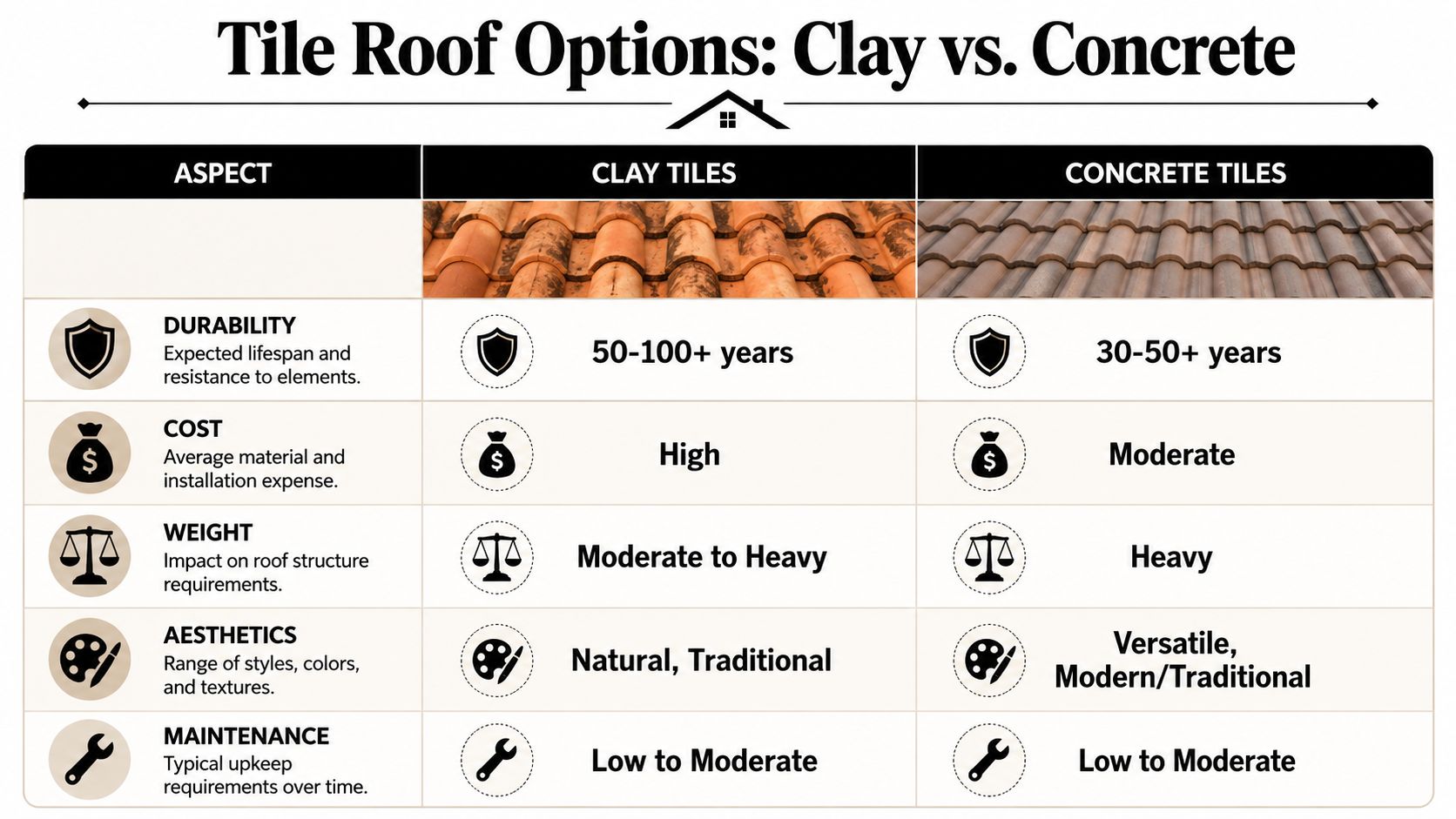
Clay and concrete are the two materials most homeowners compare. Both can perform well. The right choice depends on your budget, the look of the house, and what the roof structure can handle.
| Material | What homeowners usually like | Trade-off to consider |
|---|---|---|
| Clay tile | Traditional appearance, strong color stability, long service life when properly installed | Higher material cost and careful handling matter |
| Concrete tile | Broader style flexibility and a more moderate material cost than clay | Heavy roof assembly, so structural review is critical |
Clay often fits homes where the owner wants a more classic architectural look. Concrete works well when the goal is versatility. I've seen homeowners choose concrete because it can complement both traditional and more modern exteriors without pushing the budget as hard as clay.
If you're still deciding whether the roof needs replacement at all, it helps to compare the scope carefully. A useful starting point is this guide on roof replacement vs repair, especially when part of the existing roof system may still be serviceable.
What gets checked before tear-off
A real pre-installation plan starts below the surface. The old roofing comes off. Then the deck gets inspected for rot, soft areas, delamination, fastening issues, and previous patch jobs that were hidden by the old covering.
Here's what a competent contractor should review before ordering material:
- Structural load capacity: Tile is heavy enough that framing and sheathing condition can't be assumed. The roof has to be evaluated for the load of the finished system.
- Roof geometry: Valleys, hips, ridges, wall transitions, and penetrations all affect labor and detail work.
- Slope and exposure: The roof pitch influences fastening and water movement, and it changes how the tile should be installed.
- Deck condition: Water staining, soft decking, and split boards need repair before underlayment goes on.
- Accessory compatibility: Flashings, underlayment, ridge components, and tile profile have to work together as one assembly.
A tear-off tells the truth. Until the old roof is removed, nobody knows exactly what condition the substrate is in. That's why the cheapest quote on paper can become the most expensive job once hidden deck problems show up.
If a contractor prices a tile roof without talking about structure, tear-off findings, and underlayment compatibility, that quote is incomplete.
Another planning issue homeowners miss is installer method. Some crews are comfortable with asphalt and metal, but they rarely do tile. That shows up fast on cut quality, layout, fastening, and flashing detail. Tile is slower, more exacting work. The roof has to be treated like a system built in layers, not just rows of material moving uphill.
Building Your Roofs Protective Layers
A Pennsylvania tile roof usually shows its weak spots in February, not on installation day. Snow sits at the eaves, a thaw pushes water uphill, then a hard freeze locks that moisture in place. If the layers under the tile were built carelessly, the first sign is often a ceiling stain in a bedroom or around a chimney chase.
Tile is the outer covering. The actual water control comes from the roof deck, underlayment, flashings, edge metal, and the way each transition is tied together. That matters in Pittsburgh, Erie, and Sharon, where wind-driven rain, lake-effect snow, ice buildup, and freeze-thaw cycling put more stress on a roof than a generic installation guide accounts for.
The underlayment does the waterproofing
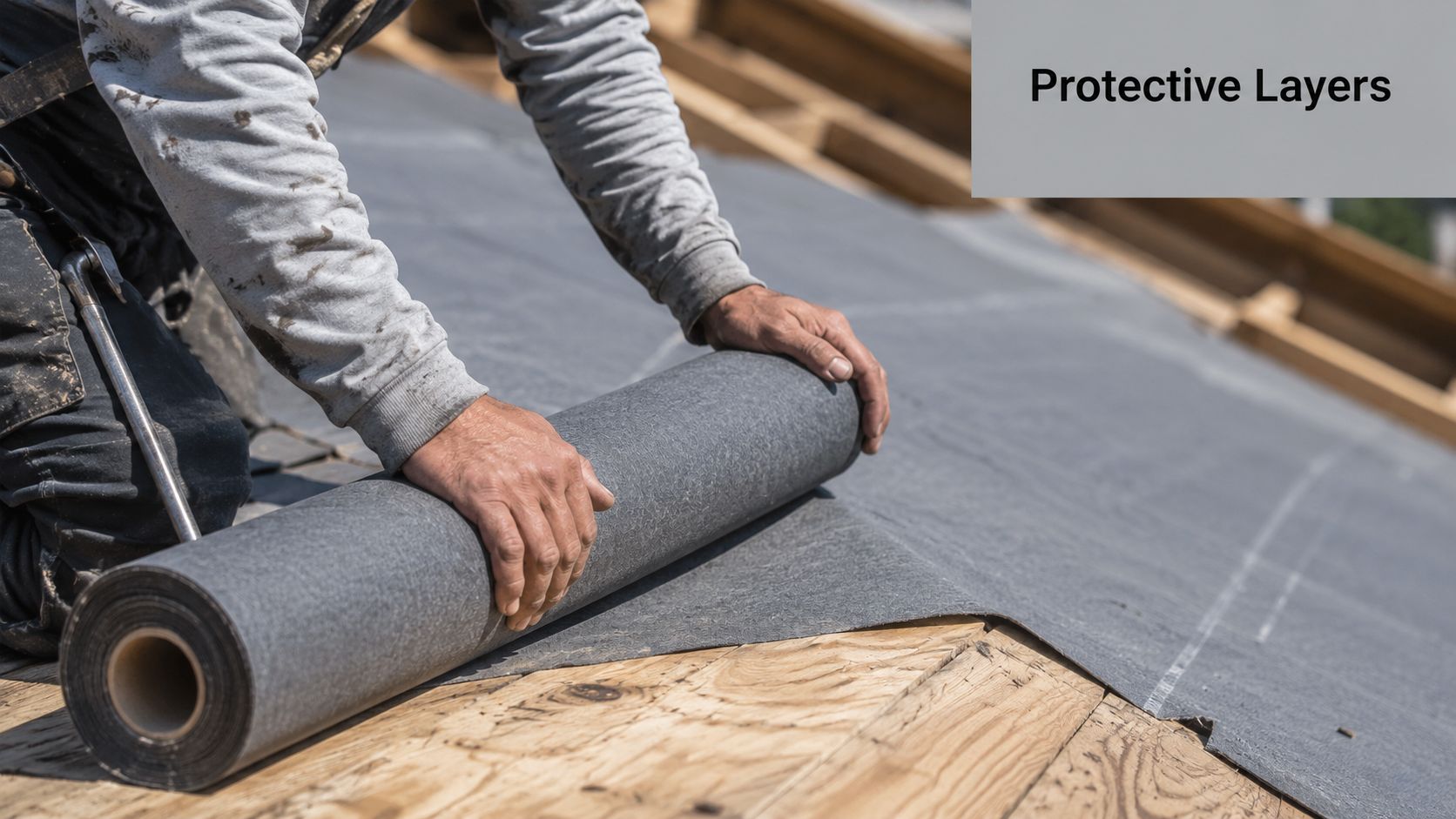
Once the deck is exposed, the work has to slow down. Rotten sheathing, loose fasteners, and uneven surfaces need to be corrected before a single roll goes down. A lot of roof failures start with a crew trying to cover bad decking instead of fixing it.
Underlayment installation has to match the roof design, slope, and local weather exposure. On Pennsylvania homes, I want special attention at eaves, valleys, sidewalls, and any area where ice backup can hold water longer than expected. If meltwater gets under the tile, the layers below need to shed it cleanly and direct it back out at the edge.
Some details are set by manufacturer and trade guidance, not installer preference. The FRSA tile installation manual calls for a 4-inch head lap, identifies mechanically attached 90# or modified cap sheet fastening at the deck, and also outlines mortar-set drainage details such as vertical mortar placement under the pan and weepholes to release trapped water. Those points matter in a state like Pennsylvania, where trapped moisture can freeze, expand, and start breaking down the assembly from below.
Ice-dam protection deserves extra scrutiny here. In Erie and other heavy-snow areas, the lower roof edge takes abuse all winter. If a contractor treats that eave detail like a warm-climate tile job, the roof may look fine from the street and still leak at the soffit line or the inside wall.
Flashing separates durable work from expensive callbacks
Field tile is usually not where chronic leaks start. The trouble spots are almost always the interruptions in the roof plane. Chimneys, skylights, plumbing vents, dead valleys, sidewalls, and roof-to-wall transitions need proper metal work integrated with the underlayment below, not surface sealant spread on after the fact.
I see the same mistakes over and over on repair calls:
- Valleys cut too tight: Water slows down, debris builds up, and winter ice has more to grab onto.
- Chimney flashing smeared with sealant: Sealant dries out. Layered base, step, and counter flashing lasts longer.
- Pipe boots forced under tile profiles that do not fit: The boot wrinkles, lifts, or channels water sideways.
- Mortar used to hide bad metal work: Mortar can be part of a tile assembly, but it does not replace flashing.
Pennsylvania weather exposes sloppy transition work fast. A valley that drains acceptably in a mild rain can fail during a wind-driven storm in Pittsburgh or during freeze-thaw cycling in Sharon. Good flashing gives water a defined path off the roof. Bad flashing leaves water looking for one.
Water usually gets in at the interruption, not in the open field. Chimneys, valleys, and wall lines deserve the best work on the roof.
Homeowners can judge this part without climbing a ladder. Look for neat metal lines, clean tile cuts, and details that appear planned instead of patched together. Straight rows matter, but hidden protection matters more. If the protective layers are built right, the tile roof has a real chance to hold up through Pennsylvania winters.
The Art of Tile Layout and Fastening
A tile roof can have good materials and still turn out wrong if the layout is sloppy. I have seen roofs in western Pennsylvania where the first few rows looked fine from the driveway, but by the time the installer reached the ridge, the courses had drifted, cuts got tighter, and water had fewer clean paths to move off the roof. That kind of error shows up fast in places like Erie, where snow sits longer, and in Pittsburgh, where wind-driven rain tests every exposed edge.
Tile work rewards control. The crew needs a measured layout before the roof is loaded, and every course needs to stay true as the work moves uphill. Good installers check exposure, headlap, side laps where applicable, and alignment against the manufacturer's instructions. They do not eyeball the field and hope the last row works out.

Layout before fastening
The cleanest tile roofs start with reference lines at the eaves and regular checks across the plane. Chalk lines keep the courses straight. Story poles or measured layout marks help keep exposure consistent. On a large roof, especially one broken up by dormers or intersecting ridges, that prep work saves the crew from chasing mistakes later.
Pennsylvania homes add another layer to this. Older houses around Sharon and Pittsburgh are often not perfectly square, and roof planes can be a little out of true. A contractor who does not catch that early may force the layout to the framing instead of adjusting the coursing to what the eye sees from the ground. Homeowners notice that. So does water.
A dependable sequence usually looks like this:
- Confirm the deck is flat enough for tile work: High spots and dips telegraph through the finished roof.
- Verify the underlayment is complete before loading tile: Tile sheds most of the water, but the roof still depends on the layers below.
- Snap horizontal and vertical control lines: Straight rows do not happen by accident.
- Set battens or direct-attach points to match the tile system: The method has to follow the manufacturer's installation instructions.
- Install and check each course as work progresses: Crews should keep checking alignment, seating, and headlap, not wait until the roof is nearly finished.
- Cut tiles carefully at hips, ridges, and valleys: Rough cuts look bad and can interfere with drainage.
- Inspect attachment and fit before cleanup: Loose tiles, rocked tiles, and crooked courses are easier to fix before the roof is finished.
Fasteners change with pitch, snow load, and tile profile
Fastening is where a lot of contractors give away the job.
The fastening pattern has to match the tile, the deck, the slope, and the local weather exposure. A low-slope section on a sheltered home in Sharon is not fastened the same way as a steeper roof in Erie that takes lake-effect snow and repeated freeze-thaw cycles. The IIBEC tile roof publication spells out some of those differences, including added fastening requirements on structural spaced sheathing, steeper slopes, and roofs in snow counties. That matters in northwestern Pennsylvania, where snow load and ice are part of the installation plan, not an afterthought.
The FRSA/TRI Florida High Wind Concrete and Clay Tile Installation Manual is also useful for the fastening principles themselves, even though Pennsylvania is not a hurricane state. It explains mechanical attachment options, tile seating, and uplift considerations that apply anywhere crews want a secure installation. The climate is different here, but loose tile is loose tile.
On Pennsylvania jobs, I pay close attention to these fastening mistakes:
- Wrong fastener length: If the fastener does not get proper purchase in the deck or framing as required by the system, the tile can shift, rattle, or break loose.
- Under-fastening at the eaves and perimeter: Edge areas take more punishment from wind and ice.
- Forcing a fastening pattern from one tile profile onto another: Flat tile, high-profile tile, and interlocking tile do not behave the same way.
- Fastening a tile that is not fully seated: A rocked tile stays under stress and often cracks later.
- Ignoring local winter exposure: Roof edges that are vulnerable to ice dam formation on Pennsylvania homes need careful attachment and clean water paths, especially in Pittsburgh and Erie.
The shortcuts that cause failures
Bad tile roofs usually fail because the installer rushed the details in the field. The tile itself is durable. The weak points are poor layout, poor fastening, bad cuts, and crews trying to correct mistakes with sealant or mortar after the fact.
The most common problems are easy to spot once you know what to look for. Courses start drifting because no one kept checking the lines. Perimeter tiles are not secured well enough. Interlocking tiles are left proud instead of fully engaged. Valley cuts wander, leaving an uneven reveal that holds debris and looks patched together.
IIBEC's article on tile attachment history and storm performance also explains why the industry moved away from attachment methods that performed poorly under severe weather. Pennsylvania does not see Florida hurricane conditions, but we do get heavy wind events, snow loading, and repeated freeze-thaw cycles. Mechanical attachment gives the roof a more dependable hold under those stresses.
A good tile roof should look straight, sit flat, and stay quiet. If tiles rock underfoot, rows wander, or cuts look improvised, the crew cut corners somewhere you can see and probably somewhere you cannot.
Homeowners can ask a simple question that tells you a lot: “How are you laying this roof out before the first full course goes on?” A contractor who knows tile will have a clear answer. A contractor who shrugs and says they will adjust as they go is the one I would worry about.
PA Code Compliance Safety and Ventilation
A tile roof can be beautiful and still fail inspection, leak at the eaves, or trap moisture in the attic. Code compliance is what turns a roof from a visual upgrade into a legal, safe, durable assembly. In Pennsylvania, that means paying attention to certification requirements, underlayment compatibility, ice protection, fastening details, and site safety.
Homeowners in Pittsburgh, Erie, and Sharon shouldn't assume every roofing crew keeps up with the state and municipal side of the job. Some do. Some don't. That's why asking direct questions matters.
What Pennsylvania homeowners should ask
Pennsylvania's code updates changed some of the conversation. The 2025-2026 Pennsylvania building code update requires contractors to be certified to install roofs meeting the new code standards, and it requires ice barriers to extend from the eaves to at least 24 inches inside the exterior wall line in areas with a history of ice damming, including places like Pittsburgh, according to this summary of the code update.
That requirement matters because tile roofs are heavy assemblies. If water backs up at the eave and the lower roof edge isn't protected correctly, the leak can travel inward and show up far from the actual entry point.
Questions worth asking your contractor:
- Are you certified for the current Pennsylvania code requirements?
- How are you handling ice barrier placement at the eaves?
- Which underlayment products are being used, and are they compatible with the tile system?
- How will flashing be integrated at chimneys, valleys, and wall transitions?
- Who is pulling the permit with the municipality?
If you live in a spot that sees repeated freeze-thaw cycles, it also helps to understand the mechanics behind those winter problems. This explanation of what causes ice dams on roofs gives homeowners useful context before they approve a roofing plan.
A contractor who gets annoyed by code questions is telling you something. A contractor who answers them clearly is usually running a tighter job.
Ventilation affects the whole roof system
Ventilation doesn't get much attention because homeowners can't see it from the curb. But it changes attic temperature, moisture behavior, and the stress placed on the roof assembly over time.
Poor ventilation can leave warm, moist air lingering under the deck in winter. It can also drive uneven roof temperatures that contribute to snow melt at the upper sections and refreezing at the colder eaves. On a tile system, that matters because trapped moisture and recurring freeze-thaw pressure can work against the layers below the tile.
A good contractor should explain how intake and exhaust ventilation fit the house, not just the roof covering. That discussion should include attic configuration, insulation behavior, and whether existing venting is balanced. Ventilation isn't a decorative add-on. It's part of how the whole roof stays stable through Pennsylvania seasons.
Safety belongs in the same conversation. Tile is brittle under concentrated loads, roof pitches can be steep, and the work area can become hazardous fast if materials are staged poorly. Ask how the crew will protect landscaping, control debris, and move on the roof without cracking installed tile. Those aren't minor details. They reflect whether the installer works like a tile contractor or just a general roofer trying to get through the job.
Costs Timelines and Common Installation Issues
A homeowner in Pittsburgh or Erie usually sees the tile sample first. I look at the structure, the flashing, and how long the roof needs to stay watertight while the crew works. That is where the ultimate cost and schedule are set on a tile job in Pennsylvania.
Tile costs more than lighter roofing because every step asks more of the house and the installer. The crew moves slower. Materials are heavier. Details have less forgiveness. On many older homes in western Pennsylvania, the surprise is not the tile price. It is the deck repair, framing review, and metal work needed to support a roof that can handle freeze-thaw cycles, lake-effect weather, and wind-driven rain.
Where the money usually goes
The visible tile is only part of the invoice. The expensive part is often the work buried underneath it, especially on houses in Sharon, Erie, and older Pittsburgh neighborhoods where the roof framing may have seen decades of moisture and patch repairs.
Typical cost drivers include:
- Tear-off and disposal: Removing old roofing without damaging trim, siding, gutters, or landscaping takes labor and planning.
- Deck repair or reinforcement: Soft spots, delamination, or undersized framing need to be corrected before tile goes on.
- Underlayment and flashing package: These layers carry a lot of the waterproofing burden during Pennsylvania storms and winter weather.
- Cutting and finish work: Valleys, hips, ridges, dormers, chimneys, and skylights add time fast.
- Staging and access: Steep driveways, tight city lots, and limited material access can raise labor costs.
- Municipal review and scheduling: Some towns move quickly. Others can slow the start date or inspection sequence.
That is why two tile quotes can be far apart even when the tile brand looks similar on paper. One contractor may be pricing a full tile system. Another may be leaving out deck corrections, better flashing metals, or the labor it takes to keep lines straight and tiles intact.
What affects the timeline
A simple home with good access and a clean deck moves much faster than a cut-up roof with chimneys, dead valleys, and structural repairs. Weather matters more here than many homeowners expect. In Pennsylvania, rain delays, cold mornings, snow risk, and high winds can stop tile work or slow it down enough that a crew needs extra days to finish correctly.
Material lead time can also stretch the calendar. Specialty profiles, color matches, and trim pieces are not always sitting in a local yard. If a contractor promises a very fast start and finish without talking through delivery, access, and weather protection, ask harder questions.
Homeowners should also ask how the house will be protected if tear-off exposes problems. A disciplined crew has a plan for temporary dry-in, staged loading, and cleanup at the end of each day. That matters on a Pennsylvania job where the forecast can change quickly.
Installation problems that show up later
The expensive mistakes usually show up after one hard season, not on the day the crew leaves. I see the same patterns over and over.
| Problem | What it usually means |
|---|---|
| Uneven tile lines | Layout control was poor from the starter courses up |
| Loose or rocking tiles | The tile was not seated or fastened consistently |
| Messy valley cuts | The installer rushed cuts or lacked tile-specific experience |
| Leaks near chimneys or walls | Flashing was treated like an afterthought instead of part of the roof system |
| Broken tiles after foot traffic | The crew walked and staged materials carelessly |
Fastening is another area where shortcuts cause trouble. The attachment method has to match the tile profile, roof pitch, exposure, and local conditions. A contractor who gives a vague answer about fastening is telling you the crew may be treating tile like standard shingle work. That is how tiles loosen in wind, crack under stress, or shift enough to create water entry points around flashings and penetrations.
Pennsylvania winters expose weak workmanship fast. Minor alignment errors can trap snow and debris in places where water should shed cleanly. Sloppy flashing around chimneys and sidewalls often shows up after ice, wind-driven rain, or repeated freeze-thaw movement. If you want an outside opinion before signing off on a questionable scope or a finished job, finding a qualified roof inspector can help you verify what is being installed.
A lower bid is not automatically a bad bid. It can be a fair price from an efficient tile crew. It can also mean fewer repairs, thinner underlayment, lighter metal work, or less time spent on the details that keep the roof performing. After the job is complete, a practical tile roof maintenance checklist for Pennsylvania homes helps catch cracked units, blocked valleys, and flashing issues before they turn into interior damage.
Hiring a Pro and Maintaining Your Investment
A tile roof can look sharp on day one and still be a problem job. I have seen plenty of Pennsylvania roofs that passed the driveway test but failed at the permit desk, failed inspection, or started leaking around a chimney after the first hard winter in Pittsburgh or Erie. Hiring the right installer is what separates a roof that lasts from one that becomes an expensive repair project.
What to verify before signing
Price matters, but tile work is won or lost in the details the contract spells out.
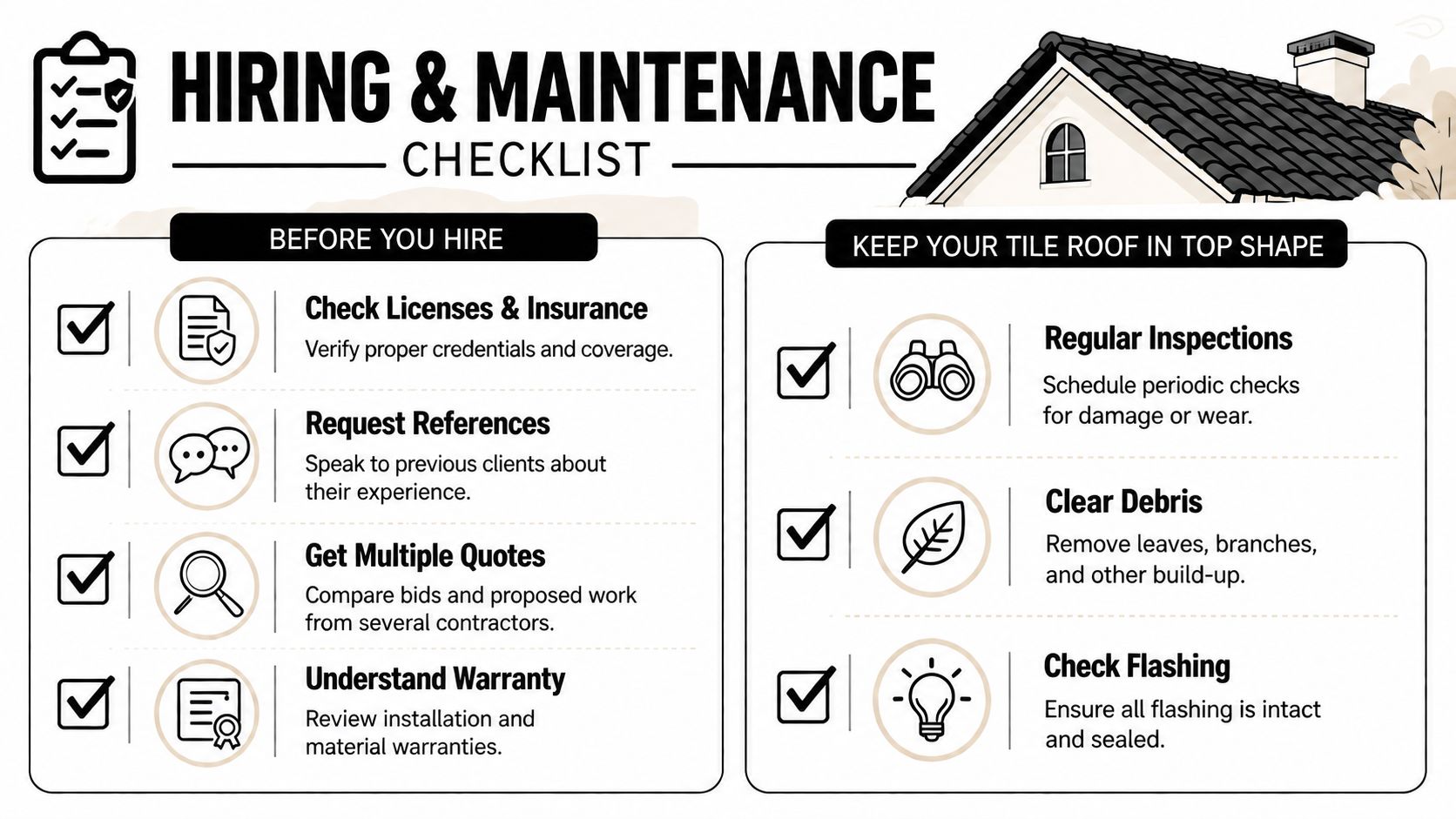
- Licensing and insurance: Ask for current documentation. Do not accept a verbal yes.
- Permit responsibility: The contractor should tell you who is pulling the permit, which municipality is involved, and what inspections are expected. In Pennsylvania, that answer can vary by town, and places like Sharon, Erie, and Pittsburgh do not always handle roofing paperwork the same way.
- Tile-specific experience: General roofing experience is not enough. Ask how often the crew installs tile, what tile profiles they work with, and how they protect tiles during staging and foot traffic.
- Written scope: The contract should list tear-off, deck repairs if needed, underlayment type, flashing metal, fastening method, ventilation work, disposal, and cleanup.
- Inspection support: If you want an outside opinion before or after the job, finding a qualified roof inspector can help you understand what to verify on a tile project.
A good contractor should also talk plainly about structure. Tile is heavier than asphalt, and Pennsylvania homes with older framing sometimes need a closer look before material is ordered. If a bidder skips that conversation, skips permit talk, or stays vague about code compliance, that is a warning sign.
For homeowners in western Pennsylvania, Penn Ohio Roofing & Siding Group is one local option that handles tile roof installation among other roofing services. The point is not the brand name. The point is whether the contractor explains the full assembly clearly and takes responsibility for the work from permit to final cleanup.
Simple maintenance that protects tile
Tile does not need constant attention, but it does need regular checks. Snow loads, freeze-thaw movement, wind-driven rain off the lake, and clogged gutters can shorten the life of a good roof if nobody catches the early signs.
- Check after major weather: Look for cracked, slipped, or missing tiles.
- Keep gutters clear: Overflow at the eaves can push moisture where it does not belong.
- Watch flashing zones: Chimneys, valleys, skylights, and wall intersections deserve a close look.
- Limit roof traffic: Tile cracks easily when someone walks it the way they would walk shingles.
- Use a checklist: A seasonal roof maintenance checklist for Pennsylvania homes helps homeowners stay ahead of small problems.
Small problems do not stay small for long. A cracked field tile, a loose ridge piece, or a bit of failed sealant around flashing can let water into the underlayment and decking long before you see a ceiling stain inside.
If a contractor tells you permits are not part of the job, verify that with your local building office before work starts. As noted earlier, Pennsylvania roof replacement requirements depend on the municipality and the scope of work, and tile adds structural and inspection questions that should never be brushed aside.
If you're planning a tile roof installation in Pennsylvania and want a clear assessment of structure, code requirements, underlayment, fastening, and long-term maintenance, Penn Ohio Roofing & Siding Group can help you review the project scope and next steps.