
You usually notice a built-up roof problem the same way most owners do. A ceiling stain gets darker after a storm. A tenant reports a drip near a vent pipe. Or you finally get up on the roof and see cracked surfacing, loose gravel, and a spot that just doesn't look right.
That's when people start searching how to repair built up roof systems, and the first thing to know is this. Some BUR repairs are manageable if the damage is small, dry, and easy to reach safely. Some are not. A bad patch on a low-slope roof can trap water, soak insulation, and turn a repairable issue into a much larger job.
A built-up roof, or BUR, is a multi-layered system made of asphalt and reinforcing fabrics. It's durable, and it has a long service life. BUR typically lasts 15 to 30 years according to This Old House roofing facts and statistics. The same source cites a long-term study showing proactive maintenance averages 14 cents per square foot, compared with 25 cents per square foot for reactive repairs. That's why smart owners don't wait for obvious leaks.
Table of Contents
- Your Guide to Built Up Roof Repair
- How to Safely Inspect Your Built Up Roof for Damage
- Gathering Your Tools and Materials for BUR Repair
- Common Built Up Roof Repair Techniques Explained
- Proactive Maintenance Tips for Your Built Up Roof
- Knowing When DIY Repair Is Not Enough
Your Guide to Built Up Roof Repair
BUR roofs are forgiving in one way. They're layered, so a small surface issue doesn't always mean the whole roof has failed. They're unforgiving in another. Water moves sideways in low-slope systems, and the leak you see inside often isn't directly under the damage.
That's why the right approach starts with decision-making, not a bucket of roof cement. If the issue is a small split at a seam, a minor puncture, or a localized flashing gap, a careful owner may be able to make a limited repair. If the roof feels soft, holds water, or leaks keep coming back, the repair needs a trained crew and a full moisture assessment.
What owners need to decide first
A built-up roof repair usually falls into one of three categories:
- Temporary stopgap work for an active leak when weather is coming in and you need to limit interior damage.
- Targeted repair when the damaged area is isolated and the surrounding roof is still solid.
- System-level restoration or replacement when the membrane, insulation, or flashing failures are spread across the roof.
Practical rule: If you can't confirm the area is dry and structurally sound, don't seal over it and hope for the best.
Quick fixes fail for predictable reasons. People patch over wet material. They smear mastic over gravel without cleaning the surface. They ignore flashing. Or they repair the symptom while the actual leak path stays open.
A good BUR repair protects the building today and preserves the roof's remaining life. That's the standard to use as you read the roof, choose materials, and decide whether you're handling a minor issue or bringing in a professional crew.
How to Safely Inspect Your Built Up Roof for Damage
Before you try to repair built up roof sections, make sure you can inspect it without becoming the next emergency. Low-slope roofs look safer than steep roofs, but falls still happen at edges, skylights, weak decking, and slick membrane surfaces.
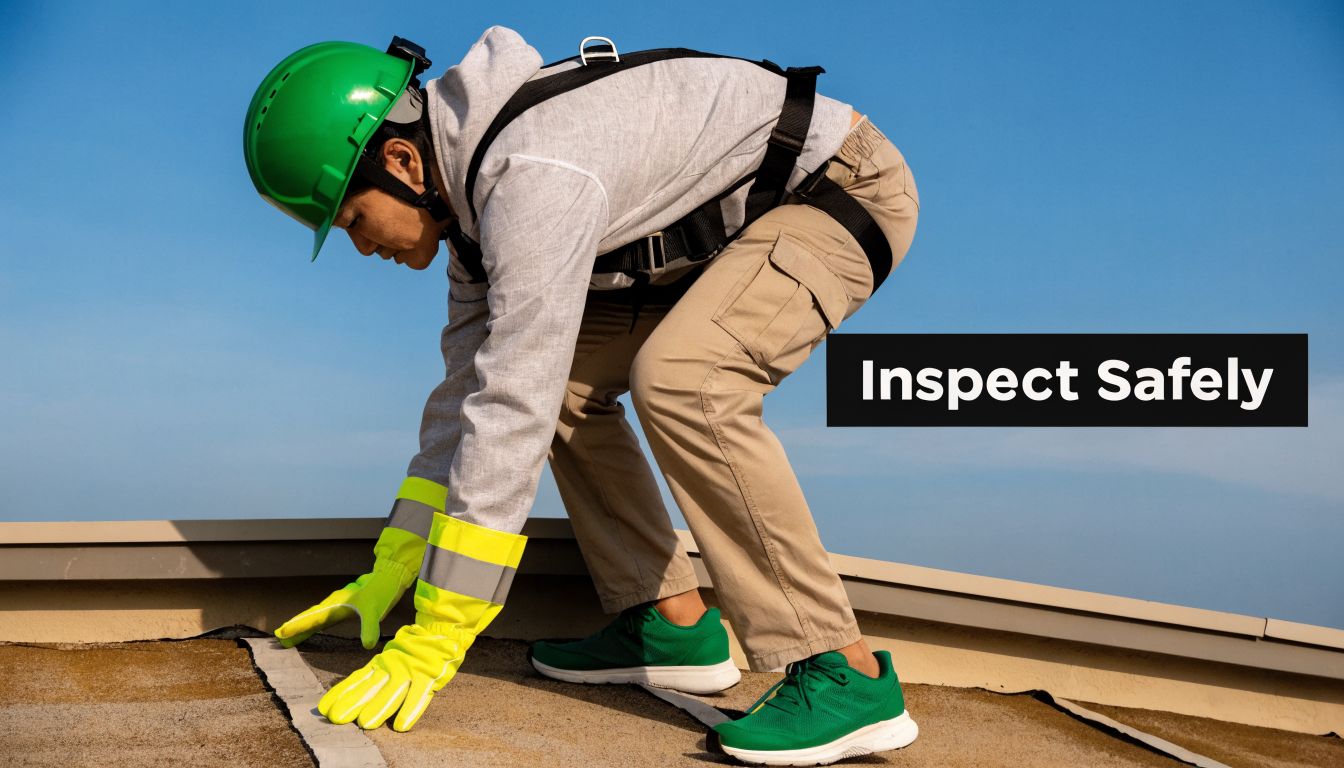
If you're reviewing safe access procedures, fall protection basics, and site controls, this guide on H&S management for working at heights is a useful starting point. On commercial properties, documented inspection routines also help. Penn Ohio's commercial roof inspection checklist gives owners a practical framework for recording what they see.
Start on the ground first
The first inspection shouldn't begin on the roof. Start outside and inside the building.
Look for:
- Interior water signs such as stained ceiling tiles, damp insulation, wall streaking, or musty odors near penetrations.
- Perimeter clues like loose coping, stained masonry, blocked downspouts, or overflow marks below scuppers.
- Drainage evidence including places where water appears to sit too long after rain.
Then inspect the roof surface itself. Professional roofers use both ground-level and rooftop evaluations, and the initial inspection determines 85% of repair success according to this roof repair process guide.
What damage on a BUR roof actually means
Some defects are mostly surface wear. Others point to hidden moisture or system failure.
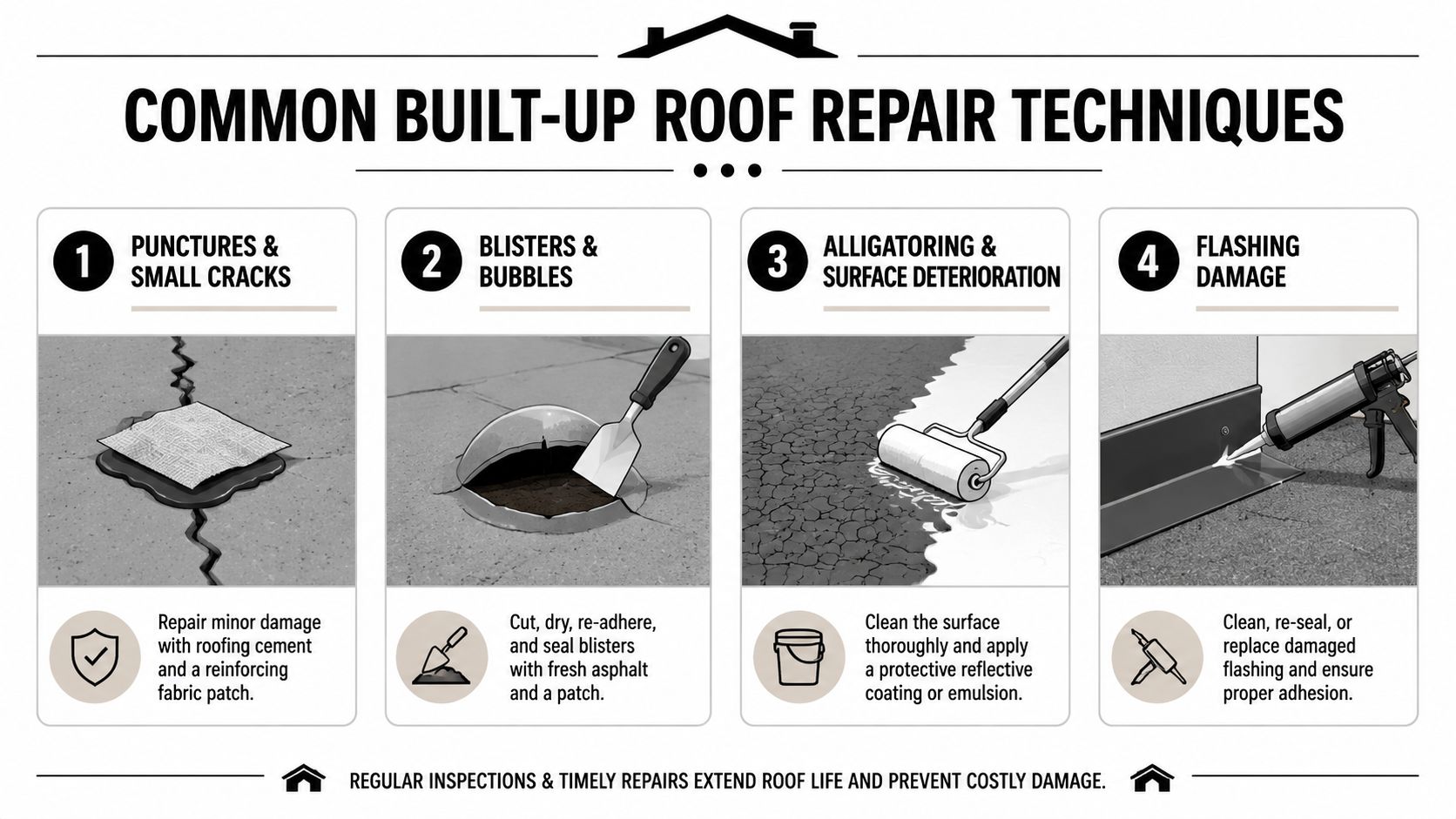
- Alligatoring means the asphalt surface has aged and cracked into a pattern that looks like reptile skin. Light alligatoring may be a wear issue. Deep cracking can expose lower layers.
- Blisters and bubbles can indicate trapped moisture or air. A stable blister isn't always an immediate emergency, but a broken blister is an open entry point for water.
- Open seams or splits are active leak risks. These need prompt attention because water doesn't stay local on a flat roof.
- Ponding water usually means a slope or drainage problem, not just a membrane problem.
- Loose or missing gravel exposes surfacing and often shows where foot traffic or weather has worn the roof faster.
- Soft spots underfoot are a major warning sign. That often means wet insulation or deteriorated substrate.
Flashing deserves special attention around vents, chimneys, curbs, and skylights. The same source notes that 60% of roof leaks originate from flashing failures.
If the membrane issue is small but the flashing is loose, the flashing still wins. That's where many leaks start.
Don't poke aggressively, cut into the roof casually, or walk a wet BUR surface in soft shoes. Inspection should identify whether the problem is localized and repairable, or whether the roof is already telling you it needs more than a patch.
Gathering Your Tools and Materials for BUR Repair
A decent repair starts before you open a can of anything. Wrong tools waste time. Wrong materials create a patch that looks sealed but fails the first time the roof expands, contracts, or sees standing water.
If you're comparing systems beyond patch work, Penn Ohio's overview of the best roofing material for flat roof helps sort out when BUR, coatings, or other low-slope materials make more sense.
What to bring for a temporary patch
For a limited leak-control repair, keep the setup simple and controlled:
- Work gloves and fall protection gear because safety comes first.
- Push broom or stiff brush to clear debris and loose surfacing.
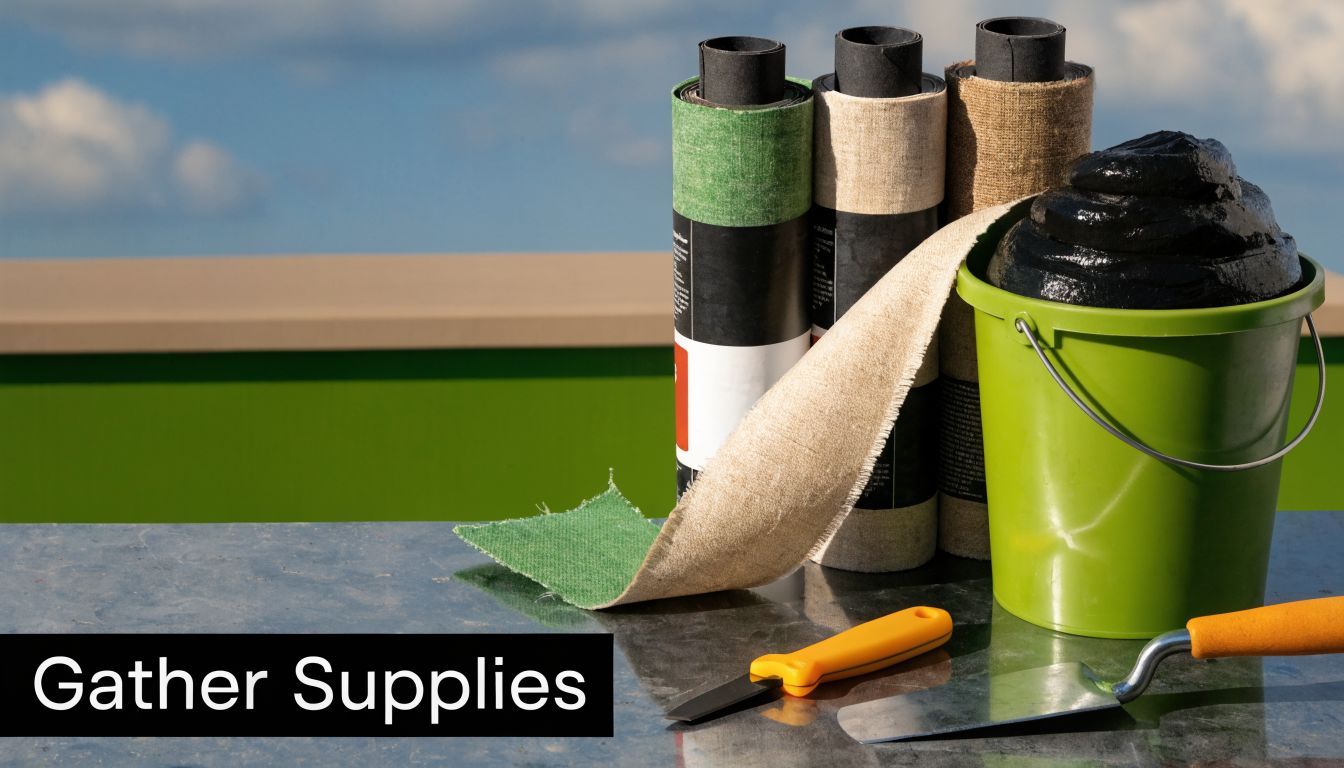
- Utility knife with hook blades for trimming membrane and reinforcing fabric.
- Roofing cement compatible with low-slope repairs for small patches.
- Reinforcing fabric or polyester patch material to give the repair strength.
- Trowel or putty knife for spreading cement evenly.
- Rags and cleaner approved for roofing work to improve adhesion where appropriate.
Cold-applied products are the practical choice for owners. Hot-mop asphalt belongs to trained crews with the right kettles, handling procedures, and fire controls. DIY work should stay on the cold-applied side.
What you need for a longer lasting repair
A more durable repair often needs better prep and better materials:
- Probe or moisture-check tools to identify soft sections.
- Replacement felt or BUR-compatible patch membrane for cut-out repairs.
- Roof primer if required by the material system.
- Flashing cement or sealant for metal details and penetrations.
- Roller to press patches down and remove trapped air.
- Granules or surfacing material where the repair system calls for it to protect exposed mastic or coating.
Use matching materials whenever possible. BUR roofs are layered systems, so repairs work better when the patch behaves like the surrounding roof. A random sealant from the hardware aisle usually isn't the answer.
Buy more reinforcing fabric than you think you need. Running short halfway through a patch is how people start “making do,” and that's where sloppy repairs begin.
Common Built Up Roof Repair Techniques Explained
Most BUR repairs are problem-specific. You don't treat a puncture, a blister, and a failing flashing base the same way. You also need to be realistic about what each repair is buying you. Some methods stop a leak. Some restore surface protection. Some are closer to a system upgrade.
Patching punctures and small cracks
This is the most common owner-level repair. It works when damage is isolated, the substrate is dry, and the surrounding membrane is still firmly attached.
Clean the area first. On gravel-surfaced BUR, remove loose gravel far enough beyond the damaged spot to create a clean patch zone. Dry matters more than speed. If moisture is trapped under the patch, the repair is already compromised.
Apply roofing cement to the cleaned area, embed reinforcing fabric, and cover it fully so the fabric is saturated and sealed at the edges. Feather the edges so water can't catch the patch. For small cracks, this method is often enough. For punctures, the patch needs to extend well beyond the visible damage.
Repairing blisters and bubbles
Blisters need judgment. If the blister is intact and stable, cutting into it may do more harm than good. If it has broken open or feels likely to split, repair becomes more urgent.
A careful repair usually involves opening the damaged blister, letting the area dry completely, re-adhering loose material, and sealing it with fresh patch material and compatible asphalt-based repair products. This is not a same-hour process if moisture is present.
Don't trap wet insulation under a patch. Water always wins that argument.
If the blistered area feels soft or widespread, stop there. That usually points to a deeper failure than a surface bubble.
Addressing surface wear with coatings or foam
When the roof has broad weathering rather than one isolated hole, coatings or foam can become part of the discussion. The trade-off depends on roof type, condition, and climate.
For gravel BURs, spray foam installation costs $8 to $12 per square foot with 15 to 20 year warranties. For smooth BURs, silicone coatings cost $5 to $8 per square foot initially and need recoats every 10 years, according to the cited repair options discussion. In cold climates like Pennsylvania and Ohio, that same source notes spray foam's closed-cell insulation can cut HVAC costs 20% to 30%.
That doesn't mean foam is always better. Foam needs precise application and proper protection. Coatings can be a smart choice on the right smooth BUR roof if the substrate is sound. But neither system fixes wet insulation by magic. If moisture is in the assembly, a coating over the top can just hide the problem.
Fixing flashing and edge details
If you've got a leak around a curb, vent, chimney, or wall transition, start with the flashing before you start blaming the field membrane.
A repair may include cleaning the area, removing failed sealant, tightening or replacing loose metal, and reinstalling compatible flashing cement or membrane patching at the transition. Corners, laps, and terminations matter. Rushed work fails fast at these critical points.
For many commercial owners, this is the point where a roofer should take over. Penn Ohio Roofing & Siding Group handles low-slope repair work, including the flashing and transition details that often decide whether a leak is actually solved or just slowed down.
Built-Up Roof Repair Options at a Glance
| Repair Method | Best For | DIY Difficulty | Estimated Cost | Longevity |
|---|---|---|---|---|
| Roofing cement and reinforcing fabric patch | Small punctures, minor cracks, limited seam issues | Moderate | Qualitatively low compared with larger restorations | Short to moderate term, depends on prep and dry conditions |
| Blister cut-out and patch | Open or failed blisters in localized areas | Moderate to high | Qualitatively moderate | Moderate if the area is dry and surrounding membrane is sound |
| Silicone coating on smooth BUR | Broad surface wear on a stable smooth BUR roof | High for DIY, often better for pros | $5 to $8 per sq ft initially | Needs recoats every 10 years |
| Spray foam over gravel BUR | Aging gravel BUR where restoration and insulation upgrade both matter | High, pro-only in practice | $8 to $12 per sq ft | 15 to 20 year warranties |
Hot-mop repairs still have a place, but they're professional work. Heat control, material handling, and crew safety aren't casual tasks. For owners doing minor repairs, cold-applied methods are the ceiling. Once you move into widespread membrane work, foam, or major flashing reconstruction, professional intervention stops being optional.
Proactive Maintenance Tips for Your Built Up Roof
Most expensive BUR repairs start as cheap maintenance tasks that got skipped. A blocked drain. Wind-blown debris left in place. A flashing seam that loosened months before anyone looked. If you want to avoid emergency roof calls, routine attention beats heroic patching every time.
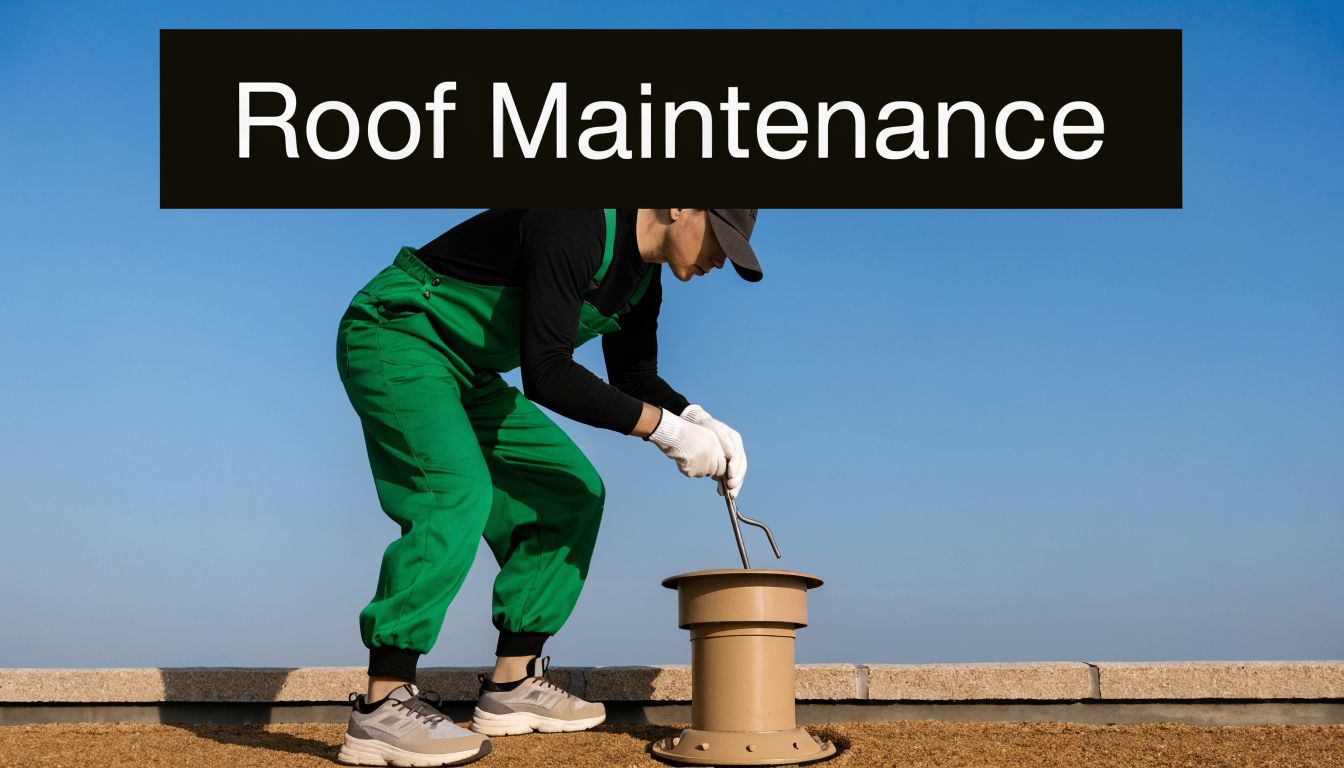
If you're building a repeatable service routine, Penn Ohio's commercial roof maintenance plan is a good reference point. And if your roof is aging past practical repair, this expert guide to flat roof replacement can help you think through replacement timing before a failure forces the decision.
A maintenance routine that actually works
Use a simple checklist and stick to it.
- Clear drains and scuppers: Low-slope roofs depend on drainage. Leaves, gravel migration, and trash keep water where it shouldn't sit.
- Remove debris carefully: Branches and sharp objects can puncture surfacing and hide damage underneath.
- Check penetrations: Vents, curbs, skylights, and wall intersections need frequent visual review because movement shows up there first.
- Watch traffic paths: Service technicians often damage roofs without meaning to. Walk pads and marked access routes help control that.
- Document changes: Photos after storms, service calls, or repairs make it easier to tell whether a defect is active, stable, or spreading.
A BUR roof usually doesn't fail all at once. It gives warnings. Owners who record those warnings make better repair decisions and avoid paying for the same leak twice.
When maintenance turns into replacement planning
Maintenance is worth doing, but maintenance shouldn't become denial. If the roof needs frequent patches, drains poorly, or shows widespread aging, maintenance should feed into a replacement discussion.
Sometimes repair is still the right move because it buys time and protects the building while you budget. Sometimes replacement is cheaper than repeated interruptions, interior damage, and emergency labor. The hard part is being honest about which situation you're in.
A roof can be serviceable without being healthy. Maintenance tells you which one you've got.
Knowing When DIY Repair Is Not Enough
Many owners lose money at this stage. They keep repairing a roof that has already crossed the line from localized damage to system failure. The patch looks productive. The invoice looks smaller. But the leak comes back, the insulation stays wet, and the final bill grows.
Roof repair and replacement costs reached nearly $31 billion in 2024 according to Insurance Business and Verisk reporting on roofing costs. That number matters because it reflects the actual cost of delay, storm damage, and aging roofs.
Red flags that mean call a roofer now
DIY repair is not enough when you see any of the following:
- Soft or spongy areas underfoot that suggest wet insulation or substrate damage.
- Recurring leaks in the same general area after one or more patches.
- Widespread splitting, open laps, or failed flashing across multiple roof details.
- Large areas of ponding water that point to drainage or slope problems.
- Interior leaks around electrical equipment, tenant spaces, or finished ceilings where the risk of secondary damage is high.
- Damage after a major storm or impact event when documentation and insurance support matter.
The key question is whether the issue is isolated. If it isn't, patching becomes guesswork.
Insurance and replacement decisions
For permitted BUR roofs, if damage exceeds 25% of the surface area, insurers often cover a full replacement rather than partial repair, according to the same insurance report on roof repair and replacement costs. That threshold changes the conversation.
Owners sometimes spend money trying to avoid a bigger claim when the roof may already qualify for broader action. If you're dealing with a disputed claim or an insurer pushback, this explanation of how to dispute a denied roof claim is a practical resource for understanding the process.
If your building is in Mercer, Beaver, or Lawrence County and the roof has crossed into structural concerns, repeated leaks, or claim-related damage assessment, a professional roof inspection is the right next move. That's where you want clear documentation, moisture diagnosis, and a repair-versus-replacement recommendation based on what the roof is doing, not what everyone hopes it will do.
If your BUR roof is leaking, blistering, or showing signs that a simple patch won't hold, Penn Ohio Roofing & Siding Group can inspect the roof, document the condition, and help you determine whether targeted repair or full replacement makes more sense for the property.