While national averages for major restoration projects can hit $7,000, many systems like silicone coatings cost $3 to $7 per square foot, which makes restoration far more affordable than a full replacement. For many Pennsylvania homeowners, that puts roof restoration cost in the range where saving the existing roof structure makes financial sense before committing to a complete tear-off.
If you're reading this, there's a good chance your roof has started showing the usual warning signs. A leak around a vent, stained ceilings after a hard rain, missing shingles, worn flashing, or a roof that looks tired from the street. A "full replacement" is rarely the desired initial answer, especially when the numbers get big fast.
Restoration sits in the middle ground. It's more substantial than a patch repair, but it avoids the cost and disruption of replacing everything when the roof still has life left in it. That matters in places like Hermitage, Sharon, Pittsburgh, and Erie, where weather exposure can age roofs unevenly and online calculators rarely reflect local conditions.
A lot of homeowners also get blindsided by line items that weren't obvious at the start. Cleanup, permits, disposal, and substrate repairs can change the final number. This guide strips that down and gives you the practical view of roof restoration cost, using national pricing where it helps and Pennsylvania-specific numbers where homeowners need them most.
Table of Contents
- What Is Roof Restoration and What Does It Cost
- Breaking Down the Average Roof Restoration Cost
- Key Factors That Influence Your Final Price
- Roof Restoration vs Replacement The Cost-Benefit Analysis
- Pennsylvania-Specific Costs From Pittsburgh to Erie
- The Restoration Process and How to Get an Accurate Quote
- Your Next Steps with Penn Ohio Roofing & Siding Group
What Is Roof Restoration and What Does It Cost
A homeowner in Hermitage usually calls about restoration after a familiar problem. The roof is aging, a stain has shown up on a ceiling, and the first fear is a full tear-off. In plenty of cases, that is not the only option.
Roof restoration keeps the existing roof system in service by correcting problem areas and renewing the surface so it sheds water and holds up longer. That can mean cleaning, resealing, replacing damaged shingles or flashing, addressing leak points, and applying a protective treatment where the roof type allows it. The goal is to extend service life without paying for a full replacement if the roof deck and the larger system are still sound.
That distinction matters because restoration sits in the middle of the price range. A basic repair handles one failure point. A full replacement starts over. Restoration covers more than a patch job but stops short of stripping everything down to the deck.
For homeowners, the main question is usually whether the roof is a candidate. If the roof has widespread cosmetic wear, isolated leaks, aging sealants, or failing flashing, restoration may make financial sense. If the decking is soft, moisture is trapped throughout the system, or the roof has already reached the point of broad structural failure, replacement is usually the better use of money. Homeowners comparing restoration to a full new roof shingles cost in Pennsylvania should look at remaining roof life, not just the first number on the estimate.
National averages can help set expectations, but they do not price your house in Hermitage. Online calculators usually miss the line items that change the quote in western Pennsylvania. Chimney flashing, steep pitch, layered old repairs, poor attic ventilation, hard access, and hidden deck damage can move the cost fast. Those are the charges homeowners call "surprises," but they are predictable once someone gets on the roof and inspects it properly.
That is also why two homes with similar square footage can land in very different ranges. One roof may need cleaning, minor shingle replacement, resealing around penetrations, and gutter edge corrections. Another may look similar from the driveway but require carpentry repairs, vent replacements, and moisture-related work that no national average can see.
Owners of rental houses and fix-and-flip properties run into the same decision from a budget angle. If the roof can be restored and the numbers support the broader project, that can preserve capital for other work. For investors weighing rehab financing, securing capital for investment properties is often part of the decision alongside the roofing scope.
The short answer on cost is simple. Roof restoration is usually less expensive than replacement, but only when the existing roof still has enough integrity to justify saving it. In Hermitage, PA, the useful number is not a generic national average by itself. It is the local price range after the roof's condition, access, and hidden repair items are accounted for.
Breaking Down the Average Roof Restoration Cost
A homeowner in Hermitage might get one restoration quote at the low end of the range and another that is thousands higher, even before anyone talks about replacement. The difference usually comes down to how the contractor built the estimate, what level of repair is included, and whether the quote reflects local labor and roof conditions instead of a national calculator.
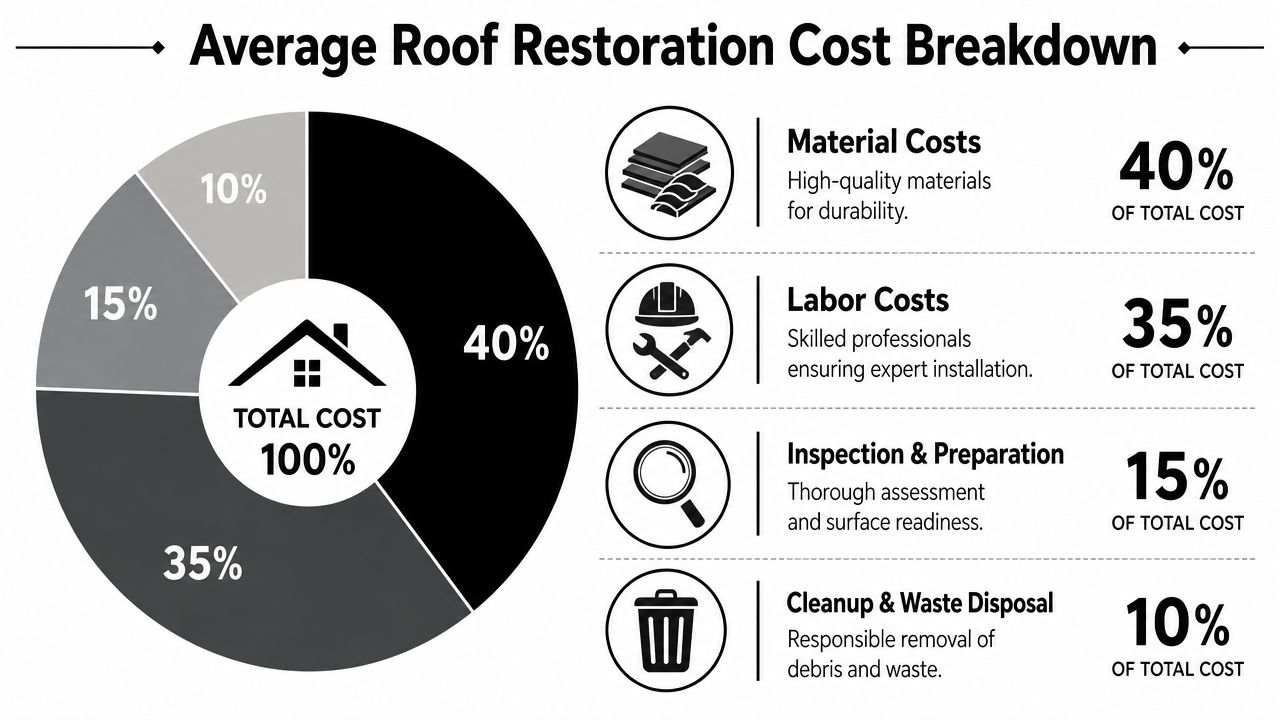
A solid restoration quote is usually built from four cost groups: prep work, repair work, the restoration system itself, and site-related labor.
Here is what should be inside those numbers:
- Surface preparation: cleaning, treatment of moss or algae, scraping loose material, and getting the roof ready for repair or coating
- Targeted repairs: flashing corrections, small shingle or membrane repairs, resealing penetrations, ridge and edge detail work, and leak-area repairs
- Protective system: the coating or restoration method selected for the roof type and condition
- Site costs: safety setup, ladder and access staging, debris handling, protection of landscaping, and final cleanup
The product category changes the price fast. A basic restoration with limited repair work and a straightforward coating system will usually stay closer to the lower end of the range. A restoration that includes specialty coatings, more detailed prep, or insulation-related upgrades climbs from there. That is why broad national averages are only a starting point.
In Hermitage and nearby western Pennsylvania markets, I tell homeowners to watch how the estimate allocates labor. Material prices matter, but labor often decides whether the quote is realistic. A crew can apply coating in a day. Proper prep, detail work around penetrations, and correction of problem areas are what take time and make the restoration hold up.
That is also where hidden costs show up in plain sight if the estimate is written correctly.
A good bid should separate the work instead of rolling everything into one vague total:
| Cost area | What to check |
|---|---|
| Materials | Coating type, repair products, and whether they match your roof system |
| Labor | Time allotted for prep, repairs, application, and finish work |
| Inspection | Whether the contractor includes a close-condition review and documents problem areas |
| Cleanup | Debris removal, magnet sweep, haul-off if needed, and site protection |
If one quote is much lower than the others, look for what is missing. The usual omissions are prep, flashing work, cleanup, and repair allowances. Those line items do not sound dramatic, but they are often the difference between a restoration that buys real service life and one that turns into a callback.
It also helps to compare the restoration number against a realistic replacement benchmark. This local guide to new roof shingles cost gives useful context when you are trying to decide whether restoration still leaves enough savings to justify keeping the existing roof.
A quote that glosses over prep work usually glosses over the lifespan of the repair.
Key Factors That Influence Your Final Price
No two roofs age the same way. A roof that looks rough from the driveway might need light restoration. Another roof that looks decent at a glance may have moisture intrusion around penetrations, weak decking near prior leaks, or failing ridge details that expand the scope once the contractor gets on the roof.
That's why roof restoration cost changes from property to property even within the same neighborhood.
The roof itself changes the price first
Start with size and geometry. Larger roofs need more materials and more time. Steeper roofs usually slow production, require more safety setup, and make every stage harder, from cleaning to repairs to coating application.
Complexity matters just as much as square footage. A simple surface with clean access is cheaper to restore than a roof loaded with valleys, dormers, skylights, chimneys, vent stacks, and awkward transitions. Each penetration is another place crews need to inspect, seal, detail, and test.
Material type also affects the final number. A metal roof, a tile roof, and an asphalt system don't restore the same way. Some take coatings well. Some need more component replacement first. Others may technically be restorable, but only after enough prep work that replacement starts to look more rational.
The costs people miss
The biggest pricing surprises usually come from what isn't obvious on the first walk-around. According to EcoWatch's roof repair cost guide, hidden costs such as debris cleanup, permits, disposal fees, and structural reinforcement can inflate the final price by 15% to 25%.
That one point explains a lot of homeowner frustration. Online calculators often act as if the roof is clean, accessible, permit-ready, and structurally sound. Real roofs aren't that cooperative.
Look closely at these add-ons when reviewing an estimate:
- Cleanup and hauling: Old sealants, broken components, and jobsite debris still have to leave the property.
- Permit requirements: Some municipalities require permits depending on scope, even when the job is restoration rather than replacement.
- Disposal fees: If materials come off, somebody pays to dispose of them.
- Structural corrections: Soft spots, moisture-damaged sheathing, and compromised edges can't be coated over responsibly.
Budget note: If a quote seems much lower than others, check whether cleanup, disposal, and permit handling are actually included.
Another factor people underestimate is access. A roof over tight landscaping, fences, porches, or attached structures usually takes more setup and more careful movement of materials. That doesn't always show up as a separate line item, but it affects labor hours and crew planning.
The bottom line is simple. A trustworthy estimate doesn't just price the visible roof. It prices the work required to restore it correctly.
Roof Restoration vs Replacement The Cost-Benefit Analysis
A homeowner in Hermitage might get one quote for a restoration and another for a full replacement, then wonder why the spread is so wide. The answer usually comes down to what the roof needs, not what an online calculator assumes. Until somebody gets on the roof, checks the decking, and looks at the leak history, the cheaper option can be either the smart buy or a short-term patch that costs more later.
When restoration makes financial sense
Restoration makes sense when the roof system is still structurally sound and the problems are limited to aging surfaces, failing sealant lines, exposed fasteners, minor flashing issues, or weathered sections. In that situation, replacing the whole roof often buys more work than the house needs.
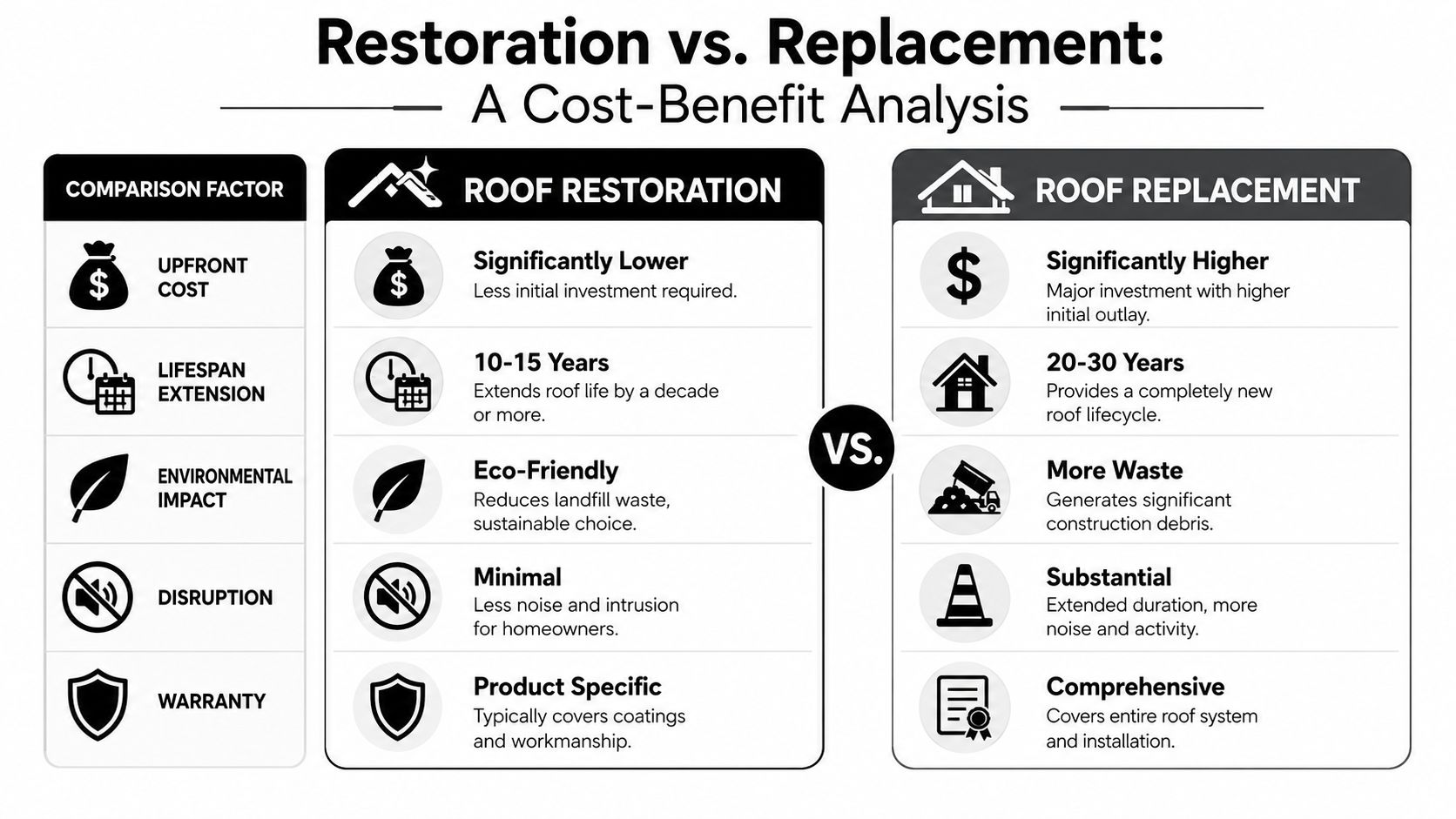
SSpray Coatings reports that restoration can cost 30% to 60% less than replacement while adding more service life to a viable roof. This is its main appeal. You spend less upfront, avoid a full tear-off in many cases, and keep usable materials in place.
That does not mean restoration is always the better value.
If the roof has widespread moisture intrusion, soft decking, repeated leaks in different areas, or clear signs the system is at the end of its life, replacement is usually the honest recommendation. A coating or surface restoration on a failing roof does not solve the failure underneath.
Side-by-side comparison
Here's the practical difference:
| Factor | Roof Restoration | Full Roof Replacement |
|---|---|---|
| Upfront cost | Lower in many eligible cases | Higher |
| Tear-off required | Often limited or avoided | Required |
| Disruption to household | Usually less | Usually more |
| Waste generated | Lower | Higher |
| Best use case | Roof has life left but needs renewal | Roof is worn out or structurally compromised |
One of the biggest cost differences is tear-off and disposal. As noted earlier, replacement carries labor, hauling, dump fees, and longer installation time that restoration often avoids. That gap matters nationally, and it matters even more in places like Hermitage where dump runs, access constraints, and labor scheduling can push replacement pricing up fast.
This is also where local quoting beats generic calculators. National averages are useful for setting expectations, but they miss the hidden costs that show up on real western Pennsylvania jobs, such as saturated insulation, chimney flashing rebuilds, steep-pitch staging, or detached garage access behind fencing. Those details can shift the decision from restoration to replacement, or the other way around.
Insurance and contractor qualification matter too. A lower quote is not a bargain if the contractor is underinsured or vague about liability coverage. Homeowners who want to vet that side of the job can review Coverage Axis roofing policies before signing a contract.
If you are trying to sort out whether a targeted fix, a restoration, or a full reroof fits your situation, this guide on roof replacement vs repair gives a useful local comparison.
The best choice is the one that matches the roof's real condition and the years of service you expect to get from the money spent. In Hermitage, PA, that usually means looking past headline pricing and asking a harder question. Are you paying to restore a roof with good bones, or are you delaying a replacement the house already needs?
Pennsylvania-Specific Costs From Pittsburgh to Erie
A homeowner in Hermitage might look up a national roof restoration average, then get a local quote that lands well above or below it. That usually happens for one simple reason. Online calculators price a category, while contractors price the roof in front of them.
Across western Pennsylvania, the spread between Pittsburgh, Sharon, Hermitage, and Erie comes from job conditions as much as zip code. Lake-effect weather near Erie can shorten the repair window and expose hidden moisture issues. Older housing stock around Pittsburgh often means more flashing work at chimneys, walls, and additions. In Hermitage and Sharon, I often see smaller residential jobs where access, detached garages, and patchwork repairs from prior leaks affect labor more than homeowners expect.
Local pricing benchmarks that actually help
Targeted repairs are the easiest place to compare local numbers. In Sharon, PA, pipe boot or vent flashing repair costs $330 to $670, and ridge cap repair costs $530 to $1,020. Those numbers are useful because they show what happens when the problem is limited to one detail instead of the whole roof system.
Statewide pricing gives a second reference point. In Pennsylvania, a pipe boot leak repair costs $350 to $600 and typically takes 1 to 2 hours. That is often the kind of repair that keeps a restoration project reasonable, provided the surrounding shingles, decking, and ventilation are still in decent shape.
For homeowners comparing restoration against larger work, Erie helps show how material choice changes the budget. Asphalt systems and premium materials do not carry the same pricing pressure, and that difference matters when a roof has aged past a simple repair but may still be a candidate for restoration.
Why Hermitage quotes often differ from online estimates
The hidden costs usually come from conditions the calculator cannot see. Wet decking around a vent. Chimney flashing that has to be rebuilt instead of resealed. Steep sections that require extra staging. A garage or rear roof plane with limited access. Those are real line items on western Pennsylvania jobs, and they are common in Hermitage.
That is why a professional roof inspection in Hermitage gives homeowners better numbers than any national estimator. A proper inspection separates a small repair, a true restoration candidate, and a roof that is already too far gone.
Insurance paperwork deserves the same level of attention. Homeowners can review Coverage Axis roofing policies before signing a contract so they know what to ask for on liability and contractor coverage.
The practical takeaway is simple. Use national averages to set expectations. Use Pittsburgh, Sharon, Erie, and especially Hermitage job conditions to set the definitive budget. That is how homeowners avoid underpricing the hidden work that turns a cheap estimate into an expensive project.
The Restoration Process and How to Get an Accurate Quote
Most homeowners get better pricing conversations once they understand the sequence of the work. Restoration isn't just “spray something on the roof.” A proper job follows an order, and each stage affects whether the final result holds up.
This is the basic flow a professional crew follows:
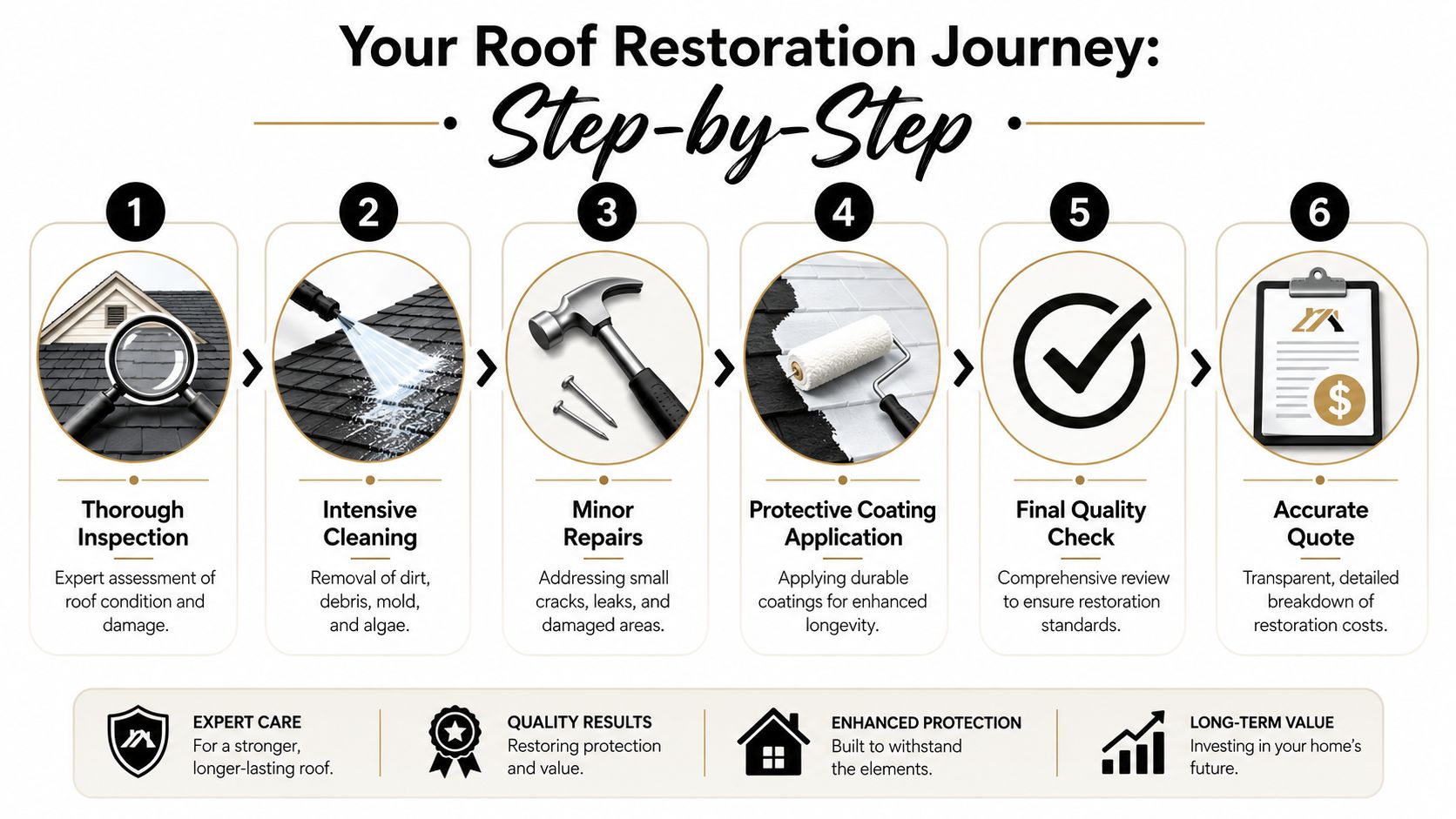
What happens during a professional restoration
A sound restoration usually moves through these steps:
Inspection first
Crews identify leak points, worn details, failed flashing, and areas where restoration is possible versus areas that may need more invasive work.Cleaning the roof
Dirt, algae, loose debris, and contaminated surfaces have to be removed before repairs or coatings can bond correctly.Repairing defects
During this step, cracked components, vent details, weak seals, and localized failures are corrected.Applying the protective system
Once the roof is clean and stable, the contractor installs the restoration system selected for that roof type.Final review
The last pass checks workmanship, seal continuity, transitions, and obvious weak spots before closeout.
A restoration only performs as well as the preparation under it. Skipping prep is how “cheap” jobs become expensive twice.
How to avoid a bad estimate
If you want an accurate quote, insist on an actual inspection. Remote pricing based on a street view or a rough square-foot guess is where bad expectations start.
In Pennsylvania, a residential drone roof inspection typically costs $150 to $400, with Erie-specific pricing averaging $120 to $320. That's useful because it gives homeowners a realistic threshold for detailed roof evaluation without jumping straight into construction.
Drone work isn't a replacement for judgment, but it's a valuable tool for documenting slope condition, penetrations, damage patterns, and hard-to-access sections. If you want a broader look at how inspection methods are used and what they can reveal, this comprehensive guide on roof inspections adds helpful context.
When you request a quote, ask for these specifics:
- Scope clarity: What repairs are included before restoration starts?
- Material detail: What coating or restoration system is being used?
- Exclusions: What conditions would trigger added charges?
- Documentation: Will you receive photos or findings from the inspection?
A local service page for professional roof inspection can also help homeowners understand what a thorough evaluation should include before they compare bids.
Your Next Steps with Penn Ohio Roofing & Siding Group
The numbers tell a clear story. Roof restoration can be the smart option when the roof is worn but still structurally worth saving. It often costs less than replacement, creates less disruption, and gives homeowners a way to extend roof life without paying for a full tear-off before it's necessary.
That doesn't mean every roof should be restored. Some roofs need replacement. Some only need targeted repairs. The value comes from accurately diagnosing the roof and pricing the work with the full scope in view, including prep, access, cleanup, and the hidden costs that throw off generic estimates.
For homeowners in Hermitage, Mercer County, Sharon, Pittsburgh, Erie, and nearby communities, that kind of clarity matters. Local weather, local housing stock, and local roof conditions don't line up neatly with national calculators.
Penn Ohio Roofing & Siding Group brings the kind of background that helps homeowners make that decision with confidence. The company is family-owned and operated, has over 25 years of experience, serves Hermitage and the surrounding counties of Mercer, Beaver, and Lawrence, and has earned the GAF Triple Excellence Award. That combination matters because restoration and replacement decisions are only as good as the inspection and workmanship behind them.
If your roof is leaking, aging, or raising questions, the next sensible step is to get a property-specific evaluation instead of relying on averages alone.
If you want a direct assessment from a local team, contact Penn Ohio Roofing & Siding Group for a free, no-obligation estimate and find out whether your roof is a good candidate for restoration, repair, or full replacement.